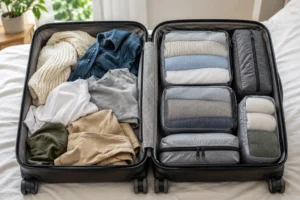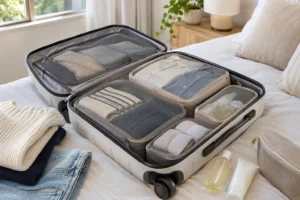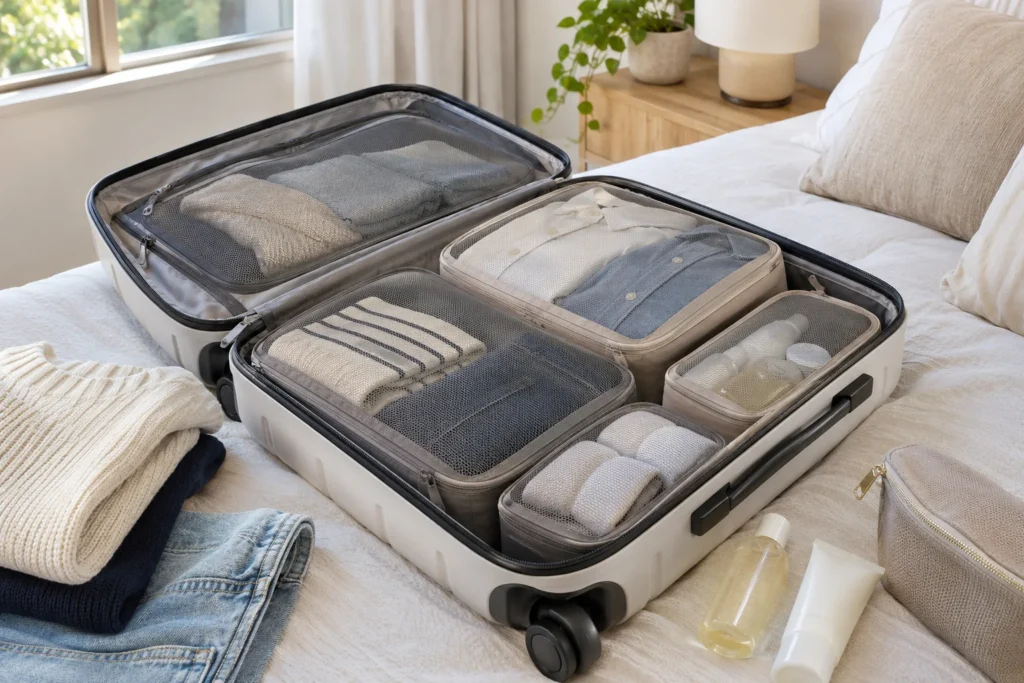
Packing cubes make a suitcase easier to organize, unpack, and repack. The simplest way to use them is to group clothes by category or outfit, choose cubes that fit your suitcase, fold or roll the clothes neatly, zip each cube without overfilling it, and arrange the largest cubes first. Compression packing cubes add one optional step: closing a second zipper to reduce the packed depth.
You do not need an elaborate system or a matching cube for every item. A few well-chosen sizes and a repeatable routine work better than stuffing every available organizer to its limit.
Before You Start: What Do You Need?
Start with your suitcase, your actual travel clothing, and a small assortment of packing cubes. A mix of sizes is generally more useful than several oversized cubes. Keep a separate shoe bag and an appropriate leak-resistant toiletries bag nearby; standard mesh packing cubes are intended primarily for dry clothing.
The basic choices are straightforward:
These are usage examples, not standardized size definitions: actual dimensions vary by brand. Compare the cube measurements with the inside dimensions of your luggage before buying. If you are new to the product, start with what packing cubes are. For dimensions, see our packing cubes size guide.
How to Use Packing Cubes Step by Step
Step 1: Lay out everything you plan to pack
Put all your clothes on the bed before putting anything into a cube. Check the length of your trip, likely weather, laundry access, and the number of outfits you will realistically wear. Remove duplicates you would not have packed without an organizer.
This matters because packing cubes organize what you bring; they do not make an excessive packing list reasonable. Keep shoes, liquids, devices, and other bulky objects outside the clothing pile so they can be positioned separately.
Step 2: Choose a simple way to group your clothes
There are three reliable approaches:
- By category: one cube for tops, one for bottoms, one for underwear or sleepwear. This works particularly well when you will stay in one place.
- By outfit: place a full day’s or activity’s clothing together. This makes short trips and multi-stop itineraries easier to manage.
- By person: assign each traveler a color or designated set. This can simplify shared-family luggage.
Pick one main system rather than mixing all three at random. If you use a category system, keep the categories consistent when you repack at the end of the trip.
Step 3: Match each category to the right cube size
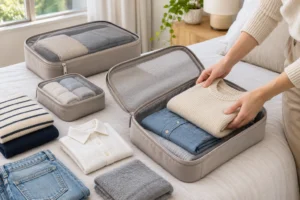
Fill a small cube with socks or underwear, a medium cube with T-shirts, and a large cube with pants or thicker layers. The goal is a comfortably filled rectangle, not a rounded, strained bundle.
Before you fill everything, lay the empty cubes inside the suitcase. This five-minute check reveals whether the sizes fit around the suitcase’s wheel housings, handle channels, and curved corners. Two medium cubes may fit better than one large cube even when their total stated capacity is similar.
Step 4: Fold or roll clothes to fit each cube
Use whichever method produces a tidy shape for the fabric. Rolling often works for T-shirts, leggings, pajamas, and casual items. Flat folding may be easier for jeans, collared shirts, sweaters, and clothes that you want to keep more structured.
To roll a T-shirt, smooth it flat, fold in the sleeves, fold the shirt into a narrow rectangle, and roll from the hem toward the collar. To fold a shirt, smooth it, fold the sleeves inward, then fold it into a rectangle that fits the cube’s footprint.
Neither technique guarantees fewer wrinkles. The fabric, how tightly it is packed, and how long it stays packed all matter. For wrinkle-prone clothing, use gentler folds and avoid pressure from overstuffed cubes.
Step 5: Fill the cube evenly—without forcing it
Place clothing across the base of the cube in an even layer, filling the corners rather than piling everything in the center. If the cube has a mesh panel, you should be able to close the lid without the mesh pulling excessively or the zipper having to push against a large mound of fabric.
A useful test is to close the cube, reopen it, and remove one item. If the entire pile shifts or the zipper repeatedly catches, reduce the fill or change how the pieces are arranged. Keep fragile jewelry, sharp objects, and leaking toiletries out of ordinary clothing cubes.
Step 6: Close the zipper, then compress only if your cube is designed for it
With a standard packing cube, smooth the edges and close the main zipper. Stop if the slider catches: move trapped fabric away instead of pulling harder.
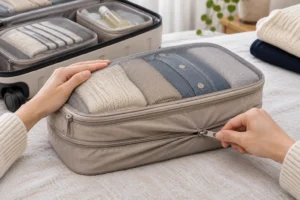
With a zipper-compression cube, first close the main opening while the expansion gusset is open. Then gently press the filled cube to level its contents and move the second, perimeter compression zipper around the gusset. Work around corners gradually; stop if the zipper needs excessive force.
Compression cubes do not remove clothing weight. They can reduce the thickness of some soft items, but the result varies with the load and design. A standard packing cube does not magically gain a compression feature by being stuffed tightly.
Step 7: Arrange packing cubes in the suitcase
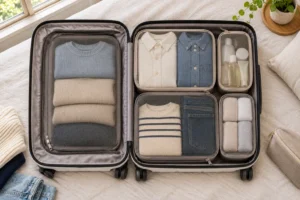
Start with the largest, flattest cubes and place smaller ones around them. In a rolling suitcase, try keeping heavier items relatively close to the wheel end for stable handling, while ensuring the zipper and lid can close without pressure. Shoes and a dedicated toiletries pouch may fit better in leftover spaces than another rectangular cube.
Try placing some cubes on their side if this gives you easier access or a better fit. You do not have to cover every inch of the suitcase with cubes: the goal is usable organization, not the appearance of a perfect grid.
Finally, open the suitcase and retrieve one item you expect to need quickly. If getting to it requires moving every other cube, revise the layout before departure.
What Is the Best Way to Organize Packing Cubes for Different Trips?
These are starting points, not rules. Adjust the method to your luggage and itinerary.
Common Packing Cube Mistakes to Avoid
Overpacking because everything looks tidy
A neatly arranged suitcase can still be too heavy. Check your airline’s current baggage weight and size rules; packing cubes do not increase the permitted allowance.
Using the wrong cube dimensions
An oversized cube may leave unusable gaps in a carry-on. Measure the inside of the bag, not just the advertised exterior size, and test the layout before committing to a set.
Forcing a compression zipper
A compression zipper is meant to close the fabric gusset, not to crush hard objects. Remove an item if the zipper stalls or the seams are under visible strain.
Packing wet items in regular mesh cubes
Mesh and ordinary fabric are not leakproof barriers. Damp swimwear or liquids belong in a suitable separate bag; dry used clothing can go in a designated laundry cube.
Forgetting how you will unpack
If every cube is full and every category is mixed, you will still end up searching through everything. A useful system must work at the hotel and on the return journey—not only in a perfectly arranged departure photo.
Frequently Asked Questions
Do you put clothes directly into packing cubes?
Yes. Standard packing cubes are intended to hold folded or rolled dry clothing directly. You do not need to put clothes in a plastic bag first.
Is it better to roll or fold clothes in packing cubes?
Both work. Roll soft casual pieces when they fit neatly; fold more structured or wrinkle-prone garments. The best method is the one that makes each cube easy to close and its contents easy to find.
How many packing cubes do I need for a carry-on?
There is no universal number. A small set combining one or two medium cubes with one small cube is a practical starting point, but the right combination depends on your suitcase’s internal dimensions and clothing volume.
Can you use packing cubes in a backpack?
Yes, provided their dimensions match the backpack. Slimmer or more flexible cubes may fit a curved backpack better than large rectangular cubes designed for hard-shell luggage.
Can packing cubes help prevent wrinkles?
They can reduce random shifting and creasing from rummaging, but tight folding or compression can still create wrinkles. Delicate items benefit from lighter packing and suitable folding.
Can packing cubes save suitcase space?
Sometimes. Standard cubes mainly improve organization. Compression cubes may reduce the volume of soft clothing, but neither approach guarantees that more clothes will fit. Read our separate guide on whether packing cubes actually save space for the trade-offs.
Final Takeaway
The best way to use packing cubes is to keep the system simple: sort, size, fold or roll, fill evenly, zip without force, and arrange the cubes for easy access. Once you find a layout that works, packing and repacking become more predictable.
Developing packing cubes for your own travel brand? Great Shine supports custom packing cube sets with options for sizes, fabrics, mesh, zipper construction, colors, and private-label packaging. Explore the product options and send your requirements through the inquiry form on the product page.