Toy Box Measurements: How to Choose the Right Size for Your Space

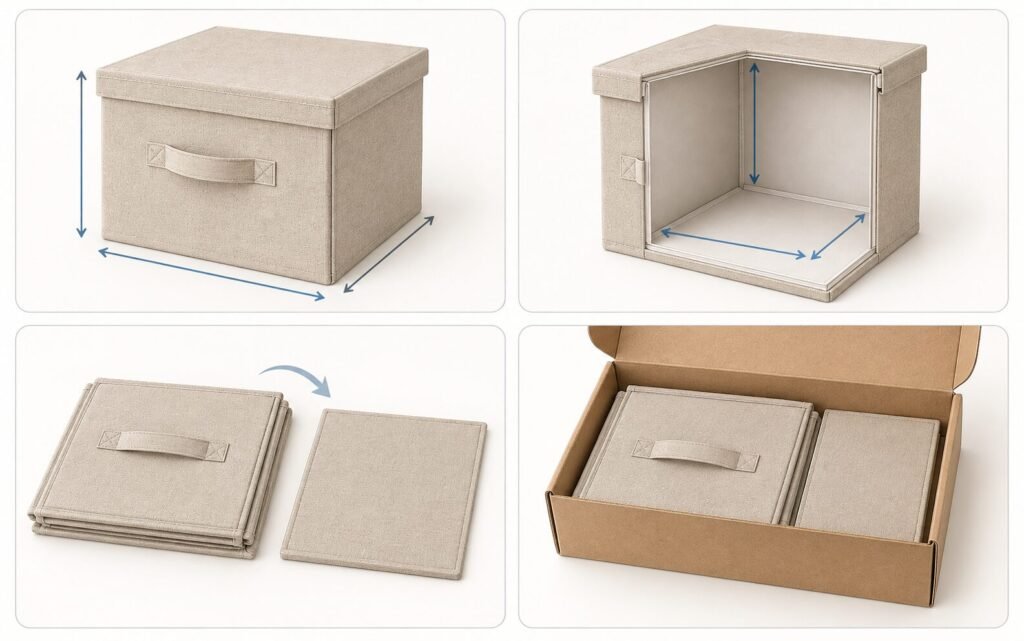
Diagram comparing outside and inside measurements of a fabric box with its folded and packed forms

In This Article

Useful toy box measurements include the assembled outside size, usable inside space and clear opening. Measure the place where the box will sit, then check the largest toys and the space needed to open or remove the box. A box can fit a shelf while its lid cannot open there.

Keep the measurement order consistent. Write width, depth and height beside a simple drawing, and identify the front. Sellers may use length, width and height in a different orientation. Do not compare three numbers until you know which edge each number describes.

Separate outside size, inside space and opening

Outside dimensions determine whether the assembled box fits its location. Include anything that projects beyond the main body, such as a rigid handle, lid edge, feet or wheels. Ask whether the published dimensions include those parts.

Inside dimensions describe the usable space after the base, support panels, lining and dividers are fitted. Measure at the narrowest relevant points. Soft walls may change shape when loaded, so repeat the check with the intended contents.

The clear opening can be smaller than the interior. A zipper, lid frame or curved edge may restrict how a large toy enters. Check both the item’s final position and the path it takes through the opening.

Do not calculate useful toy capacity by multiplying external dimensions. That gives the volume of an outside rectangular envelope, not the space available around irregular toys. Folded product size and shipping carton size are separate measurements too.
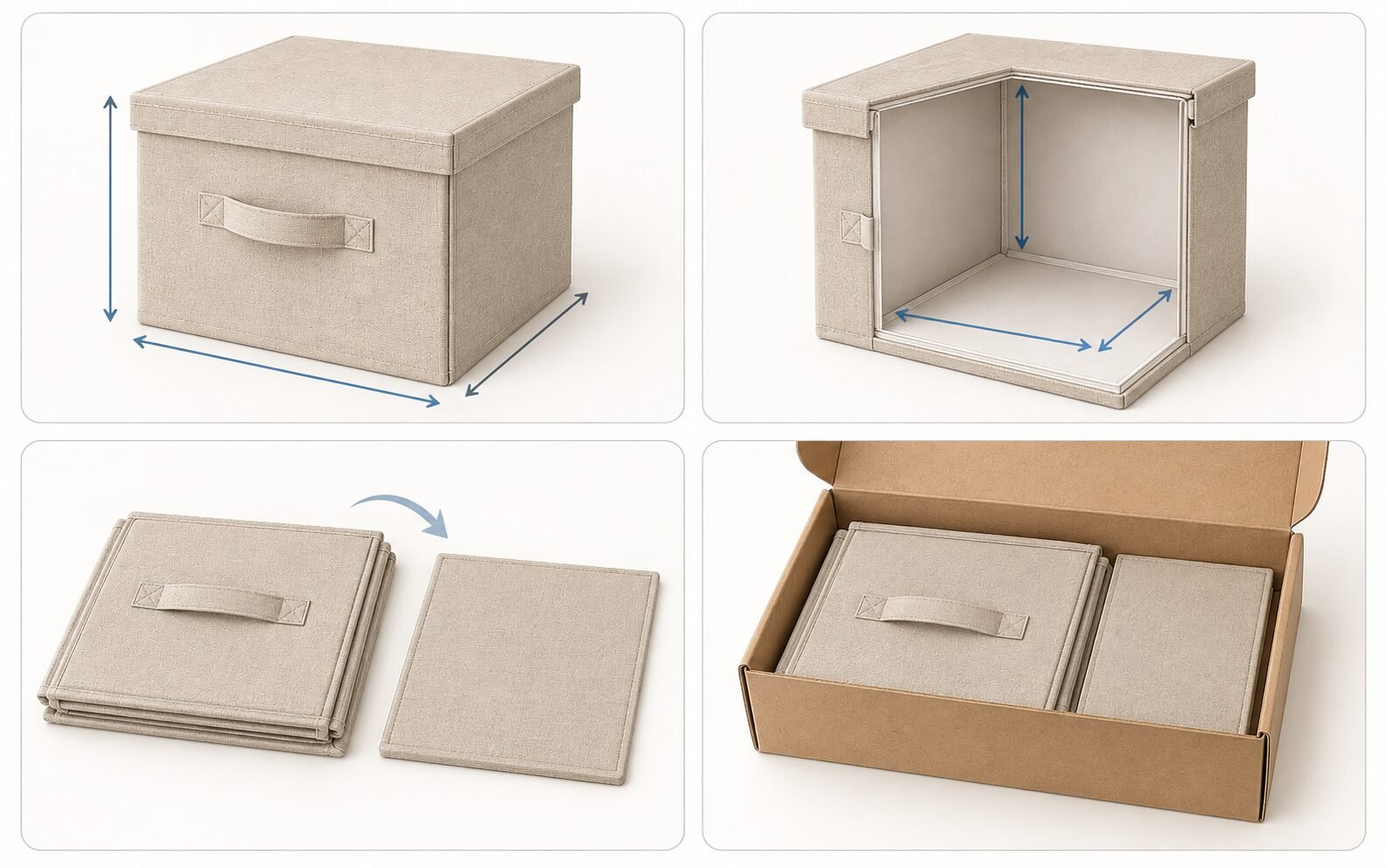
Diagram comparing outside and inside measurements of a fabric box with its folded and packed forms
Measurement illustration only. It does not establish numeric dimensions or a tested toy load.

Measure the location and the access route

Use a tape measure to record the available width, depth and height. Check skirting boards, shelf supports, door hinges and other parts that reduce the opening.

For a shelf or under-bed location, measure the narrowest point along the route into place. Then check the final position. A box that fits at the back may still catch on the front rail.

For a hinged lid, inspect its full opening path. For a removable lid, allow room to lift it off and put it aside. For a pull-out box, leave enough space in front to withdraw it and grasp the handle.

Mark the proposed footprint on the floor with removable tape if that helps you judge access. This checks the layout only; it does not replace checking the assembled product. Keep walkways and door movement clear.

Measure the toys before choosing the box

Start with the largest item in the position you intend to store it. Measure its widest, deepest and tallest points, including wheels, handles, ears or other projecting parts.

Lay out the remaining toys in the groups you want to retrieve together. Separate small pieces where appropriate, then include the dimensions of their inner containers or dividers. Those components use space inside the main box.

Try placing and removing the largest item without bending it or stretching the opening. For soft toys, check the arrangement without pressing them flat to meet a target height. Our long-term stuffed animal storage guide explains packing when shape protection is the priority.

Use a real configuration as a measurement reference

A produced Great Shine fabric-box configuration has assembled external dimensions of 40 × 50 × 25 cm, recorded as length × width × height. It has an attached lid, a front PVC window and 2 mm cardboard support panels.

Those are configuration details, not measured toy capacity. The following record separates the known external specification from measurements that must be taken on the assembled sample. It does not claim that this general storage box is certified as a children’s toy chest.

Measurement recordReference or action
Assembled external size40 × 50 × 25 cm, L × W × H; confirm which side faces forward
Usable inside sizeMeasure the assembled interior with all panels fitted; record width, depth and height
Clear openingMeasure the narrowest entry points with the lid in its normal open position
Lid and removal clearanceCheck the full lid path and the space needed to remove the box
Contents usedList the actual toys and their largest dimensions during the sample check
Loaded resultRecord whether contents enter, the lid closes and each group can be removed without forcing

Do not subtract twice the board thickness from the outside size and call the result verified internal dimensions. Seams, lining, folds and panel placement also affect the space.

For your own sample record, photograph the tape at each measurement point, then photograph the loaded box and its normal closure. Keep the toy list with those images so the result can be reproduced.
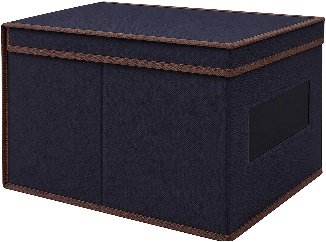
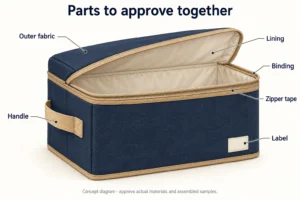
Reference drawing of a blue fabric storage box with attached lid and front window
Reference drawing for the produced 40 × 50 × 25 cm fabric-box configuration. Internal space and toy fit require a sample check.

Choose between one large box and several smaller boxes

A large box may suit a bulky item that cannot be split between containers. Check the loaded handling method and whether smaller toys will become difficult to reach beneath it.

Several smaller boxes can keep categories separate and make one group easier to remove. They also add walls and gaps between containers, which reduce the space available for toys within the same shelf opening.

Compare both arrangements using the same toy list. Choose based on access and handling as well as fit. Avoid filling spare capacity with a load that the box or its handles were not intended to carry.

Size does not establish child safety. Review the intended age and use, lid behavior, entrapment risks and the manufacturer’s product instructions separately. An ordinary fabric storage box should not be presented as a tested toy chest because toys happen to fit inside.

Give a supplier a dimensioned brief

For a purchase inquiry, send the location measurements, largest items, intended arrangement and opening method. State whether your requested numbers are maximum outside dimensions or minimum usable inside dimensions.

Identify handles, feet, wheels and lid clearance on the drawing. Agree how the sample will be measured and which tolerances apply. Review the fabric storage box options against those requirements, then check the actual sample before confirming the size.

Frequently asked questions

Is there a standard toy box size?

Treat each product’s published dimensions as specific to that model. Confirm its orientation, usable interior and opening instead of assuming that “large” or “extra large” describes a shared size.

What if the outside size fits but the toys do not?

Check the interior and opening separately. You may need a different layout, wider access or another container. Forcing the lid shut is not a fit solution.

Discuss Your Custom Storage Product Project

Share your product idea, reference image, dimensions, quantity, target market, branding and packaging needs. We will review feasibility and reply with the next practical step.

Latest Sourcing Guides

Great Shine OEM/ODM storage bags and organizers manufacturer logo
Great Shine contact QR code for storage product wholesale inquiries

REQUEST A FREE QUOTE

contact us to get latest product catalog