To store stuffed animals long term, clean each toy according to its care instructions, let it dry completely and pack it without forcing its shape. Choose a container that closes freely, keep it in a dry indoor location and record what is inside. Check the toys again when storage conditions change or before returning them to use.
The best way to store stuffed animals long term depends on their construction. A washable plush bear, a toy with a sound unit and a fragile collectible need different preparation. Choose the container after checking those differences, rather than buying a large bag and compressing everything to fit.
Check each toy before cleaning or packing
Read the care label and the manufacturer’s instructions. For example, Steiff’s care guidance distinguishes washable plush from collectible materials that need different care. Check seams, loose decorations, stiff ears, plastic eyes and flattened areas. Photograph anything you want to compare after storage.
Separate toys with electronics, batteries, glued decorations or delicate fabrics from ordinary washable plush. Do not assume that similar-looking toys can share the same cleaning method. Follow the manufacturer’s instructions for battery removal and storage where applicable; do not open a sealed electronic unit to reach a battery.
For a valuable or fragile collectible without clear care instructions, ask the maker or a suitable conservation specialist before washing or compressing it. Keep any original care information with your storage record.
Clean only by the permitted method. After cleaning, allow the filling and thick parts to dry as well as the surface. If you cannot establish that the toy is dry, postpone packing. A closed container cannot finish drying damp stuffing.
Inspect the empty container too. It should be clean, dry and free from rough edges, loose fittings or residue that could catch or mark the toys. Follow its own cleaning instructions, especially if a fabric box contains cardboard support panels.
Choose a container for shape, access and location
For toys that need to keep their shape, start by looking at the space available around them. The container’s walls, opening and lid matter as much as its material.
| Container | When it can be useful | What to check |
|---|---|---|
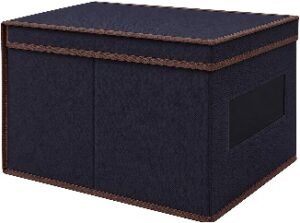
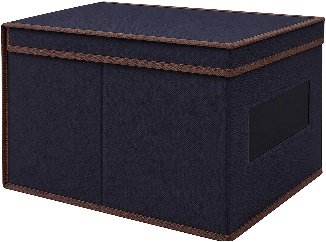
| Fabric storage box | Keeping grouped toys on an indoor shelf or in a cupboard | Whether panels hold their shape, the lid closes freely and handles suit the loaded box |
| Lidded plastic box | Keeping contents enclosed with a more rigid outer structure | Clean, dry interior; lid pressure; actual seal; and the maker’s stacking instructions |
| Storage bag | Packing a flexible group of toys where the surrounding space provides support | Whether the sides squeeze the toys, the zipper catches fur and other stored items press on the bag |
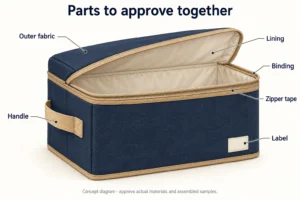
A fabric surface does not establish how breathable the complete box is. Coatings, lining, windows and closures affect the construction. Likewise, a plastic lid does not automatically make a container waterproof or suitable for a damp room.
If you are considering a fabric box, compare the storage box and fabric bin constructions against your intended shelf and contents. Confirm the usable interior and closure on the actual sample. External dimensions alone cannot tell you how many toys will fit.
Keep daily-use toys separately so the stored collection does not need repeated unpacking.
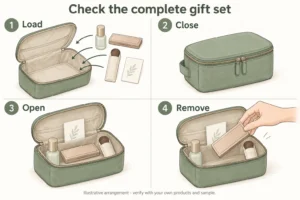
Pack one container without forcing it closed
Use the same empty container throughout this check so that changing the box does not hide a fit problem.
- Lay out the toys beside it. Place the largest and most easily deformed items where you can see their original shape.
- Arrange the larger, more stable shapes first. Leave delicate faces, ears and decorations clear of the walls, lid and zipper path.
- Add smaller toys only where they fit without pushing the others down. Do not use a heavy toy to compress a softer one.
- Bring the lid into its normal closed position, or draw the zipper along its intended path. Stop if closure requires you to press down on the contents or pull hard.
- Remove an item or use another container if the sides bulge, the lid sits raised or a toy changes shape under pressure.
- Open the container again and remove the toy you expect to need first. If several toys must be crushed or pulled out by their limbs to reach it, change the arrangement.
Photograph the layout, loaded container and closed lid so you can repeat the arrangement. These views record the packing condition, not the result of months in storage.
For fragile shapes, consider a separate container or suitable supporting material recommended for that toy. Do not assume that adding paper around an already compressed toy removes the pressure.
Can you use vacuum bags for stuffed animals?
Use a vacuum bag only when the toy’s manufacturer permits compression and the construction suits it. Removing air presses the contents together, so it conflicts with the goal of leaving delicate shapes undisturbed.
Be particularly cautious with structured parts, electronics, glued decorations and fillings whose response to compression is unknown. A soft outer fabric does not establish that the whole toy will recover.
If keeping the original shape matters and you have no specific guidance, choose storage with enough room to avoid compression. Do not rely on a general promise that every stuffed animal will expand back to its original form.
A short packing check cannot prove long-term recovery. Keep any observations tied to the toys, duration and conditions actually checked.
Choose a dry location and keep a storage record
Place the container away from direct sunlight, known leaks and areas with condensation. Assess the actual conditions in a cupboard, garage, attic or basement instead of treating the room name as proof that it is suitable.
Avoid placing heavy boxes on flexible storage. Stack rigid containers only as their manufacturer allows, and keep access possible without dragging the toy container over sharp surfaces. Where floor dampness or leakage is a concern, choose a different location.
Label the container with its contents and packing date. Keep a note of the cleaning method, special care requirements and photographs.
Plan checks around the conditions. Check sooner after a leak, a move or a noticeable change in dampness. There is no single inspection interval that proves every collection remains in good condition.
Check before returning toys to use
Open the container in a clean, dry area and compare the toys with your packing notes. Look for dampness, unusual odor, marks, damaged seams, loose parts and changes in shape.
If something has changed, separate the affected items while you investigate the toy, container and storage location. Do not cover an odor with fragrance or return a damaged toy to use without checking the relevant care and repair guidance.
Follow the maker’s instructions for any cleaning, reshaping or battery replacement. Let the toy dry fully again if it is cleaned. Keep the updated record if it will go back into storage.
Frequently asked questions
Can I store all my stuffed animals in one large box?
Only if they fit without pressure and you can handle the loaded container appropriately. Separate delicate or frequently needed toys. Several manageable containers can make access easier than one tightly packed box.
Should I wash the toys every time I check them?
Inspect first and follow their care instructions. Repeated washing is not a substitute for keeping the storage location dry and the container clean.
Can I promise that a toy will stay unchanged for a year?
The packing method alone cannot support that promise. Materials, previous condition, pressure and the storage environment affect the outcome. Keep observations tied to the actual toy and storage period.