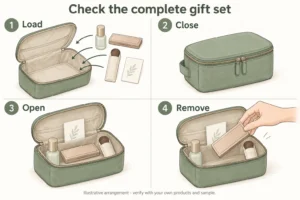
Before ordering lunch bags wholesale, confirm that the intended meal containers can pass through the opening, sit in the planned arrangement and remain clear of the zipper when the bag closes. Include ice packs, cutlery and any retail packaging in that review. Then compare materials, construction, order quantities and packaging against the same specification.
A stated capacity or external size cannot establish that a lunch bag fits a particular lunch box. An attractive sample also cannot establish cooling performance. Both questions need checks suited to the intended use.
Start with a complete meal-kit reference
Prepare one contents list for quotation and sample approval. Record each container’s outside dimensions, including lids, clips and handles. Add the intended ice packs, drinks, cutlery and napkins rather than treating them as space left over after the lunch box fits.
Decide whether containers must stay upright. A bag that accepts a box only when tilted may be unsuitable for a meal kit that must remain level. Identify the largest rigid item and check its path through the opening.
Ask the supplier to identify assembled external dimensions and the measurement orientation. Confirm usable internal space with the sample because insulation, lining, seams and pockets occupy room. For a detailed measurement record, use the lunch bag size and sample-fit guide.
A documented printed bento bag configuration
Great Shine’s animal-print bento bag project gives buyers a concrete specification to compare with their own brief. The record covers five designs and 2,520 bags. That figure is the recorded project quantity; confirm the minimum order for any new configuration separately.
| Item | Recorded specification | What to check on the sample |
|---|---|---|
| Body and folded size | Body: 15.5 × 11 × 17 cm. Folded: 25.5 × 17 cm. | Identify measurement directions on the drawing; check usable interior space and the actual opening separately. |
| Outer fabric | Printed 6 oz polyester canvas. | Compare print alignment at seams and check that the bottom motif is complete. |
| Insulation and lining | 1.5 mm polyurethane insulation, PEVA lining and PEVA binding. | Check the specified layers and binding against the approved sample. |
| Closure | Ivory nylon cord. | Load the intended container and check insertion, closure and removal. |
| Individual packaging | 0.05 mm PP bag, 200 gsm glossy paper insert and one desiccant. | Check the packed size, artwork and placement of the included items. |
| Carton quantity | 60 bags per carton. | Confirm the final carton dimensions and weight for the agreed assortment. |
These are project requirements, not published thermal or food-contact test results. For the product reference and project-specific QC details, see the custom insulated lunch bag page. Record your own sample approval before applying the same construction to a different meal kit.
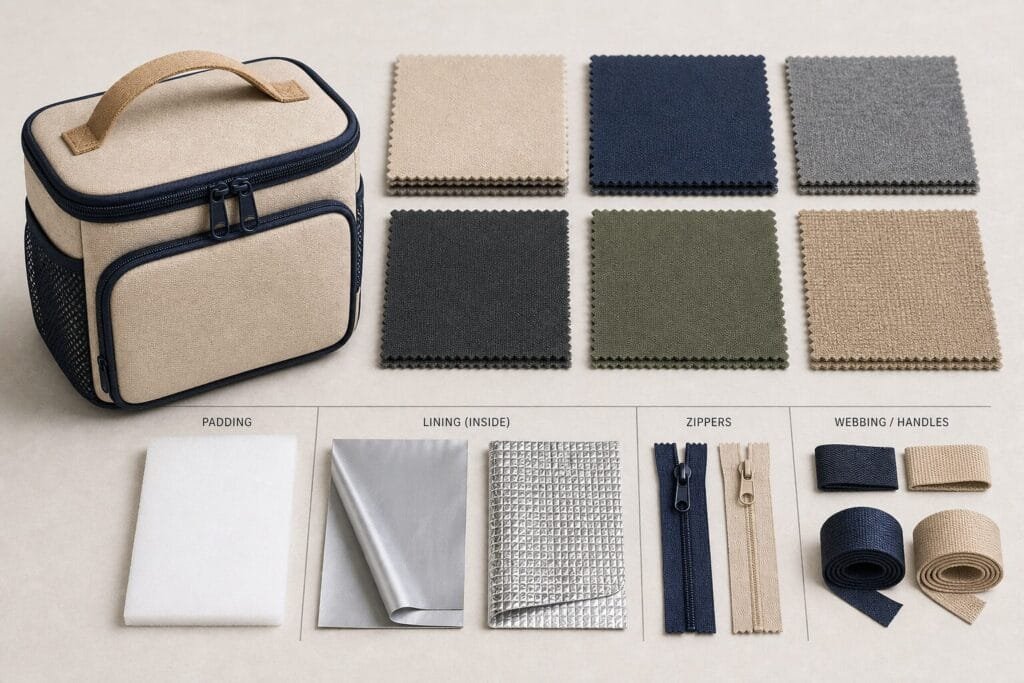
Specify the material layers separately
The outer fabric, insulation and lining serve different purposes. Record each separately so that two quotations do not describe different constructions with the same phrase, such as “insulated lunch bag.”
- Outer fabric: confirm the material reference, color, finish and cleaning instructions.
- Insulation: confirm its material, thickness specification and where it is fitted, including the lid and base.
- Lining: confirm its material, seam construction and cleaning method. Clarify whether food will remain inside separate containers.
- Closures and fittings: identify the zipper, puller, handles, shoulder strap and attachment points included in the quoted model.
Do not treat a wipe-clean lining as proof that the entire bag is leakproof. Water can follow seams or escape through a zipper opening. If leakage resistance is required, agree on the relevant construction and a suitable finished-product check.
Likewise, insulation does not create cold. If the project needs a stated cooling duration, agree on the contents, starting conditions, ice-pack arrangement, ambient conditions and test method before using that claim. Do not copy a duration from another size or construction.
Check the loaded sample in a fixed sequence
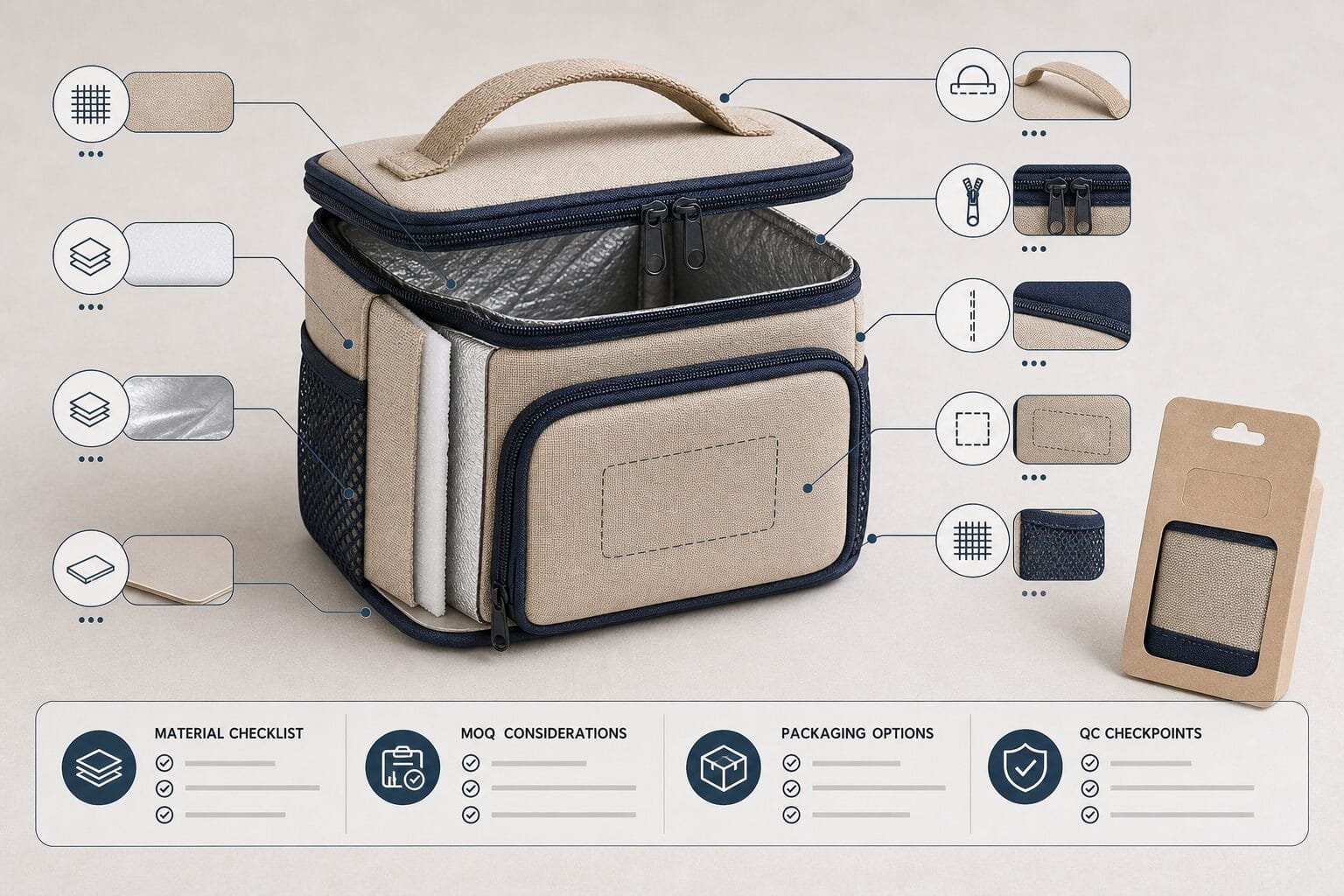
Use the same meal kit for each sample revision. Photograph its arrangement before closing the bag, then record any change needed to make it fit. This keeps comparisons useful when the opening, padding or internal layout changes.
| Check | What the buyer should do | What to record or confirm |
|---|---|---|
| Opening clearance | Insert and remove the largest container with its lid and clips fitted. | Any snagging, tilting or forced stretching; the opening revision needed. |
| Loaded closure | Arrange the full meal kit, then close the zipper along its complete path. | Pressure on container lids, zipper strain and any item that must be removed. |
| Ice-pack position | Fit the intended packs beside the actual containers. | Pack dimensions, placement and whether they obstruct access or closure. |
| Interior corners and seams | Open the bag fully and inspect where lining panels meet. | Gaps, exposed edges, difficult-to-clean folds and the agreed seam construction. |
| Handles and attachment points | Review stitching and carry the sample using the agreed contents under controlled conditions. | Contents used, visible movement or damage, and whether further load testing is required. |
| Cleaning access | Follow the proposed care instructions and check access to the base and corners. | Areas that cannot be reached, lining movement and how the sample dries. |
| Retail pack | Pack the approved sample with tags, inserts and accessories. | Fit, protection, barcode access and the final packed dimensions. |
Stop if a handle, seam or closure begins to fail. A brief sample carry check is not a rated-load test. If the buyer needs a load claim or repeated-use performance requirement, define it separately with the supplier.
Decide which features solve the actual use problem
A larger opening may improve container access but also changes the zipper route and lid structure. An internal pocket can separate cutlery, yet its contents may reduce space available for a rigid lunch box. A shoulder strap changes how the loaded bag hangs and requires its own attachment review.
Assess those features with the contents in place. Check whether the bag tips when lifted, whether a handle obstructs the opening and whether the customer can reach the items in the intended order.
The same approach applies to cleaning. Ask how to clean the finished construction, including insulation and fittings, rather than assuming that instructions for the lining material apply to the whole bag. A removable component should have its own care instructions when these differ.
Compare MOQ and packaging on the same order basis
Ask the supplier to state the minimum order quantity for the selected model and customization. Record whether that quantity is per style, per color or per printed design. If colors can be mixed, confirm the permitted split in writing.
Separate the bag count from accessory and set counts. For example, a quotation should make clear whether an ice pack or container is included, separately priced or supplied by the buyer. An image showing a full meal kit does not establish what is included in the sale.
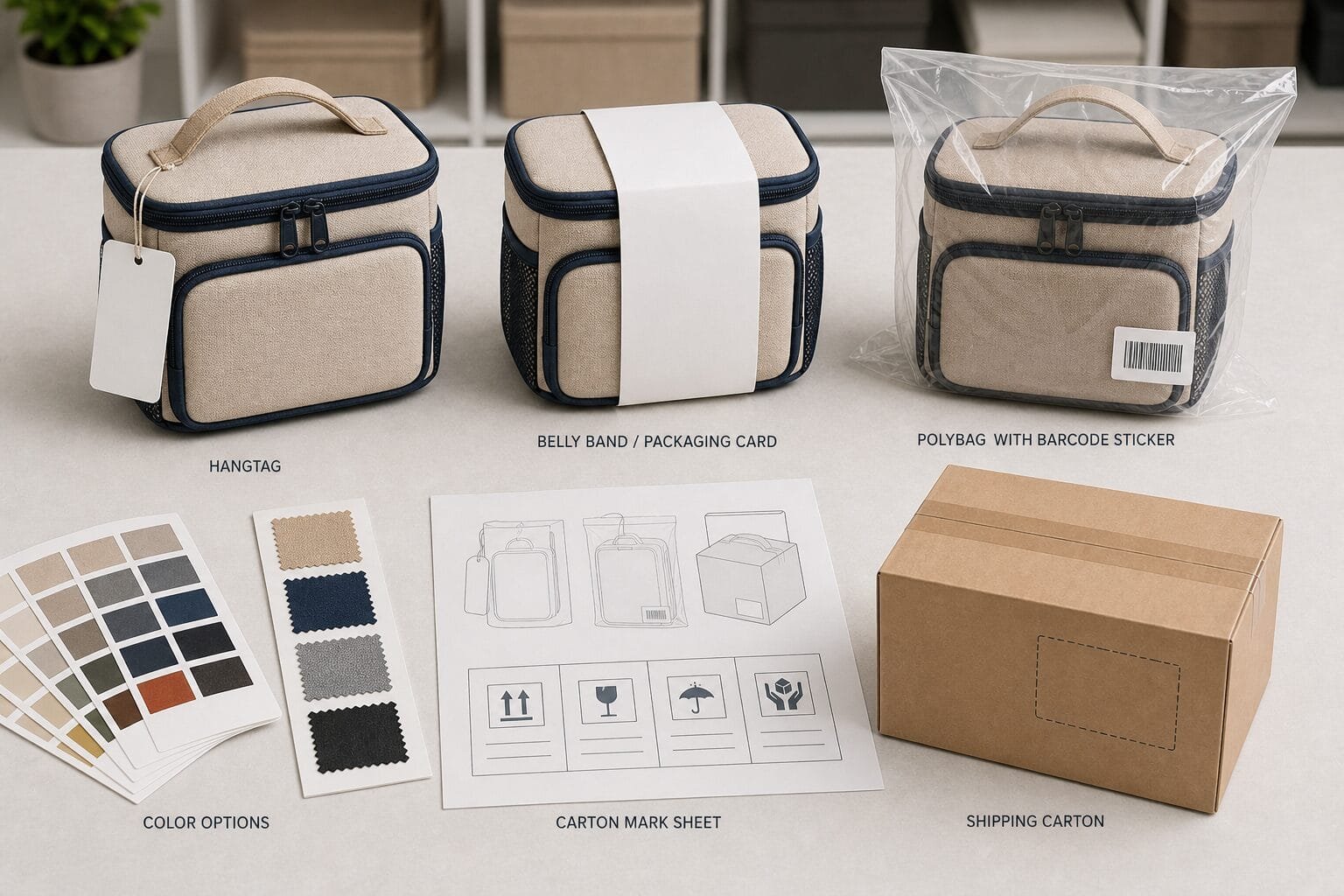
For packaging, confirm the individual bag or box, hangtag, insert, barcode label and any protective material. Then request units per carton, carton dimensions and weight for the approved pack. Changes to accessories, inserts or retail boxes can change those figures.
Do not use the unpacked bag dimensions as shipping dimensions. A compressed shipping pack may also leave creases, so review how the bag looks after unpacking if presentation matters at retail.
Send one RFQ and approval record
Keep the request concise enough for suppliers to answer against the same information:
- Product style and reference image.
- Assembled size, dimension orientation and complete contents list.
- Outer fabric, insulation, lining and closure requirements.
- Ice packs, containers and other accessories: included, excluded or buyer-supplied.
- Logo, color references and quantities by style and color.
- Retail pack, labeling, destination market and requested delivery terms.
- Sample checks, care instructions and any performance evidence required.
Before production, attach the approved sample reference and list any remaining exceptions. Record which changes need another sample, and confirm packing details alongside the bag itself. Material or size changes after approval should trigger a review of the affected fit and construction checks.
To discuss a configuration, review Great Shine’s custom insulated lunch bag options and send the contents list with your requested order quantities.
Frequently asked questions
Can I choose a lunch bag by its stated capacity?
Capacity can help narrow the options, but it does not describe opening width or the space around rigid containers. Check the actual meal kit in an assembled sample before approving fit.
Does an insulated lunch bag include ice packs?
Only if the agreed supply specification includes them. Confirm the number, size and source of the packs, and whether their cost and packaging are included in the quotation.
Which sample problems should stop approval?
Unresolved fit, strained closure, insecure handle attachment, missing components or a material mismatch should be recorded and addressed before approval. Cosmetic differences also need a decision against the agreed sample and appearance references.
Can one sample approval cover several lunch bag sizes?
Only to the extent explicitly agreed. A shared fabric does not prove that another size has suitable opening clearance, handle placement or packing dimensions. Identify which checks must be repeated for each variant.