Canvas can be made from cotton, linen, polyester or blends of fibers. The name describes a type of woven fabric; it does not identify one fixed fiber composition. For a canvas bag, read the fiber content, fabric weight and surface finish separately, then check what materials form the lining and other parts.
Two bags described as “canvas” can feel and behave differently. A cotton tote and a coated polyester bag need their own specifications. This guide covers canvas for bags.
What does “canvas” mean?
Canvas is generally a firm woven cloth, commonly made with a plain-weave construction. Woven fabric has lengthwise warp yarns and crosswise weft yarns. Their arrangement forms the weave. Cotton Incorporated’s Weaving 101 guide explains these structures, including plain and basket weaves.
Fiber content describes what those yarns contain. “Cotton” and “polyester” therefore answer a different question from “canvas.” A specification saying “100% cotton canvas” gives both a fiber description and a fabric name. “Canvas fabric” on its own leaves the composition unresolved.
Suppliers do not always use the name with the same precision. Ask for the construction and a sample when comparing materials. Two similar-looking surfaces may be different cloths.
Which fibers can canvas contain?
Cotton is a natural fiber from the cotton plant; linen comes from flax, while polyester is a synthetic fiber. Compare the stated percentages before drawing conclusions from color, texture or a product photograph.
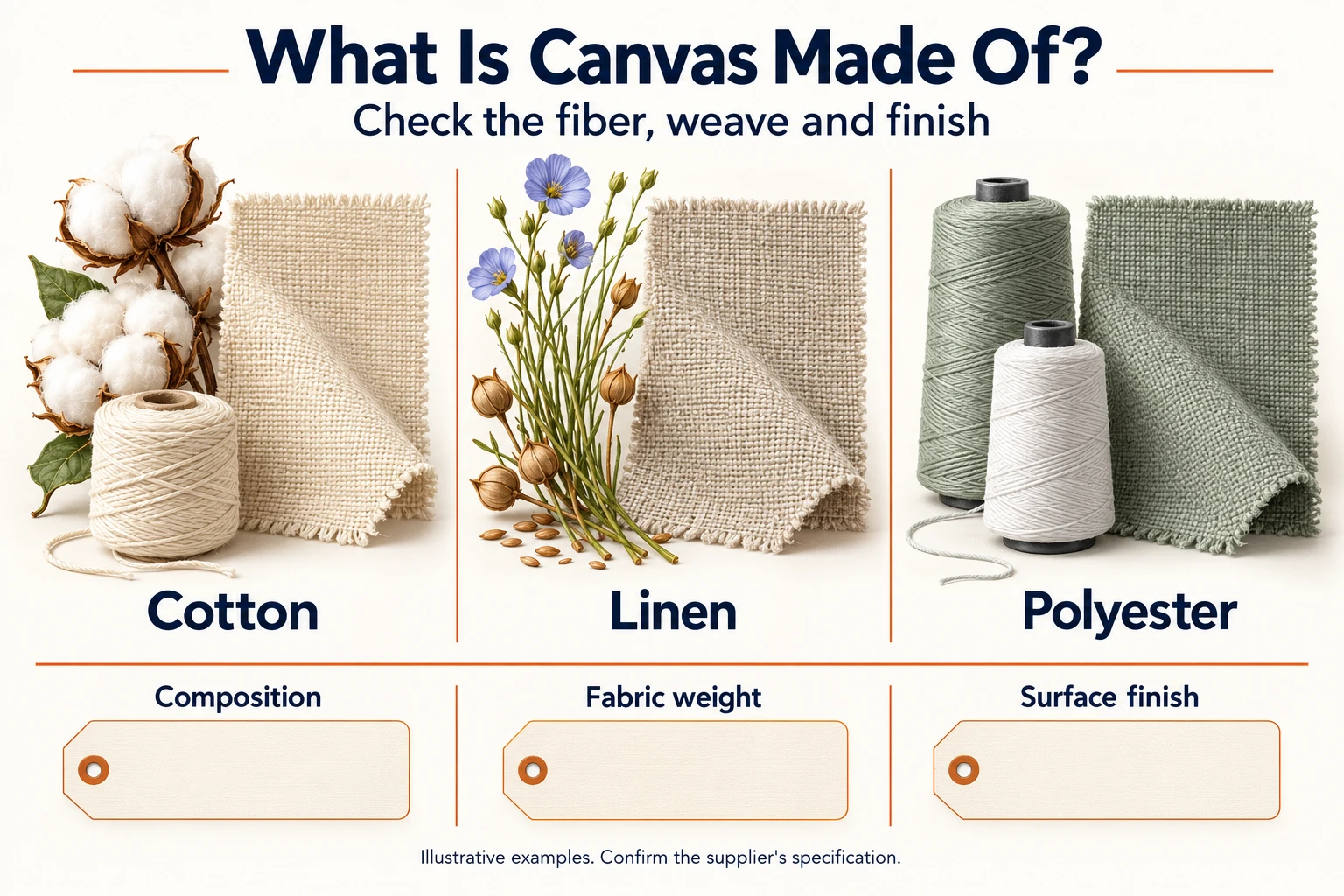
Illustrative material examples. The colors and textures are not a way to identify fibers. Confirm composition from the supplier’s specification.
| Material description | What it tells you | What still needs checking |
|---|---|---|
| 100% cotton canvas | The specified fabric’s fiber content is cotton | Weight, weave, finish and suitability for the bag design |
| Linen canvas | The description identifies linen, a flax-derived fiber | Whether the cloth is all linen or a blend, plus the stated percentages |
| Polyester canvas | Polyester is the named fiber in the canvas fabric | Exact composition, weight, backing and surface treatment |
| Cotton-linen or cotton-polyester canvas | More than one fiber is involved | The proportion of each fiber and the construction supplied |
For a cotton tote, start with the cloth’s feel and how it folds, then check the finished sample with its intended contents. The cotton percentage alone does not establish handle strength or printing results.
Linen may be supplied on its own or in a blend. For example, manufacturer Art of Where describes a cotton-linen canvas. That example shows why a linen-like appearance is not enough to establish an all-linen composition.
Polyester canvas should be identified as such rather than described to customers as cotton. A blend also needs a complete description: the word “blend” gives too little information for a buyer comparing repeat orders.
Fiber content, fabric weight and finish are different specifications
Read these as separate entries in a material brief. Each answers a practical question, and none replaces the others.
Fiber content: what are the yarns made from?
Look for the fiber names and percentages. Confirm which component the statement describes. “100% cotton outer fabric” does not mean the lining, thread, zipper and support board are also cotton.
For a repeat order, keep the approved material reference with the composition. A color name alone is too broad to identify the same cloth.
Fabric weight: how much does a given area weigh?
Fabric weight is commonly expressed in grams per square meter (g/m² or GSM) or ounces per square yard (oz/yd²). It describes mass per area, not the weight a finished bag can carry.
If a quotation says only “6 oz,” ask the supplier to confirm its measurement basis and whether it describes the finished or unfinished material. Do not silently turn an incomplete unit into a precise specification.
Heavier cloth may change a bag’s bulk and feel. Its effect on the whole product still depends on the weave, seams, handles and other components.
Surface finish: what has been added or changed?
Printing, waxing, coatings and backing can alter how a fabric looks, feels or responds to use. Ask which side receives the treatment and whether it is included in the stated fabric weight.
Keep the lining separate in the specification. A lining is another component inside the bag; its material cannot be inferred from the exterior’s texture.
Is every canvas bag cotton, washable or waterproof?
Canvas does not guarantee any of those three properties. Cotton content must be stated, washing depends on the complete product, and waterproof claims need evidence for the relevant construction.
For care, inspect the finished bag’s instructions. Printing, trim, reinforcement and lining can affect what treatment is suitable even when the outer fabric is cotton. Our guide to how to clean a canvas bag explains how to choose between local cleaning and an allowed wash.
A coating may change how water interacts with a fabric surface. It does not by itself establish that water cannot enter through the bag’s seams, opening or zipper. Ask what a water-resistance claim covers and how it was checked before using it in a product listing.
Likewise, a natural-looking beige fabric is not proof of organic content, recycled content or environmental certification. Keep any such claim tied to documentation for the material being supplied.
A documented polyester-canvas bag example
One Great Shine insulated-bag project handover lists a printed, all-polyester canvas exterior described as “6 oz.” It separately lists a PEVA interior and a 1.5 mm polyurethane layer.
This is a useful example of how to read a layered bag specification. “Canvas” names the exterior fabric, “all-polyester” describes its fiber content, and the other entries identify different parts of the construction. The bag as a whole is not made from a single material.
The original record’s “6 oz” wording is retained here without converting it into a confirmed GSM value. These details apply to that project only. They do not establish a standard configuration for every Great Shine shopping bag, or prove washing, load-bearing or temperature-retention performance.
Choose a sample around the bag’s use
For a shopping tote, list the items it must carry and how often it will be folded. Compare cloth samples for feel and bulk, then check the handles and seams on the complete bag with those contents.
For a gift bag, review the fabric with the actual artwork and gift packaging. Check whether the surface keeps small lettering readable and whether the filled bag holds the intended shape. Choose the cloth and print process together.
For a lined bag, review the opening and usable space after assembly. A lining, support layer or insulation occupies space and can change folding and care requirements. Approve those layers separately from the outer canvas.
Why do two canvas bag quotes differ?
The fabric name leaves several costs undefined. Compare fiber composition, fabric weight, finish, dimensions, printing, lining, handles, quantity and packaging on the same basis. A lower quote may describe a different construction or omit an item. Ask the supplier to identify differences before treating either quote as the cheaper equivalent.
What should a buyer ask before choosing canvas for a bag?
Give the supplier the intended use before approving a fabric swatch. A folding shopping tote and a lined organizer place different demands on the same outer cloth.
Use these five questions to complete the material brief:
- What is the fiber composition, and which part of the bag does it describe?
- What is the fabric weight, its full unit and the agreed measurement basis?
- Is the fabric printed, coated, waxed or backed, and on which side?
- Which decoration method will be used on this exact material?
- What care instructions and finished-sample checks will support the intended use?
Review the assembled sample with the intended contents. Examine folds, seams, handle attachments and the area carrying the print. Record any requested changes against the material reference so a later sample can be compared with it.
Include the target dimensions, item list, order quantity, sales market, artwork and packaging requirements in your enquiry. Mark any undecided material choices so the supplier can propose samples on a clear basis.
For a bag project, review Great Shine’s custom shopping bag options with your preferred composition, carrying task and branding requirements. The finished sample should confirm how the chosen material works in that design.
Frequently asked questions
Can I identify cotton canvas by touching it?
Touch can help compare feel, but it does not confirm composition. Yarn construction and finishes affect the surface. Use the material specification and any required verification rather than treating a photograph or swatch impression as proof.
Does thicker canvas mean a stronger finished bag?
Thickness alone cannot establish a bag’s load capacity. Handle attachments, seams, panels and the way the load sits all matter. Confirm the intended load and an agreed finished-product check.
Can I use the same print file on different canvas materials?
You can provide the same artwork, but review the result on each selected fabric and finish. Surface texture and the printing process can change the appearance. Keep the approved printed sample with the material reference for production.