Introduction
Toy storage boxes are a practical product category for Amazon sellers, retail buyers, toy brands, home storage importers, promotional buyers, and private label companies. For B2B buyers, the sourcing task is not simply choosing a colorful box. The product must be strong, safe for family environments, suitable for retail display or FBA delivery, and flexible enough to carry a custom logo without production problems.
This guide is written for purchasing teams sourcing toy storage boxes with custom branding for Amazon FBA, retail shelves, wholesale distribution, or private label storage lines. It explains what buyers should check before ordering, including material, size, lid structure, handle design, durability, logo methods, packaging, MOQ, samples, lead time, and export support.
If your team is evaluating , this guide will help you build a clear specification before approving samples or placing a bulk order.
Market and Product Positioning
Toy storage boxes can serve several B2B channels. Amazon sellers often need products that photograph well, pack efficiently, meet labeling requirements, and survive parcel delivery. Retail buyers need stable shelf presentation, clean packaging, and consistent product appearance. Importers and wholesalers need repeatable specifications, carton efficiency, and reliable production capacity. Private label brands need custom colors, logos, packaging, and sometimes exclusive structure adjustments.
The product can be positioned as a toy storage bin, kids storage box, foldable organizer, playroom storage container, multi-purpose storage box, or branded home organization product. It may be sold as a single unit, a set of two, a multi-size pack, or part of a wider storage collection.
For Amazon FBA, buyers should think about product dimensions, folded size, carton packing, barcode labeling, and damage resistance. For retail, buyers should focus on appearance, packaging style, shelf-ready labeling, and whether the product can stand out without looking too expensive. For private label buyers, the main goal is to balance cost, durability, branding, and logistics.
Key Buying Factors
Material
Material selection depends on the target price, sales channel, and product structure. Toy storage boxes may use PP plastic, polyester fabric, Oxford fabric, non-woven fabric, cardboard reinforcement, transparent panels, or mixed-material construction. Plastic boxes are easy to clean and keep their shape. Fabric storage boxes can be folded and shipped more efficiently.
Buyers should check material thickness, fabric weight, plastic strength, odor level, color consistency, surface finish, and whether the material is suitable for the target market. For children’s storage products, sharp edges, brittle plastic, weak seams, and unstable structures can become quality risks.
Material inconsistency is a common sourcing problem. A sample may use thicker fabric or stronger plastic, while bulk production may be thinner or softer. Buyers should confirm material specifications in writing and keep an approved sample for comparison during production inspection.
Size, Capacity, and Set Configuration
Size should be decided based on the sales channel and intended use. A small toy box may work for building blocks, dolls, cars, art supplies, or small accessories. A larger storage box may be used for plush toys, blankets, puzzles, or mixed household items. Ecommerce buyers often prefer multipacks, while retail buyers may prefer one attractive unit with clear packaging.
Buyers should confirm external dimensions, internal usable space, folded size, carton quantity, and shipping weight. If the box will be sold on Amazon, parcel size and dimensional weight are important. A product that looks profitable at unit price level may lose margin if the packaging is oversized.
For retail, buyers should also check whether the product fits shelf dimensions and whether the packaging can show the product clearly. For private label programs, size consistency matters because listings, packaging artwork, and cartons are built around exact dimensions.
Structure, Lid, Handle, and Stackability
The structure determines how the product performs in daily use and how it appears in product photos. Common structures include open-top bins, foldable fabric boxes, boxes with lids, stackable plastic boxes, handle boxes, drawer-style units, and storage sets.
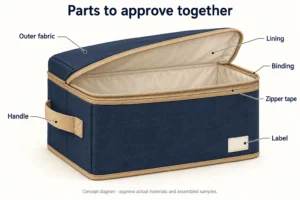
Buyers comparing should check whether the product needs a lid, whether it should stack, whether it folds flat, and whether children can open it easily. A lid can improve dust protection and retail value, but it must fit smoothly and should not bend during shipping. Handles improve usability, but weak stitching or thin plastic handles can create complaints.
Stackability should be tested with realistic weight. Some boxes look stackable in photos but deform when filled. If the product includes a lid, clip, frame, or wheel, buyers should test these parts before sample approval. The most visible failures usually happen at corners, handles, hinges, clips, and connection points.
Safety and Durability
Toy storage products are often used in family environments, so buyers should pay attention to safety-related details. Rounded corners, smooth edges, stable shape, and strong handles are important. If the product is made from plastic, buyers should check whether the material is brittle or too thin. If the product is made from fabric, they should test seam strength and reinforcement boards.
Durability is not only about thickness. It also depends on how the product is assembled, stitched, welded, folded, or packed. Common quality issues include cracked corners, loose seams, weak handles, poor lid fit, warped panels, color variation, and packaging damage.
Before bulk production, buyers should define an inspection standard. This should include size tolerance, material requirement, logo placement, handle strength, lid fit, carton packing, and acceptable defect levels.
Logo and Branding
Toy storage boxes can support different logo methods depending on material and structure. Common options include screen printing, heat transfer printing, woven labels, rubber patches, stickers, embossed plastic logos, printed insert cards, hangtags, and custom retail packaging.
For Amazon and retail, branding should be clear but not excessive. A strong product image often comes from the combination of color, shape, logo placement, and packaging. Buyers ordering should confirm artwork format, Pantone color, logo size, position, printing method, and packaging layout before mass production.
Logo approval is important because printing on fabric, plastic, and coated surfaces can produce different results. A digital mockup is useful, but a physical logo sample is safer for private label projects.
Packaging for Amazon FBA and Retail
Packaging is a major buying factor for this product category. Amazon sellers need packaging that protects the item during parcel shipping and supports barcode or FNSKU labeling. Retail buyers need packaging that looks clean, includes correct product information, and can be handled efficiently by stores and warehouses.
Buyers should confirm individual polybag, color box, belly band, insert card, barcode label, warning label, carton quantity, carton marks, and whether the product is shipped folded or assembled. For Amazon FBA, incorrect labels, weak cartons, or oversized packaging can create extra costs.
Packaging should be approved before production, not after the goods are finished. Buyers should request packed sample photos and carton details before confirming the order.
MOQ, Sample, and Lead Time
MOQ depends on material, size, structure, logo method, color, packaging, and whether the buyer uses an existing design or develops a custom product. Standard colors and existing molds or patterns usually allow a lower MOQ. Custom colors, special prints, new structures, retail boxes, and multi-size sets may require higher quantities.
Samples help buyers confirm real product quality before committing to bulk production. Existing samples are useful for reviewing material, structure, and workmanship quickly. Custom samples are better for confirming logo, exact size, color, packaging, and Amazon or retail requirements.
Lead time should be confirmed after final sample approval. It may vary based on order quantity, material availability, customization, packaging printing, and factory schedule. Buyers should allow time for sample production, sample shipping, sample review, artwork changes, mass production, inspection, and export shipment.
Customization, OEM, and ODM
OEM and ODM support can help buyers create a product that fits a specific sales channel. Custom options may include size, color, fabric, plastic thickness, lid structure, handle design, folding method, transparent window, logo, label, insert card, color box, barcode, and carton mark.
For ODM projects, buyers can share the target retail price, Amazon listing plan, competitor reference, expected order quantity, packaging style, and destination market. The supplier can recommend a specification that balances product appearance, durability, shipping cost, and margin.
To reduce mistakes, buyers should prepare a detailed product brief covering material, size, color, logo artwork, packaging, labeling rules, carton information, and inspection expectations.
Packaging, Shipping, and Export Support
Toy storage boxes can be lightweight, but carton volume can strongly affect shipping cost. Foldable fabric boxes often ship more efficiently than rigid plastic boxes. However, rigid boxes may offer stronger structure and higher perceived value. Buyers should compare product positioning and freight cost together.
Important export details include folded size, pieces per carton, carton dimensions, gross weight, loading quantity, barcode labels, FNSKU labels if needed, outer carton marks, pallet requirements, and coordination with the buyer’s freight forwarder.
For retail and FBA orders, labeling accuracy is critical. Mixed SKUs, wrong barcodes, unclear carton marks, or damaged packaging can delay receiving and increase handling costs.
Recommended Product Options
Great Shine can support different toy storage box options for Amazon sellers, retailers, importers, and private label buyers:
- Foldable fabric toy storage boxes for ecommerce and retail programs
- Plastic toy storage boxes with lids for durable storage lines
- Custom logo toy boxes for private label brands
- Multi-size toy organizer sets for Amazon FBA bundles
- Retail-ready storage boxes with barcode labels and custom packaging
Review the to compare structures, MOQ, branding methods, and packaging choices. For faster quotation, prepare your target channel, order quantity, logo plan, packaging requirement, and shipping destination.
FAQ
Can toy storage boxes be customized with a logo?
Yes. Logo options include printing, woven labels, stickers, rubber patches, embossed plastic logos, hangtags, insert cards, and custom packaging. The best method depends on the material and order quantity.
What should Amazon FBA buyers check before ordering?
FBA buyers should check product dimensions, folded size, packaging strength, barcode or FNSKU labeling, carton marks, parcel shipping resistance, and whether the product can arrive without deformation.
What MOQ is required for custom toy storage boxes?
MOQ depends on material, size, color, logo method, packaging, and whether the product uses an existing design. Custom colors, printed packaging, and new structures usually increase MOQ.
How can buyers reduce sourcing risks?
Buyers should approve a physical sample, confirm material specifications, test handles and lids, verify logo placement, check packaging labels, and define inspection standards before bulk production.
CTA
Looking for a reliable manufacturer for your Amazon FBA or retail product line?
Approve the logo and packed sample before channel-specific claims
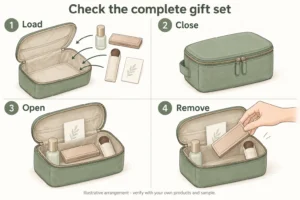
Review the logo on the actual panel and confirm its size, placement and appearance after folding. Pack a complete sample with its inserts and labels. Verify the sellable-unit count and carton arrangement against the retailer or fulfilment programme’s current requirements.
If a product is marketed for children or carries a safety, recycled-content or performance claim, establish the relevant requirements for its intended market and construction. A general factory certificate does not demonstrate compliance of every finished toy-storage box.