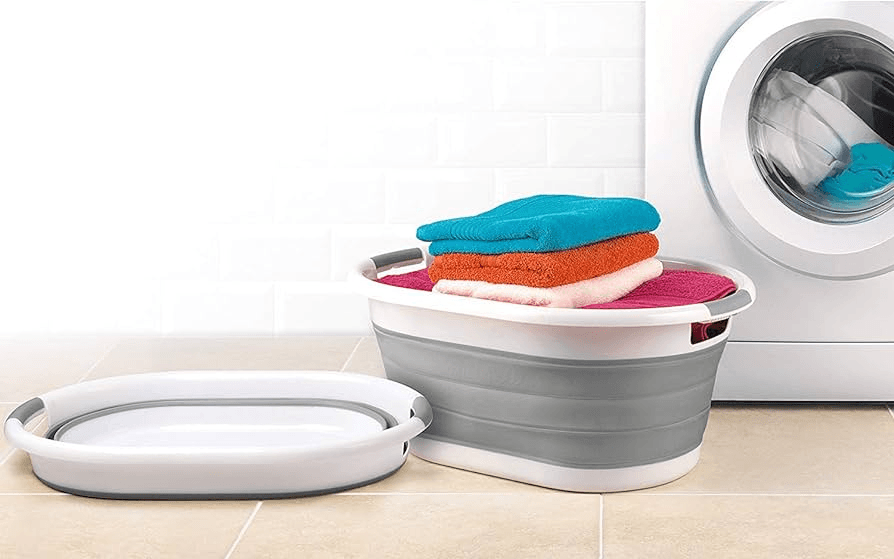
A collapsible laundry basket takes up less space when its folding structure is closed. That can help in a small home, shared laundry room, or temporary setup, provided the basket also works comfortably when open and filled.
Quick answer: Compare the open and folded dimensions, the way the structure locks or supports itself, and how you will carry the laundry. Choose a basket you can empty, clean, dry, and fold according to its instructions. Collapsible describes a storage feature; it does not establish capacity, washability, or suitability for wet clothes.
Decide whether you need collection or transport
A hamper that stays in a bedroom mainly collects laundry. A basket carried to a washing machine has a different job, even when the two products look similar.
For collection, the opening and standing shape matter. For transport, consider the filled size, handle grip, empty weight, and route between rooms.
Some households benefit from separate containers for these tasks. A stationary hamper can remain where people change clothes while a manageable basket carries smaller loads.
Consider how often it will fold
A basket used for sorting and put away after each wash can benefit from a compact folded shape. If it will stay open throughout the week, give more weight to how it stands, opens, and carries laundry.
Picture its empty destination. Behind a door, beneath a shelf, and beside a washing machine offer different amounts of space and different exposure to moisture.
Check that storing the folded basket does not block ventilation, a doorway, or access needed for the appliance. A narrow gap is useful only when the product can be placed and removed comfortably.
Understand the folding structure
Different products collapse in different ways. Soft pop-up hampers, fabric baskets with removable supports, hinged frames, and flexible-sided containers should not share one set of folding instructions.
Flexible frames and pop-up designs
These may use a frame that folds or twists into a compact form. Follow the specified sequence and any retaining strap instructions.
Do not improvise by forcing the frame in an unfamiliar direction. Control it during opening and closing, and keep it away from the face while following the manufacturer’s method.
Removable inserts and supports
Some fabric baskets hold their shape through a base or side insert. Removing that part may allow the body to fold flat.
Keep the components together and reinstall them before loading if required. A partly assembled basket can behave differently from the product shown in the listing.
Hinged and flexible-sided containers
A hinged frame may need a lock or brace engaged in its open position. A flexible-sided container may collapse through folds in the body.
Check where fingers and fabric move during closing. Empty the basket first unless the design explicitly supports another method, and do not press laundry into a folding joint.
Measure the open and folded forms
The open dimensions determine where the basket can stand. The folded dimensions determine whether it fits the storage space that made the product attractive in the first place.
Include handles, feet, lids, and any detached components. A slim folded body is less useful if a separate rigid base has nowhere to go.
For a lidded model, allow opening and liner-removal space. A basket can fit beneath a counter while remaining awkward to empty.
Check the carrying route
Think about doors, corners, stairs, and the area in front of the washing machine. A wide basket may be manageable in an open room but difficult to move through a narrow route.
Try the intended handling position when comparing products. The basket should not require you to hold it at an awkward distance simply to keep the frame open.
Treat capacity and carrying weight separately
A volume describes the space inside the basket. It does not tell you the safe load for its handles, seams, supports, or frame.
Follow the stated weight limit and intended use. Wet laundry can create a different handling task from the same clothing when dry, so check whether that use is supported.
Leave enough room to grip the handles and remove the contents. A load piled above the rim may be difficult to control even before a stated limit is reached.
Inspect handles as part of the whole basket
Look at where handles attach and whether they are accessible when filled. A comfortable-looking grip does not tell you how the attachment performs.
Use the intended carrying points. A lid loop, closure tab, or liner attachment should not be treated as a loaded lifting handle unless the instructions identify it that way.
If carrying the whole load is awkward, split it into smaller trips or use another suitable carrier. Folding capability does not make every load easy to lift.



Check stability while the basket is partly filled
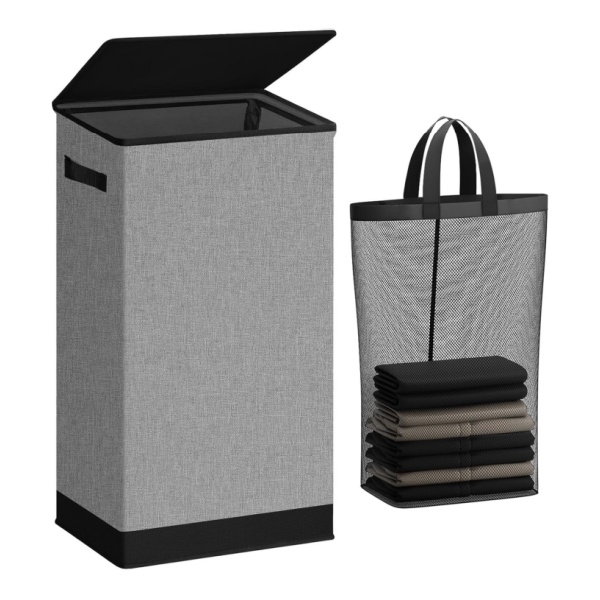
A product photo often shows a neatly loaded basket. In daily use, the basket may be empty, partly filled, or loaded unevenly as clothes are added and removed.
Check that required supports remain correctly positioned throughout that routine. Put the basket on a suitable level surface and avoid using surrounding furniture to conceal instability.
For divided hampers, one side may fill earlier than another. Consider whether the design remains convenient under that ordinary uneven loading.
A folding frame should not be used as seating or a step unless specifically designed and rated for that purpose. A flat lid does not establish a seating function.
Manage damp laundry separately
Mesh or an open top can expose parts of the contents to air, but a dense pile of damp fabric can still remain wet. The material does not replace a washing or drying routine.
Put items in the condition appropriate for waiting between washes. If clothing needs airing or immediate washing, handle that before treating the basket as its storage place.
Do not fold the basket with wet contents inside. Empty it and dry any damp areas according to the care instructions before storing it closed.
Choose the location carefully
Avoid a position that repeatedly wets the base unless the product is intended for it. Bathroom use does not automatically include standing in splash water.
A dry collection point near where you change clothes may work better than a narrow gap beside the shower. Check that you can empty the basket there without moving other bathroom items.
Follow the care instructions for every component
A removable liner may have different care requirements from the outer body. Likewise, a fabric shell may contain a support panel that limits washing.
Check the product label before choosing machine washing, soaking, or a cleaning chemical. Cleanability should be established for the actual construction rather than inferred from the outer material.
Remove lint or loose debris when the basket is empty. Inspect corners, seams, frame pockets, and handle attachments for damage that affects use.
Let all parts dry as directed before reassembly or folding. Store detachable parts where they will remain identifiable and ready for the next use.
Compare features around your routine
A removable liner can help when the outer basket stays in one place, but confirm whether the liner is intended for carrying. A lid can hide laundry, but adds an opening action and clearance requirement.
Dividers can separate laundry groups, provided the sections match how much of each group collects. Several narrow sections may be less useful than one open space if your loads vary.
Compare those features with a normal laundry day: adding clothes, taking them to the machine, returning clean laundry, and putting the empty basket away. A lid or divider is worthwhile when it helps one of those tasks.
When is a rigid basket a better fit?
A rigid container may suit a routine where the basket stays open and needs no compact storage. It can avoid the extra setup and folding steps of a collapsible product.
Compare actual models for carrying, care, and space. Rigid and collapsible are structural descriptions, not universal rankings of quality or lifespan.
The choice can also change by task. A foldable sorting basket and a rigid carrier may both have a place if they serve different parts of the laundry routine.
Frequently asked questions
Do all collapsible laundry baskets fold flat?
No. Some fold into a slim rectangle, some into a round form, and others only reduce part of their height. Check the complete folded dimensions, including components that must be removed.
Can I carry wet laundry in one?
Only if the product is suitable for that use and load. Check the material, base, handle instructions, and care guidance. A basket intended for dry-clothes collection may not suit wet transfer between appliances.
Can I machine wash the whole basket?
Follow the specific care label. Frames, inserts, coatings, and fittings may prevent machine washing even when the outer surface is fabric. A washable liner does not make the complete basket washable.
Are folding baskets good for small apartments?
They can be useful when the empty basket is regularly stored away and fits the available gap. Measure both forms and consider where it stands during use. A basket that never gets folded may offer less of that benefit.
Does a mesh basket prevent odors?
Mesh does not guarantee odor control or dry a packed load. The condition of the laundry, time between washes, cleaning, and room environment all matter. Use ventilation features alongside an appropriate laundry routine.
How do I stop a basket collapsing during use?
Check that the required base, braces, or locks are installed as directed. Stay within the intended loading arrangement. If it remains unstable or a part is damaged, seek the manufacturer’s guidance before continuing to use it.
Find a structure that fits the laundry routine
Great Shine’s laundry basket and hamper range includes collapsible designs. Compare the open structure, folding method, carrying arrangement, and care instructions for the particular model rather than choosing from folded appearance alone.