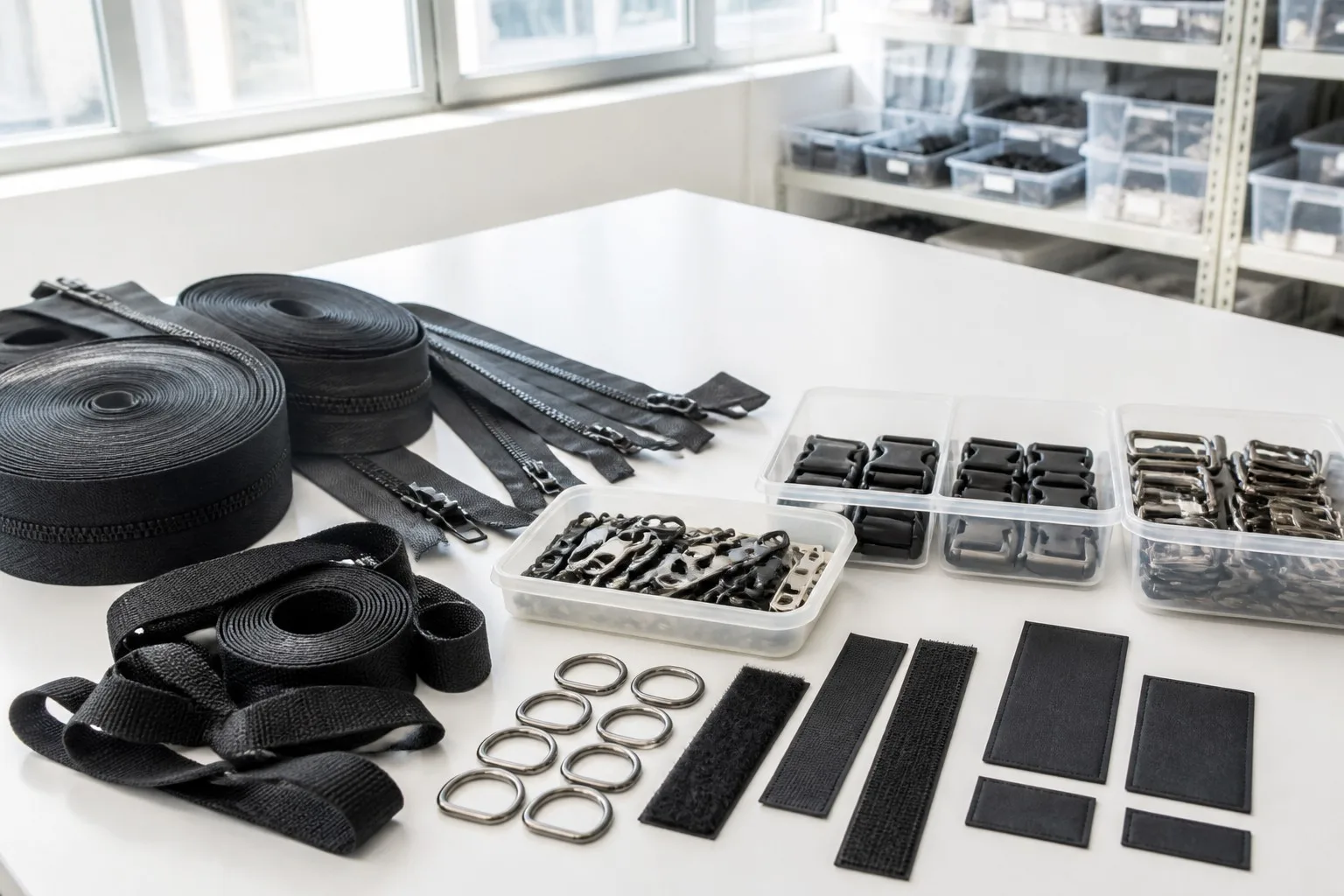
Why Hardware Matters More Than Fabric
When a storage bag fails, it almost never fails at the fabric. The 600D Oxford holds up. The PEVA lining holds up. What fails is the hardware — the zipper that jams after 200 cycles, the buckle that snaps under load, the webbing that frays at the bartack, the Velcro that loses its grip after 500 opens.
In our 16 years of manufacturing storage bags, we have seen every hardware failure mode possible. The root cause is always the same: the buyer did not know what they were specifying, and the factory used the cheapest option that “looked the same.”
This article is the guide we wish every buyer had before sourcing storage bags. It covers every hardware category — what raw materials go into it, how it is manufactured, and what happens to it in daily use. If you are an Amazon FBA seller, a retail buyer, or a DTC brand owner, this is the reference you need to make sure your bags last 100 uses, not 10.
1. Zippers: The #1 Failure Point
The zipper is the most critical hardware component on any storage bag. It is also the most misunderstood. A zipper is not a single piece — it is an assembly of four distinct components, each made from different materials.
Raw Materials
How Zippers Are Manufactured
Nylon coil zippers (the most common type for storage bags):
- Tape weaving: Polyester yarn is woven into a narrow tape on a needle loom. The tape is typically 25-32mm wide with a reinforced edge.
- Coil forming: Nylon monofilament is spiraled around one edge of the tape using a coiling machine. The coil is heat-set at 180°C to lock the spiral shape.
- Dyeing: The tape-and-coil assembly is dyed in a vat. Common colors: black, navy, gray, beige. Custom Pantone matching requires a 5,000-meter MOQ.
- Slider attachment: The slider is pressed onto the coil by hand or machine. The slider body is die-cast from zinc alloy, then plated (nickel, antique brass, or gunmetal finish).
- Cutting and stopping: The continuous zipper is cut to length. Bottom and top stops (metal or plastic) are crimped on to prevent the slider from running off the end.
The entire process for a nylon coil zipper takes 3-5 days from weaving to finished product. The #5 and #8 sizes used in storage bags differ only in the diameter of the nylon monofilament — #5 uses 0.6mm, #8 uses 0.9mm.
Waterproof TPU zippers (used in cooler bags and some toiletry bags):
The same nylon coil zipper is coated with a layer of TPU (thermoplastic polyurethane) film on both sides. The TPU is applied by hot-rolling at 160°C, which bonds the film to the polyester tape. The coil teeth remain exposed on one side for functionality. This adds $0.10-0.15 per zipper and makes the zipper 80-90% water-resistant (not fully waterproof — water can still enter through the slider gap).
YKK vs SBS vs Local: What Is the Actual Difference?
The difference in cycle life comes from two factors: (1) the heat-set temperature — higher temperature locks the coil shape more permanently, so the teeth do not deform under repeated stress; (2) the zinc alloy purity — impurities in recycled zinc create micro-crystals that fracture under load, causing the slider to jam.
Daily Use Scenarios
- Storage bag on a closet shelf: Zipper is opened and closed 2-3 times per week. A local zipper fails at ~3 years. SBS lasts ~6 years. YKK lasts ~12+ years.
- Moving bag with backpack straps: Zipper is stressed under load — the bag is full and heavy, putting lateral pressure on the teeth. This is where the coil heat-set temperature matters most. A low-temperature coil will split open under load.
- Cooler bag in a car trunk: Temperature cycling (hot car to cold cooler) causes TPU-coated zippers to expand and contract. Cheap TPU cracks at the slider contact point after 50-80 thermal cycles.
2. Zipper Pulls: The Brand Touchpoint
The zipper pull is the one piece of hardware that every customer touches every time they use the bag. It is the primary brand touchpoint — and most buyers spend zero time specifying it.
Raw Materials
Manufacturing Process
Metal pulls are die-cast from zinc alloy in the same process as the slider body. The pull is cast, deburred, plated, and then attached to the slider with a metal ring. Logo application is by laser engraving (permanent, no color) or pad printing (adds color but wears off in 1-2 years). Cost: $0.05-0.15 per pull.
Silicone pulls are injection-molded from liquid silicone rubber (LSR). The mold includes a cavity for the logo — when the silicone is injected, the logo is debossed (pressed into the surface) as part of the molding. Color is added by mixing pigment into the LSR before injection. The pull is attached to the slider with a metal jump ring. Cost: $0.06-0.12 per pull.
PU leather pulls are cut from sheets of PU leather using a steel rule die in a clicker press. The logo is debossed using a heat press at 120°C. The pull is folded and stitched around a metal D-ring, then attached to the slider. Cost: $0.08-0.15 per pull.
Paracord pulls are hand-assembled. A length of 550 paracord (4mm diameter, 7-strand core) is cut, the ends are melted with a flame to prevent fraying, and the cord is looped through the slider hole and tied with a lanyard knot. No logo possible — the brand touchpoint is the cord color. Cost: $0.04-0.08 per pull.
Daily Use Scenarios
- Kids’ storage bins: Silicone pulls are the safest — no sharp edges, no metal to scratch furniture. They also bounce back from being pulled at odd angles, which is how children always pull zippers.
- Premium closet organizers: Leather pulls age beautifully — the PU softens and darkens slightly over 2-3 years, creating a patina that signals quality.
- Outdoor/garden storage: Metal pulls corrode. The plating wears off at the contact point with the slider ring, exposing raw zinc which oxidizes. Silicone or paracord is better here.
- Airplane carry-on storage: Metal pulls set off TSA scanners more often than silicone. Minor, but some DTC travel brands specify silicone pulls specifically for this reason.
3. Webbing and Straps: The Load-Bearing Spine
Webbing is the structural backbone of any storage bag with handles or straps. It carries the weight. When it fails, the bag fails catastrophically — a dropped laundry hamper full of wet towels is a mess nobody wants.
Raw Materials
Manufacturing Process
Woven webbing (polyester, cotton, RPET):
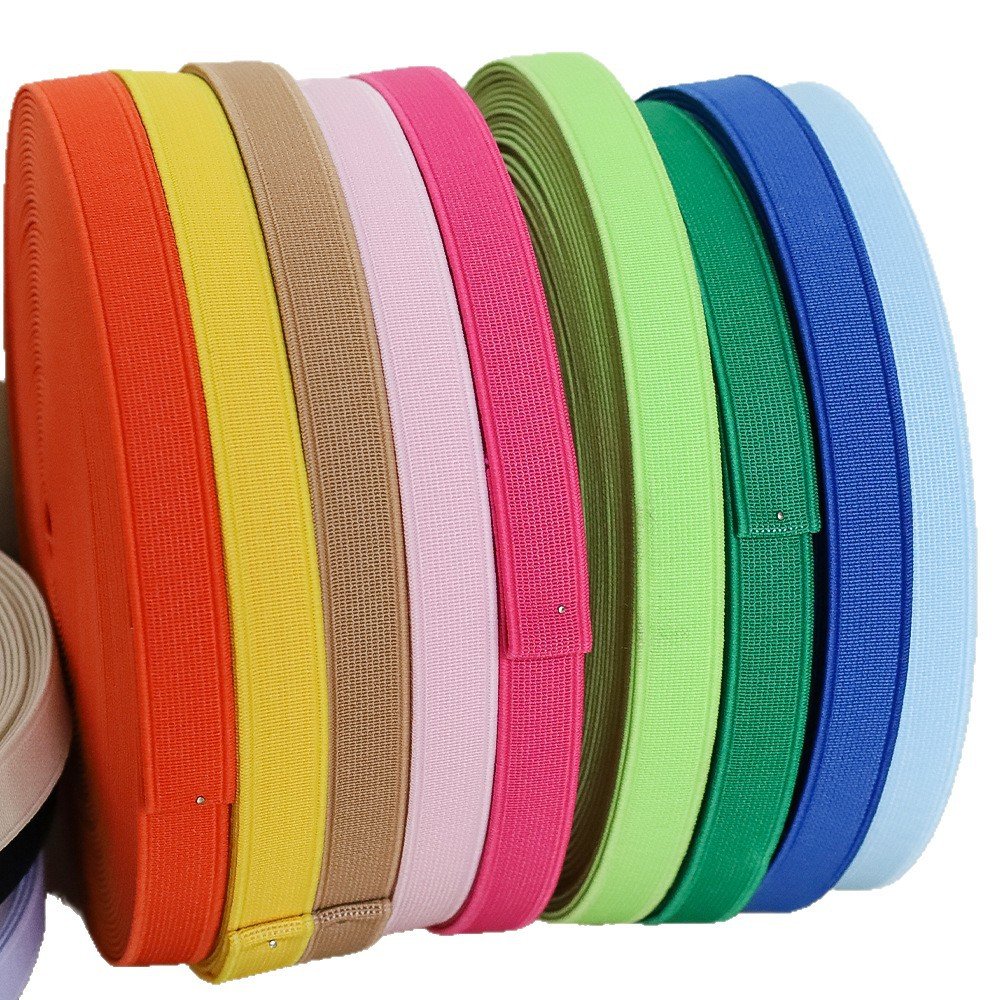
- Yarn preparation: Continuous filament yarn (polyester) or spun yarn (cotton) is loaded onto bobbins. For RPET, recycled PET flakes are melted and extruded into yarn first.
- Weaving: The yarn is woven on a needle loom into flat webbing. Standard widths: 15mm, 20mm, 25mm, 38mm, 50mm. The weave is typically a plain weave or twill weave. Twill is more flexible and softer; plain is stiffer but stronger.
- Dyeing: The webbing is dyed in a rope dyeing machine at 130°C for polyester (requires disperse dyes) or 95°C for cotton (requires reactive dyes). RPET dyes like polyester but takes color less evenly due to recycled content variability.
- Finishing: The webbing is heat-set at 170°C to lock dimensions, then wound onto spools.
PP (polypropylene) webbing is extruded directly — the polymer is melted and forced through a die that produces a flat strip. No weaving. This makes it cheaper but also stiffer and less comfortable against skin. It is the default for budget storage bags.
Daily Use Scenarios
- Moving bag with backpack straps: The webbing carries 15-25 kg of household items. Polyester 38mm webbing with bartack reinforcement at 4 points is the minimum safe specification. PP webbing is unacceptable here — it has poor abrasion resistance and will fray at the shoulder attachment point within 5-10 uses.
- Laundry hamper handles: Cotton webbing is the premium choice — it is soft on hands, does not slip when wet, and develops a natural grip texture over time. Polyester is the standard choice — stronger than cotton and does not absorb water.
- Trolley cart straps: These see constant friction against the cart frame. Nylon tubular webbing is best — it has the highest abrasion resistance of any webbing type. Polyester works for budget carts. PP should not be used here.
- Closet organizer hanging straps: These bear static load for months or years. Polyester is ideal — it does not stretch under load (less than 5% elongation at 30% breaking strength) and is UV-stable. Cotton stretches up to 15% under sustained load, which causes the organizer to sag over time.
4. Buckles and Hooks: The Connection Points
Buckles and hooks are the joints that connect webbing to the bag, straps to each other, and the bag to external anchor points. They are small, cheap components with outsized structural importance.
Raw Materials
Manufacturing Process
Plastic buckles (POM, ABS, Nylon 6/6):
- Injection molding: Plastic pellets are melted at 190-220°C (POM) or 210-240°C (ABS) and injected into a steel mold. The mold for a side-release buckle has 3-4 parts (two halves + sliders) to create the internal mechanism.
- Cooling and ejection: The part cools in the mold for 8-15 seconds, then the mold opens and the part is ejected. Cycle time: 12-20 seconds per part.
- Deflashing: Excess plastic at the parting line (flash) is trimmed by hand or with a trimming jig.
POM (polyoxymethylene) is the best plastic for buckles because it has the highest tensile strength per cost, excellent dimensional stability (does not warp), and good low-temperature performance (does not become brittle at -40°C). ABS is cheaper but cracks below -20°C and has 30% lower tensile strength.
Metal hardware (D-rings, swivel hooks):
- Die casting: Zinc alloy is melted at 419°C and injected into a steel mold. The mold for a D-ring is a simple two-part mold; a swivel hook mold has 3-4 parts to create the swivel mechanism cavity.
- Deburring: The cast part has flash and gating marks that are removed by tumbling in a vibratory deburring machine with ceramic media for 2-4 hours.
- Plating: The part is electroplated — nickel, antique brass, or gunmetal finish. Plating thickness: 5-12 μm. The plating provides corrosion resistance and visual finish.
- Assembly (swivel hooks only): The swivel mechanism is assembled by inserting the hook body into the swivel barrel and crimping the barrel closed.
Daily Use Scenarios
- Trolley cart hook: The swivel hook bears the full weight of a loaded cart (10-15 kg) and rotates constantly as the cart moves. The failure point is the swivel mechanism — the crimp that holds the barrel together loosens over 200-300 rotation cycles. Steel hooks with nickel plating last 500+ cycles; zinc alloy hooks last 200-300.
- Closet organizer D-rings: These bear static load (5-15 kg) for months. The D-ring itself rarely fails — the failure point is the stitching that attaches it to the webbing. Always specify bartack stitching at D-ring attachment points.
- Travel bag side-release buckle: Opened and closed 2-3 times per trip. POM buckles last 1,000+ cycles. ABS buckles last 500-800 cycles before the latch mechanism wears. The difference matters for bags that are used weekly vs. occasionally.
- Salt-spray exposure: For bags used in coastal or marine environments, plastic POM buckles are superior — they have Grade 5 salt-spray resistance (no corrosion). Metal buckles, even plated, degrade to Grade 4 (moderate corrosion) after 200 hours of salt-spray exposure per ISO 9227.
5. Hook-and-Loop (Velcro): The Silent Workhorse
Velcro is used for lid closures, compartment dividers, panel attachments, and adjustable straps. It is invisible in most product photos but is critical to the bag’s daily functionality.
Raw Materials
Manufacturing Process
- Nylon yarn preparation: Nylon 6 or Nylon 6,6 yarn is loaded onto a specialized knitting machine called a warp knitter.
- Loop knitting: The yarn is knitted into a base fabric with thousands of tiny loops standing upright. The loop height is 1.5-3mm.
- Hook forming (hook side): The loops on one fabric are cut and then heat-treated so they curl back on themselves, forming hooks. This is done by passing the fabric under a heated roller at 170°C that simultaneously cuts and curls the loops.
- Dyeing: Both sides are dyed in the same color. Black is standard; other colors require 500m MOQ.
- Cutting: The Velcro is cut into strips or pieces and wound onto rolls.
The critical spec is cycle life — how many times the Velcro can be opened and closed before it loses 50% of its grip strength:
Daily Use Scenarios
- Storage bin lid closure: Opened and closed daily. Industrial-grade Velcro (25mm width) maintains grip for 3-5 years of daily use. Standard-grade starts slipping after 1-2 years.
- Closet organizer panel attachment: Velcro holds panels together under the weight of stored clothing. The failure mode is not the Velcro losing grip — it is the stitching that holds the Velcro to the fabric tearing out. Always specify edge-stitching around all four sides of Velcro patches, not just at the corners.
- Adhesive-back Velcro on plastic surfaces: The adhesive softens at 50-60°C, which is reached inside a car trunk in summer. For any application that sees heat, specify sew-on Velcro, not adhesive-back.
6. Labels and Hang Tags: The Brand Identity
Labels are the final hardware component — the one that tells the customer who made the bag. They seem trivial, but they are the component that Amazon listing photos zoom in on, and the component that retail buyers inspect first.
Raw Materials and Manufacturing
Woven jacquard labels are the industry standard. Polyester yarn in two colors (typically logo color + background) is woven on a Jacquard loom that creates the logo as part of the weave. The label is then cut, folded, and sewn into the bag. The key quality spec is thread density — measured in picks per centimeter. Standard density is 23 picks/cm; high density is 35+ picks/cm, which creates sharper logo edges and a more premium feel.
Daily Use Scenarios
- Washing: Woven polyester labels survive 50+ wash cycles without fading. Printed labels fade after 5-10 washes. If the bag is washable (like a laundry hamper), always specify woven, never printed.
- Retail shelf: Hang tags are the first thing a retail buyer sees. A kraft paper hang tag with twine string signals eco-brand. A glossy card stock with satin ribbon signals premium. The hang tag should match the brand positioning — a 30storagebagshouldnothavea0.02 hang tag.
- Instagram unboxing: PU leather patches and metal plates photograph well. Woven labels photograph poorly (they are small and flat). If your brand lives on social media, invest in a PU patch or metal plate — it is the label that customers will feature in their own photos.
How to Specify Hardware in Your Purchase Order
The most common mistake we see from new buyers is writing “good quality zipper” on a PO. That means nothing. Here is what a complete hardware specification looks like:
ZIPPER: #8 nylon coil, SBS brand, black tape, double-slider,
  with locking auto-lock sliders, nickel-plated pull tab.
  Pull cycle life: minimum 1,000 cycles per ASTM D2061.

ZIPPER PULL: Silicone, black, debossed logo (Pantone Black 6 C),
  attached with nickel jump ring. MOQ: 1,000 pcs.

WEBBING: 25mm polyester, black, 40gsm, twill weave,
  bartack-stitched at all attachment points.

BUCKLE: Side-release, POM, black, 25mm, load rating ≥20 kg.

VELCRO: Sew-on, 25mm width, industrial grade (5,000+ cycles),
  edge-stitched on all four sides.

LABEL: Woven jacquard, polyester, 35 picks/cm, black + white,
  50×15mm, center-fold, sewn into top seam.
When the factory receives a PO with these specifications, there is no room for substitution. The buyer gets exactly what they specified, and the bag performs as expected in the field.
Free Hardware Sample Pack
The best way to understand hardware quality is to feel it in your hands. We ship a free sample pack containing:
- 3 zipper samples (YKK #5, SBS #8, waterproof TPU)
- 5 zipper pull samples (metal, silicone, leather, PVC, paracord)
- 3 webbing strips (polyester, cotton, RPET)
- 5 buckle/hook samples (D-ring, side release, swivel, ladder lock, rectangle)
- Velcro samples (sew-on, adhesive, industrial grade)
- Label samples (woven, PU patch, hang tag)
Curated to your product type. Shipped worldwide in 3-5 days. Free for OEM buyers with MOQ 500 pcs.
Contact: grace@g-shine07.com
WhatsApp: +86 177 0171 9207
Website: greatshine07.com
Great Shine — 16 years manufacturing storage bags and hardware sourcing. BSCI, ISO 9001, SEDEX certified. 150+ containers per year to 50+ countries.