To source custom bags for Germany, give suppliers a brief they can quote and use in production. Describe what the bag will carry, its dimensions and construction, and how it will be branded and packed. Review the sample against that brief and settle product safety and packaging responsibilities before approving artwork or bulk production.
Quick answer: Compare suppliers using one written specification, approve a documented sample, and confirm which business handles each market obligation. A low unit price is useful only when you know what it includes. Keep the approved construction, inspection requirements, packaging data, and delivery terms together so changes are visible before shipment.
Start with a clear product and customer
Describe what the bag will carry and how the customer will use it. A shopping tote carried home on foot needs a different brief from a packing cube, a structured bedding bag, or a cooler holding packaged lunches.
Include the sales channel. A retail display may need a particular folded presentation, while an online order needs packaging that suits the planned fulfillment process. These details can change the finished product and the quotation.
Separate fixed requirements from choices
List what must stay fixed: perhaps a shelf footprint, an approved logo, or a compartment for a particular item. Identify what remains open, such as fabric color, handle construction, or a removable insert.
Suppliers can then suggest alternatives while keeping the essential features intact. Ask them to mark any proposed deviation beside the requirement it changes, so you can compare the options before approval.
Describe function in observable terms
Replace “heavy duty” with a description of the expected contents and handling. Replace “easy to clean” with the intended cleaning method and the surfaces it applies to.
Where performance matters, agree on an evaluation method. A cooler’s performance depends on the complete construction, load, cold sources, and surrounding conditions. A material name alone cannot support a cold-retention promise.
Send an RFQ that makes quotations comparable
An RFQ, or request for quotation, should give each supplier the same starting point. Use a version number so an updated handle or packaging requirement does not get mixed with an earlier price.
Include:
- Product drawings or reference images with the changes you want.
- Finished dimensions and any important fit requirements.
- The intended contents and handling conditions.
- Outer material, lining, inserts, closures, and handles where decided.
- Logo artwork, position, size, and proposed application method.
- Order quantity, color split, and set composition.
- Unit packaging, labels, carton arrangement, and destination.
- Required documents, sample review, and inspection arrangements.
Ask for open questions and exclusions alongside the price. If one supplier includes printed packaging and another quotes a plain bag, the headline amounts do not describe the same order.
A reference photograph helps explain appearance, but it cannot specify hidden reinforcement, seam construction, or the exact material. Request clarification of those components before approving a price as final.
Evaluate the supplier’s role and production process
Ask which company will contract with you, which site performs the work, and how any subcontracted stages are controlled. A factory address or a manufacturing claim on a website is a starting point for verification, not a complete assessment.
Useful evidence can include a live production discussion, relevant process records, a sample made to your brief, and documents that identify the actual legal entity and site. Match that evidence to the product you are developing.
For example, sewing a fabric pouch does not establish capability in a wheeled frame assembly. A factory producing bags may coordinate specialist components from another supplier. Understanding that arrangement helps identify who controls revisions and problems.
Assess communication through a real question
Ask how a proposed change affects the design. If you make a bag wider, does the base insert change? Does a longer handle need a different attachment? Will the revised shape change packed dimensions?
Look for an explanation of which components, sample checks, and costs would change. That gives you something concrete to assess when comparing suppliers.
Review documents within their scope
Check the document holder, site, date, and product or process covered. A management-system certificate does not establish the performance of every bag, and a report for one material does not automatically cover a different coating or color.
Keep requested claims separate from supplier background information. If recycled content or a particular material certification is part of the listing, identify the component and the supporting documentation needed for that claim.
Approve the materials as a complete construction
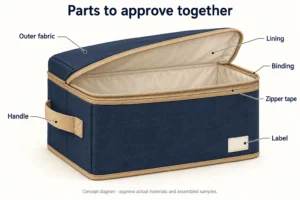
Record the outer fabric, lining, reinforcement, and hardware separately. Similar-looking bags can use different components, and the difference may become apparent only when the bag is loaded or folded.
For a structured organizer, inspect the board insert and the way it fits its pocket. For a travel bag, check the opening, zipper path, and handle attachments. For a cooler, consider the insulation and lining assembly together.
Material trade names and shorthand are useful but incomplete. A description such as Oxford fabric does not settle the fiber, coating, finish, or the entire bag’s water resistance.
Keep approved swatches or clear material references with the sample record. If a substitute is proposed later, review the affected properties and appearance before accepting the change.
Plan product safety information before printing labels
Identify the applicable requirements for the actual product and the businesses involved. Ordinary consumer bags, products intended for children, and articles intended for direct food contact can raise different questions.
The EU’s General Product Safety Regulation has applied since 13 December 2024. The European Commission’s guidance addresses risk assessment, traceability, economic-operator responsibilities, and information in online offers. Use it to determine what your product file and sales listing need, including the relevant EU responsible person where required. European Commission guidance on the product safety framework
For a German launch, review language requirements for the instructions and safety information that apply to the product. Approve their meaning before the supplier lays out the final label; a translation step added after printing is too late.
A useful working file connects the product reference to its specification, relevant risk assessment, supplier details, reports, labels, and revision history. Assign a person in the buying organization to resolve missing information before release.
Avoid accepting “EU compliant” as an undefined substitute for that work. Ask what requirement the statement refers to, which version of the product it covers, and what supports it.
Treat packaging responsibilities as a separate workstream
The bag being sold and the packaging around it are separate parts of the project. A reusable product does not remove the need to assess its retail packaging, shipping packaging, or other packaging used in distribution.
The EU Packaging and Packaging Waste Regulation began applying on a phased basis from 12 August 2026. Different provisions have different timing and scope, so a sourcing decision should use current requirements rather than an old checklist. European Commission explanation of the PPWR’s application
Germany’s Central Agency Packaging Register explains registration, system participation, and reporting duties. Its current guidance also addresses responsibility for own brands and imports. Determine the role of each business in your specific supply chain before assuming that the overseas supplier or freight arrangement covers these duties. ZSVR guidance for own brands and imports
Request packaging material and weight data early. Review the unit pack, inserts, labels, inner cartons, and shipment packaging actually proposed. If the packaging changes, update the records used for the launch.
Use sample approval to settle open questions
A sample should answer both appearance and use questions. Review it against the written specification, not only against a photograph of the preferred style.
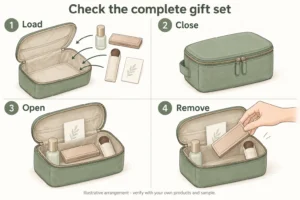
Check dimensions, access, handles, closures, seams, inserts, and the intended contents. Open and close the bag in the way the customer will. Pack it using the proposed retail method and inspect the shape after unpacking.
Where a function needs testing, agree on the conditions and acceptance criteria. Sample handling can reveal problems, but an informal demonstration is not a substitute for a report supporting a quantitative claim.
Keep a revision record
Give each sample a clear identity. List requested changes and the decisions made after review, including any changes accepted because a different construction worked better.
When the final sample is approved, retain the matching specification and artwork. A photograph of the sample does not capture every hidden component or agreed tolerance.
If production materials will differ from the sample, resolve that difference before approval. The purpose of the sample is to establish a reproducible reference.
Compare the total order cost
Review product cost alongside sample charges, artwork or tooling charges, packaging, inspection, freight, and other costs relevant to your delivery arrangement. Confirm the currency, validity period, payment terms, and named delivery place in the quotation.
Customs classification and import costs depend on the actual product and transaction. Have the responsible importer or adviser confirm them for the order; a similar-looking bag is not enough to establish the applicable treatment.
Keep recoverable taxes separate from non-recoverable costs in internal planning, where appropriate to your business. A cash-flow forecast and a product-margin calculation may treat the same payment differently.
Larger quantities can spread some setup costs, but they also create inventory and storage commitments. Compare realistic sell-through and reorder needs rather than choosing a quantity solely to reach the lowest unit price.
Agree on inspection and shipment release
Write down what will be checked, when the check occurs, and what happens if the result is unacceptable. “Inspection included” does not tell you the scope or who makes the release decision.
The plan should address relevant dimensions, workmanship, component function, branding, quantity, assortment, and packaging. Add product-specific checks that follow the agreed use and claims.
Confirm which records accompany shipment and who receives them. Keep the packing list, product references, carton marks, and approved assortment consistent so a warehouse can identify what arrived.
Allow time to resolve issues before the planned dispatch. A delivery deadline should not become the first moment when an unresolved sample difference is discussed.
Frequently asked questions
Should I use OEM or ODM development?
Use the terms to clarify who supplies the design and what development work remains. A detailed existing design and an early product idea require different support. Ask the supplier to describe the work included, approval stages, and ownership of the relevant files.
What should I request before paying for a sample?
Confirm the sample specification, charges, delivery estimate, revision scope, and whether any fees can be credited against an order. Record the conditions in writing. Do not assume a general free-sample statement applies to a fully customized project.
Does a German delivery address settle packaging responsibility?
No. Responsibilities depend on the product flow and the legal role of the businesses involved. Review current ZSVR guidance for your supply chain and assign the required registrations, participation, reporting, and packaging-data tasks explicitly.
Can one test report cover the entire bag range?
Only where its scope supports that use. Materials, construction, intended use, and claims can differ across products. Match the report to the relevant version and resolve coverage with the responsible compliance team or laboratory.
How can I avoid price changes after sampling?
Settle the specification and packaging before final quotation, record exclusions, and review each later change for cost impact. A changed material or added feature may legitimately change the price; documenting it prevents surprises.
What is the first step with Great Shine?
Prepare the product type, intended contents, reference images, dimensions, quantity, branding, and German sales channel. Great Shine’s custom bag sourcing support for Germany describes the relevant product directions and project process. Use that information to open a discussion around a specific brief.