TL;DR
There is no universally correct number of pieces for a packing cube set. A 3-piece set gives buyers a clear good-better-best size progression with simpler packaging. A 4-piece set can add a useful specialist item, such as a shoe or laundry bag. A 6-piece set creates stronger shelf and listing impact, but only when every piece has a clear job and the retail package does not become unnecessarily bulky.
For most private label projects, choose the set by target luggage size, traveller type, retail price position, packaging limits and SKU strategy. Do not add pieces simply to advertise a higher count.
Why does the number of pieces matter to retail buyers?
The piece count affects perceived value, product usefulness, packaging volume, inspection workload and the number of components that must remain consistent in production.
A packing cube set is not just several zippered pouches placed in one package. The pieces need to work together. If two cubes compete for the same use, the set feels repetitive. If the largest cube does not fit the intended suitcase, the main selling point breaks down. If a high-count set relies on tiny accessories that customers rarely use, the listing may attract attention but create weaker long-term satisfaction.
Retail buyers should therefore begin with the packing system, not the number printed on the front of the box.
Is a 3-piece packing cube set enough?
A 3-piece set is often enough when the goal is straightforward clothing organisation and a compact retail offer.
A typical three-piece concept uses small, medium and large cubes. The exact dimensions should follow the luggage family and product brief rather than a generic online size chart.
The three sizes can be assigned clear roles:
| Piece | Typical role | Product-development question |
|---|---|---|
| Small | Underwear, socks or compact accessories | Can it use otherwise awkward suitcase space? |
| Medium | Tops, sleepwear or children’s clothing | Does it remain useful for both short and longer trips? |
| Large | Trousers, knitwear or larger folded garments | Does it fit the target carry-on or checked luggage layout? |
A 3-piece set keeps the size story easy to explain. It can also reduce packaging and colour-matching complexity compared with a larger assortment. Its limitation is breadth: buyers targeting family travel, long trips or a gift-oriented presentation may want an additional functional piece.
When is a 4-piece packing cube set a better choice?
A 4-piece set works best when the fourth item adds a function rather than repeating another size.
Useful directions include:
- three graded cubes plus a shoe bag;
- three graded cubes plus a laundry pouch;
- two garment cubes plus a small cube and accessory pouch;
- three standard cubes plus a slim cube for narrow suitcase spaces.
This structure gives the set a stronger use story without becoming difficult to understand. It also lets a brand introduce a signature feature through one item while keeping the main cubes familiar.
The fourth piece should be evaluated as part of the system. A shoe bag needs enough room for the intended footwear category. A laundry pouch needs a closing method and material suitable for its intended use. A slim cube should match a real gap in the target suitcase layout. Calling an item “multi-purpose” is not a substitute for deciding what it is meant to hold.
Does a 6-piece packing cube set provide more value?
It can, but only when the additional pieces solve distinct packing problems and support the intended retail position.
Six-piece sets can create a complete travel-organising presentation. They may suit gifting, marketplaces with comparison-heavy listings, family travel ranges or retailers that want a visibly substantial package.
However, a larger count introduces trade-offs:
| Decision area | Potential advantage | Potential limitation |
|---|---|---|
| Product story | Covers more travel categories | Functions can overlap or become unclear |
| Retail presentation | Looks complete in photography and packaging | Larger package may require more shelf or fulfilment space |
| Price positioning | Supports a broader, more premium offer | More components increase material and sewing inputs |
| Customisation | More surfaces for coordinated colours and branding | More opportunities for shade, logo and measurement inconsistency |
| Quality control | Demonstrates a full product system | More pieces and zippers must be inspected and counted |
For a six-piece concept, create a one-line purpose statement for every item. If two statements are almost identical, combine or redesign those pieces.
How should buyers choose the size mix?
Start with the suitcase footprint and clothing categories, then build sizes that nest efficiently.
The outer dimensions alone are not enough. Buyers should consider seam allowance, binding, zipper path, gusset depth, mesh stretch and how the cube changes when filled. A cube that fits an empty suitcase may become difficult to position when packed firmly.
Use this development sequence:
- Select the luggage type the set is intended to support.
- Measure the usable internal width, length and depth.
- Decide whether cubes should sit side by side, stack or fill separate zones.
- Assign a real clothing category to each proposed size.
- Make paper or simple fabric volume mock-ups.
- Test both empty nesting and filled placement.
- Adjust the retail package around the folded set.
For luggage brands, cube dimensions can be developed around a known suitcase interior. General retailers may need a more versatile size progression that works across common luggage formats. In both cases, the size set should be tested as a group.
Should every piece use the same construction?
Use a consistent visual system, but allow functional differences where they help the user.
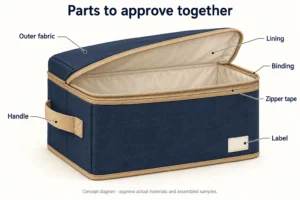
The main cubes may share fabric, mesh, zipper tape, binding and handle details. A shoe or laundry piece may need a different opening, panel structure or opacity. Consistency should make the set feel intentional; it should not force every item into an unsuitable construction.
Before sampling, define:
- main fabric and any coating;
- mesh placement and mesh openness;
- zipper direction, number of sliders and puller style;
- binding and seam construction;
- handle position;
- logo method and location;
- labels and care information;
- colour relationship across all pieces.
If the set combines standard and compression cubes, document the two structures separately. Compression pieces normally require an additional perimeter zipper or expansion panel, which changes pattern making, sewing and sample evaluation.
How do packaging and e-commerce limits affect the set?
The retail package should be designed at the same time as the set, because piece count and folded construction directly affect package size.
Common directions include a simple bag, paper belly band, insert card, drawstring storage pouch or retail carton. The appropriate format depends on the sales channel and brand presentation. Buyers should check how the cubes fold into one another, whether the package shows the colour and material clearly, and whether the packed set holds its shape during transport.
For e-commerce, record the final packed dimensions and weight instead of relying on the largest cube’s dimensions. A larger piece count can create avoidable parcel volume when the products are folded inconsistently. A packing diagram and approved reference sample help repeat the intended configuration.
What customisation choices should remain consistent across the set?
Colour, trim and branding need a controlled system so the set reads as one product.
Possible custom elements include fabric colour, printed pattern, mesh, zipper tape, zipper puller, binding, handle, woven label, heat-transfer logo, screen print, insert card and outer packaging. Not every method suits every material or order plan, so the final route should be confirmed during quotation and sampling.
Some brands use one colour across all sizes. Others use a tonal family or colour coding to help users identify each piece. When colours vary, the RFQ should state whether the difference is functional, decorative or tied to size. The supplier should not have to infer the system from a mood board alone.
Great Shine supports custom size combinations and coordinated travel-organiser development through its custom packing cubes for travel brands page. Available materials, logo methods, minimum quantities and timing should be confirmed for the specific design.
What should buyers check during sample review?
Review the set as a complete packing system and inspect each piece individually.
The sample checklist should include:
- finished dimensions and tolerances for every item;
- whether the pieces nest and pack as planned;
- zipper opening direction and slider movement;
- mesh alignment and panel tension;
- stitching at corners, binding and handles;
- logo size, position and consistency;
- shade consistency across body fabric, mesh and trim;
- correct piece count and size identification;
- folded presentation and retail packaging;
- carton packing method.
Do not approve only the best-looking cube. A set is sold as one unit, so a mismatch in a small pouch, label or zipper can affect the entire retail item.
What information belongs in a packing cube set RFQ?
A useful RFQ describes every piece and the shared requirements in separate fields.
| RFQ section | Information to provide |
|---|---|
| Set concept | Target buyer, travel scenario and retail position |
| Piece list | Item name, intended use and quantity per set |
| Dimensions | Finished size and tolerance for each item |
| Construction | Standard, compression, mesh, opaque or specialist pouch |
| Materials | Body fabric, mesh, zipper, binding and handle direction |
| Branding | Logo method, artwork size and location by piece |
| Colours | Shared colour, tonal set or size-based colour coding |
| Packaging | Folding method, insert, band, pouch, box and barcode needs |
| Commercial input | Estimated quantity and destination market |
| Review | Sample, QC, labelling and document requirements |
Buyers can also review a related wholesale packing cube product when preparing references. Treat any reference as a starting point; the quotation should follow the final approved specification.
FAQ
What is the most common number of pieces in a packing cube set?
Three-, four- and six-piece concepts are all common product directions, but there is no universal best count. The correct number depends on the user, luggage format, product functions, price position and package size.
Should a packing cube set include a shoe bag or laundry bag?
Include one when it adds a clear function for the target traveller. It should have an appropriate size, closure and material rather than serving only to increase the advertised piece count.
Do all packing cubes in a set need to be different sizes?
No. A set may use graded sizes, repeated medium cubes, slim formats or specialist pouches. The combination should reflect how the target user packs.
Can standard and compression packing cubes be mixed in one set?
Yes, but the structures and product story should be clear. Compression cubes require separate specification and sample checks because of the additional zipper or expansion panel.
What should be confirmed before requesting a quotation?
Confirm the piece list, intended use, target sizes, material direction, zipper and mesh preferences, logo, colours, packaging, estimated quantity and destination market.
Request a Custom Packing Cube Set Quote
Send Great Shine the intended piece count, use of each item, target dimensions, fabric direction, logo artwork, colour plan, packaging concept, estimated quantity and destination market through the contact page. The team can review whether the set is practical to sample and quote before the structure is finalised.