Choose fabric storage boxes with lids by checking the space they must fit, the room needed to open the lid and the construction supporting the fabric. A box that fits on a shelf when closed may need to be pulled out before it can open. A clear viewing window, label pocket and handle also need to face the direction from which the box will be used.
Retail buyers need to check the assembled box and its retail pack before finalising size diagrams or shelf displays. Record external dimensions separately from internal space and carton dimensions so that the listing does not confuse shelf fit with packaging size.
Quick answer
Measure the usable shelf opening, choose an external box size with working clearance, and check the lid on the actual sample. Specify the outer fabric and support board separately. If the box contains paperboard, use care instructions suitable for that complete construction and do not assume that a fabric exterior makes it machine-washable or waterproof.
Great Shine’s documented examples include attached-lid boxes with 80 gsm PP non-woven fabric and 2 mm paperboard support. The reference range contains both viewing-window and label-window versions, which serve different purposes.
Start with the shelf and access direction
Measure the clear width, depth and height where the box will sit. Use the space between shelf sides and supports, not the outside dimensions of the furniture. Note hinges, shelf lips or other parts that reduce the opening.
Then decide how the box will be used. A lower shelf may allow the entire box to slide out. A higher shelf may require the user to lift it down before opening it. Neither arrangement should depend on an unverified handle load.
Check these points on a sample:
- Whether the closed box enters without scraping or squeezing.
- Whether the front handle or lid edge projects beyond the stated body size.
- Whether there is enough space to grip the box and remove it.
- Whether the lid can open to a useful angle in the intended position.
If boxes will sit side by side, include the clearance between them. Do not calculate a set by dividing shelf width by box width and assuming a tight mathematical fit will remain convenient in use.
Compare real lidded-box configurations

The following examples come from Great Shine’s May 2026 product handover record. They identify specific constructions and project packing counts, rather than universal “small”, “medium” and “large” size categories.
| Listed external dimensions | Construction and access details | Project packing |
|---|---|---|
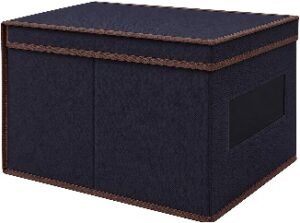
| 40 × 50 × 25 cm | Attached lid, 80 gsm PP non-woven body and lining, 2 mm paperboard, front clear PVC viewing window | CPP bag, hanging hook and printed insert; 12 pieces per carton |
| 30 × 40 × 25 cm | Attached lid, 80 gsm PP non-woven body and lining, 2 mm paperboard; one version has a viewing window, another has a front handle and PVC label window | CPP bag, hanging hook and printed insert; 12 pieces per carton |
| 30 × 40 × 13 cm | Attached lid, 80 gsm PP non-woven body and lining, 2 mm paperboard, front handle and PVC label window | CPP bag, hanging hook and printed insert; 12 pieces per carton |
Treat the sequence of dimensions as a drawing requirement: identify length, width, height and the front face before approving the order. The shorter 13 cm profile changes the available storage depth; it does not by itself establish suitability beneath a bed or inside a particular shelf.
The quoted sizes are external. Board, fabric, seams and corner construction affect the interior. Measure the assembled sample if a particular folded item must fit inside it.
Allow enough space to open an attached lid

An attached lid remains connected to the box and needs a clear movement path. The required space depends on the hinge or fabric fold position, lid dimensions and how far the user needs it to open.
The closed box height does not tell you the total height needed during opening. The 25 cm high reference box therefore cannot be assigned an opening-clearance figure without checking its lid geometry.
Use the sample to record two states:
- Closed, with the intended contents inside and the lid resting as designed.
- Open to the angle needed to place or remove those contents.
Photograph both states with a ruler or tape visible. If the box must slide forward before opening, record how far it needs to move and confirm it remains supported. For a retail display, show this access requirement in the product information rather than relying on a closed-box image alone.
A removable lid has a different trade-off: it can be lifted away but needs somewhere to rest. Compare that option only if it is part of the actual product range being quoted.
Specify fabric and support board separately
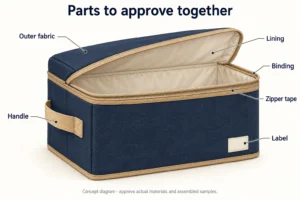
The reference lidded boxes use 80 gsm PP non-woven fabric with 2 mm paperboard support. The fabric provides the surface and sewn covering, while the board contributes to the box’s shape.
Board thickness alone does not establish stacking strength, handle strength or maximum contents weight. Performance also depends on panel size, how the board is enclosed, base construction and the assembled geometry. Test the sample with the intended contents before making those claims.
Confirm which panels contain board and whether any insert is removable. A crease in the support board can affect how the box stands or how its lid closes. Check the base and side panels after unpacking and assembling the sample.
For other fabric options, request an actual swatch and construction specification. “Linen-look” describes appearance, and “Oxford” describes a fabric construction; neither alone confirms fibre composition or water resistance. A change of outer fabric does not automatically change the support-board behaviour.
Choose a viewing window or a label window
A clear viewing window lets the user see part of the contents. A label window holds an identification card. These features can look similar in a small product image, but their retail claims and inspection points differ.
The documented 40 × 50 × 25 cm version has a front clear PVC viewing window. The 30 × 40 × 13 cm version has a front PVC label window and a fabric handle. Specify which function you want and show its position on the front-view drawing.
For a viewing window, check that the stored items are visible from the normal viewing angle. Inspect the window seam and check whether the fabric or an internal panel blocks the opening. For a label window, check the card opening, usable card size and how easily the card can be inserted and removed.
Position a window where it will remain visible on the intended shelf. A label on the side can be hidden when boxes sit together. A handle should not cover the label when the box is at rest.
Decide when an open-top box is more practical
An open-top box can suit items retrieved frequently because the user does not need to move a lid. A lidded box can suit a range where a covered appearance matters, provided access and opening space are practical.
The same documented range includes a 30 × 30 × 30 cm open-top cube with 80 gsm PP non-woven fabric, 2 mm paperboard, a front handle and a PVC label window. Its project packing quantity was 24 pieces per carton, compared with 12 for the lidded examples above.
Those counts should not be interpreted as a direct freight-cost comparison. The products have different dimensions and folding arrangements. Confirm the actual packed dimensions and weight of each option before calculating logistics costs.
A lid also does not prove that a box is airtight, waterproof or load-bearing. If stacking is part of the product brief, agree the loading arrangement and acceptance criteria before displaying a stack as a supported use.
Check style and care instructions on the complete product
Review body colour, binding, lid alignment and the appearance of the clear material together. A trim colour that looks suitable on a swatch can appear more prominent around every edge of a finished box.
For a coordinated retail set, compare the boxes assembled under the same lighting. Check which face will be visible and whether the handle, window and lid details are consistent with the pack photography.
The support board must also be considered in care instructions. Avoid soaking a paperboard-supported box or describing it as machine-washable without evidence for that construction. Agree a surface-cleaning method and check it on the sample, including the window, binding and any printed areas.
Store only dry items in a suitable dry location. A covered fabric box does not correct damp storage conditions.
Inspect the sample and retail pack
Use a short acceptance record so that the approved sample and the production specification describe the same product.
| Check | Method | Record before approval |
|---|---|---|
| Size and shelf fit | Measure assembled exterior and try the intended opening | Measurement points, tolerance and working clearance |
| Lid movement | Open and close with intended contents inside | Required access space and acceptable alignment |
| Board and base | Assemble, inspect panel condition and load with intended contents | Panel construction and any agreed load check |
| Viewing or label window | Inspect the intended function from the normal viewing position | Window type, position and usable area |
| Handle and seams | Inspect attachment, binding and stitching | Intended handling method and workmanship criteria |
| Retail pack | Fold, pack and inspect the display presentation | Pack size, hook, insert and barcode position |
| Master carton | Check count and actual packed dimensions | Pieces per carton, dimensions, weight and protection |
The project packaging used CPP bags, hanging hooks and printed inserts. Its notes require insert size to fit the packed product and carton artwork to follow any confirmed carton-size change. Agree these dimensions after a packing trial, before final artwork approval.
Frequently asked questions
Does a 2 mm board make the box stackable?
Board thickness alone does not establish a stacking rating. Check the complete box, the weight and placement of the contents, and the proposed stack under agreed conditions.
Can I choose a box that exactly matches my shelf opening?
A tight nominal match may leave no room for fabric variation, the lid edge or your hand. Measure the actual sample and allow working clearance suitable for the shelf and access method.
Is a PVC label window the same as a clear viewing window?
No. A label window holds an identification card; a viewing window reveals part of the contents. Specify the function and inspect the selected version.
Can the reference boxes be machine washed?
Their paperboard support makes soaking inappropriate unless a separate care assessment supports it. Follow the agreed instructions for the complete box and confirm the cleaning method on a sample.
Are the carton dimensions the same as the folded product size?
No. A carton contains multiple packed units and protective materials. Record the single folded product, individual retail pack and master carton separately.
Choose the configuration before requesting a quote
Review Great Shine’s fabric storage boxes and bins with your shelf measurements and intended contents. Include the lid type, window function, handle position and retail packaging so the sample can be checked against the actual use.