How to Choose a Manufacturer for Custom Storage Boxes
Choosing the right custom storage boxes manufacturer is not only about finding a supplier that can make a box in your target size. For retail buyers, importers, wholesalers, and private label brands, the better question is whether the manufacturer can translate your commercial brief into a repeatable product: the right structure, material, logo method, packaging format, and QC expectations for your sales channel.
A good sourcing process should help you reduce unclear RFQs, avoid mismatched samples, and compare suppliers on practical manufacturing details instead of price alone. This guide explains what to check before sending a custom storage box inquiry, how to compare OEM and ODM options, and what information to prepare when requesting a quote from a supplier such as Great Shine Home Storage Supplier.
Start With the Buyer Scenario, Not Only the Product Name
Most buyers searching for a custom storage boxes manufacturer are already past the inspiration stage. They may be preparing a seasonal home organization program, expanding a private label storage line, sourcing fabric bins for retail shelves, or comparing suppliers for a wholesale import order.
Before discussing materials or pricing, define the commercial use case. A storage box for a discount retail chain may need compact packaging, clear shelf communication, and cost-sensitive construction. A private label home brand may care more about fabric hand feel, color matching, logo finish, and consistent appearance across a coordinated storage collection. A Japanese or South Korean buyer may place extra attention on compact dimensions, neat sewing, packaging presentation, and product consistency. European and US buyers may need strong retail packaging, clear carton information, and confirmation of any market-specific documentation requirements.
The manufacturer should be able to ask practical questions, not only wait for a drawing. If a supplier asks about target channel, expected use, size tolerance, load expectations, packaging, logo placement, and sample requirements, that is usually a better sign than a fast generic quote.
Decide Whether You Need OEM, ODM, or Private Label Support
The right manufacturer depends on how much product development work you need.
OEM is usually suitable when you already have a design, size, material direction, packaging concept, or reference sample. The supplier helps turn that specification into a manufacturable storage box.
ODM is useful when you need help adapting an existing product route. For example, you may want a foldable fabric storage box with handles, a clear window, lid, divider, reinforced panels, or a coordinated color set, but you have not finalized every detail.
Private label manufacturing focuses on branding and retail presentation. The product may be based on an existing structure, but customized with logo, label, color, packaging, insert card, hangtag, or carton marks.
For buyers still defining their program, Great Shine’s OEM, ODM and private label bag manufacturing page is a useful internal reference because it explains the type of customization details buyers commonly need to prepare before sampling.
Key Product Specifications to Confirm
A clear RFQ starts with specifications that affect material usage, sewing difficulty, packing volume, and retail positioning.
Size and Structure
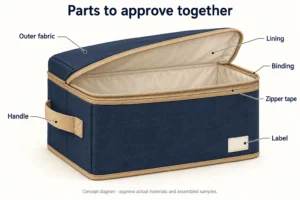
Custom size is one of the first points to define. Give length, width, height, and any tolerance expectations if your shelf, closet, drawer, or packaging system requires a strict fit. For foldable storage boxes, also confirm whether the box needs a lid, insert board, bottom panel, handles, window, divider, label holder, zipper, snap, hook-and-loop closure, or reinforced rim.
A small change in structure can affect cost and production complexity. For example, a simple open-top fabric bin is very different from a structured storage box with lid, transparent window, handles, and internal support panels.
Material Options
Material choice should match the product’s use case and retail positioning. Common directions may include non-woven fabric, polyester fabric, Oxford fabric, cotton-blend fabric, linen-look fabric, canvas-style fabric, PVC window panels, cardboard or PP board inserts, mesh, lining fabric, or mixed-material construction.
Do not ask only, “What is the cheapest material?” Instead, ask which material route fits your target retail price point, visual standard, foldability, weight, and expected use. If your target market has material or labeling requirements, ask the supplier what documentation can be provided and what must be confirmed by your compliance team before order approval.
Color, Logo, and Branding
Private label buyers should confirm logo method early. Possible branding routes may include woven label, printed logo, heat transfer, patch, hangtag, insert card, belly band, printed polybag, color box, or carton mark. The right choice depends on fabric surface, order positioning, packaging format, and brand guidelines.
For color, provide Pantone references or approved samples where possible. Fabric color can vary by material, dye lot, and surface texture, so buyers should confirm how color approval will be handled during sampling and pre-production.
Sampling Questions That Prevent Costly Misunderstandings
Sampling is where many sourcing problems appear. A buyer may approve a photo too quickly, only to find later that the structure, fabric weight, handle strength, foldability, or packaging method does not match expectations.
Before sampling, ask:
- Will the sample use the proposed bulk material or a substitute material?
- Can logo placement and size be shown before sample production?
- Which dimensions should be checked after the product is assembled and filled?
- Will packaging be sampled together with the product?
- What points should be approved before bulk production begins?
- If a reference sample is provided, which details should be matched and which can be adjusted?
A practical supplier should help separate appearance approval from production approval. A prototype may show size and structure, while a pre-production sample may be needed to confirm final material, logo, accessories, packaging, and workmanship standard.
Packaging and Carton Planning Matter for Storage Boxes
Storage products are often bulky, even when lightweight. Packaging decisions can affect shipping efficiency, retail display, shelf appeal, and damage risk. A foldable storage box may be packed flat to reduce carton volume, while a rigid or semi-rigid box may need more protection.
Discuss packaging before you compare quotes. Ask whether the item will be packed flat, folded, nested, compressed, or individually packed. Confirm whether you need a polybag, hangtag, insert card, color box, belly band, master carton, or retailer-specific carton mark.
For US, European, Japanese, and South Korean retail programs, packaging may also need language, barcode, recycling, care, warning, or importer information. Do not assume the manufacturer can make compliance decisions for every market. Treat packaging compliance as a confirmation point between your team, the supplier, and any required third-party advisor.
QC Points to Include in the RFQ
Quality control for custom storage boxes should be specific. “Good quality” is not enough. A better RFQ lists the inspection points that matter to your product.
Useful QC checkpoints include:
- Finished size and shape after assembly
- Fabric color, texture, and visible defects
- Stitching quality and thread trimming
- Handle position and reinforcement
- Lid, zipper, window, divider, or closure alignment
- Board insert firmness and fit
- Logo placement, size, and color
- Label, hangtag, and packaging accuracy
- Carton quantity and carton mark accuracy
- Product appearance after folding and packing
If performance testing, chemical testing, or market-specific compliance is required, state it as a buyer requirement and ask what documents, samples, or production controls can be supported. Do not rely on assumptions or verbal claims.
Manufacturer Comparison Table
Use this table to compare potential suppliers before selecting a custom storage boxes manufacturer.
| Selection Area | What to Ask | Why It Matters for Buyers |
|---|---|---|
| Product scope | Can the supplier make fabric bins, foldable boxes, lidded boxes, drawer bins, or related storage products? | A broader storage range can support coordinated retail programs. |
| Custom size | How are dimensions, tolerances, and structure confirmed before sampling? | Prevents shelf-fit, drawer-fit, and packaging mismatch. |
| Material options | Which fabrics, panels, linings, windows, and trims are suitable for the target use? | Material choice affects appearance, durability, foldability, and cost. |
| OEM/ODM support | Can the supplier follow your spec or help adapt an existing structure? | Clarifies whether you need execution, development help, or both. |
| Branding | Which logo, label, and packaging options fit the material and order type? | Supports private label retail presentation. |
| Sampling process | What will the sample confirm, and what still needs approval before bulk production? | Reduces approval gaps between prototype and production. |
| Packaging | How will the product be packed for retail and export cartons? | Affects freight efficiency, shelf display, and buyer receiving. |
| QC | Which inspection points will be checked during and before shipment? | Makes quality expectations measurable. |
| Communication | Does the supplier ask detailed RFQ questions? | Strong questions often indicate stronger production planning. |
Buyer Checklist Before Sending an RFQ
Prepare the following details before contacting a manufacturer:
- Target product type: fabric storage bin, foldable storage box, lidded box, drawer bin, closet organizer, or related item
- Target market: United States, Europe, Japan, South Korea, or another market
- Sales channel: retail shelf, e-commerce, wholesale, promotional program, or private label line
- Size requirements and tolerance concerns
- Material preference or reference sample
- Color requirements and brand color references
- Logo method, label type, and packaging needs
- Expected order quantity or estimated buying range, without forcing the supplier to guess
- Sample requirements and approval deadline
- QC requirements and any documentation your market requires
- Photos, drawings, product links, or reference samples if available
This checklist helps the supplier quote the same product you intend to buy. It also makes it easier to compare manufacturers because each supplier is responding to a consistent brief.
Common Red Flags When Comparing Suppliers
Be careful if a supplier quotes without asking about structure, material, packaging, or logo details. A low price may be based on a different fabric, thinner insert board, simpler sewing, smaller size, or no retail packaging.
Other red flags include unclear sample expectations, vague answers about packaging, no discussion of QC points, unwillingness to clarify material differences, or pressure to approve production before key details are confirmed.
A professional custom storage boxes supplier should be able to explain tradeoffs. For example, a heavier board may improve shape but increase packing weight. A premium fabric may improve shelf appeal but change cost. A clear PVC window may help shoppers see contents but requires careful stitching and packaging to avoid visible defects. A more compact fold may reduce carton volume but could create creases that need buyer approval.
When to Request a Quote From Great Shine
Great Shine Home Storage Supplier is positioned for B2B buyers sourcing custom storage bags, storage boxes, fabric storage bins, closet organizers, packing cubes, garment bags, makeup bags, and toiletry bags. If your project involves OEM, ODM, wholesale, or private label storage products, you can use the company’s custom bag manufacturing and OEM/ODM private label manufacturing pages to prepare your inquiry.
Request a quote when you have enough detail for a meaningful discussion: product type, size, material direction, logo requirement, packaging plan, target market, and estimated quantity. If you are still developing a wider travel or personal care storage line, the page on custom toiletry bags for hotels and travel kits may also help you compare related bag and organizer customization options.
To start a custom storage box RFQ, contact Great Shine through the quote request page and include your product brief, reference images, expected customization, packaging needs, and any buyer-specific QC or documentation questions.
FAQ
What should I ask a custom storage boxes manufacturer first?
Start with product type, size, material, structure, logo, packaging, target market, and estimated order quantity. These details help the supplier understand whether you need OEM execution, ODM development, or private label customization.
How do I compare two wholesale storage box suppliers?
Compare the same specification across both suppliers. Check material, insert board, stitching, logo method, packaging, carton plan, sample process, QC points, and communication quality. A cheaper quote may not represent the same product.
Can I request custom size and packaging for storage boxes?
Custom size and packaging are common RFQ topics for private label and wholesale storage products. Buyers should confirm dimensions, folding method, retail packaging, carton marks, and any market-specific packaging requirements before sample approval.
What information is needed for a storage box sample?
Provide size, material direction, color, logo artwork, packaging expectations, reference photos, and the purpose of the sample. Confirm whether the sample is for structure review, appearance approval, or pre-production confirmation.
Should I choose OEM or ODM for custom storage boxes?
Choose OEM if you already have a detailed specification or reference sample. Choose ODM if you need the supplier to adapt an existing structure or help develop a product route for your retail or private label program.