Quick answer: Choose Christmas tree storage bags around the dismantled tree’s dimensions and carrying needs. Choose wreath storage bags around the wreath’s full diameter, decorated depth, and need for shape protection. For a retail range, validate each product separately before pairing them: a larger tree does not automatically require a larger wreath bag, and matching fabric does not mean matching protection.
A customer puts away the Christmas tree, closes the storage bag, and lifts it toward the cupboard. The bag fits, but the weight pulls awkwardly against its handles. Beside it, a wreath slips easily into a matching round bag—until another box presses against the bow.
These are two different storage problems. Selling both products in the same seasonal range makes sense only when each solves its own problem well.
For home and holiday retailers, the buying decision goes beyond choosing a festive color and a set price. The range needs understandable sizes, suitable structures, and packaging that tells shoppers exactly what they can store. This guide covers reusable storage for artificial Christmas trees and artificial wreaths.
Start with what each storage bag needs to protect
A tree bag must accommodate a bulky, irregular load and remain manageable when filled. A wreath bag must leave enough room around foliage and raised decorations while supporting the intended storage position.
| Buying consideration | Christmas tree storage bag | Christmas wreath storage bag |
|---|---|---|
| What determines fit? | Packed section length, combined width and height, plus accessories stored inside | Widest outside diameter and front-to-back depth, including retained decorations |
| What needs attention during handling? | Load distribution, handles, base, opening, and any rolling structure | Support beneath or behind the wreath and clearance around ornaments and bows |
| What can a misleading size label hide? | Trees of the same assembled height may pack differently | Wreaths of the same diameter may have very different depths |
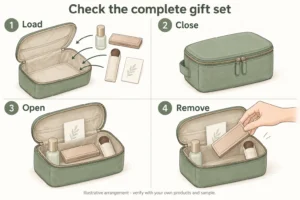
| What should the sample demonstrate? | Loading, closure, lifting or rolling with the intended contents | Loading, closure, carrying, and removal without unwanted compression |
| What should packaging explain? | Disassembled or upright use, verified compatibility, and stand storage | Usable diameter and depth, storage orientation, and any hanging or stacking limits |
Use these differences to write separate product specifications. Shared colors, labels, and trim can make the range look coordinated after the functional requirements are settled.
How do you choose the right size for trees and wreaths?
Specify usable storage space and prove it with the intended contents. Nominal tree height and wreath diameter are useful shopping cues, but neither is a complete fit specification.
Measure the tree as the customer will pack it
Disassemble a representative tree according to its instructions and arrange the sections in the intended packing layout. Record the longest section, the combined width and height, and the weight of everything going into the bag. Decide whether the stand shares the main compartment, has a separate pocket, or stays outside.
Ask the supplier to distinguish external bag measurements from usable internal dimensions. An opening can be too restrictive even when the main compartment looks large enough on paper.
During sample review, load the tree through that opening and close the zipper without using it to force the branches into place. Photograph the packing arrangement so the fit claim can be tied to a repeatable method.
Storage location also affects format. A floor-standing upright bag and a horizontal bag occupy different spaces; Coverstore’s tree-storage guide likewise recommends considering the available storage area when choosing between them.
Measure the wreath with its retained decorations
Measure across the widest point of the finished wreath, then measure from its back to the furthest decoration at the front. Include bows, berries, ornaments, or other features that will remain attached. This follows the measurement approach in Coverstore’s wreath sizing guide.
For an irregular design, record both width and height instead of assuming a perfect circle. Identify any particularly delicate or protruding features in the sample brief.
The final check is the closed bag. A wreath that fits while the lid is open may still be compressed when the zipper closes. Ask to see the stored wreath from the side, then remove it and inspect the bow, foliage, and attached decorations.
Do not turn one successful sample into a universal compatibility claim. State which configurations were checked and use actual dimensions to help shoppers assess other designs.
Which storage structures belong in the range?
Choose the structure around how the customer will move and store the decoration. The following are selection considerations, not performance guarantees for every product in a category.
| Structure | When to consider it | What to verify before buying |
|---|---|---|
| Flexible horizontal tree bag | A dismantled tree that will be carried to a suitable storage space | Filled handling, handle attachments, opening access, and protection from exposed pole ends |
| Tree bag with wheels and a supported base | A customer who can roll the bag along an accessible route | Loaded stability, wheel clearance, base support, and how the bag is lifted where rolling stops |
| Upright tree storage system | A compatible tree and enough vertical storage space | Whether disassembly is required, stand compatibility, stability, and the full stored footprint |
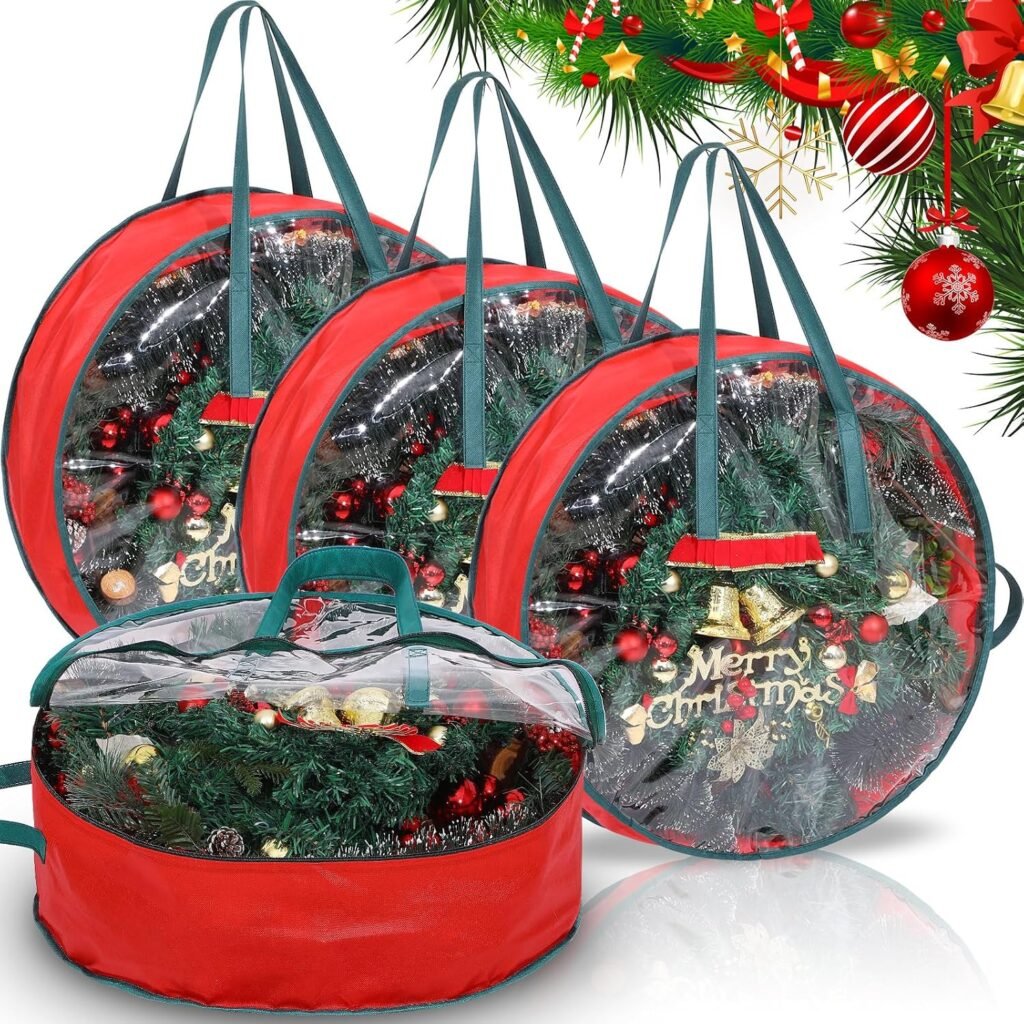
| Soft wreath bag | A wreath kept in a dedicated space without other objects pressing against it | Closure clearance, support during carrying, and clear instructions against unsupported stacking |
| Wreath case with support panels | A decorated wreath needing more shape support | Panel position and stiffness, internal clearance, and any claimed stacking performance |
| Wreath bag designed for hanging | A customer with suitable vertical storage space | The internal support point, hanging attachment, loaded behavior, and compatibility with the wreath frame |
For tree bags, follow the load from the contents through the base and handle attachments. A close-up of neat stitching is useful, but it cannot demonstrate how the filled product behaves.
For wreath bags, distinguish padding from structural support. Cushioning around a decoration does not establish that the case can resist another box pressing on it. If stacking is part of the selling proposition, define the load, placement, and duration to be evaluated before making that claim.
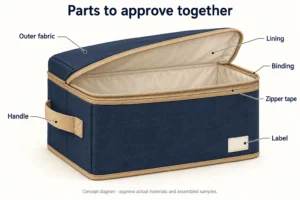
Material names alone cannot settle either decision. Request the fabric composition, construction, lining or backing, support components, and finished sample. Compare those details against the intended use and agreed inspection criteria.
Should retailers sell a matching set or separate bags?
Offer a fixed set when its two fit ranges suit a clearly defined customer. Offer separate products when tree and wreath sizes vary independently across the assortment.
A set can make the purchase convenient, but it also links inventory that shoppers may need in different quantities. A customer may own one tree and several wreaths, or a slim tree and a deep, heavily decorated wreath. Neither household fits a simple “small with small, large with large” rule.
Use the following as an illustrative assortment framework, then validate it against your own decoration range and sales information.
| Customer situation | Tree-storage direction | Wreath-storage direction | Selling approach to evaluate |
|---|---|---|---|
| One compact tree and a relatively flat wreath | Flexible bag with verified packed fit | Soft bag with adequate diameter and depth | A clearly labeled starter set |
| A bulky tree and a wreath with raised decorations | Supported or rolling format, subject to handling review | A case selected for depth and shape support | Separate items or a configurable bundle |
| One tree and several wreaths | Tree bag chosen independently | Individually sized bags or a divided system checked for fit | Separate items with optional add-ons |
Before approving a fixed set, check three things:
- Compatibility: Which actual tree and wreath combinations does it serve?
- Inventory: Can the components be reordered separately, and what are the confirmed order requirements for each?
- Packaging: Can shoppers see both products’ capacity information without opening the pack?
Do not compress support panels or distort a wreath case simply to fit a smaller retail package. Review the unpacked product after the proposed folding and packing method, then measure the finished sales unit and shipping carton.
What should a useful sample approval include?
Review a filled tree bag and a filled wreath bag separately, then review the pair as a retail offer. Empty samples are insufficient for fit and handling decisions.
The checks below are a buyer’s evaluation plan. They are not reported Great Shine test results or a substitute for an agreed inspection standard.
| Check | What the buyer should examine | Record to retain |
|---|---|---|
| Tree loading and closure | Entry through the opening, position of sections and stand, zipper clearance | Contents list, dimensions, packing photos, and fit limitations |
| Tree handling | Behavior at the intended filled weight, handle locations, base and wheel function where relevant | Evaluated load, route, method, observations, and agreed acceptance criteria |
| Wreath fit and removal | Clearance at the rim and front, closure pressure, condition after removal | Wreath dimensions, decoration details, and before/after photos |
| Wreath support | Behavior in the advertised flat, upright, or hanging position | Support arrangement, evaluation conditions, and limitations |
| Retail packaging | Correct size information, component count, instructions, and visible product identity | Approved artwork and a packed sample |
| Carton packing | Product condition after unpacking and agreement with the planned pack quantity | Packing method, measured carton dimensions, and gross weight |
Define inspection methods and acceptance criteria before the order. If a sample fails, identify whether the cause is fit, opening geometry, construction, packing, or unclear instructions, then review the revised sample against the same requirement.
Make the care instructions part of the product
Give customers a short packing sequence that matches the decoration and bag. Remove loose accessories, follow the decoration manufacturer’s cleaning and disassembly instructions, and store the contents dry. Keep delicate wreath details clear of the closure and store the bag in its intended orientation.
Balsam Hill’s artificial greenery guidance recommends a cool, dry location away from direct heat and sunlight, with enough room to avoid cramming foliage together. These are useful care principles; customers should still follow the instructions for their particular decoration.
Avoid presenting a storage bag as a solution for every garage, attic, or damp room. Similarly, do not label a finished bag “waterproof,” “crush-proof,” or suitable for hanging solely because of its fabric, padding, or carry handle. Match the wording to documented product performance and intended use.
Frequently asked questions
Can customers keep lights attached during storage?
For a pre-lit tree or wreath, follow its manufacturer’s storage instructions and protect connectors from strain or pinching. Remove separately added light strings unless the decoration’s instructions support storing them attached. Do not imply that a storage bag makes every decorated or pre-lit configuration suitable for packing.
Can one wreath bag hold two wreaths?
Only if the usable depth and support arrangement accommodate both without unwanted contact or compression. Diameter alone cannot establish capacity. Review both wreaths together, including their decorations, and confirm whether a divider or separate support is needed.
Can an artificial wreath bag be used for fresh wreaths?
Do not market it as a way to preserve fresh foliage between Christmas seasons. This guide concerns artificial decorations. Fresh or dried botanical wreaths have different care requirements that should come from their maker or seller.
Build the range around the decorations you actually sell
Start with your tree and wreath assortment, match each item to a verified storage configuration, and then decide which combinations deserve a set. The product names, photos, and packaging should make that choice understandable without a salesperson having to explain it.
For a Great Shine sourcing discussion, use the custom Christmas and holiday storage range as a starting point. Send reference photos, packed tree measurements and weight, wreath diameter and depth, preferred storage positions, quantities by item, packaging requirements, and your target delivery window.
Ask for a proposal that identifies the tree bag and wreath bag separately, explains the proposed structures, and sets out the fit and handling checks needed before approval. That gives your retail team a concrete pair of products to assess—and gives shoppers a clearer route to the storage they need.