For an Amazon seller, a Christmas tree storage bag looks like a straightforward seasonal SKU. It is large, easy to understand and simple to demonstrate in listing images. The problems usually appear later: a bag described for a 7.5-foot tree does not fit a buyer’s full tree, a handle tears when the loaded bag is lifted, or an oversized retail package quietly reduces the margin.
The safest sourcing approach is to define the product around a real use case, not just a nominal tree height. Confirm the packed dimensions and weight of the target tree, build enough allowance into the bag, reinforce the parts that carry the load, and test the product while filled. Packaging should be evaluated at the same time as the bag because unit economics depend on both.
Why This Category Is Less Simple Than It Looks
Christmas tree bags are highly seasonal. A weak product can sell through during the holiday rush, but customers may not use it until they take down their trees. By then, the seller has already committed inventory and has little time to correct the design.
That timing creates four common risks for Amazon operators:
- Product problems become visible in a short post-holiday window.
- Customers interpret tree-height labels as a fit guarantee.
- Large, soft products can create inefficient packed dimensions.
- A few repeated failures can dominate reviews because buyers use the item only once or twice a year.
This is why a sample that merely looks good on a table is not enough. It needs to be packed, closed, lifted, dragged a short distance and stored as a customer would use it.
Start With the Tree, Not the Bag
One of the easiest sourcing mistakes is requesting a “7.5 ft Christmas tree bag” without defining the artificial tree it must hold. Tree height alone does not tell the supplier the diameter, number of sections, branch density, stand size or packed shape.
A slim 7.5-foot tree and a full-profile 7.5-foot tree may require very different storage volumes. A pre-lit tree may also have heavier sections and cords that need their own protected space.
Before requesting a quote, prepare at least one target-tree profile:
| Specification | What to Send the Supplier | Why It Matters |
|---|---|---|
| Tree height | Assembled height and marketed size | Supports the customer-facing size claim |
| Packed sections | Number of sections and each section’s dimensions | Determines the useful internal volume |
| Maximum section diameter | Widest point after branches are folded | Helps prevent an undersized opening |
| Packed weight | Tree, stand and any accessories stored together | Guides handle and seam construction |
| Storage method | Horizontal, upright or rolling | Changes the bag shape and handling features |
| Included accessories | Stand, cords, gloves or instruction sheet | Determines whether an extra pocket is useful |
If you plan to sell several sizes, treat each as a separate fit problem. Do not assume that increasing only the length will create a useful larger model. Width, height, opening length and handle position may all need to change.
Turn Amazon Review Risks Into Product Requirements
Marketplace reviews often describe outcomes rather than technical causes: “too small,” “zipper broke,” “hard to carry” or “not as structured as the pictures.” A good product brief translates those complaints into specifications that can be sampled and inspected.
1. “It Does Not Fit My Tree”
The fix is not automatically a much larger bag. Excess volume can make the loaded product awkward to carry and can create a loose, shapeless appearance. A better response is to define the target tree profile, opening size and usable internal dimensions, then test a real packed tree or a repeatable load fixture.
Your listing should also explain what the size label means. If the bag was developed around a particular tree profile, state the internal dimensions and show how the tree is broken down before storage. Clear expectations usually do more for return prevention than an ambitious size claim.
2. “The Handle Tore When I Lifted It”
Handle performance depends on more than webbing width. Buyers should review how far the webbing extends across the bag, how the load transfers into the body fabric and whether stress points receive additional stitching or reinforcement.
For sampling, fill the bag to the agreed test weight and lift it repeatedly by every intended handle. Then inspect the webbing, stitch holes, surrounding fabric and seams. The test weight and number of cycles should be agreed with the supplier and recorded; they should not be guessed from a competitor listing.
3. “The Zipper Split or Was Difficult to Close”
Large tree sections push outward against the closure. If the opening is too short or the bag is overfilled, the customer may pull the zipper under high tension. That can expose weaknesses in the zipper, slider, end stops or the seam beside the zipper.
A wide opening helps the customer load sections without forcing them through a narrow gap. During sample review, close the bag with the intended contents inside, operate both sliders around the corners and check whether the fabric catches in the zipper path.
4. “The Bag Looked Rigid in the Photos”
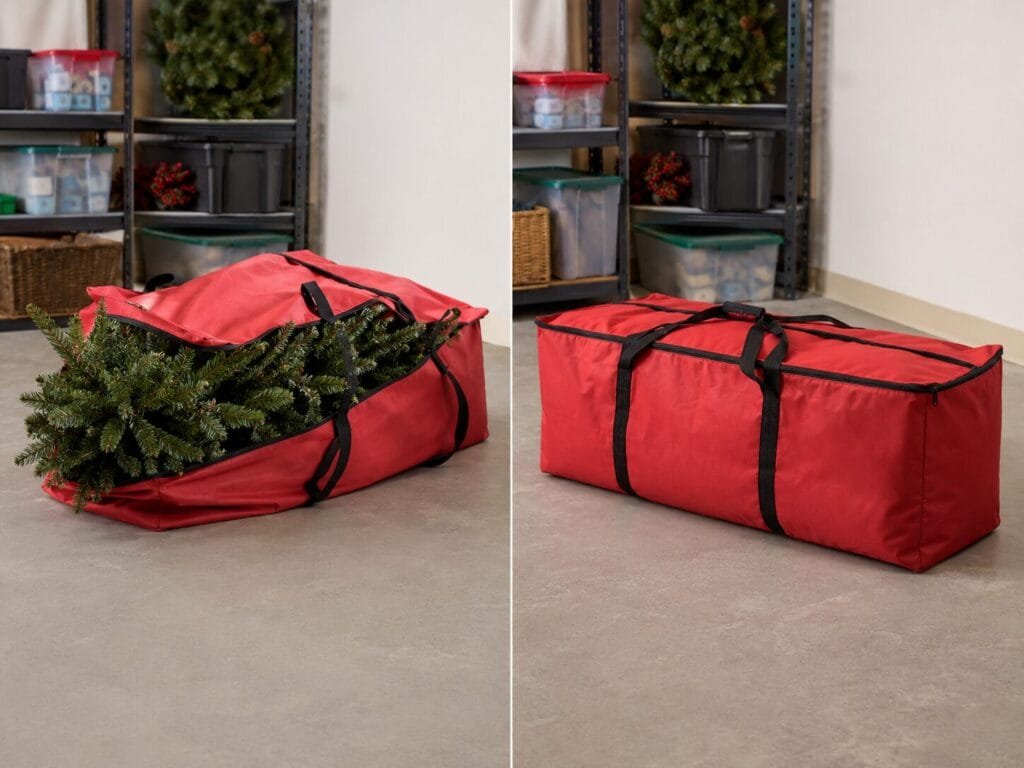
Many economical tree bags are flexible storage bags, not rigid containers. Listing images that make a soft bag appear freestanding can create avoidable disappointment.
Decide during product development whether your offer is a flexible bag, a structured bag with supporting panels, an upright cover or a rolling design. Then make the photography show the real construction. Product development and listing accuracy need to agree.
Choose the Product Format Around the Customer’s Storage Journey
Different formats solve different problems. Adding every feature to one SKU can increase cost and complexity without producing a clear customer benefit.
| Product Format | Best-Fit Customer | Development Priorities | Main Trade-Off |
|---|---|---|---|
| Flexible horizontal bag | Customer who disassembles and shelves the tree | Full opening, reinforced handles, clear sizing | Limited shape when partly filled |
| Structured horizontal bag | Customer who wants neater stacking | Support panels, balanced handles, opening access | Higher packed volume and complexity |
| Rolling tree bag | Customer moving a heavy tree across a floor | Wheel position, base reinforcement, pull handle | Wheels add cost and must work under load |
| Upright tree cover | Customer storing a tree mostly assembled | Vertical fit, closure access, base handling | Needs sufficient storage height and floor space |
For a first Amazon launch, a focused product story is usually easier to communicate than a long feature list. For example, one model might be designed around easier loading, while another is built for moving heavier tree sections. The distinction should be visible in the product itself, not created only in listing copy.
Material Names Alone Do Not Define Quality
Buyers commonly compare Oxford fabric, polyester, non-woven fabric, PVC, canvas or tarp-like materials. Those names are useful starting points, but they do not fully describe the finished bag.
Ask the supplier to confirm the actual material specification, fabric weight or construction, coating if any, color, hand feel and reinforcement method. Review whether the material supports your intended price point and customer promise. A heavier fabric may feel more substantial, but it can also affect cost, foldability and packaged dimensions.
Be careful with claims such as waterproof, tear-proof, pest-proof or weatherproof. These terms should be supported by an agreed test method and evidence. If the product has only been evaluated for ordinary indoor seasonal storage, use precise language that matches that use.
Packaging Must Be Part of the Profit Calculation
A Christmas tree bag may fold down, but the final package still depends on fabric thickness, reinforcement, wheels, inserts, retail presentation and the folding method. Two similar-looking products can have different inbound and fulfillment economics.
Before approving bulk production, request the finished package dimensions and gross weight from a production-representative packed sample. Evaluate:
- Whether the bag can be folded consistently on the packing line.
- Whether handles, wheels or support panels create a bulge.
- Whether the insert card or retail box is larger than necessary.
- Whether the package protects the product without creating empty volume.
- Whether the barcode and required labels remain flat and scannable.
- Whether a master carton uses space efficiently and stays within your logistics plan.
Do not calculate margin from an unconfirmed packaging estimate. Use the final packed sample and your current marketplace fee tools before placing the order.
Build a Sample Test That Resembles Real Customer Use
A useful approval sample should answer specific questions. It should not pass simply because the color and logo look correct.
Fit Test
Load the target tree sections, stand and agreed accessories. Confirm that the opening provides practical access and that the zipper closes without excessive force. Photograph the packing sequence so it can later inform listing content and customer instructions.
Carry Test
Lift the filled bag using each handle. Carry it through a doorway, around a corner and up a small number of steps if that reflects the intended use. Check whether the load stays balanced and whether the user’s hands or legs hit the bag.
Closure and Seam Review
Operate the zipper repeatedly with the bag empty and filled. Inspect the zipper tape, slider path, end points, seam allowance and high-stress stitching. Look for puckering, skipped stitches and fabric caught near the closure.
Packaging Trial
Fold and repack the sample using the proposed insert, polybag, carton or other retail packaging. Record the actual packed dimensions and weight. After transit simulation appropriate to your program, check whether the product arrives clean, undamaged and ready for sale.
Listing Accuracy Review
Compare the final sample with every planned claim and image. If the bag is flexible, show it as flexible. If a pocket does not close, do not imply that it secures small cords. If fit depends on disassembling the tree, show that process clearly.
A Practical RFQ Checklist for Amazon Sellers
Sending a complete request saves more time than collecting several vague quotations that cannot be compared.
Include the following in your RFQ:
- Target marketplace and target customer.
- Product format: flexible, structured, rolling or upright.
- Target tree height plus packed-section dimensions and weight.
- Required finished bag dimensions and opening style.
- Preferred material specification, color and hand feel.
- Zipper configuration and number of sliders.
- Handle positions, webbing construction and reinforcement expectations.
- Pocket, label holder or accessory-storage requirements.
- Logo artwork, print size, colors and placement.
- Retail packaging format and required package-size target.
- Barcode, warning, country-of-origin and marketplace label requirements.
- Quantity by size and color.
- Sample approval tests and inspection points.
- Required delivery window and destination.
- Any claims that require documentation or testing.
When comparing quotations, check whether each supplier has priced the same material, size, reinforcement and packaging. The lowest number is not meaningful if the specifications are different.
Plan Backward From the Post-Holiday Buying Window
Seasonal products leave less room for late corrections. Work backward from the date inventory must be available, then allow time for specification development, samples, revisions, packaging approval, production, inspection and transportation. Confirm the actual schedule with the supplier and logistics partners for each order.
It is also worth reserving time to produce listing assets from the approved sample. Fit diagrams, loading instructions and honest construction close-ups can answer questions before purchase. For a seasonal SKU, preventing confusion is often more valuable than adding another broad lifestyle image.
Final Takeaway
A strong Christmas tree storage bag for Amazon is not defined by the biggest size claim or the longest feature list. It is defined by a clear fit standard, load-aware construction, practical access, truthful merchandising and packaging that protects the margin.
Start with the tree profile and the customer journey. Convert likely complaints into sample checks. Approve the final packed product, not an early estimate. That process gives your team a better chance of launching a seasonal SKU that remains understandable and reliable after the holiday rush.
Great Shine develops custom Christmas and holiday storage products for private-label and retail programs. Buyers can also review our Christmas tree storage bag range as a starting point for material, size, handle, zipper, logo and packaging discussions. Share your target tree profile, sales channel and packaging requirements to begin a sample brief.
FAQ
What size Christmas tree storage bag should an Amazon seller source?
Choose the size from the packed dimensions of the target artificial tree, not from tree height alone. Tree diameter, section count, branch density, stand dimensions and accessories all affect the required volume and opening.
Should a Christmas tree bag use two zipper sliders?
Dual sliders can make a large opening easier to operate, but slider count alone does not guarantee performance. The zipper specification, sewing, opening geometry and the amount of tension created by the contents should all be reviewed on a filled sample.
Is a heavier fabric always better?
No. A heavier material may improve perceived substance, but it can also affect cost, foldability and package size. Select the material together with the required load, storage environment, retail price and packaging target.
What should be tested before placing a bulk order?
At minimum, confirm real-tree fit, loaded carrying, zipper operation, seam and handle reinforcement, packaging dimensions and alignment between the sample and listing claims. Agree on measurable acceptance criteria before production.
What information helps a supplier quote accurately?
Provide target-tree dimensions and weight, finished bag dimensions, material, opening, handles, reinforcement, pockets, logo, packaging, quantities, tests, destination and required delivery window.