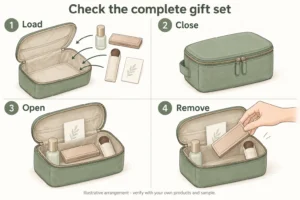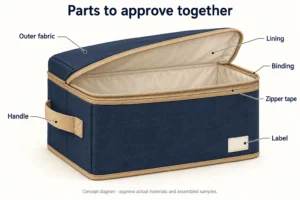
A procurement guide for Amazon sellers, DTC brands, TV shopping buyers and retail chain vendors sourcing private-label Christmas tree storage bags from China.
The Problem Nobody Puts on the Product Page
Every Christmas tree storage bag listing says the same thing: “Fits 9ft trees. Heavy-duty 900D Oxford. Rolling wheels for easy transport.”
None of those three claims means what you think it means.
A 9ft label does not establish fit. A 900D label does not establish durability. And rolling wheels do not establish that the customer can actually move the filled bag through their home.
If you are sourcing private-label Christmas tree storage bags for Amazon FBA, a DTC brand, a TV shopping campaign or a retail chain, the problems that cost you money — returns, listing disputes, FBA fee surprises, seasonal delays — almost always start with a specification that was too vague to hold the supplier accountable.
This guide walks through seven procurement problems and the specification decisions that prevent them. The advice comes from what we see in real buyer briefs at Great Shine, not from a product catalog.
1. “Fits 9ft Trees” Is a Marketing Claim, Not a Fit Specification
Why it fails
Two trees labeled “9ft” can have completely different packed profiles:
- A 9ft hinged tree with three sections may have a longest dismantled section of 48 inches.
- A 9ft branch-dense tree with four sections may have a longest section of 52 inches and a much wider gathered profile.
- A 9ft tree with a wide decorative stand may need the stand to travel separately or inside the main compartment.
If your bag’s usable opening is 46 inches, the first tree fits. The second does not. The customer returns it and leaves a one-star review saying “bag is too small.”
What to specify instead
Send your supplier four measurements before requesting a quotation:
- Longest dismantled section — measure end to end, including the exposed pole and any rigid branch sections that cannot fold inward.
- Gathered width and depth — photograph the sections in their intended packing arrangement. Do not force branches into an unrealistically tight bundle to get a smaller number.
- Section count and combined weight — identify the heaviest section and any sharp pole ends that need isolation or a protective sleeve.
- Stand and accessory dimensions — confirm whether the stand, connectors and accessories travel inside the main compartment or in separate storage.
The key distinction
The longest section must pass through the usable opening, not merely fit within the bag’s outside dimensions. A bag listed as “60 inches long” may have a usable opening of 53 inches because of zipper end reinforcement and seam allowance. Check the filled sample, not the spec sheet.
2. Choose the Format Before the Size
Many buyers start with “I need a 9ft bag” and then ask whether it should roll. The order should be reversed.
Rolling bags
Best when the customer moves a filled bag along a suitable floor-level route. The specification decisions that matter:
- Base stiffness — a soft base allows the loaded bag to sag, making the wheels useless.
- Wheel mounting — fixed wheels track straight but are harder to turn; swivel wheels turn easily but can catch on thresholds.
- Pull angle — a poorly positioned handle makes the bag tip backward when full.
- Internal restraint — without straps holding the sections in place, the load shifts during rolling and destabilizes the bag.
Stairs, thresholds and uneven surfaces may still require lifting. Do not let a supplier claim “no lifting needed” without testing on the actual route.
Carry-style bags
Best when empty-bag storage and a simpler component set matter more than rolling. The specification decisions that matter:
- Usable opening — the longest section must pass through.
- Grip positions — set the webbing layout around the loaded shape, not around an empty bag on a table.
- Loaded weight and carrying method — a larger bag is not automatically better. Extra capacity can make the pack harder to handle if the customer cannot lift it.
- One-person or two-person carry — this changes handle placement and webbing specification.
Upright covers
Best when the customer stores the tree vertically on a compatible stand and wants to reduce dismantling. The specification decisions that matter:
- Covered height including the stand — not just the tree height.
- Widest gathered branch profile — the cover must clear the widest point.
- Base footprint and stand clearance — the cover’s bottom opening must fit around the stand.
- Storage-room clearance — the customer must have sufficient vertical space.
A cover does not add wheels. A cover does not make the tree suitable for moving. If the customer expects to move a covered tree, that is a different product.
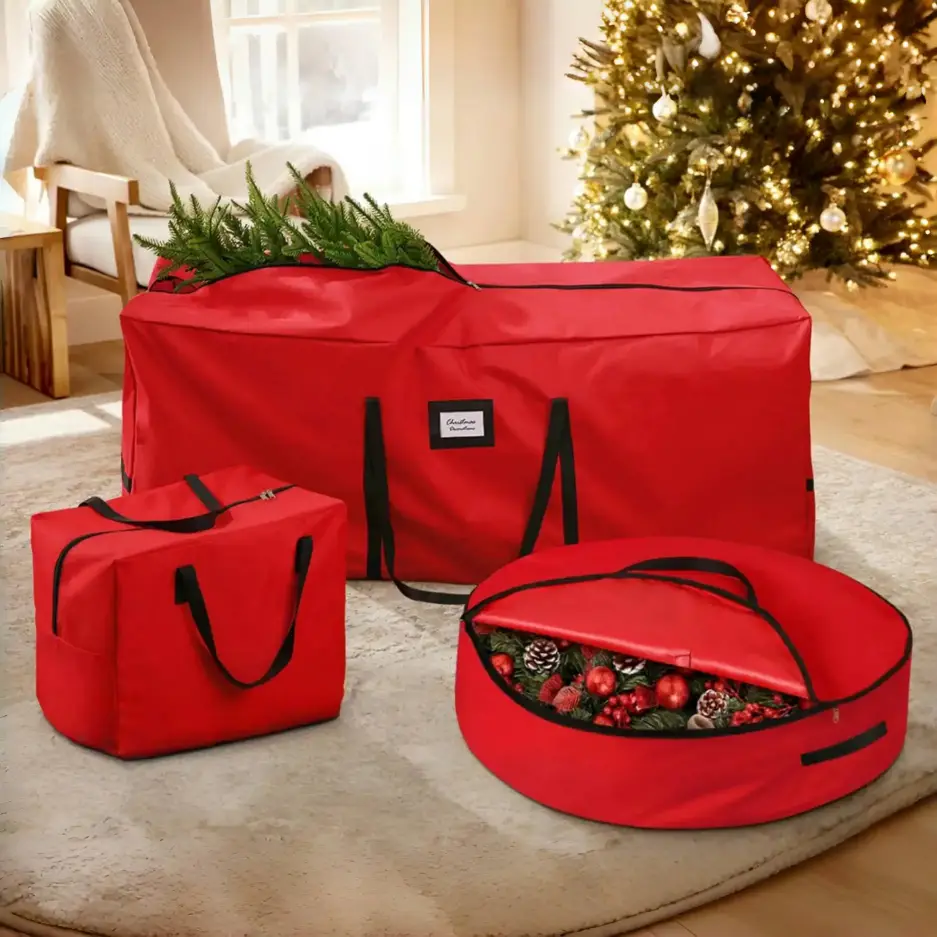
Coordinated sets
Best when a brand sells a matched seasonal range — tree bag, wreath box, ornament organizer. The risk:
- One poorly matched component compromises the usefulness of the entire set.
- Fragile ornaments need suitable protection — an extra pocket alone is not protective packaging.
- Each item’s capacity, set contents and packing sequence should be specified individually.
3. “900D Heavy Duty” Means Nothing Without the Full Construction
The fabric is one component
A 900D Oxford fabric specification is a starting point. It does not, by itself, establish:
- Whether the bag can carry the weight of a loaded 9ft tree.
- Whether the seams hold under that load.
- Whether the webbing attachment survives repeated lifting.
- Whether the base supports the wheel assembly.
- Whether the zipper operates after the bag is filled.
What “heavy duty” should mean
Define the intended load and use conditions, then evaluate the complete construction against agreed criteria:
| Component | What to review |
|---|---|
| Fabric | Yarn specification, fabric weight, coating type, tear and abrasion requirements, cleaning guidance, storage environment |
| Seams | Stitch type, stitch density, seam allowance, bar-tack reinforcement at stress points |
| Webbing | Width, weave, attachment method (wraparound vs. sewn tab), load behavior under the agreed weight |
| Base | Panel material, stiffness, wheel mounting structure, floor contact area |
| Wheels | Diameter, material (PVC vs. TPR), bearing type, axle specification, mounting plate |
| Zipper | Size (e.g., #10 vs. #5), type (coil vs. molded), slider, end reinforcement, bar-tack at ends |
The waterproof trap
A coated fabric does not establish the behavior of seams or the zipper. If the customer expects water resistance, set the required protection level and test scope. Do not describe the whole bag as “waterproof” from its coating alone — that claim causes listing disputes and returns.
4. Your Sales Channel Changes the Specification
The same tree bag may need a different opening, pack, instruction sheet or approval process for a different route to market.
Amazon and marketplace sellers
Buying concern: Customers misunderstand fit, the packed item costs more to handle than expected, or the supplied version differs from the listing.
What to specify:
- Define supported tree profiles explicitly in the listing.
- Show the actual opening and packing method, not just the assembled bag.
- Measure external pack dimensions and weight for FBA fee tier verification.
- Review buyer-supplied labels (FNSKU, suffocation warning, country of origin) for the destination marketplace.
- The sample must match the listing specification — every claim on the listing should be verifiable on the physical product.
DTC and independent website brands
Buying concern: A generic product offers little differentiation and the unboxing experience does not match the brand.
What to specify:
- Color reference (physical swatch, not Pantone number alone) approved under D65 light.
- Logo method matched to fabric: screen printing, woven label, PU leather patch, zipper-pull branding.
- Retail packaging that supports the brand experience — not just a polybag.
- Approve physical color and branding samples first, then review the finished product and retail pack together.
Creator-led consumer brands
Buying concern: The product looks distinctive on camera but is awkward to load, close or move in everyday use.
What to specify:
- Visible, useful details: wide opening, understandable restraints, accessible handles.
- Film the actual sample through one uninterrupted loading and handling sequence.
- Match demonstrations to the configuration customers receive — if the demo uses a special sample, the production version must match it.
TV shopping brands
Buying concern: A live demonstration is difficult to repeat, or customers receive components and assembly steps they were not expecting.
What to specify:
- Review the demonstration sequence before committing to production.
- Confirm supplied components, assembly needs and printed instructions.
- Rehearse with the production-intent sample and the intended tree.
- Confirm the complete kit, instructions and delivery milestones for the campaign timeline.
Chain retail and retail brand buyers
Buying concern: The pack does not fit the planned display, vendor documentation is incomplete, or repeat batches vary.
What to specify:
- Shelf dimensions, barcode placement and carton configuration.
- Component specifications agreed to the retailer’s vendor requirements.
- How material or component changes are approved — agree this before production, not after a batch fails inspection.
- Sign off the retail pack and reference sample. Agree document requirements, inspection scope and acceptance criteria.
5. The Folded Bag Is Not Your Shipping Pack
The hidden cost problem
A supplier quotes you a bag with folded dimensions of 60″ × 20″ × 2.5″. You calculate FBA fees based on that. The actual shipping pack turns out to be 60″ × 20″ × 6″ because it includes:
- Wheels or support panels that arrive detached but in the same carton.
- An illustrated loading guide and assembly instructions.
- Protective inserts for fragile components.
- A retail box with EPE foam corner protectors.
- The outer carton with multiple units.
Your dimensional weight and FBA fee tier change. Your margin disappears.
What to measure
Record these for your costing before you commit:
| Data point | Why it matters |
|---|---|
| External length, width, height of the final sellable pack | Determines FBA fee tier and dimensional weight |
| Net product weight | Unit-level freight calculation |
| Gross weight with every supplied component | Actual shipping weight |
| Units per master carton | Carton-level freight calculation |
| Carton dimensions and gross weight | Pallet planning and warehouse receiving |
| Pallet or shipment arrangement | Required by some receiving warehouses |
The honest statement
A flat-pack design typically reduces shipping volume significantly compared to a rigid, pre-assembled pack. But the actual reduction depends on your specific configuration. Ask the supplier to measure the complete pack — with every component — and use that number for your costing.
6. Sample Approval: What to Actually Check
The problem
Many buyers approve a sample by looking at it. They check the color, feel the fabric, confirm the logo, and say “looks good.” Then production arrives with a different fit, a zipper that snags, or wheels that wobble.
What to check on the filled sample
| Check | Agree before testing | Record for review |
|---|---|---|
| Tree fit & closure | Tree model, section arrangement, stand inclusion, clearance | Internal dimensions, opening, loaded photos, weight, closure behavior |
| Carry handling | Load, grip positions, carrying method, static hold vs. repeated-lift conditions | Method, duration or cycles, before/after observations, attachment condition |
| Loaded rolling | Route, surfaces, distance, turns, thresholds, pulling method | Loaded weight, route, wheel and base condition, stability, mounting movement |
| Zipper operation | Filled condition, opening/closing sequence, agreed cycle count | Snagging, operating behavior, slider/coil/end-stitch condition |
| Complete packaging | Full contents, packing arrangement, protection, transport-test method | External dimensions, gross weight, pack photos, component condition |
If the sample needs revision
- Revise size, opening, restraint or pole protection — repeat the filled fit check.
- Review reinforcement and load distribution — retest the revised construction.
- Review base stiffness, wheel mounting or pulling position — repeat the same rolling route.
- Review opening geometry, component choice and end reinforcement — retest zipper operation.
- Revise protection, assembly or carton layout — remeasure the complete pack.
Record-keeping
Keep the model and revision number, sample date, operator, measurements, photo references and approval decision together. If a future batch has a problem, this record is your reference point. Test criteria are agreed for the selected design — there is no blanket pass claim covering every configuration.
7. Seasonal Timeline: When to Start
The backward-planning problem
Christmas storage is a seasonal product. If your stock must reach a US warehouse by early October for Q4 sales, and you start the sourcing conversation in August, you are already late.
Work backward from the required date
Starting from your warehouse-ready date, plan backward through:
- Receiving and inbound processing — 3-7 days depending on warehouse.
- Ocean freight — 25-35 days from China to US West Coast, plus customs.
- Production — 30-45 days depending on quantity and complexity.
- Material preparation — 10-20 days for custom-dyed fabrics or specially sourced components.
- Sample approval — 5-7 days for standard sampling, plus revision rounds and transit.
- Specification and quotation — 3-7 days of back-and-forth.
For an October 1 warehouse-ready date, the specification conversation should start no later than late May to early June.
Sampling terms to confirm
- Standard sampling is typically 5-7 days after the specification and available materials are confirmed.
- New structures, specially sourced components and custom-dyed fabrics may need additional development time.
- Confirm the sample fee, revision scope, courier cost and any bulk-order credit in the quotation.
- Sample preparation and transit are separate — a 7-day sample does not arrive in 7 days.
Order terms to confirm
- MOQ starts from 500 pieces per design, subject to the selected construction, fabric and branding.
- Custom-material minimums may apply — confirm before placing the order.
- Bulk lead time depends on the agreed specification, material availability, order quantity and production schedule.
- Confirm freight and receiving allowances for your destination.
What to Send Your Supplier to Get a Useful Quotation
If you want a quotation that reflects your actual project — not a generic price list — send these details:
- Product format — rolling bag, carry-style bag, upright cover or coordinated set.
- Tree measurements — longest dismantled section, gathered width and depth, section count, combined weight, stand dimensions.
- Expected loaded weight — the total weight of all sections plus accessories.
- Quantity — estimated order volume per design.
- Materials and finish — fabric specification, coating, color reference.
- Logo and branding — method, artwork, position.
- Retail pack — individual packaging, retail box, set pack.
- Destination and required warehouse date — country, marketplace, arrival deadline.
If the tree profile is not yet available, photos and reference-product details can start the selection discussion. But the sooner you provide actual measurements, the more accurate the specification and quotation will be.
About Great Shine
Great Shine develops custom storage products for overseas brands and retail programs. For Christmas tree storage bag projects, we bring product requirements, packing requirements and supplier review into the same discussion — so the fit, the construction, the packaging and the timeline are specified together, not discovered separately.
Compare product formats on our Christmas Tree Storage Bags page →
This article is for procurement reference. Product specifications, sampling terms and lead times are confirmed per project. Test criteria are agreed for the selected design; no blanket performance claim applies to every configuration.