Introduction
Packing cubes are no longer just a travel accessory — they’re a category. On Amazon alone, searches for “best packing cubes” exceed 5,000 per month, and the market shows no sign of plateauing. For brand owners, retailers, and Amazon FBA sellers, the question isn’t whether to sell packing cubes — it’s how to source the right ones.
This buyer’s guide is written for decision-makers: people who need to know which materials hold up after 200 uses, what size combinations sell best, and how to customize cubes that stand out in a crowded listing.
Why Packing Cubes Are a Smart Category for Brands
Consistent Demand Across Seasons
Unlike holiday decor or winter accessories, packing cubes sell year-round. Business travelers buy them in Q1, summer vacationers in Q2-Q3, and holiday shoppers in Q4. This means your inventory doesn’t get stuck in seasonal cycles.
High Perceived Value, Low Production Cost
A set of 4 packing cubes retails for $25-$45 on Amazon. At a factory level, the same set costs $3.50-$6.00 to produce (depending on materials and customization). That margin supports advertising spend, influencer campaigns, and retail distribution.
Customization Differentiates
Most Amazon listings look identical: same rectangular cubes, same mesh top, same black or gray color. A brand that invests in custom fabric colors, branded zipper pulls, or unique packaging instantly stands out — and can command a 20-30% price premium.
What Makes the “Best” Packing Cubes: 5 Factors Brands Should Evaluate
1. Fabric Material
The fabric determines durability, weight, and price. Here’s what to look for:
| Material | Weight (typical) | Durability | Cost | Best For |
|---|---|---|---|---|
| 210D polyester | Light | Medium | $ | Budget lines, promo items |
| 290T polyester | Medium | High | $$ | Mid-range brand sets |
| 420D nylon | Medium-heavy | Very high | $$$ | Premium / travel-pro brands |
| Cotton blend | Heavy | Medium | $$ | Eco / lifestyle brands |
Buyer’s tip: The “best packing cubes” on Amazon almost universally use 290T or 420D. If a factory quotes you a set under $3.50, they’re likely using 210D — which will pill and tear after 30-40 uses. Ask for a fabric weight certificate before placing bulk orders.
2. Stitching and Seam Construction
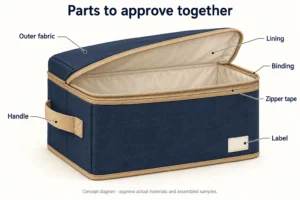
Double-stitched seams with bartack reinforcement at stress points (zipper ends, handle attachments) are non-negotiable. Single-stitched seams fail at the corners after repeated stuffing — and that’s where customer complaints start.
3. Zipper Quality
A #5 nylon coil zipper is the industry standard for packing cubes. Metal zippers look premium but corrode in humidity. The zipper pull should have a metal body, not plastic — plastic pulls snap in cold weather.
4. Mesh vs. Solid Top
- Mesh top: breathable, see-through, lighter — best for clothing cubes
- Solid top: waterproof, compresses better — best for toiletry or shoe cubes
Many brand sets mix both: mesh for clothing cubes, solid for accessory cubes. This combo outsells all-mesh sets by approximately 3:1 on Amazon.
5. Size Combination
The best-selling sets on Amazon follow a 4-piece pattern:
| Piece | Typical Size | Use Case |
|---|---|---|
| Large | 17.5″ × 12.75″ × 4″ | Shirts, pants, jackets |
| Medium | 13.75″ × 12.75″ × 4″ | T-shirts, undergarments |
| Small | 11″ × 6.75″ × 4″ | Socks, electronics, chargers |
| Slim | 14″ × 5″ × 4″ | Shoes, or fits in suitcase side pocket |
Deviating from this combo is risky unless you have data showing your audience wants something different.
How to Source the Best Packing Cubes for Your Brand
Step 1: Define Your Brand Position
Before contacting a factory, know your answer to:
- Price tier: Budget ($20/set), Mid-range ($30/set), or Premium ($40+/set)?
- Target customer: Business traveler, family vacationer, backpacker, or eco-conscious?
- Customization level: Stock fabric + your label only, or custom Pantone colors + custom packaging?
Step 2: Request Samples — What to Test
Request 2-3 sample sets. Don’t just look at them — run these tests:
- Stuff test: Pack each cube to 100% capacity. Check seam stress.
- Wash test: Machine wash cold, hang dry. Check for fabric pilling or shrinkage.
- Zipper cycle test: Open and close 50 times. Check for teeth misalignment.
- Scuff test: Rub against a rough surface. 290T polyester should not show wear.
Step 3: Understand MOQ and Pricing
Typical OEM packing cube factory terms:
| Customization Level | MOQ | Unit Price (4-piece set) | Sample Lead Time |
|---|---|---|---|
| Stock fabric, no logo | 500 pcs | $3.50-$5.00 | 5-7 days |
| Custom color, woven label | 1,000 pcs | $4.50-$6.50 | 7-10 days |
| Custom fabric, full branding | 2,000 pcs | $5.50-$8.00 | 10-14 days |
| Custom print / pattern | 3,000 pcs | $6.50-$10.00 | 14-21 days |
Step 4: Verify Compliance
If you’re selling in the US or EU, ensure your factory provides:
- REACH compliance (EU chemical safety)
- Prop 65 (California chemical safety)
- CPSIA (if marketing to children)
- BSCI or SEDEX audit (retail chain requirement)
Top Packing Cube Trends for 2026
Trend 1: Compression Zippers
A second zipper that compresses the cube by 30-40% after packing. This feature alone can raise retail price by $5-$8 per set. It’s the fastest-growing feature on Amazon best-seller lists.
Trend 2: Sustainable Materials
Recycled polyester (rPET) and organic cotton blends are gaining shelf space in European retailers. If you target EU markets, ask your factory about rPET options — the cost premium is only 10-15% over standard polyester.
Trend 3: Anti-Microbial Coating
Silver-ion coatings on inner lining are being marketed as “odor-free” cubes. Popular with gym-to-work and business travel segments. The coating adds $0.80-$1.20 per set at factory level.
Trend 4: Personalization via Sublimation
Full-print customization via sublimation lets brands print patterns, maps, or brand artwork across the entire cube surface. MOQ is higher (2,000+), but the visual differentiation is significant.
Common Mistakes Brands Make When Sourcing Packing Cubes
Mistake 1: Choosing Price Over Durability
A factory quoting $2.80/set is cutting corners — likely 210D fabric, single stitching, and plastic zipper pulls. Your return rate will eat the savings within 90 days.
Mistake 2: Ignoring Packaging
Retail buyers (especially Amazon FBA) often forget that the product package matters. A PVC display box or kraft gift box can increase conversion rate by 15-20% over a plain polybag.
Mistake 3: Over-Customizing Too Early
First-time brand owners often order full custom print at 3,000 MOQ before validating demand. Start with stock fabric + woven label at 500 MOQ, test the market, then scale customization.
Mistake 4: Not Testing the Wash
Packing cubes get washed. If your fabric shrinks 5% or the mesh delaminates after one wash, you’ll face returns. Always wash-test before bulk approval.
OEM Packing Cube Manufacturing: What to Look for in a Factory
| Criteria | What to Ask | Why It Matters |
|---|---|---|
| Experience | “How many packing cube sets have you produced?” | A factory with 3,000+ sample cases knows edge cases |
| Materials | “What fabric weights do you stock?” | 200+ in-stock fabrics = faster sampling, lower MOQ |
| QC Process | “What’s your inspection standard?” | 3-stage QC (incoming/mid/pre-ship) catches defects |
| Compliance | “Do you have BSCI/ISO 9001?” | Required by EU retail chains and Amazon Vendor |
| Logistics | “Can you ship FBA direct?” | Saves 2-3 weeks vs. freight forwarder handoff |
FAQ
What are the best packing cubes made of? The best packing cubes use 290T polyester or 420D nylon for the main body, with mesh tops (typically 90gsm polyester mesh) for breathability. These materials balance durability, weight, and cost. Avoid 210D polyester — it pills and tears after 30-40 uses.
How many packing cubes should a brand sell per set? 4-piece sets (large + medium + small + slim) are the Amazon best-seller standard. 3-piece sets sell at a 20-30% discount to 4-piece. 6-piece sets (adding a shoe bag and laundry pouch) are growing in popularity for premium positioning.
What is the MOQ for custom packing cubes? For stock fabric with a woven label, MOQ is typically 500 sets. For custom Pantone colors, MOQ rises to 1,000. Full custom print requires 2,000-3,000 sets. These thresholds vary by factory — some manufacturers offer 300 MOQ for returning customers.
Can packing cubes be machine washed? Yes — 290T polyester and 420D nylon cubes are machine-washable in cold water. Hang dry only; machine drying can damage the mesh and shrink the fabric. Always confirm washability with your factory before claiming it on packaging.
How much does it cost to manufacture a packing cube set? At factory level, a 4-piece set in 290T polyester with woven label costs $4.50-$6.50 per set (at 1,000 MOQ). Premium 420D nylon with full branding runs $5.50-$8.00. Retail price on Amazon ranges from $25-$45 per set.
Internal Links
- Custom Travel Bags & Organizers Manufacturer — packing cubes product page
- Custom Cosmetic & Makeup Bags Manufacturer — toiletry cube crossover
- Free Design & Sampling Service — sampling process
- OEM / ODM & Private Label Bag Manufacturing — customization levels
- Storage Bag Fabric Selection Guide — material deep dive
Last updated: September 2026. For custom packing cube manufacturing inquiries, contact Great Shine or WhatsApp +86 177 0171 9207.