The question sounds simple and the honest answer is a range: a plain insulated lunch bag holds cold food around two to four hours, and with ice packs pushed to four to six under good conditions. Food safety extension services put the practical figure at about four hours for a packed lunch. Where a bag falls inside, below or beyond that range depends on five factors, and this guide lists them, the temperatures that matter, and the test that tells you whether a supplier’s hold-time claim means anything.
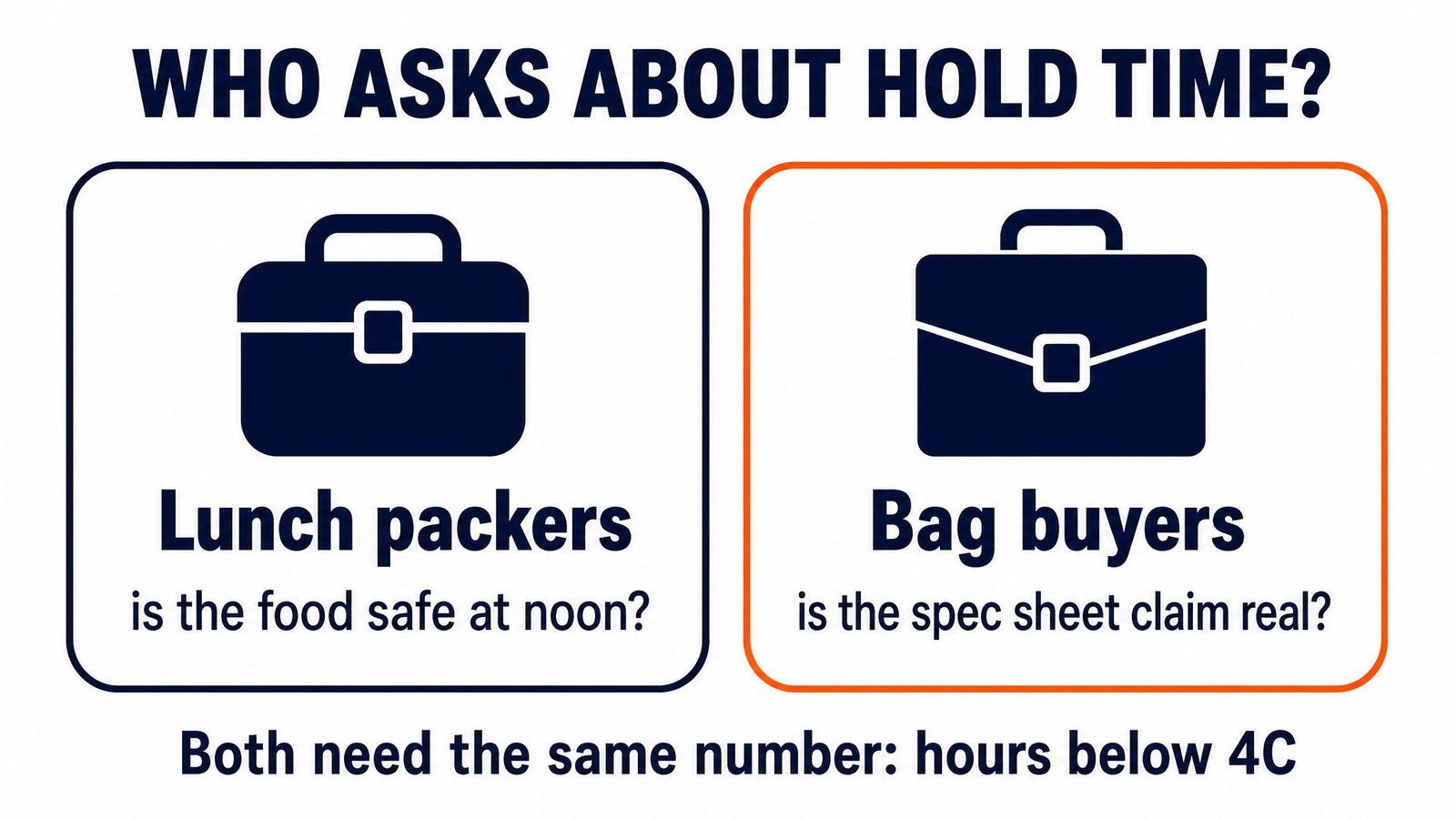
Who asks this question
Parents packing lunches, meal-prep commuters and grocery delivery drivers all want to know if the food is still safe at the end of the trip. Food safety rules set the bar: perishable food should stay below 40°F (4°C), and the general outside-the-fridge limit is two hours, or one hour above 90°F (32°C). An insulated bag stretches that window but never replaces a refrigerator. The second group asking is buyers who source bags for resale and need to know what a hold-time claim on a spec sheet is actually worth.
Base numbers by bag type
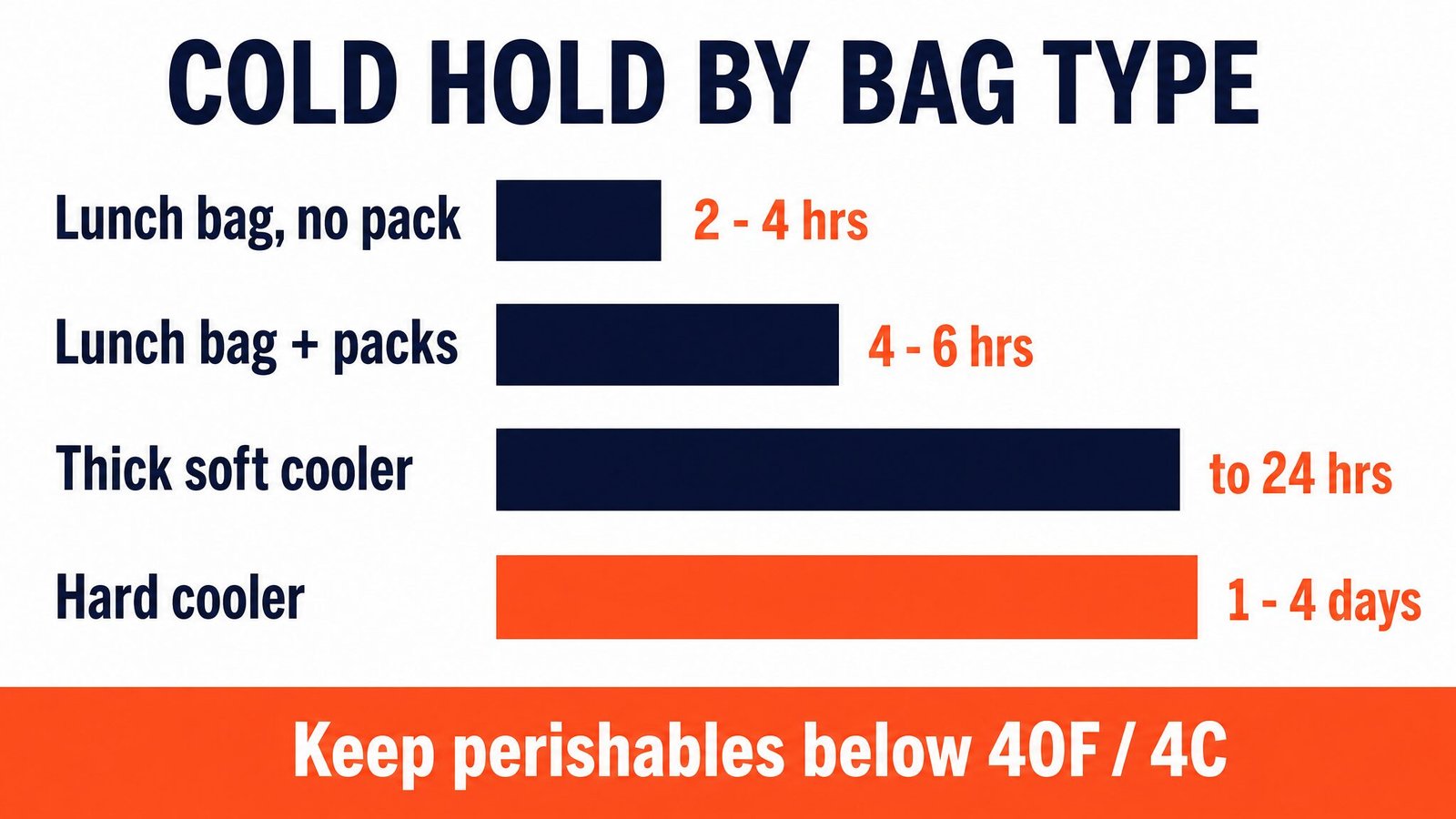
| Bag type | Typical cold hold | Notes |
|---|---|---|
| Insulated lunch bag, no ice pack | 2 – 4 hours | Slows warming, does not reverse it; fine for a morning commute |
| Insulated lunch bag with ice packs | 4 – 6 hours | The packed-lunch standard; two small packs beat one large |
| Thick soft cooler (8 mm+ foam) | Up to about 24 hours | Needs full ice pack load and a closed lid to get there |
| Hard cooler | 1 – 4 days | Different product class; ice mass, not insulation, does most of the work |
The ranges above match what food safety extensions and insulated-packaging guides publish. Any spec sheet promising a single exact number without test conditions attached is quoting a best case, not a guarantee.
What moves a bag up or down the range
Ambient temperature is the biggest lever: the same bag that holds six hours in a 70°F office manages far less in a 95°F car trunk. Preconditioning is second: food and packs that start fully frozen or refrigerator-cold buy hours that room-temperature contents never had. Lid discipline matters, since every opening exchanges the cold air you paid for. Payload mass helps, because a full bag holds temperature better than a half-empty one. And ice pack choice sets the ceiling: disposable packs fade in 4 – 8 hours, reusable gel packs commonly hold 24 – 36 hours on their own.

How a buyer verifies a hold-time claim
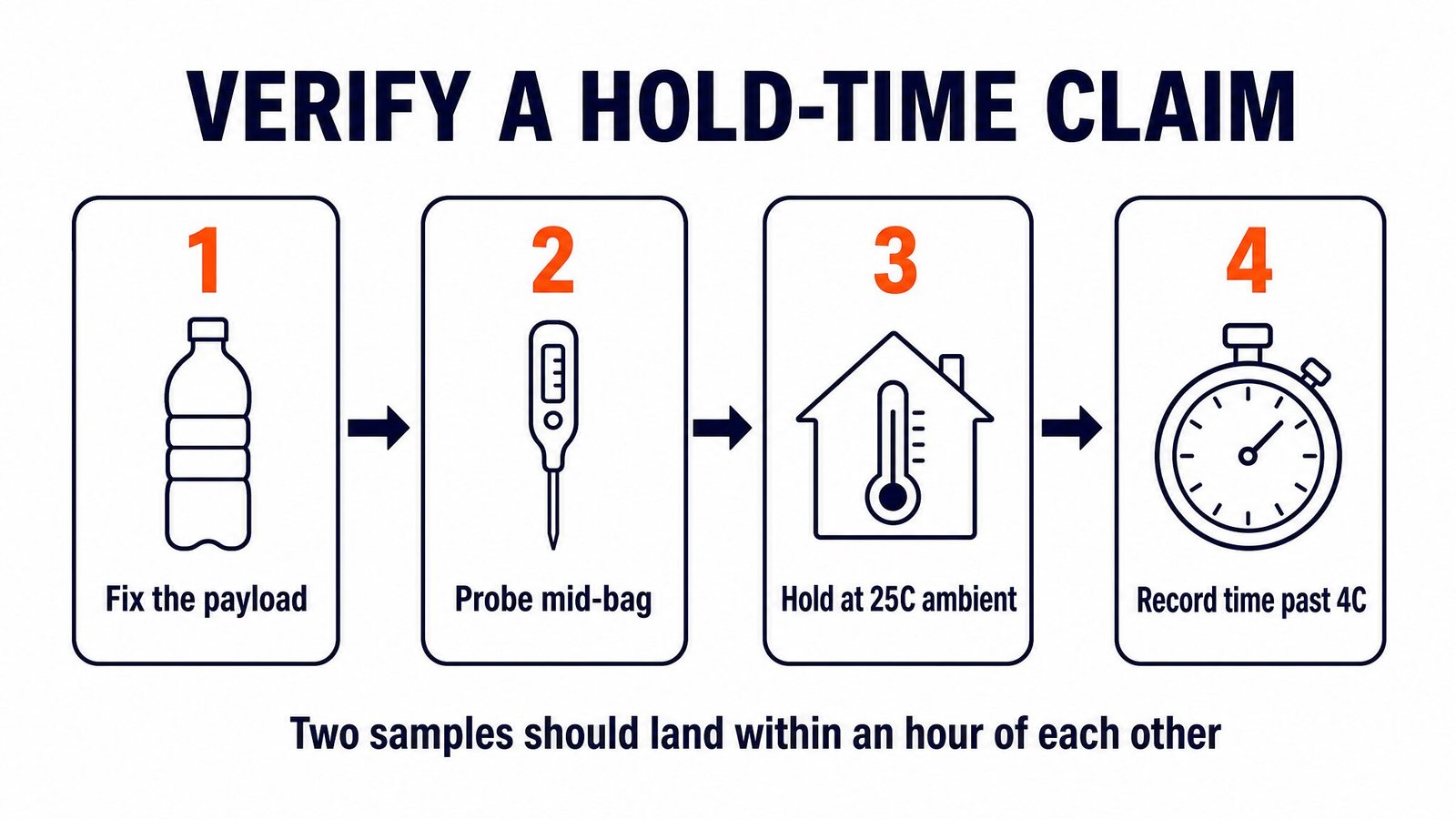
Suppliers quote hold times from tests you never see. The check is simple enough to run on samples: fix a payload, for example two 500 ml chilled water bottles plus two standard gel packs; place a probe thermometer or datalogger mid-bag; hold the bag at a stated ambient, 25°C indoors is the common baseline; keep it closed; and record the time until the payload passes 4°C. Two samples of the same SKU should land within an hour of each other. A supplier who cannot tell you the payload, ambient or pass line behind their claim has not run the test.
Questions that come with the topic
Can an insulated bag keep frozen food frozen?
Not for long. Frozen transport needs ice mass in a thick-walled cooler, and even then surface items soften first. An insulated bag maintains chilled food, it does not re-freeze it.
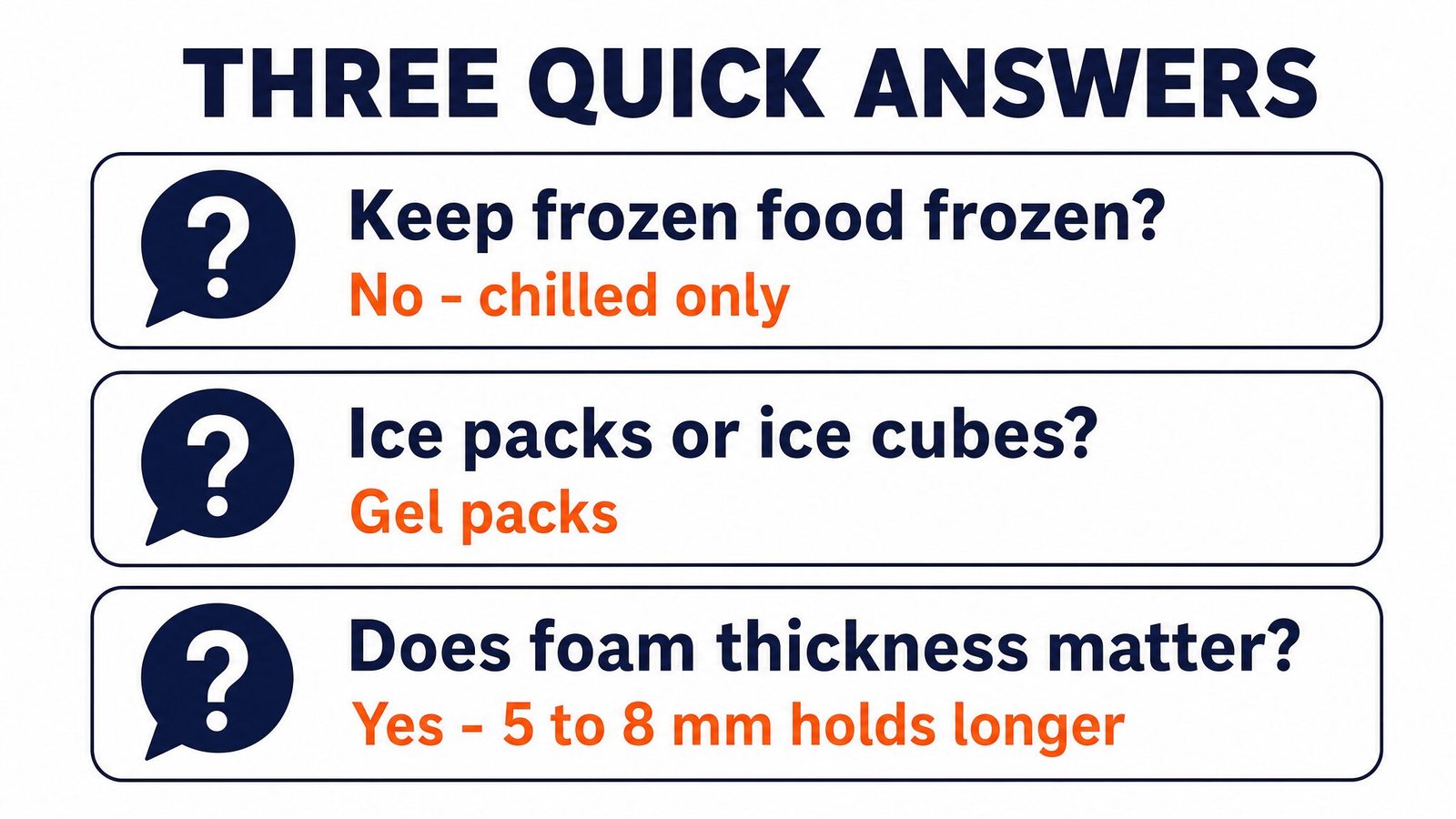
Do ice packs or ice cubes work better?
Gel packs refreeze cleanly and do not slosh; loose ice melts into pooled water that speeds warming of whatever it touches. For lunch sizes, two conditioned gel packs is the standard setup.
What does PE foam thickness change?
Everything else equal, thicker foam slows heat entry. Doubling from 3 mm to 6 mm roughly buys hours rather than minutes in lunch-bag sizes, which is why premium lunch bags and soft coolers specify 5 – 8 mm.
Related reading
Thermal bag vs insulated bag (what the words mean) · Insulated lunch bag vs cooler bag (which format to pick) · What is an insulated lunch bag (how the layers work)