By Grace Ji, Sales Director at Great Shine · Updated August 2026
If you’re reading this, you’ve probably already discovered that sourcing storage bags from China for Amazon FBA isn’t as simple as “find a factory on Alibaba, place an order, ship to FBA.”
The sellers who succeed on Amazon don’t just find a supplier — they find the right supplier, lock in quality systems, engineer their packaging for FBA compliance, manage customs documentation, and build a replenishment pipeline that survives peak season.
I’ve been on the factory side of this equation for 16 years. I’ve supplied Amazon sellers across the US, UK, Germany, and Japan — from first-time 500-pc test orders to 50,000-pc Q4 peak replenishments. I’ve seen every mistake, every customs hold, every quality drift, every “my listing got suppressed because of packaging compliance” disaster.
This guide is everything I wish my buyers knew before their first order — and everything experienced sellers need to know to scale without breaking their supply chain.
The 5-Stage Sourcing Framework
Most guides treat sourcing as a linear process: find supplier → place order → ship. Reality is a cycle with 5 stages, each with its own failure points:
Total first-order timeline: 90–120 days. Reorders can compress to 45–60 days with standing fabric inventory and locked specs.
The mistake most sellers make: they spend 80% of their effort on Stage 1 (finding the cheapest supplier) and 20% on Stages 3–5 (where 90% of problems actually happen). Reverse that ratio and your Amazon business transforms.
Stage 1: Supplier Identification & Verification
Why “Alibaba Verified Supplier” Means Almost Nothing
Alibaba’s “Verified Supplier” badge means a third-party inspection company visited the factory once and confirmed it exists. It does NOT mean:
- The factory makes the product you want
- The factory has QC systems
- The factory understands Amazon FBA
- The factory owns the equipment shown in their photos
- The contact person you’re emailing works for the factory
How to Actually Verify a Manufacturer
Test 1: Business License Check
Ask for the Chinese business license . The “business scope” field will list either:
- Manufacturing: Real factory ✓
- Wholesale/Retail/Import-Export: Trading company ✗
A trading company can’t show “manufacturing” because their license doesn’t permit it. This is the fastest, most reliable verification method.
Test 2: Live Video Walkthrough
Request a 30-minute video call on WeChat or Zoom. Say: “I’d like to see the production floor.” A real factory shows you:
- Fabric warehouse with rolls on shelves
- Cutting tables with fabric panels
- Sewing machines with workers actively working
- QC inspection area with measuring tools
- Finished goods warehouse
A trading company will make excuses: “our factory is in a different city,” “privacy concerns,” “schedule conflict.” If they can’t show you a factory floor in real time, walk away.
Test 3: Tiered MOQ Pricing
Ask for pricing at 500, 2,000, 5,000, and 10,000 pcs. A real factory gives you different unit prices at each tier because their costs genuinely decrease with volume. A trading company quotes flat pricing — they mark up a fixed percentage and can’t pass on volume savings.
Test 4: SEDEX/BSCI Verification
Ask for their SEDEX Member ID or BSCI audit number. Verify it independently:
- SEDEX: search at sedex.com
- BSCI: search at amfori.org
A real factory has its own audit ID. A trading company either has none or borrows a factory’s certificate (which won’t match their company name).
The Red Flag Checklist
Stage 2: Product Development & Sampling
The Spec Sheet: Your Insurance Policy
Before any sample is produced, get a written spec sheet that covers:
- Product name and model number
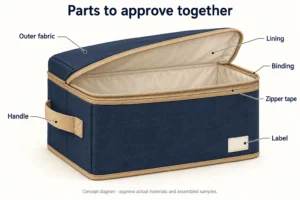
- Outer fabric: type (600D Oxford), weight (280gsm), coating (PU, not PVC), color (Pantone reference)
- Lining material: type (210D polyester or PEVA), thickness
- Dimensions: assembled size AND folded/shipping size, in cm and inches, with ±0.5cm tolerance
- Construction details: stitching density (8–10 stitches/inch), reinforcement points, bar-tack locations
- Hardware: zipper brand (YKK/SBS), zipper size (#5/#8), pull type, buckle type, webbing width
- Logo: method (screen/heat/woven/embroidery/PU patch), size, placement, color
- Packaging: individual poly bag, insert card, hang tag, carton dimensions, pieces per carton
- Compliance requirements: OEKO-TEX, Prop 65, REACH, CPSIA — which apply to your market
- Carton marks: buyer name, PO number, SKU, quantity, gross/net weight, country of origin
This spec sheet becomes the “golden standard” that every production batch is compared against. No verbal agreements. No “same as last time.” Written, signed, physically retained.
The Sample Process: What to Check
When your sample arrives (5–7 days for standard, 10–15 for custom), check these 7 things:
- Dimensions: within ±0.5cm of spec?
- Color match: compare under D65 daylight (not office fluorescent). Use Pantone reference. Delta-E should be ≤ 1.5.
- Stitching: even density (8–10 stitches/inch), no skipped stitches, bar-tack reinforcement at stress points?
- Zipper: smooth pull, no catching, correct brand (YKK/SBS)?
- Handle/strap: comfortable grip, load-tested feel?
- Odor: no chemical smell? If yes, factory is using PVC coating — switch to PU.
- Logo: correct method, placement, color, size?
If any item fails, request a revision. Good factories offer free revisions up to 2 rounds. If your supplier charges $200 per revision sample or takes 3 weeks per round, you’re dealing with the wrong factory.
The “Golden Sample” Rule
Once you approve the sample, both you and the factory retain a physical copy. This is the “golden sample.” Every bulk production batch must match it. If the factory switches material, changes coating, or alters construction without written agreement — that’s a breach of the approved spec.
Never accept “we made a small improvement to save cost” without seeing and approving the change first.
Stage 3: Production & Quality Control
Why Post-Production Inspection Is Too Late
Once products enter an Amazon FBA warehouse, you lose direct access to them. You can’t pull defective units before they ship to customers. You can’t rework a bad batch. You can’t negotiate a quick fix.
Your only quality leverage window is before the goods leave the factory in China. This makes pre-shipment QC not just useful — it’s structurally essential.
The 4-Stage QC Process
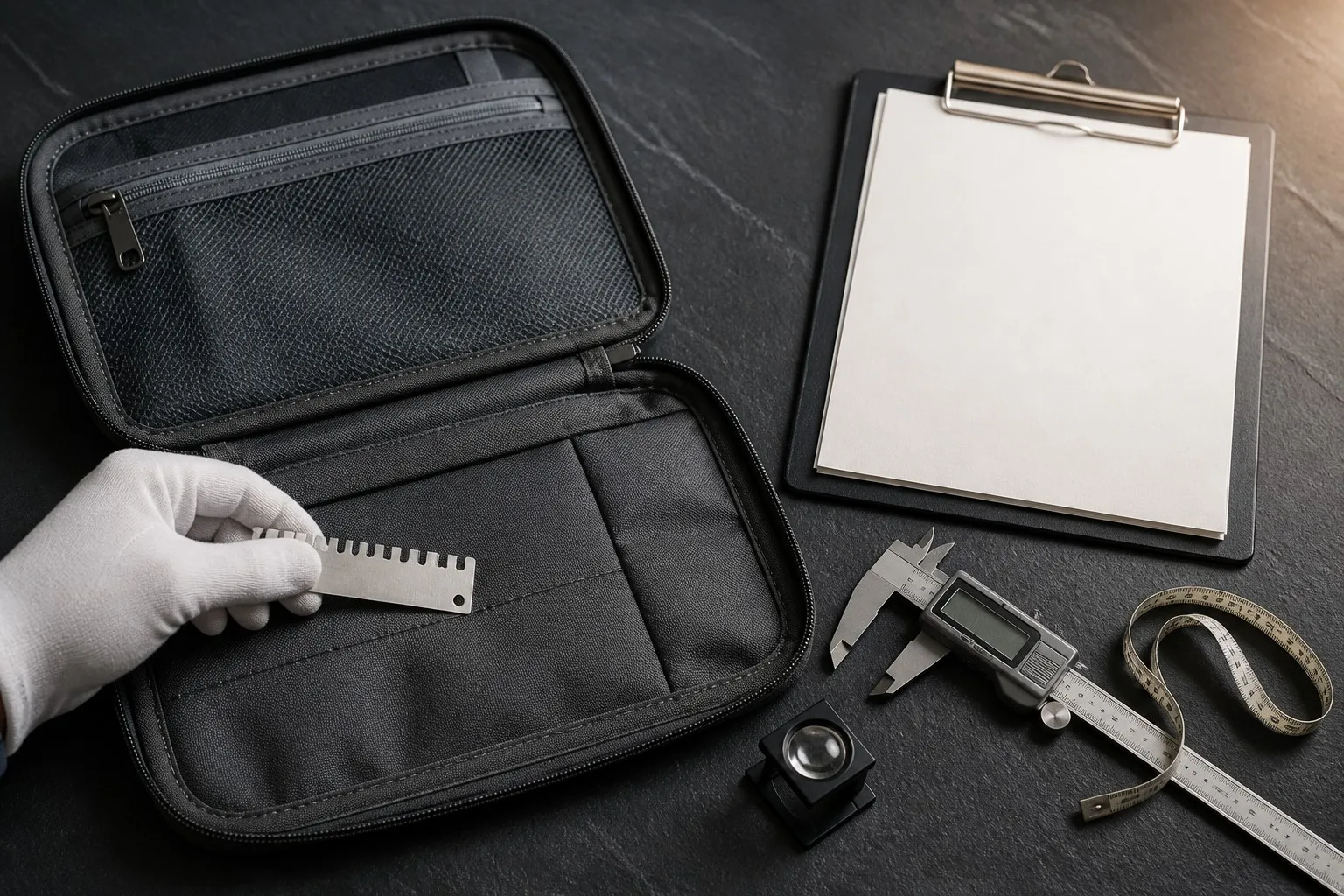
Stage 1: Raw Material Inspection (Before Cutting)
- Fabric weight verified (e.g., 600D Oxford must be 280gsm ±5%)
- Zipper pull strength tested (500 cycles minimum for SBS, 1,000 for YKK)
- Webbing load test (25mm polyester: 50 kg minimum)
- Color match against approved sample (D65, Delta-E ≤ 1.5)
- Coating type confirmed (PU, not PVC — check with solvent test)
If the fabric fails here, the factory rejects the roll before cutting. Catching it here costs 0.Fixingitaftersewingcosts2–5/unit in rework.
Stage 2: Production Line Patrol (During Sewing)
- Patrol inspection every 2 hours
- Check: stitching density, seam alignment, dimension tolerance, logo placement
- First-piece inspection: the first unit of each style is checked against golden sample
- Random in-process check: pull 1 unit every 50 pcs for spot check
This catches issues mid-production — before the full batch is complete. A defect caught at hour 2 costs 50 units of rework. The same defect caught at final inspection costs 10,000 units.
Stage 3: Final Inspection — AQL 2.5 per ISO 2859-1
AQL (Acceptable Quality Level) is the international standard for statistical inspection. AQL 2.5 at General Inspection Level II is the minimum standard Western retailers and Amazon expect.
What this means in practice for a 10,000-unit order:
- Sample size: 200 units (per ISO 2859-1 table)
- Critical defects: 0 allowed (any critical defect = reject entire batch)
- Major defects: ≤ 10 allowed in the 200-unit sample
- Minor defects: ≤ 15 allowed
But here’s what most inspection companies do wrong: they sample 20–30% of boxes and only report pass/fail. They don’t identify specific defects in specific bags. They don’t coordinate repairs at the factory.
What you should require: full-piece inspection (every unit, not a statistical sample) with a defect report that includes:
- Photo of each defect
- Classification (critical/major/minor)
- Root cause (material/production/handling)
- Corrective action taken
At Great Shine, we inspect every single piece. Yes, it costs more in labor. But the historical defect rate is 0.5% — well below the 2.5% AQL threshold.
Stage 4: Container Loading Supervision
- Carton count verified against packing list
- Carton condition checked (no damage, no moisture)
- Loading pattern documented (which cartons where)
- Container sealed in your presence (or your agent’s)
- Photos of loading process
Why this matters: If your shipment arrives damaged and you can’t prove the container was loaded properly, the factory can claim “shipping damage” and you have no recourse. Loading supervision documents the condition at handoff.
Stage 4: FBA Packaging & Compliance
The FBA Packaging Checklist
Amazon’s FBA requirements change frequently. As of 2026, here’s what must be correct on every unit:
The matte-printed label requirement is critical. Amazon FCs use infrared scanners. Glossy labels reflect the beam and fail scan. When a label fails scan, Amazon rejects the entire inbound shipment — and charges you for return shipping and repackaging.
Dimensional Weight: The Hidden Margin Killer
Amazon charges fulfillment fees based on whichever is greater: actual weight or dimensional weight. Storage bags are lightweight but bulky — the dimensional weight almost always exceeds actual weight.
FBA Size Tiers (2026):
A storage bag that’s 14×11×0.5″ fits Small Standard. The same bag in a 16×13×3″ box jumps to Large Standard — a fee difference of $1.50–2.50 per unit.
On a 10,000-unit order, that’s $15,000–25,000 in avoidable fees.
K/D Folding: The Solution
Knock-down (K/D) folding compresses your storage bag flat for shipping. A bag that’s 12×12×8″ assembled folds to 12×12×1.5″ for shipping.
Benefits:
- Drops dimensional weight by 70%
- Keeps carton in Small Standard tier
- More units per carton = lower per-unit freight
- Avoids Amazon oversize surcharges
- Reduces FBA storage fees (smaller footprint)
What to ask your manufacturer: “Can you design K/D folding to keep the shipping carton under Small Standard size tier? Calculate the Amazon dimensional weight before we approve production.”
A manufacturer who understands Amazon will run the FBA fee calculator with your exact carton dimensions before production — not after.
Stage 5: Shipping, Customs & Replenishment
The Complete Documentation Kit
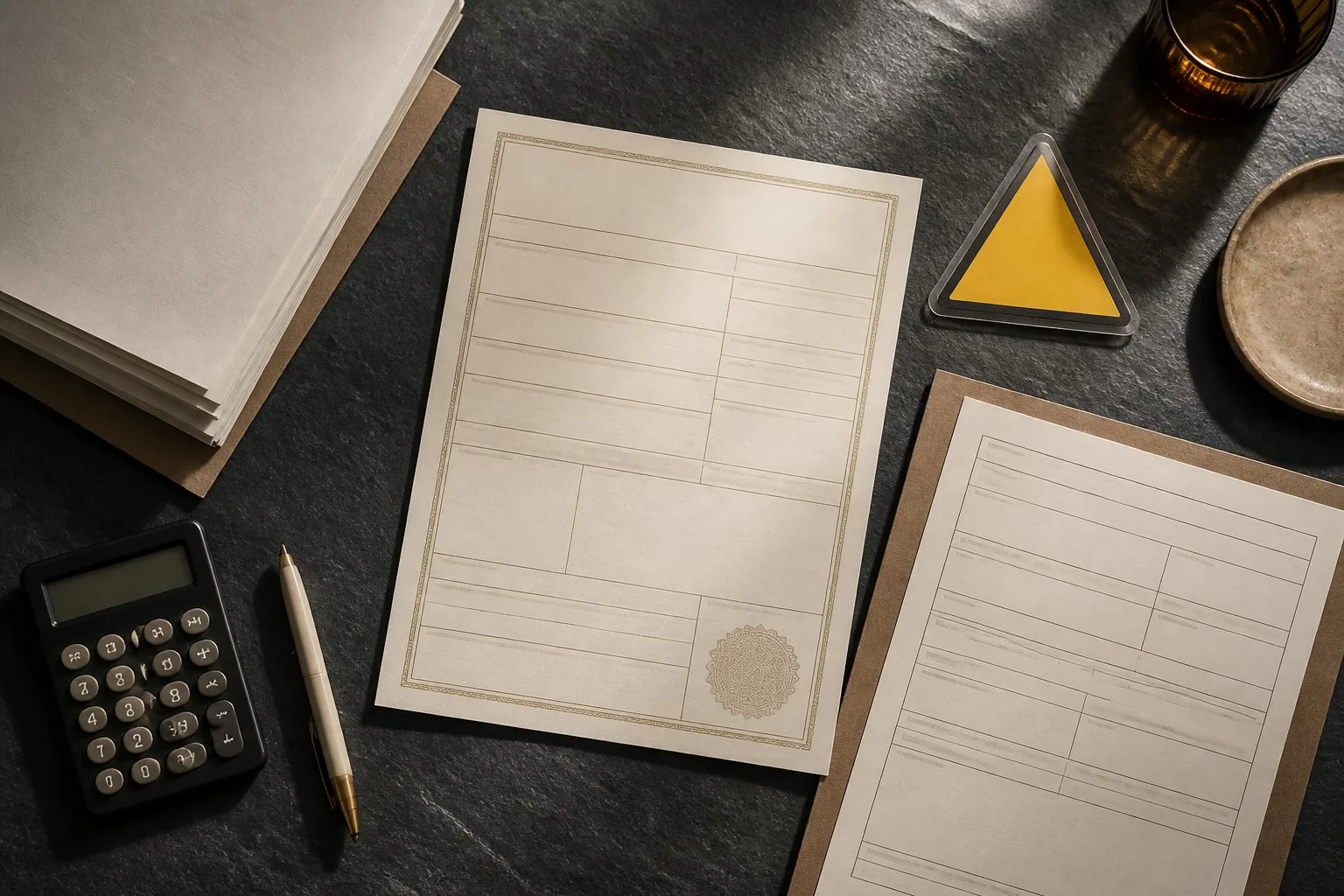
Your shipment needs these documents to clear US customs without delays:
Mandatory:
- Commercial invoice — with pre-verified HS codes (not “bags”)
- Packing list — carton dimensions, weight, pieces per carton
- Bill of Lading (or Airway Bill for air freight)
Product-specific (often required): 4. Certificate of Origin (Form E/A/F for FTA duty savings — saves 3–15%) 5. Test report — fabric composition, harmful substance testing (SGS/Intertek/BV) 6. REACH declaration — even if not explicitly requested 7. Prop 65 documentation — for California market 8. Fumigation certificate — for bamboo/wood components
For Amazon FBA specifically: 9. ISF (Import Security Filing) — filed 24 hours before vessel departure 10. FBA shipment plan ID — matches Amazon Seller Central 11. Delivery appointment — scheduled with Amazon’s carrier
The #1 customs mistake I see: the HS code on the commercial invoice doesn’t match the code your broker files. For storage bags, the most common code is 4202.92 (textile storage bags). If your supplier classifies it as 6307.90 (other textile articles) and your broker files 4202.92, customs may hold the shipment for reclassification — 5–7 days of delay.
Shipping Methods: When to Use What
Pro tip for FBA sellers: Use sea freight for your main inventory and air freight for emergency replenishment. Don’t air-freight your entire order — it destroys your margin.
The Replenishment Pipeline
Peak season (October–December) is when most storage bag sellers stockout. Here’s how to prevent it:
- Produce full order at once (get the best tiered pricing)
- Store 60–70% in China warehouse (free for 1–2 months at Great Shine)
- Ship 2,000–3,000 units to FBA initially
- Replenish in batches as sell-through dictates
- Seasonal buffering: produce in off-peak (Feb–May), store, ship in peak (Oct–Dec)
This approach:
- Avoids Amazon long-term storage fees
- Manages your IPI score (inventory turns faster = higher IPI = more storage capacity)
- Prevents stockouts during peak
- Gives you flexibility to adjust if a product underperforms
The MOQ Strategy: How to Start Smart
The MOQ-PPC Profit Matrix
Here’s the calculation that separates serious sellers from hobbyists. For a storage bag selling at $24.99:
The strategy: Use MOQ 500 to test → validate → then scale to the tier where PPC becomes profitable. Never start at 10,000 on an unproven product.
How to Negotiate MOQ Without Looking Like an Amateur
- Ask for in-stock fabric options — bypasses dye-lot minimum, drops MOQ to 500
- Offer to pay a setup fee — covers factory calibration, lowers the quantity requirement
- Commit to a reorder in writing — “500 for testing, 5,000 within 90 days if it performs”
- Simplify the construction — remove custom compartments, use standard zippers, skip custom molds
- Combine SKUs — 3 colors × 500 each = 1,500 total, factory may accept combined MOQ
The Return Rate Reduction System
Returns kill Amazon businesses. In the storage bag category, return rates of 6–8% are common. Amazon’s IPI system penalizes high-return sellers with reduced storage capacity — creating a vicious cycle where you can’t send enough inventory to maintain BSR.
The Monthly Return Rate Audit
At Great Shine, we run this audit for top FBA buyers every month:
- Mine your top 20 negative reviews — analyze for root cause
- Mine top 5 competitors’ reviews — same analysis
- Classify each issue: product / listing / shipping / packaging
- Propose engineering fixes: zipper gauge upgrade, fabric weight increase, stitching reinforcement, odor elimination
- Produce A/B test sample — updated spec for your approval before next bulk
- Track return rate trend — 30/60/90 day measurement
Results from Our Buyers
The cost of implementing engineering fixes: typically 0.20–0.50perunit.Thesavings:0.28+ per unit in reduced returns, plus listing health protection.
The 12 Costliest Mistakes I’ve Seen in 16 Years
Mistake 1: Choosing the Cheapest Supplier
The 1.50yousaveperunitcostsyou4+ in returns, customs delays, and quality drift. The cheapest supplier is the most expensive.
Mistake 2: No Written Spec Sheet
“Same as the sample” is not a spec. Every batch drifts. Lock it in writing — material, weight, color, dimensions, stitching, hardware, logo, packaging.
Mistake 3: Trusting Freight Forwarder for Customs
Your forwarder handles shipping. Your customs broker handles clearance. They’re different people. Missing a fumigation certificate or REACH declaration = 5–10 day customs hold.
Mistake 4: PVC Coating Instead of PU
If your PO says “waterproof Oxford” without specifying PU, the factory uses PVC. PVC off-gasses phthalates → “chemical smell” returns. Always write “PU coating, OEKO-TEX certified.”
Mistake 5: Glossy FNSKU Labels
Amazon FCs use infrared scanners. Glossy labels reflect the beam and fail scan. Your entire shipment gets rejected. Specify matte-printed labels.
Mistake 6: No Dimensional Weight Calculation
A 1-inch difference in carton size can drop you from Large Standard to Small Standard FBA tier — saving $1.50–2.50 per unit. Run the math before production.
Mistake 7: Ordering 10,000 on an Unproven Product
Start at 500. Use the first order to collect review data, fix issues, then scale. The 3,000you”waste”onhigherunitcostat500pcsisinsuranceagainsta50,000 mistake.
Mistake 8: No Exclusivity Agreement
You develop a beautiful sage green storage bin. Three months later, your competitor launches the same product. Sign an 18–36 month exclusivity agreement before your first order.
Mistake 9: Accepting “100% Inspection” Without Proof
Suppliers say “we do 100% inspection” but never produce evidence. Require: photo defect reports, classification (critical/major/minor), root cause, corrective action. No documentation = no inspection.
Mistake 10: No Peak Season Buffer
Q4 peak demand is predictable. If you don’t produce in July and store in China, you’ll stockout in October — exactly when demand is highest. Plan backward from October 1, not forward from today.
Mistake 11: Ignoring Return Rate as a Supply Chain Metric
Returns aren’t just a customer service issue — they’re a supply chain issue. High returns consume FBA capacity, lower IPI, and trigger Amazon quality flags. Treat return rate as a KPI your supplier is responsible for improving.
Mistake 12: No Reorder Spec Control
Batch 1 was perfect. Batch 3 has quality drift because nobody locked the spec. Your golden sample should travel with every reorder. No spec changes without written approval.
FAQ
How do I find a reliable storage bag manufacturer in China?
Verify four things: (1) business license scope says “manufacturing” not “wholesale,” (2) live video walkthrough shows the production floor, (3) tiered MOQ pricing shows real cost differences at higher volumes, (4) SEDEX or BSCI audit ID verified independently. “Alibaba Verified Supplier” means almost nothing — it only confirms the factory exists.
How long does it take to source and launch a storage bag on Amazon?
90–120 days from first inquiry to sellable inventory in Amazon FBA. This includes: 2–4 weeks for supplier verification, 2–3 weeks for sampling, 4–5 weeks for production, 1–2 weeks for FBA packaging, and 3–6 weeks for shipping and customs. Reorders compress to 45–60 days with locked specs and standing inventory.
What MOQ should I start with for a new storage bag product?
Start at 500 pcs using in-stock fabric. This lets you test the market with 3,000–4,000totalinvestmentinsteadof50,000+ at 10,000 pcs. Use the first order to collect review data and fix product issues. Then scale to 2,000–5,000 pcs where PPC math becomes profitable. See our Amazon FBA solutions for full tiered pricing.
How can I reduce my storage bag return rate?
Implement a monthly review audit: mine your top 20 negative Amazon reviews, classify issues (product/listing/shipping/packaging), and request engineering fixes from your supplier. Common fixes: switch PVC coating to PU (eliminates “chemical smell”), upgrade zipper from #5 to #8 with bar-tack reinforcement, add insert card with folding instructions. Our buyers saw returns drop from 6.8% to 3.1% in 90 days.
What FBA packaging requirements must my supplier handle?
Your supplier must handle: FNSKU barcodes (matte-printed), suffocation warnings (printed on poly bag, not sticker), Made in China labels (every unit + carton), outer carton FBA labels, and dimensional weight optimization (K/D folding to stay in lower FBA tier). All should be included in your OEM package — not charged as a separate labeling fee.
What documents do I need to import storage bags from China?
Mandatory: commercial invoice with pre-verified HS codes, packing list, bill of lading. Product-specific: Certificate of Origin (for FTA duty savings), test reports (SGS/Intertek), REACH/Prop 65 declarations, fumigation certificate (for bamboo/wood). For FBA: ISF filing, FBA shipment plan ID, delivery appointment. See our landed cost and customs guide for the complete checklist.
Can my supplier ship directly to Amazon FBA warehouses?
Yes. Your supplier should ship to FBA warehouses in US, UK, DE, FR, IT, ES, JP, and AU — with all labeling and compliance handled at the factory. Ask about free 1–2 month storage in China for batch shipping to manage your IPI score and avoid Amazon long-term storage fees. See our USA storage bag manufacturer page for US-specific compliance details.
How do I prevent quality drift between production batches?
Lock your spec in a signed approval sheet: material type and weight, color (D65 matched, Delta-E ≤ 1.5), dimensions, stitching density, hardware brand and size, logo method and placement, packaging format. Get a physical bulk sample from every production batch — not just pre-production sample. No material substitution without written approval. See our private label manufacturing page for spec control details.
Grace Ji is Sales Director at Great Shine, a Chinese OEM manufacturer of storage bags, packing organizers, and seasonal storage products. We’ve supplied Amazon FBA sellers, DTC brands, and retail chains across 50+ countries for 16 years. Free sampling, free listing kit, free 1–2 month storage, and full FBA compliance — all included. Contact her at grace@g-shine07.com.