Oxford fabric shows up on every custom bag quote, usually as “600D polyester Oxford with PU coating”. If you order bags for a brand, that line decides how the bag feels, how it ages and how it behaves in rain. This guide covers what the weave is, what the D number means, what coatings do, and how the fabric behaves in real product categories.
What oxford fabric means
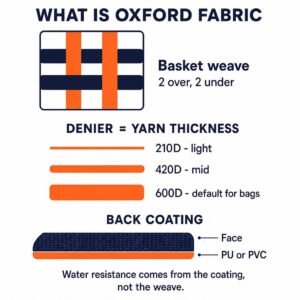
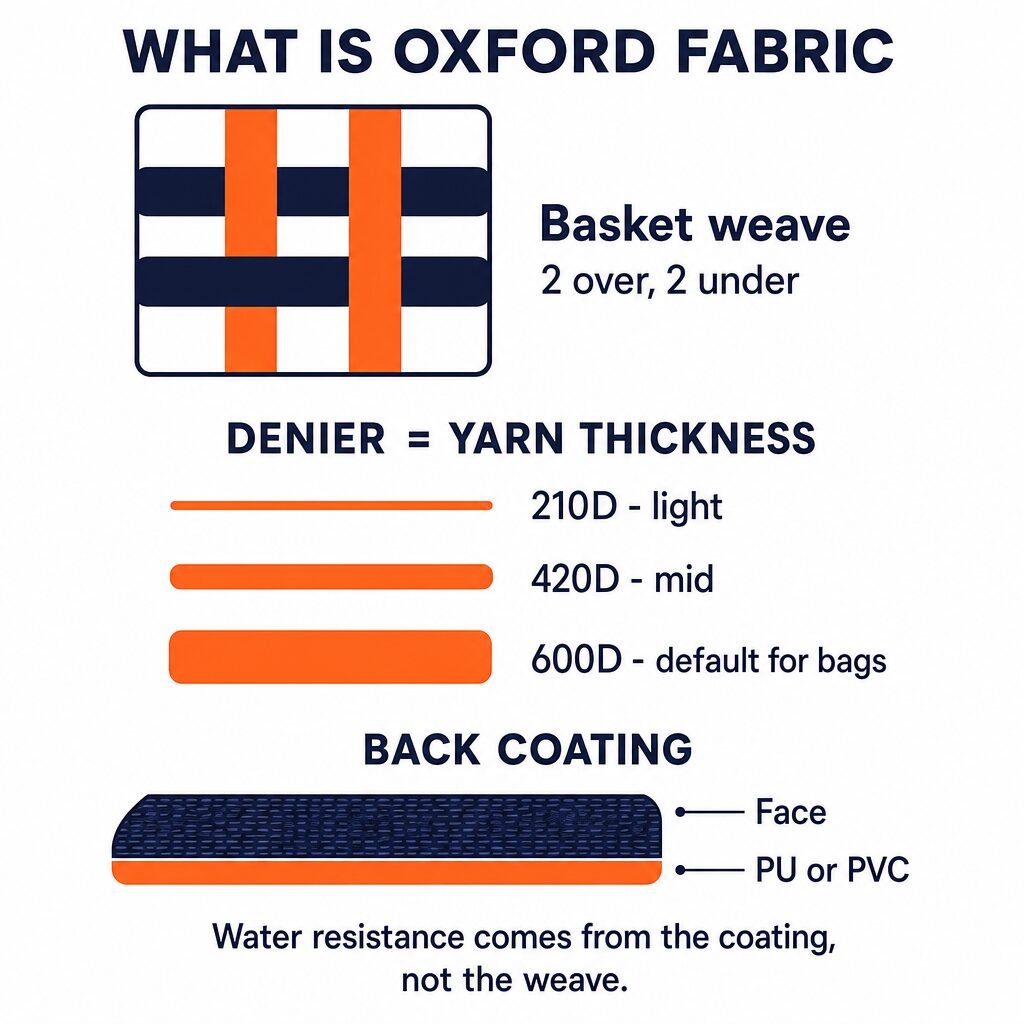
Oxford fabric is a basket weave. Two or more warp yarns pass over and under two or more weft yarns in a repeating pattern, which produces the fine checkerboard texture you can see on the surface of most backpacks and storage bags. The name comes from the shirt cloth woven this way in the 19th century. Today the weave matters more than the fiber: polyester Oxford dominates bags and covers because it is cheap and holds coatings well, but the same weave is made in nylon for hard use, and in cotton for shirts.
So when a factory says “Oxford”, they are naming the weave structure first and the fiber second. A cotton Oxford shirt and a 600D polyester Oxford tool bag share the weave, nothing else.
Who asks this question
Two groups search it. Retail customers read the material line on a product page and want to know if the bag will survive rain and washing. Buyers and product managers see it on quotes and need to judge whether 420D or 600D fits the product and the price point. The second group also needs the vocabulary for the spec sheet, which is where denier and coatings come in.
What the D number means
The D is denier: the linear mass of the yarn, grams per 9,000 meters. A 600D yarn weighs 600 grams per 9,000 meters. Higher denier means thicker yarn, which generally means a heavier, more abrasion-resistant fabric that is also stiffer and costlier. Lower denier goes the other way.
| Spec | Typical weight | Where it fits |
|---|---|---|
| 210D Oxford | ~90 – 120 gsm | Liners, drawstring bags, light covers |
| 420D Oxford | ~160 – 200 gsm | Backpacks, school bags, mid-weight storage |
| 600D Oxford | ~180 – 250 gsm | The default for storage bags, tool bags, pet carriers |
| 840D and up, to 1680D | 280 gsm and up | Heavy covers, luggage, travel bags |
The ranges above come from public fabric supplier listings for coated polyester Oxford. They overlap on purpose: a densely woven 420D can outweigh a loosely woven 600D, so the gsm number on a fabric swatch card tells you more than the denier alone.
Against neighboring weaves, oxford trades a little strength for texture and coating adhesion:
| Weave | Tear strength | Abrasion resistance | Typical role |
|---|---|---|---|
| Oxford basket weave | Better than plain weave at the same denier | Favorable at similar weight | Bags, covers, structured panels |
| Plain weave | Standard | Standard | Liners, cheap covers |
| Ripstop | High, reinforced grid stops tears | High | Outdoor gear, tents, flags |
The width runs 150 cm as standard, with extra-width versions at 280 to 300 cm for tent and cover production.
What the coating does
The weave gives the texture and the strength. Water resistance comes from the back coating:
- PU coating: thin, soft hand feel, the default for bags that live indoors or face splashes. Applied to the back of the fabric, invisible from the front.
- PVC coating: thicker and stiffer, more durable against abrasion, common on heavy covers and outdoor gear. Adds noticeable weight and can crack in extreme cold over time.
- PA coating: lighter water repellence, sometimes used as an entry-level finish.
One line worth repeating from our sourcing guides: a coated fabric resists water, it is not a waterproof bag. Coatings are measured in hydrostatic head, and seams, zippers and stitching holes let water through long before the coating fails. For products sold as waterproof, seam taping or welding is a separate process with a separate cost.
Reading water resistance ratings
Coating performance is quoted as a hydrostatic head in millimeters, the water column pressure the fabric holds before it leaks. The bands used across the industry:
| Rating (mm) | What it means | Typical use |
|---|---|---|
| 0 – 1,500 | Minimal resistance | Casual bags, windbreakers; sheds a splash, fails in rain |
| 1,500 – 5,000 | Water resistant | Light rain jackets, daypacks, light tents |
| 5,000 – 10,000 | Waterproof grade | Most tents, rain jackets, medium-duty backpacks |
| 10,000 – 20,000+ | Highly waterproof | Expedition tents, heavy outerwear, dry bags |
A PU coating on standard oxford typically lands in the 1,000 – 2,000 mm band. Anything above that usually means a thicker coating, multiple passes, or a different membrane, and the price moves accordingly.
The lab tests behind a fabric spec sheet
When a factory sends a real spec sheet, these are the tests named on it. Asking for these reports by name is the fastest way to separate a spec sheet from a sales sheet:
| Test | What it measures |
|---|---|
| Tensile and tear strength | Force the fabric takes before ripping or tearing |
| Abrasion, Martindale or Taber | Rubbing cycles before the surface wears through |
| Coating adhesion | Whether the PU or PVC layer peels from the base cloth |
| Colorfastness to rubbing and washing | Color transfer onto clothes and skin |
| Dimensional stability | Shrinkage and warping after washing or wetting |
| OEKO-TEX or REACH screening | Harmful substance limits, relevant for EU and children’s products |
Certification is worth one more note: OEKO-TEX Standard 100 applies to the fabric, not the finished bag. If your market requires the finished product to pass chemical limits, ask whether the factory has tested the assembled product, not just the roll.
Oxford versus the fabrics next to it
On quotes, Oxford competes with two neighbors. Non-woven polypropylene is pressed, not woven, so it is cheap and light but tears along folds and ages fast. It is the standard for disposable covers and promotional gifts at retail. Canvas is a plain weave in thicker yarns, usually cotton or a cotton blend, with a softer look and no coating by default. Oxford sits between them: woven strength, coating options, and a cost close to non-woven at the low end.
Where you meet it in products
- Storage bags and organizers: 600D Oxford with PU coating is the default for storage baskets, hanging organizers and moving bags, because it takes printing well and holds shape in panels.
- Pet carriers: 600D Oxford over self-material padding, with mesh windows, is the standard construction for soft carriers.
- Lunch and cooler bags: the outer shell is often 420D or 600D Oxford, with the insulation and liner as separate layers.
- Outdoor and workwear: nylon Oxford at 210D to 420D covers tents, ponchos and utility clothing where weight matters more than cost.
How to check a fabric swatch
Before approving bulk, ask the factory for a swatch card with the actual spec: denier, gsm, coating type and width. Rub the face of the swatch with a damp cloth to check print adhesion. Fold it sharply and crease it a few times, then look at the back: a coating that flakes at the crease will fail at bag corners in use. If the product claims any water resistance, ask for the coating’s hydrostatic head figure in writing rather than accepting “waterproof” on a chat message.
FAQ
Is oxford fabric waterproof?
The coated version resists water. PU and PVC coatings stop light rain and splashes, but seams and zippers are open paths for water. A bag sold as waterproof needs sealed seams, which is a different construction.
Is 600D better than 420D?
Heavier and more abrasion-resistant, yes. Better depends on the product. A school bag in 420D is lighter and cheaper, and still survives daily use. 600D earns its cost on storage bags, tool bags and anything that drags across floors.
Is oxford fabric polyester or cotton?
The weave is oxford. The fiber is whatever the spec says. Bags use polyester because it is strong for its price and bonds well with coatings; shirts use cotton; hard-use gear uses nylon.
Can you wash oxford fabric?
Surface wash the bag with a damp cloth and mild soap. Machine washing agitates the coating and the foam inside padded bags, which shortens the life of both. Removable liners are the workaround when a product needs real washing.
What does 64T or 84T mean on a fabric spec?
Thread count per square inch. Higher T with the same denier means a tighter weave, which raises the density and the coating performance without changing the yarn thickness.
Related reading
Non-woven versus polyester garment bags (how the two materials compare in a real product) · What changes the quote for a custom storage bag set (where fabric choice hits the price) · MOQ meaning (the order minimums behind fabric rolls)