A custom storage bag set quote changes when the contents of the set, its dimensions, materials, components, order mix or packaging change. The amount depends on the specific construction and commercial terms. A larger bag, an extra pouch and a mailer box affect different parts of the quotation, so ask the supplier to identify each revision separately.
Start with one defined configuration. Record what the price includes, then compare alternatives against it. A brand can then see whether a revised price covers the same product, fewer components or a different packing arrangement.
Quick answer: define one set before discussing the price
List every bag and accessory in the selling unit, including the quantity, dimensions and material reference for each. State the order quantity in sets, the color allocation and the complete packaging requirement. Ask for the price per set, any separate charges and the delivery basis.
When you request a change, keep the remaining requirements fixed where possible. Ask the supplier to explain any secondary changes, such as a new carton count or a different sample requirement. Do not apply a general percentage increase to a change that has not been quoted.
Use an existing configuration as the reference
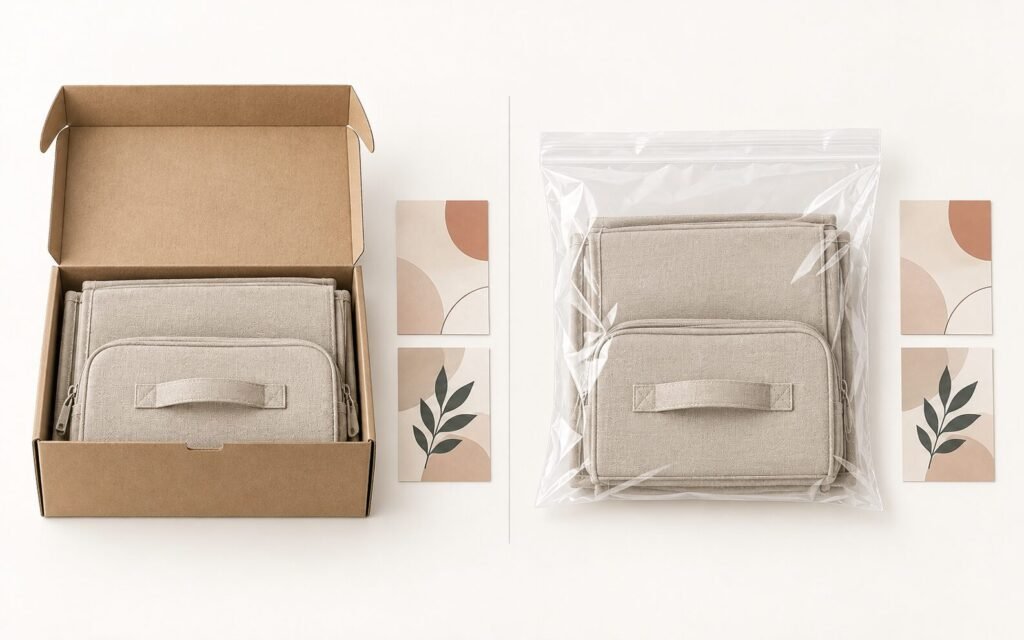
A Great Shine travel-organizer quotation contains two options with the same listed dimensions and materials. The material entry specifies 300D Oxford fabric, 210D Oxford fabric and a standard zipper. One option uses a brown box with two color inserts; the other uses a PE bag with two color inserts. Both options use FOB Shanghai as the quotation basis.
The quotation includes later component-removal notes, so the final packing list must be reconciled before placing an order. The case is used here to compare the documented packaging options, without presenting an unresolved list as the final contents of a set. Customer details and prices are omitted.
The quotation records 20 sets per carton, confirmed by Great Shine, and the same carton dimensions of 46 × 34 × 62 cm for both options. These are the quoted packing details for this configuration, not a general packing rule. They should be checked against the selected packed sample before shipment planning.
How do bag dimensions change the quotation?
Changing the finished dimensions can change fabric consumption, panel shapes, zipper length, handle placement and the packed format. The effect depends on the construction. A small dimensional change does not necessarily produce a proportional change in price.
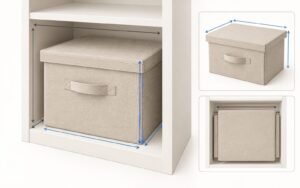
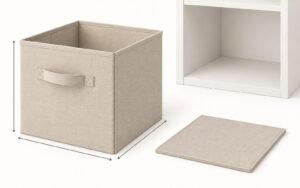
The quotation’s size list includes a 43 × 30 × 9 cm cube and a 36 × 30 × 9 cm cube. A request to enlarge one is different from a request to resize the whole range. Identify the retained component being changed and provide its revised dimensions. “Make the set bigger” leaves the supplier to decide which parts need to change.
If the selected bags are intended to nest for packing, review that fit again. A dimension change may require a different layout, revised opening or packing method. Ask whether the quote assumes the same nesting arrangement and whether a revised sample is needed.
Request the measurement basis with the new size
Record whether the dimensions are external, internal or measured flat. Use the same method for the reference and alternative. Otherwise, a supplier may price a bag with different usable space while apparently matching the requested numbers.
Also request revised packed dimensions when the change could affect packing. A product quote and a freight estimate answer different questions; the packing data connects them.
Which material details change the quoted construction?
Specify the outer fabric, coating or backing, lining and any mesh or window separately. A material label such as Oxford does not describe all the layers or identify which part of the bag uses them.
The travel-organizer quotation lists both 300D and 210D Oxford fabric. Those entries should not be read as two interchangeable grades for the entire set. Ask for the material assignment by component before proposing substitutions.
A separate Great Shine quotation from March 2025 illustrates how alternatives can be itemized: a three-piece storage-box set has lines for printed 600D Oxford, printed 210D Oxford and printed 80 gsm non-woven fabric, with the same listed dimensions and mailer-box packaging. These are alternatives for that storage-box design, not confirmation that the travel-organizer set can use the same substitutions. Their performance still needs review against the intended use.
When discussing an alternative, identify the exact change. It might affect only the main bag’s outer shell, while the smaller bags and lining remain the same. Request the supplier’s material reference or swatch so that the quoted alternative can be reviewed as a defined option.
Do not infer a durability rating from the denier number alone. A lower-cost offer is useful only if the alternative still meets the agreed use and sample requirements. Record any change to feel, appearance, care or construction that needs review.
Why do piece count and order quantity need separate fields?
Piece count describes one set. Order quantity describes how many sets will be supplied. Mixing those figures can change the scope of the order without either party noticing.
Create a final list showing how many of each bag and accessory belong in one set. Reconcile removal notes with that list and update the set name, pack artwork and assembly instructions where needed. An earlier “six-piece” description should not survive unchanged if the approved contents no longer match it.
For the travel-organizer example, 20 sets per carton describes complete selling units, not 20 individual cubes. Confirm that the quotation, packing list and carton marking use the same unit. Only calculate the total number of individual bags after the final contents of one set are agreed.
A hypothetical version with an extra small bag is a different set. Its quotation may need to account for another bag, extra assembly or packing work, and a different packed size. Do not estimate the new set price by dividing the previous total by its bag count; differently sized bags and accessories need not contribute equally to the total.
Keep color allocation visible
An order of one color and an order divided among several colors may involve different purchasing and production arrangements. Ask whether the quoted quantity applies to the total order, each color, each size or another component requirement.
For a mixed set, state whether every set contains the same color combination. A carton of assorted single bags is not equivalent to individually packed retail sets, even when the total number of bags matches.

How do accessories and branding change the scope?
List accessories as separate components of the set. Identify their count, dimensions or capacity where relevant, material reference and packing position. An accessory shown in a reference photo should not be assumed to be included in the quoted unit.
Keep optional bags and other accessories identifiable in the component list. If the customer removes an item, state whether its label, printed description or separate packaging must also be removed. Review the product photo used for approval so it does not continue to imply that a deleted item is included.
For the bags themselves, record zipper configuration, pulls, handles, straps, buckles, windows and label pockets where applicable. A seemingly small change may alter sewing or assembly steps, but the supplier must quote the actual revision before a cost difference can be stated.
Branding needs the same clarity. State which components receive a logo, its size and position, the application method and the artwork version. Adding branding to every small bag is a different scope from branding only the main bag.
Ask whether development or setup charges are included, separate, reusable on a repeat order or not applicable. Record the answer instead of treating an empty field as zero cost.
Why can packaging change a quote when the bags stay the same?
Packaging adds a deliverable to the order. Its materials, printed elements, assembly and packing arrangement should be described as precisely as the bags themselves.
The travel-organizer quotation is useful because the two lines retain the same listed product specification while changing the retail pack. The comparison is brown box plus two color inserts versus PE bag plus two color inserts. The inserts remain part of both options; the pack is not being compared with an unpackaged product.
A box does not establish a fixed cost increase over a bag. Its size, construction, print, quantity and packing method need confirmation. Ask which elements are included in the revised set price and whether any packaging charge remains separate.
Check the complete pack, including its shipping role
Confirm whether a proposed mailer box is intended as the final shipping pack, an inner retail pack or another part of the distribution setup. The name alone does not establish that it is suitable for every delivery route or retailer requirement.
Request the finished retail-pack dimensions and gross weight, sets per carton, carton dimensions and carton gross weight. Check that all figures refer to the same packing version. In this quotation, both packaging lines show the same carton dimensions and set count, while carton gross weight is unfilled. That does not establish a shipping-cost difference between the options. Review the actual packs and complete the missing weight before estimating freight.
Keep channel-specific work visible. Barcode application, instruction inserts, retail sleeves and carton markings should be listed if required. This avoids a quote that covers the bags but leaves the brand to arrange essential packing work after production.
Keep the commercial basis fixed while comparing options
Use the same currency, price unit, order quantity and delivery basis when reviewing a configuration change. Note the quote date and validity. An older price and a current price may differ for reasons beyond the design change.
The U.S. International Trade Administration’s pro forma invoice guidance identifies unit and total prices, dimensions, delivery terms and other transaction details as useful quotation information. For a set, the unit description should make its contents clear.
Separate recurring product charges from one-time or order-level charges. If a sample, print setup or inspection is charged separately, record what triggers that cost. Do not automatically add it to every repeat order or assume that it disappears on the next one.
For a comparison on a defined basis, multiply the price per set by the number of sets, then add confirmed separate charges that apply to that basis. Count each charge once. Leave unresolved costs visible instead of presenting an incomplete figure as a final landed cost.
Send a change request the supplier can price
Use the following sequence for each alternative. Keep the approved or quoted reference configuration attached so that unchanged details remain identifiable.
- Name the quote reference, date and specification revision.
- Identify the affected bag, accessory or packaging item.
- Describe the requested change with a drawing, dimensions, material reference or artwork file.
- List what should remain unchanged, including set contents and order allocation where applicable.
- Request the revised price per set and any separate charges.
- Ask for changes to packed dimensions, carton quantity, sample requirements and timing.
- Record the selected option and issue a consolidated specification before ordering.
For example, a packaging-only request for the travel-organizer set could read:
Please quote a brown-box option and a PE-bag option, both with two color inserts. Use the same final approved component list, dimensions, materials and order quantity. Confirm each retail pack’s dimensions and gross weight, the carton packing and any separately charged work. Identify any exception to the unchanged product specification.
This is an example of a buyer’s request, not a quotation or a commitment to a particular price. It works because the supplier can see the changed item and the scope that should stay fixed.
Check whether a proposed saving changes the offer
When a supplier offers a lower-cost alternative, ask which components or operations have changed. Review the proposed saving alongside the revised contents, handling and presentation. The selected set should match the product description the customer will see.
Review the sample and the retail contents together. Confirm whether existing photos, instructions or artwork still describe the selected configuration. A removed component should not remain pictured as an included item.
This article covers changes within one set configuration. If you are comparing different suppliers, use our guide to why storage bag quotes differ between factories, which focuses on matching specifications and quotation scope across offers.
Frequently asked questions
Does a bigger bag always cost more?
Do not assume a fixed direction or percentage from size alone. Ask the supplier to quote the revised dimensions and identify changes to materials, construction and packing. The effect depends on the particular design and production arrangement.
Is a price per bag useful for a mixed-size set?
It can be useful for internal analysis, but it should not replace the agreed price per complete selling unit. Dividing a set price equally among differently sized bags can hide the role of accessories and packaging.
Can I request several options in one inquiry?
Yes. Define one reference configuration and give each alternative its own identifier. Change one variable at a time when you want to understand its effect, and ask the supplier to state any linked changes.
Does a container-based quote establish the MOQ for every order?
No. The travel-organizer quotation gives separate price columns based on a 20-foot general-purpose container and a 40-foot high-cube container. That is the quantity basis of that offer, not a universal MOQ. Request the applicable basis for your own order allocation.
Should shipping be included in the configuration comparison?
Compare the product options on the same delivery basis, then assess the relevant shipping costs using their confirmed packing data. Do not mix a product-only offer with one that includes additional transport and treat the difference as a material cost.
When should I request a revised sample?
Ask when a change affects fit, construction, handling, appearance or packing. The appropriate review may involve a complete bag, a component or the packaged set. Agree on what evidence is needed before approving the revised specification.
Prepare your set for quotation
Send the contents of one set, dimensions for each component, material references, accessory counts and order allocation. Include the packaging option and delivery basis you want quoted. Review Great Shine’s custom storage bag options when choosing a format, then identify the exact configuration for quotation.