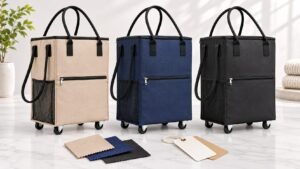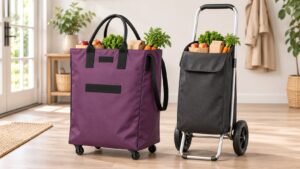
Illustrative image; confirm actual model specifications with the supplier.
A grocery bag with wheels can make it easier to move shopping from the store to the car, through an apartment hallway or across a market. But the biggest bag is not necessarily the best one. A bag that holds more than a shopper can safely lift, fits poorly in the trunk or becomes unstable when loaded can be less useful than a smaller, well-designed rolling grocery bag.
Quick answer: Start with the amount and type of groceries you usually buy. Choose a compact wheeled bag for frequent small trips, a medium model for mixed weekly shopping, or a larger rolling tote for bulky household supplies. Check usable capacity, tested load rating, wheel clearance, handle comfort and the space needed to fold or store the bag.
1. Choose a Grocery Bag for the Way You Shop
A grocery bag with wheels can take several forms. A soft rolling tote has a flexible body and a supportive wheel-bearing base. A traditional grocery trolley uses a frame and usually larger wheels. The soft tote format can be useful in supermarkets and apartments, while a framed trolley may be more appropriate on routes with uneven pavements.
Do not choose by appearance alone. Think about the complete journey: loading groceries, moving through the checkout area, lifting the bag into a car, crossing a doorway and unloading at home. A product that works well in the aisle may still be awkward at the trunk.
For a broader comparison of trolley and tote types, read our guide to the best shopping bag on wheels.
2. Grocery Bag with Wheels Size Chart: Small, Medium and Large
There is no universal sizing standard for rolling grocery bags. Two models sold as “large” may differ considerably in internal width, base shape, opening size and usable volume. A useful size chart should describe the space available for groceries, not just the external measurements including wheels and handles.
The following are illustrative internal dimensions for planning a product range. They are not Great Shine stock specifications, measured samples or load ratings.
How to calculate volume: Multiply the usable internal length, width and height in centimeters, then divide by 1,000. For example, 40 × 30 × 45 ÷ 1,000 = 54 liters.
The result is a geometric estimate. Curved corners, support boards, linings, pockets and tapered shapes can reduce actual usable capacity. A flexible bag may also change shape when loaded. Confirm real capacity with a physical sample and a consistent measurement method.
Which size should you choose?
Choose small if the bag needs to fit beside a seat or in a tight hallway. Choose medium if you regularly mix cartons, produce and packaged food. Consider large if you often buy bulky items, but check whether the loaded product can still be lifted or unloaded safely. The number of grocery bags a tote can hold varies with the shopping bag size and contents, so it is better to measure actual representative goods.
3. What Should a Large Rolling Tote Bag Be Able to Carry?
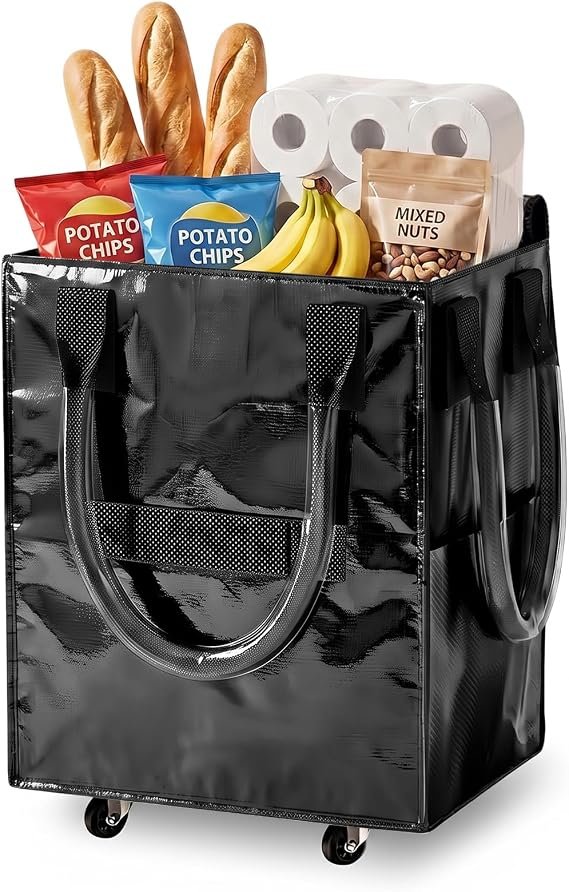
A large rolling tote bag can have more room for cereal boxes, paper products and other bulky purchases. However, capacity in liters and load capacity in kilograms or pounds measure different things. A full tote of paper products can weigh much less than a partially filled tote of bottled water.
A responsible product specification should distinguish between load during rolling, hand carrying and static placement. The claims must be supported by a test appropriate to the chosen model. Never assume that a higher bag volume means a higher safe load.
When packing a rolling grocery bag:
- Place heavier, stable items low and distribute them across the base.
- Keep delicate produce, bread and eggs above hard or dense items.
- Avoid filling beyond the closure or obstructing the wheels with loose straps.
- Keep liquids in sealed containers and follow the product’s intended load and cleaning instructions.
If the route involves stairs, do not use a standard soft tote as a stair-climbing cart unless it has been designed and validated for that purpose.
4. Check the Opening, Handles and Wheel Layout
Opening: easy loading without losing support
A wide opening helps shoppers place square cartons and bulky goods inside without force. A zipper or other closure can help retain contents, but only if the bag is packed within its intended dimensions. Open-top designs may provide quicker access for tall items, while a closed design may be more useful when contents must be contained.
Handles: plan for both rolling and lifting
A shopping tote with wheels is still a bag that users may need to lift over a threshold or into a vehicle. Consider carry-handle length, grip comfort, attachment strength and the position of the handles when the bag is full. A telescopic pull handle is useful in some configurations, but it should be evaluated for clearance, comfortable height and locking performance.
Wheels: maneuverability and surface conditions
Illustrative image; confirm actual model specifications with the supplier.
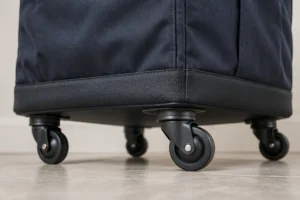
Multiple small swivel wheels can make turning convenient on smooth supermarket floors. Wheel diameter, tread, mounting and the shape of the base affect the ride on thresholds and pavement joints. A bag should remain stable when turning under a representative load. Check for wheel-to-fabric contact, twisting at mounting points and uneven weight distribution.
5. Choose Fabric and Cleaning Features for Groceries
A rolling grocery bag is often used near wet produce, dust and spills. Wipe-clean coated fabrics may be convenient, but the finished material, stitching and closures determine how the bag behaves. Water-resistant fabric does not make the complete bag waterproof.
For grocery-focused designs, consider whether the interior is accessible for cleaning and whether separate pouches or compartments would help organize small items. For chilled food, a normal fabric rolling bag is not a replacement for an insulated cooler. If temperature protection is needed, review a separately validated insulated design and appropriate ice packs or other cold-storage measures.
For product developers, compare fabric weight, coating, appearance, abrasion behavior and cleanability together with the target price. A material that looks good in a showroom may not be the easiest to maintain after repeated grocery trips.
6. Will the Bag Fit in a Car Trunk or Small Apartment?
Illustrative image; confirm actual model specifications with the supplier.
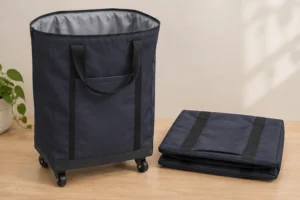
A foldable shopping bag with wheels can be attractive to shoppers who have limited storage. Compare the bag’s full dimensions, folded dimensions, weight and wheel or handle protrusions. A foldable bag is only useful if it can be folded without an awkward process or damage to the support structure.
Ask the supplier for a demonstration of the actual model, including opening, packing representative goods, unloading and folding. Check whether the base is fixed or removable and whether the folded unit stays compact without forcing the fabric or hardware.
For a retailer or an online brand, these measurements also affect packaging, shelf allocation and transport planning. Verify the final packed size before using it to estimate freight or marketplace fulfillment costs.
7. For Brands and Retailers: Build a Size Range Around Buyer Needs
A grocery bag program can be more useful when its sizes are developed as an intentional range. Instead of choosing three sizes simply because they are available, map each size to an actual shopping behavior and sales channel.
Great Shine Houseware Ltd. develops custom fabric storage and shopping bag solutions for global brands and retailers. We can review the intended grocery bag structure, material, size range, wheel arrangement, branding and packaging before sampling. For selected products, projects can start from 500 pieces; actual MOQ, lead time and test requirements depend on the final configuration.
If you are planning a small, medium and large rolling grocery bag collection, send us your reference images, sales market, preferred materials, target quantity and required load performance. We can discuss a practical development direction rather than simply quote a similar-looking bag.
Explore our custom shopping bags and trolley carts program and request a custom quote.
Frequently Asked Questions
What size grocery bag with wheels should I buy?
A medium model is a reasonable starting point for mixed household groceries. For smaller, more frequent trips, a compact model can be easier to move and lift. For bulky purchases, consider a larger model with sufficient verified load capacity and a stable base.
How many liters should a rolling grocery bag hold?
There is no single recommended volume. Choose according to the goods you buy, your route and your ability to lift or unload the bag. The example sizes in this guide range from 35 to about 87 liters in geometric volume; actual usable capacity depends on the construction.
Is a grocery bag with wheels better than a shopping trolley?
A soft rolling bag can be convenient on smooth surfaces and may be easier to store, depending on its design. A traditional framed trolley with larger wheels may be better suited to uneven pavement. Compare the route and handling needs rather than assuming one type is always superior.
Can I use a regular rolling grocery bag for frozen food?
A standard soft-sided shopping bag does not necessarily provide insulation. For frozen or chilled food, use a suitable insulated solution and follow appropriate cold-food handling practices.
Can brands customize grocery bags with wheels in different sizes?
Yes. OEM/ODM development can include body dimensions, fabric, wheels, base construction, handles, branding and packaging. The sample and test requirements should be agreed for each size before bulk orders.
Final Takeaway
The best grocery bag with wheels is not just the largest bag. It is a bag that fits the shopper’s groceries, route, lifting needs and storage space. For brands and retailers, a clearly defined size range and verified product specifications can support better shopping decisions and reduce avoidable product misunderstandings. Start with the user’s routine, then develop the bag around it.