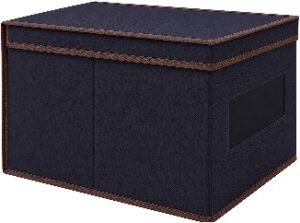
Two factories can receive the same storage bag photo and quote different prices because each has priced a different specification or scope of work. The fabric, finished size and handle construction may differ. One quotation may include retail packaging and a service that the other lists separately.
Even when the specifications match, storage bag quotes can differ because suppliers purchase materials and organize production differently. Their overheads and margins also vary. First establish what each price includes, then assess the saving against the sample and order requirements.
Quick answer: compare the specification before the price
Send both factories the same written requirements for materials, finished dimensions, components, order quantities and packaging. Ask each to identify deviations and list included and excluded charges. Compare the same currency, price unit and delivery basis, then review samples against that specification.
A photo is a useful reference for appearance. It cannot confirm fabric weight, seam construction, packed dimensions or the terms behind a quotation. Keep unresolved details visible until the supplier answers them.
Why a matching photo does not mean a matching product
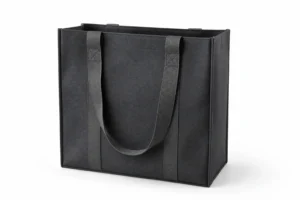
A storage bag’s exterior can hide differences that matter during use. Two bags may share a rectangular shape, clear window and zipper, while using different fabric constructions, window materials or handle attachments.
An under-bed bag mainly pulled from beneath a bed has different handling needs from a moving bag carried while full. If the inquiry says only “quote this style,” the suppliers may assume different uses and price accordingly.
Begin with a short description of what customers will store, where they will use the bag and how they will move it. Then identify the features that must match. If you are still choosing a format, review the relevant custom storage bag options before requesting comparable quotations.
Ask factories to put any proposed alternatives on separate lines. A lower-cost construction can be worth considering, but it should remain distinguishable from the specification you originally requested.
Which material details should both factories quote?
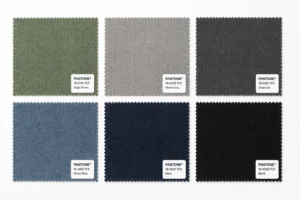
Request a description of each material layer and component, rather than relying on a general name such as “Oxford” or “heavy-duty fabric.” A broad description leaves room for different interpretations.
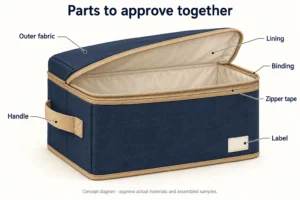
For the outer fabric, record the fiber or polymer, fabric construction and agreed weight or other relevant specification. Include the backing, coating or lamination when required. For a lined bag, describe the lining separately.
If a supplier uses a denier value, do not treat that number as a complete finished-fabric specification. Ask what else defines the quoted material and obtain a swatch for approval. The finished bag still needs to be evaluated for its intended use.
For a bag with a clear window, identify the window material, thickness and attachment. For a bag with support panels, record their material and dimensions. A quote that leaves those details open is not yet directly comparable to one that specifies them.
Mark material references with a version or sample code. “Same as the sample” is useful only if both parties can identify which sample the quotation covers.
How do size and construction affect the comparison?
Compare finished dimensions using the same measurement method. State the length, width and height, the unit of measurement and whether the bag is open, filled or laid flat when measured.
A product described only by its capacity can leave its proportions unclear. A taller bag and a wider bag may be inconvenient in different storage spaces even if their stated capacity is similar. Include any shelf or under-bed clearance the product must fit.
Handles, seams and reinforcement
Specify the number and position of handles, along with the intended way to carry or pull the bag. Ask each supplier to describe the handle attachment and any reinforcement included in its price.
During sample review, inspect the attachment on both sides where accessible. Confirm whether the handle design in the sample matches the quoted construction. If you require a load claim, agree on a test method and acceptance criteria rather than accepting an unsupported description such as “extra strong.”
For seams, identify the construction or an approved sample reference. Ask where binding or reinforcement is included. The supplier should identify proposed construction changes that affect your requirements, even if you leave the production method to its team.
Zippers and other components
Record the zipper type and size where specified, the number of sliders and the pull style. Identify hook-and-loop closures, buckles, label pockets or other components individually.
For vacuum storage bags, the corresponding comparison should cover the film specification, closure, valve and any included pump. Do not compare a pump-and-bag set with a bag-only refill using the same price-per-unit label. This is a quotation scope issue before it is a price issue.
Are both prices based on the same quantity?
Match the order quantity and its split by size, color and artwork. A quote for one standard color may use a different basis from a quote for several custom colors, even when the total number of bags is the same.
Ask whether MOQ applies to the order, each size, each color or a particular component. Request quantity breaks using the same product specification so you can see what changes with volume.
Clarify what one quoted unit means. It might be one bag, a retail set or a carton. If a set contains different sizes, list its contents. Record the price per agreed selling unit and the number of bags in that unit.
Also compare quote dates and validity periods. If you need a current decision, ask both suppliers to refresh their prices against the same brief. A price from an earlier inquiry should not be treated as a current offer without confirmation.
Is the packaging actually the same?
Specify both retail packaging and transport packaging. A plain individual bag, printed sleeve and retail carton are different deliverables, even when each supplier describes its offer as “packed.”
For the retail unit, confirm the packaging material, print requirements, barcode placement and any insert or instruction sheet. State whether the supplier will apply your labels or only supply the product for later labeling.
For shipment planning, request:
- Folded product dimensions and finished retail-pack dimensions.
- Retail units per shipping carton.
- Shipping carton dimensions and gross weight.
- Any separate packing or labeling charge.
Use the packed sample to check those details before relying on them for freight estimates. An attractive unit price can still produce a higher shipping estimate if the quoted packing arrangement occupies more space. Conversely, a compact pack may be unsuitable if it damages the product or makes assembly difficult.
Keep any packaging change visible in the comparison. If a supplier proposes removing an insert or changing the retail pack, ask for the revised cost as an alternative.
From a Great Shine quote: one set with two packaging options
In a September 2026 quotation, Great Shine priced two packaging options for a dog travel organizer set. We confirmed that this configuration could be ordered at 500 sets.
Both quotation lines listed one 37 × 15 × 30 cm bag and two 14.5 × 14.5 × 13.5 cm bags. The material and accessory entries were the same: 600D Oxford/PU, 210D Oxford, mesh and silicone bowls. Both options used FOB Shanghai as the quoted delivery basis.
- Option A included a PP bag.
- Option B included a PP bag plus a mailer box and carried a higher quoted price.
A buyer who needs a mailer box should ask every supplier to include it in the base quote. Keep a PP-bag-only offer as a separate alternative, and confirm the packed dimensions and gross weight before estimating freight.
This example comes from two options in a single Great Shine quotation. The customer name and prices are omitted. The 500-set order quantity applies to this configuration; confirm quantities separately for other products or specifications.
Which costs are included, excluded or still unknown?
Ask for an itemized list of charges outside the product price. A blank field should mean “not confirmed,” not “free.”
Possible items to clarify include sample development, sample delivery, print setup, custom tooling where needed, testing, third-party inspection and special packaging. These are questions to ask, not charges that every factory will apply.
For each item, record whether it is included in the unit price, charged separately, not applicable or awaiting confirmation. Note whether a separate charge is per unit, per order or a one-time development cost. If a sample charge is refundable, record the conditions rather than assuming it will be credited.
The U.S. International Trade Administration’s quotation and pro forma invoice guidance identifies unit and total prices, dimensions, delivery terms, payment terms and validity dates as useful quotation details. The same level of clarity helps a buyer compare two offers without filling gaps with assumptions.
Match the delivery basis
A factory collection price and a price covering additional transport cannot be compared as though they include the same service. Record the agreed trade term, named place or port, and applicable version.
ICC’s Incoterms® 2020 rules allocate responsibilities, costs and risks between buyer and seller. Confirm the appropriate rule with your logistics provider and ask suppliers to quote on a common basis. If they cannot, list the additional buyer-paid costs needed to reach the same destination.
Keep payment terms separate. Compare the deposit, balance-payment trigger and bank or payment charges, where applicable. Two offers with the same total can still require different amounts of cash at different stages.
How to use a storage bag quotation comparison sheet
Copy this table into your quotation worksheet. Fill in your requirements first, then record each supplier’s written answers. A blank cell means the detail is not confirmed. Use the last column for the question, quote reference or sample code needed to resolve a difference.
| Quotation item | Your requirement | Factory A | Factory B | Questions / reference |
|---|---|---|---|---|
| Product reference and contents of one set | ||||
| Fabric, lining, coating and components | ||||
| Finished dimensions and measurement method | ||||
| Handles, seams, zippers and reinforcement | ||||
| Order quantity and size/color split | ||||
| Retail packaging, labels and inserts | ||||
| Units per carton, carton size and gross weight | ||||
| Unit price, currency and price unit | ||||
| Delivery term and named place or port | ||||
| Separate fees and their charging basis | ||||
| Sample approval, lead time and payment terms | ||||
| Quote date, validity and specification version |
Work through the sheet in this order:
- Confirm the exact product and the price unit, including the contents of any set.
- Match the material, measurements and component specifications.
- Align quantities, color splits and packaging requirements.
- Record the currency, delivery basis and quote validity.
- Separate included services from additional or unresolved charges.
- Request revised quotations for every material difference before comparing totals.
Once the product and quantity match, calculate the cost on the same delivery basis. Start with the product price multiplied by the agreed number of units. Add separately charged items and the buyer-paid costs required to reach that basis, counting each cost once.
Use one reporting currency and record the exchange rate and date if conversion is necessary. Keep estimates identifiable. Leave the comparison incomplete when a material cost is unknown; a precise-looking total based on missing charges can lead to the wrong decision.
Keep first-order costs separate from repeat-order costs. A development fee paid once should remain visible in the first order comparison without automatically appearing in every future order.
A practical example: two offers that need clarification
Consider this hypothetical inquiry for an under-bed storage bag. Both suppliers receive the same photo and total quantity. Factory A returns a lower unit price with a plain individual pack. Factory B includes a printed retail sleeve and describes its handle reinforcement more precisely.
You cannot yet conclude that Factory A has weaker handles. Its quote may simply omit that detail. Nor can you conclude that Factory B offers better value, because the printed sleeve may not be part of your requirement.
Send both suppliers the same revised specification. Ask Factory A to confirm the handle construction and quote the required sleeve. Ask Factory B to confirm that its price covers the same material and finished measurements. Then compare revised prices and samples.
If the specifications and commercial scope now match, a remaining price difference may reflect the suppliers’ costs or commercial decisions. Ask whether there is a different production assumption, but accept that a supplier may not disclose its internal margin or full cost breakdown.
How do you decide after the quotations match?
Review the sample and delivery plan alongside the comparable cost. Check the written confirmations for anything still unresolved. A detailed quote makes the offer easier to assess, but production still needs to meet the approved sample.
Before placing the order, identify the approved sample and specification version. Agree on inspection points, permitted variation and how the supplier must request approval for substitutions. Confirm what happens if the delivered goods do not meet the agreed requirements.
If you need to reduce cost, ask for clearly separated alternatives. Simplifying the artwork, consolidating color variants or changing the packaging may be worth evaluating. Each alternative should state what changes and what remains the same.
Avoid asking only for a lower price while leaving the specification open. A written revision lets you decide whether the saving is worth the change before it reaches production.
Frequently asked questions
Is the cheapest storage bag quote a warning sign?
A low quote is a reason to check the details, not proof of poor quality. Confirm the product specification, price unit and excluded charges. If those match, assess the sample and supplier’s ability to meet the order requirements.
Does a higher fabric weight always justify a higher price?
Fabric weight is only one specification. Check the material construction, finish and suitability for the intended use. Ask why the proposed material is needed and assess the finished sample before paying for a difference that may not help your product.
Should I ask a factory to match a competitor’s price?
Ask it to quote the same written specification and explain any changes needed to reach your target. You can share your requirements and target budget without circulating another supplier’s confidential documents.
Why can a bulk quotation change after sampling?
Sampling may reveal a revised construction, material or packaging requirement. Ask the supplier to identify the change, explain its price effect and issue an updated quotation. Agree on the final version before authorizing bulk production.
Does a factory always quote less than a trading company?
The seller’s business model alone does not establish the best price. Compare the actual specification, services, payment terms and delivery scope. Also verify who is responsible for production coordination, inspection and resolving order problems.
Can I compare quotations before receiving samples?
Yes, for an initial shortlist, provided you record assumptions and unresolved details. Treat the result as provisional until the samples and written specification confirm what each supplier will deliver.
Request a quotation against a clear specification
When approaching Great Shine about a custom storage bag, send the intended use, reference style, finished measurements, material requirements and quantities by variant. Include your packaging needs and the delivery basis you want quoted.
Ask for alternatives and exclusions to be listed separately. You can send Great Shine your storage bag requirements with the same brief used for other suppliers, then compare the offer against that shared specification.