By Grace Ji, Sales Director at Great Shine · Updated August 2026
If you sell storage bags on Amazon FBA, 2026 has not been kind to your margins. Three things happened simultaneously:
January 2026: Amazon revised FBA fulfillment fees, adjusting size-tier thresholds and weight-based pricing. Products sitting on the borderline between tiers jumped into higher brackets.
April 2026: Amazon applied a 3.5% fuel and logistics surcharge on top of all FBA fulfillment fees for the US and Canada. Not a one-time charge — it applies to every single unit shipped through FBA, indefinitely.
Throughout 2025–2026: Amazon cut FBA storage capacity by up to 75%, restricting sellers from 450 cubic feet down to 130. You can no longer send full-container loads to Amazon. You need to ship in smaller batches, manage your IPI score obsessively, and pay close attention to long-term storage fees.
Combined effect: most storage bag sellers have seen a 5–8% increase in total FBA costs per unit in 2026 — without any change to their product, their listing, or their pricing strategy.
The question isn’t “should I raise my price?” (that kills conversions). The question is: “What can I do at the factory level to recover that margin?”
After 16 years on the factory side supplying Amazon sellers across 50+ countries, I’ve identified 7 specific, measurable actions you can take with your manufacturer to offset 2026 FBA cost increases. Each one has a real dollar value attached. Together, they can recover $1.50–3.00 per unit — more than the 2026 surcharge cost you.
Why Storage Bags Are Uniquely Vulnerable to FBA Fee Changes
Storage bags sit in a painful sweet spot of Amazon’s fee structure:
1. Dimensional Weight Trap
Storage bags are lightweight but bulky. A fabric storage bin weighs 1.5 lbs but ships in a 12×12×12 inch carton. Amazon’s dimensional weight formula may charge you for 2+ lbs of “weight” even though the actual weight is 1.5 lbs. If your carton is even 1 inch larger than the tier threshold, you jump to a higher fee bracket — silently, without any notification.
2. Seasonal Volume Spikes
Storage bags peak in Q4 (moving season, holiday organization) and Q1 (New Year decluttering). Amazon’s capacity restrictions hit hardest during these exact peaks — the time when you need the most inventory is when Amazon gives you the least space.
3. High Return Rate Category
The storage bag category historically has higher return rates (6–8%) than average Amazon products (4–5%). Returns consume FBA capacity (returned units re-enter your inventory), trigger return processing fees, and lower your IPI score — which further restricts your storage capacity. It’s a vicious cycle: returns → lower IPI → less capacity → more stockouts → lower BSR → less organic traffic → more PPC spend → tighter margins.
4. The 3.5% Surcharge Multiplier
The 2026 fuel surcharge doesn’t just add 0.14perunitona4.00 fee. It compounds with every other cost layer. A product that already has a high fulfillment fee (Large Standard tier) now pays 3.5% more on that higher fee. The surcharge penalizes the most — the products that haven’t been optimized for dimensional weight.
Lever 1: Dimensional Weight Optimization via K/D Folding
Potential savings: $1.50–2.50 per unit
K/D (knock-down) folding is the single most impactful thing your manufacturer can do to offset 2026 fee increases. Here’s why:
The FBA Size Tier System
Amazon charges different fulfillment fees based on product size. The tiers are:
A storage bag that’s 14×11×0.5″ when flat-packed fits Small Standard. The same bag in a 16×13×3″ box jumps to Large Standard. That 2-inch difference costs you $1.50–2.50 per unit in fulfillment fees.
On a 10,000-unit order, that’s $15,000–25,000 in avoidable fees — more than the 3.5% surcharge costs you across the entire order.
How K/D Folding Works
A storage bag that’s 12×12×8″ assembled can fold flat to 12×12×1.5″ for shipping. The bag uses:
- Collapsible structure: fabric panels with flexible seams that fold flat
- Removable rigid inserts: cardboard or plastic stiffeners that the customer inserts after unpacking (optional)
- Compression straps: hold the bag flat during transit
What to Ask Your Manufacturer
“Can you design K/D folding to keep the shipping carton under Small Standard size tier? Calculate the Amazon dimensional weight with our exact carton dimensions before we approve production.”
A manufacturer who understands Amazon FBA will run the fee calculator simulation with your actual carton dimensions before production approval. If they can shave 1 inch off the carton to drop a tier, they should do it — because that $1.50/unit savings is your margin.
Lever 2: Packaging Tier Drop — Small Standard vs Large Standard
Potential savings: $1.50–2.50 per unit (same as Lever 1, different approach)
Even without K/D folding, there are packaging-level optimizations that can drop your product to a lower FBA tier:
Approach 1: Vacuum Compression for Bulky Items
For bags with thick padding, insulation, or multiple layers, vacuum compression reduces shipping volume by 40–60%. A vacuum-sealed storage bag that’s 14×12×4 uncompressed can ship at 14×12×1 vacuum-sealed.
Cost: vacuum bags + sealing machine at the factory — approximately 0.05–0.10perunit.Savings:1.50–2.50 per unit if the compression drops you to Small Standard.
Approach 2: Tuck-in Design
“Loose, bulky materials skew dimensions” — this is Amazon’s own advice. A storage bag with floppy handles, unstructured sides, or protruding zippers may measure 16×13×3 in Amazon’s scanner even though the product is designed for 14×11×1.5.
Solution: design the bag so all protruding elements (handles, zippers, tags) tuck inside when packed. A “snug” package measures smaller in Amazon’s dimensional scanners.
Approach 3: Carton Optimization
Your outer carton dimensions directly affect whether the shipment triggers Amazon’s oversize surcharges. Design your carton to be:
- ≤ 18″ on the longest side (stays in Standard tier)
- ≤ 14″ on the median side
- ≤ 8″ on the shortest side
- ≤ 50 lb total weight (Amazon’s per-carton limit)
If your carton exceeds any of these, you pay oversize surcharges on the entire carton — not just the oversized dimension.
Lever 3: Return Rate Reduction via Monthly Review Audit
Potential savings: $0.28–0.56 per unit
Returns are the hidden FBA fee that most sellers don’t calculate. In 2026, with tighter capacity limits, every returned unit costs you three times:
- Refund to customer — you lose the sale
- Return processing fee — Amazon charges per returned unit
- Capacity consumption — the returned unit re-enters your FBA inventory, consuming precious space that counts against your IPI-restricted limit
If your return rate is 7% on a 24.99storagebag,andeachreturncostsyou8 in fees + lost product, you’re losing $0.56 per unit sold — before you even account for the IPI impact.
The Monthly Review Audit System
This is a system we run for our top FBA buyers. Here’s exactly how it works:
Step 1: Mine Your Reviews (Monthly)
Pull your top 20 negative reviews from Amazon. Read each one. Categorize the complaint:
Step 2: Mine Competitor Reviews
Pull the top 5 competitors’ negative reviews. Same analysis. You’re looking for problems they have that you can solve — or problems you both have that you can fix first.
Step 3: Classify and Prioritize
Sort issues by frequency. If “zipper broke” appears in 8 of 20 reviews, that’s your #1 priority. If “color mismatch” appears once, it’s lower priority.
Step 4: Propose Engineering Fixes
Work with your manufacturer to propose specific fixes. Here are the most common ones:
Step 5: A/B Test Before Next Bulk
Your manufacturer produces an updated sample with the engineering fix. You approve it. The next bulk order ships with the fix. No more guessing — you’ve addressed the root cause before 10,000 more defective units reach customers.
Step 6: Track Results Over 90 Days
Return rate trend is the KPI. Here’s what our buyers typically see:
The Math
The 0.29perunitsavingsmorethanoffsetsthe2026fuelsurcharge(0.14/unit on a $4 fee). And that’s before counting the IPI score recovery — which gives you back storage capacity, which lets you send more inventory, which improves BSR ranking, which increases organic sales. The flywheel effect.
Lever 4: Batch Shipping with Free Factory Storage
Potential savings: $0.30–0.50 per unit in avoided long-term storage fees
With Amazon cutting storage capacity by up to 75%, you can’t send full-container loads to FBA anymore. But you still need to produce at volume to get good tiered pricing. The solution: batch shipping with factory-side storage.
How It Works
- Produce your full order (e.g., 10,000 units) at once — getting the best 10,000-pc tier pricing
- We store 60–70% in our China warehouse — free for 1–2 months
- Ship 2,000–3,000 units to FBA initially
- Replenish in batches as sell-through dictates — every 2–4 weeks
- Seasonal buffering: produce in off-peak (Feb–May), store, ship in peak (Oct–Dec)
What This Solves
The Cost
At Great Shine, factory storage is free for 1–2 months — included in your OEM package. Some factories charge 0.02–0.05perunitpermonthforwarehousestorage.Eitherway,it′sdramaticallycheaperthanAmazon′slong−termstoragefees(6.15 per cubic foot per month for items stored 181+ days, as of 2026).
Lever 5: FBA Labeling Compliance — No Rejection Fees
Potential savings: $0.20–0.30 per unit + eliminates inbound rejection
When Amazon rejects your inbound shipment for labeling non-compliance, the costs compound:
- Return shipping fee — Amazon charges to return the rejected shipment
- Repackaging fee — you pay a third-party to fix the labels
- Reshipping fee — you pay to send it back to Amazon
- Time cost — 5–14 days of lost sellable inventory while this happens
- Stockout risk — if this was your only inventory, you lose BSR ranking
The 5 Most Common Rejection Reasons
What Your Manufacturer Should Handle
All of these should be handled at the factory — before the product ships. At Great Shine, every unit gets:
- FNSKU barcode (matte-printed)
- Suffocation warning (printed on poly bag)
- Made in China label (on every unit + outer carton)
- Outer carton FBA labels (2 per carton: top + side)
- Heat-sealed poly bags (1.5mil+)
- Carton weight verification (≤50 lb per carton)
All included in your OEM package — no separate labeling invoice.
Lever 6: Insert Cards That Prevent “Soft” Returns
Potential savings: $0.15–0.25 per unit
15–25% of storage bag returns are “soft” returns — the product is fine, but the buyer’s experience was bad. No instructions. No unboxing moment. No size reference. The buyer feels underwhelmed and returns for “not as described.”
The 3 Insert Card Strategies
Strategy 1: 3-Step Visual Folding Guide (Prevents “No Instructions” Returns)
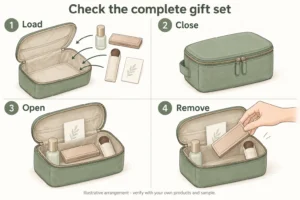
A 4×6 inch card with 3 simple line-drawing diagrams showing how to fold/assemble/use the bag. No text-heavy manual — just 3 pictures. Cost: $0.05–0.08 per card. Eliminates “confusing” and “can’t figure out” return reasons.
Strategy 2: Capacity Reference Card (Prevents “Not as Described” Returns)
Print actual dimensions in inches and cm, plus a capacity reference: “Holds 4 heavy blankets” or “Fits 15 folded sweaters.” This gives the buyer a mental model before they open the box — eliminating the “smaller than expected” surprise.
Cost: included in the insert card ($0.05–0.08). Eliminates “smaller than expected” and “not as described” returns.
Strategy 3: Brand Story Card (Prevents “Feels Cheap” Returns)
A branded card with your logo, a 2-sentence brand story, and a care note (“Wipe clean with damp cloth. Do not machine wash.”). This transforms the perceived value from “factory direct” to “real brand” — the difference between a 4.2-star and 4.6-star review average.
Cost: $0.10–0.15 per card. Eliminates “feels cheap” and “low quality” returns.
The Total Math
On a 10,000-unit order, 2,000ininsertcardspreventsapproximately1,500–2,500 in soft returns. Break-even within the first order.
Lever 7: Material Upgrades That Eliminate Failure Returns
Potential savings: $0.28 per unit (after net cost)
The cheapest fabric isn’t the cheapest option. Here’s the cost-benefit analysis:
The PVC-to-PU Switch
If your supplier uses PVC coating (the default for “waterproof Oxford” without specified coating), you’re getting:
- Chemical odor returns (phthalate off-gassing)
- OEKO-TEX certification failure
- Prop 65 non-compliance
- “Smells like chemicals” reviews that tank your listing
The fix: Specify “PU coating, OEKO-TEX certified” in your PO.
On a 10,000-unit order with 0.4 yards per bag:
- Additional PU cost: 0.03×0.4×10,000=120
- Returns prevented: (2.8% − 0.3%) × 10,000 × 8=2,000
- **Net savings: 1,880∗∗(0.19/unit)
The Non-Woven-to-Oxford Upgrade
If you’re using 80gsm non-woven for a “durable” product, you’re getting:
- Handle tear-out returns (3–6 months)
- Bottom abrasion returns (3–6 months)
- “Flimsy” and “ripped after one use” reviews
The fix: Upgrade to 600D Oxford with PU coating.
Even after the 0.42materialupgrade,yousave0.44 per unit in reduced returns. Net positive from Day 1.
The Full Margin Recovery Model
Let’s model all 7 levers on a 10,000-unit storage bag order:
Before optimization: Your per-unit FBA cost in 2026 is approximately $10.20 (fulfillment + surcharge + returns + storage + labeling).
After optimization: 10.20−3.97 = $6.23 per unit.
That’s a 39% reduction in total FBA-related costs — achieved entirely through factory-side actions. No price increase. No PPC change. No listing edit.
On a 10,000-unit order: $39,700 in recovered margin.
What to Ask Your Manufacturer Before Your Next Order
Add these 7 questions to your next supplier communication:
“Can you calculate Amazon dimensional weight for my product before production?” If they can’t, they don’t understand your FBA costs.
“Can you design K/D or flat-pack folding to reduce carton size?” A 1-inch reduction can drop you to a lower FBA tier — saving $1.50–2.50/unit.
“Do you offer free storage in China for batch shipping to FBA?” If they charge, you’re paying Amazon long-term storage fees instead — which cost more.
“What’s your return rate reduction program?” If they don’t have one, your returns will keep eating your margin and IPI score.
“Do you use PU coating or PVC coating on waterproof fabrics?” PVC = odor returns. PU = odor-free, OEKO-TEX certifiable. Always specify PU.
“Are FNSKU labels matte-printed?” Glossy labels fail Amazon infrared scan. Your shipment gets rejected. Specify matte.
“Can you include insert cards with folding guide, capacity reference, and brand story?” 0.20/unitininsertcardsprevents0.20+/unit in soft returns. Break-even in one order.
FAQ
How much will the 2026 Amazon FBA fee changes cost me?
The 3.5% fuel surcharge adds approximately 0.14perunitona4.00 fulfillment fee. Combined with the January fee revision and storage capacity cuts, most storage bag sellers see a 5–8% increase in total FBA costs per unit. However, factory-side optimizations (K/D folding, return rate reduction, batch shipping) can recover $3.97 per unit — far exceeding the surcharge.
How can I reduce my Amazon FBA fees for storage bags?
Seven factory-side levers: (1) K/D folding to drop dimensional weight tier, saving 1.50–2.50/unit;(2)vacuumcompressionandtuck−indesignfortierdrop;(3)monthlyreturnrateaudit,saving0.29/unit; (4) free factory storage for batch shipping, saving 0.30/unit;(5)FBAlabelingcompliance,eliminatingrejectionfees;(6)insertcardspreventingsoftreturns,saving0.20/unit; (7) material upgrades (PU coating, Oxford fabric), saving $0.21/unit net.
What is K/D folding and how does it save FBA fees?
Knock-down (K/D) folding compresses your storage bag flat for shipping. A 12×12×8″ bag folds to 12×12×1.5″, dropping dimensional weight by 70% and keeping the carton in Amazon’s Small Standard size tier. This saves $1.50–2.50 per unit in fulfillment fees. Ask your manufacturer to calculate Amazon dimensional weight before production approval.
How does return rate affect my Amazon FBA costs in 2026?
Returns cost three times: refund, return processing fee, and FBA capacity consumption. With 2026’s tighter storage limits, each returned unit that re-enters inventory consumes precious space. Reducing return rate from 6.8% to 3.1% saves $0.29 per unit and protects your IPI score for better storage capacity. A monthly review audit with engineering fixes can achieve this within 90 days.
Can my manufacturer help reduce Amazon FBA costs?
Yes — if they understand Amazon. A manufacturer who serves FBA sellers should handle: dimensional weight optimization, K/D folding design, free factory storage for batch shipping, FBA-compliant labeling (matte-printed), insert cards, and monthly return rate audits. All included in your OEM package. See our Amazon FBA solutions for details.
What is batch shipping to Amazon FBA?
Batch shipping means producing your full order at once (lower unit cost) but shipping to Amazon FBA in smaller batches at intervals you choose. Your manufacturer stores the rest in their China warehouse free. This avoids Amazon long-term storage fees, manages IPI score, and prevents capacity-limit violations. We offer 1–2 months free storage — included in every OEM order.
Should I switch from PVC to PU coating for my storage bags?
Yes. PVC coating off-gasses phthalates, fails OEKO-TEX certification, triggers Prop 65 non-compliance, and causes “chemical smell” returns. PU coating costs 0.03–0.08moreperyardbuteliminates90120 additional material cost saves $1,880 in returns. See our fabric selection guide for the complete material comparison.
How much can I save by optimizing my Amazon FBA supply chain?
Across all 7 levers (K/D folding, tier drop, return audit, batch shipping, labeling compliance, insert cards, material upgrades), the total per-unit savings is approximately 3.97.Ona10,000−unitorder,that′s39,700 in recovered margin — all from factory-side actions, with no price increase or PPC changes needed. Contact us to run this optimization on your specific product.
Grace Ji is Sales Director at Great Shine, a Chinese OEM manufacturer of storage bags and organizers for Amazon FBA sellers worldwide. We provide free dimensional optimization, free 1–2 month China storage, batch shipping to FBA, matte-printed FBA labeling, insert cards, and monthly return rate audits — all included in your OEM package. Contact her at grace@g-shine07.com to run the margin recovery model on your product.