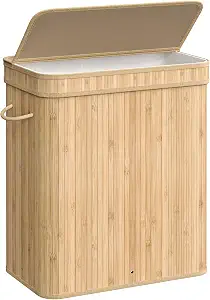
A bamboo laundry basket is a container for collecting or carrying laundry that uses bamboo in its body, frame, handles, or other structural parts. Many designs combine bamboo with a fabric liner, metal fittings, or a separate base. The name does not mean every component is bamboo.
Quick answer: Choose a bamboo laundry basket by its construction and daily use. A slatted basket, a fabric hamper with a bamboo frame, and a portable basket with bamboo handles behave differently. Check where laundry enters, how it leaves, what the user lifts, and how each component is cleaned. For brands and retailers, those details explain the product more accurately than broad claims about natural materials.
Which parts of a bamboo laundry basket are actually bamboo?
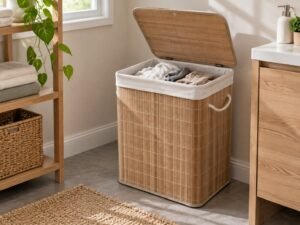
The bamboo may form most of the visible shell, only the supporting frame, or a small set of handles. A useful product description identifies those parts separately.
A product called a bamboo-frame hamper may contain a large fabric body. Show that construction in the main image and name the fabric separately so customers understand what the title describes.
The liner deserves its own description. Its fiber composition, care instructions, and attachment method cannot be inferred from the bamboo exterior. In the United States, the FTC also distinguishes actual bamboo fiber from rayon or viscose made using bamboo as a source. See the FTC’s bamboo textile guidance.
Bamboo slat or panel body
A slatted design uses narrow bamboo pieces around the basket’s sides. Those pieces may be joined to a flexible backing or supported by another structure, depending on the model.
This construction gives the basket a visible bamboo surface. It can also create several edges and joins that should feel smooth where users handle the product.
Look inside as well as outside. The inner surface, rim, and base connection affect how a liner sits and whether loose clothing could catch during loading or removal.
Bamboo frame with a fabric body
A frame design uses bamboo members to support a textile bag or body. The laundry sits mainly inside the fabric, while the frame maintains the opening and overall shape.
Some frames fold, while others remain assembled. A folding frame can make an empty hamper easier to store, but its joints and opening mechanism become important parts of the user experience.
The fabric bag may be removable, or it may be attached in a way intended only for assembly. Product copy should make that distinction clear.
Bamboo handles on another material
A basket can have bamboo handles while most of its body uses another material. The handles may provide a firm grip and a visible natural finish.
In this case, describe the body material just as clearly as the handle material. Customers deciding how to clean or carry the basket need both pieces of information.
The handle’s presence alone does not establish a load rating. Its shape, attachment, surrounding fabric, and intended use determine whether the filled basket is practical to lift.
Lids, bases, liners, and fittings
A lid may use bamboo, fabric, a supporting board, or a combination of materials. A base can also differ from the visible side walls.
Metal hinges, fasteners, and fabric bindings may be small, but they influence folding, stability, and cleaning. They also mean the finished product contains more than the main advertised material.
For buyers comparing samples, a component list is useful. It explains what the product is made from without requiring the customer to guess from a lifestyle photograph.
Is a bamboo laundry basket the same as a hamper?
The terms overlap, but a laundry hamper usually refers to a container where worn clothes wait before washing. A laundry basket often refers to a container used to carry laundry, although retailers use both names for similar products.
A bamboo laundry hamper may stay in a bedroom while its removable liner travels to the washing machine. A portable basket may move through the whole routine, from collecting clothing to carrying clean laundry back.
The product’s actual handling method is more important than the name. A large upright container with small decorative grips may be intended to remain in place.
Collection and transport are different jobs
Collecting laundry requires an accessible opening, enough usable space, and a stable position. Transport requires a manageable load and reliable places to grip.
A design can perform both jobs, but that should be demonstrated. A tall basket that works well beside a wardrobe may feel awkward on a narrow staircase.
Buyers should consider the complete route. Doorways, turns, steps, and the distance to the laundry area affect whether the user should carry the whole basket or remove its contents.
A removable liner can connect the two jobs
A liner can hold the clothing inside a decorative outer structure and then lift out for transport. This allows the bamboo body to remain where it is.
However, not every removable liner is intended to carry a full load by its top edge or ties. The carrying method must match the liner’s design and instructions.
Photograph the liner’s approved lifting points. Where dedicated handles are provided, show how users reach and grip them after releasing the liner from the rim.
Regional naming should remain understandable
For US and European shoppers, “basket” and “hamper” can both be useful terms. The surrounding description should explain whether the product collects, sorts, carries, or combines those functions.
There is no need to force both terms into every sentence. A clear title and one explanation of the intended use can resolve most confusion.
For wholesale buyers, naming consistency also helps keep packaging, product listings, and assembly instructions aligned. Customers should not have to work out whether three different names refer to the same item.
How does a bamboo laundry basket fit into a laundry routine?
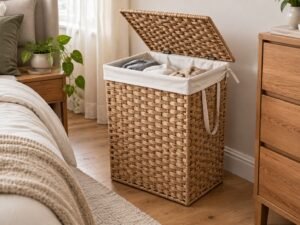
A bamboo laundry basket provides a place for worn clothing until the user moves it to the laundry area. Its usefulness depends on whether loading, emptying, and cleaning are easy in the household where it is used.
Think through the routine from the first garment to the empty basket. Problems often appear between those steps, even when the product looks suitable while standing empty.
Dropping clothes into the basket
The opening should suit the items the household uses. Small clothing can pass through a narrow opening, while towels or bulky layers may need more room.
A lid can make the room look tidier, but it adds an action each time someone uses the basket. Check whether the user can open it comfortably while holding laundry.
The opening should also remain usable at the planned location. A hamper beneath a shelf may have enough floor space but too little clearance to raise its lid.
Holding laundry between washes
Usable capacity depends on the interior shape, liner position, and type of clothing. An advertised volume does not tell a customer exactly how many days of laundry it will hold.
Bulky towels take up space differently from lightweight shirts. A household that washes little and often may need a different design from one that stores several categories between wash days.
Avoid relying on claims such as “one week’s laundry” without context. A photo with named example contents is more useful than a household-size promise that assumes every routine is the same.
Emptying the container
A large opening can make it easier to remove a filled liner. A narrow rim may catch bulky clothing or require the user to pull the bag out at an awkward angle.
Try emptying the basket when the liner is realistically filled. This shows whether the liner’s attachments release easily and whether the body remains stable during removal.
If the whole basket is intended to move, check the grip positions. Handles that are comfortable when empty may be less comfortable under a representative load.
Returning the liner and resetting the basket
After washing or emptying, the liner should be straightforward to refit. Ties, loops, hook-and-loop fasteners, or a folded rim each create a different routine.
A system that requires careful adjustment every time may frustrate frequent users. The liner should stay in place while clothes enter, while remaining removable when that function is advertised.
Retail demonstrations can show this reset step. It is often missing from product images, even though customers repeat it throughout the product’s life.
What are the main types of bamboo laundry basket?

The main types include open baskets, lidded hampers, divided sorters, collapsible designs, and fabric hampers with bamboo frames or handles. These descriptions can overlap within one product.
Choose the type by the customer’s routine and room. A feature useful in a utility room may have less value in a small bedroom.
Open bamboo laundry baskets
An open basket gives direct access to the contents. The user can add or remove clothing without moving a lid.
This can suit frequent laundry handling or a container kept in a less visible space. It also makes it easy to see when the basket is becoming full.
The tradeoff is that the contents remain visible. An open top also does not guarantee that clothing buried at the bottom will dry, especially when the basket is tightly filled.
A bamboo laundry basket with lid
A bamboo laundry basket with lid can conceal worn clothing and create a more finished appearance in a bedroom or bathroom. The lid should be easy to open at the intended location.
Check whether it lifts off, hinges upward, or folds back. A removable lid needs somewhere to rest; a hinged lid needs clearance and a suitable attachment.
A lid is not proof of odor control. Moisture, the condition of the contents, ventilation, and cleaning all affect how the basket performs between wash days.
Divided laundry hampers
A divided hamper provides separate spaces for the categories a household wants to keep apart. These might be different people’s clothes or groups intended for separate wash routines.
The divider may be fixed, flexible, or formed by separate liner bags. Each approach affects how much space one side can borrow when the other side is nearly empty.
Check how each section empties. A sorter is easier to understand when the product presentation shows whether users lift one bag, remove both bags, or carry the whole frame.
Collapsible bamboo-frame hampers
A collapsible design can reduce the space occupied by the empty product. It may suit occasional use, compact storage, or an assortment where packaged size matters.
Folding introduces joints, pivots, or other moving points. The sample should open into a stable working shape and remain there during normal loading.
Do not assume the folded dimensions from a photograph. Measure the product in the exact state in which it will be stored or supplied, including any detached parts.
Baskets with removable liners
A removable liner can separate laundry from the basket’s inner surfaces. It may also make emptying and cleaning more convenient if its construction supports those uses.
“Removable” and “machine washable” are different claims. A liner can detach while still requiring a limited cleaning method.
For a retail buyer, liner access is worth showing clearly. It can be a strong practical feature when the customer understands how to remove, carry, wash, and refit it.
Are bamboo laundry baskets good?
Bamboo laundry baskets can be useful when their structure suits the room, their handling method suits the laundry routine, and their care needs are realistic for the user. Bamboo alone does not guarantee those results.
The visible material can be part of the appeal. The decision should also consider the liner, base, joints, handles, and any moving components.
Where they can work well
A bamboo exterior or frame can suit a room where the laundry container remains visible. The product can serve an everyday function while matching other household furnishings.
A removable-liner model may also help users keep the outer basket in place. This can be convenient when the basket has a defined corner or sits beside furniture.
A brand can present the basket in the room where it belongs and show the liner moving to the laundry area. Customers can then judge whether that arrangement would work in their own homes.
Where another design may be more practical
A household that frequently handles wet, muddy, or dripping items may need a container designed for those conditions. A decorative bamboo basket should not be assumed suitable for soaking or repeated heavy wetting.
A user who carries laundry over a long distance may prioritize weight and grip over appearance. A person with limited floor space may need a shape that fits a narrow location.
These situations do not rule out every bamboo product. They show why the complete construction and intended use matter more than the material name.
What cannot be judged from appearance
A smooth product photograph cannot establish joint strength, coating durability, liner shrinkage, or resistance to repeated moisture exposure. Those points require product-specific information and appropriate evaluation.
A buyer can inspect a sample for visible defects and practical handling, but a brief inspection is not a substitute for a formal test where a performance claim depends on one.
Record the observations from the sample review separately from test reports. A smooth edge or easy-to-remove liner can be observed directly; a durability claim may require further evidence.
How do you choose a basket that fits the room?
Choose a bamboo laundry basket using its full outside dimensions, opening clearance, and normal handling space. The floor footprint is only part of the fit.
A basket that occupies an empty corner can still obstruct a drawer, door, or route through the room. Measure the intended position before selecting capacity or shape.
Allow space for the lid and liner
A hinged lid needs room to move. A lift-off lid needs a temporary resting place. A removable liner needs room to rise above the rim.
Check these actions together. A basket may fit under a counter while making its advertised removable liner difficult to extract.
For online listings, a drawing or photograph that shows the open state can answer this question. Closed product dimensions alone may leave an important part of the user’s decision unresolved.
Consider the full shape
Rectangular baskets can align with walls or furniture. Rounded baskets may suit a different room layout, but their maximum width may not represent the usable space at every height.
Tapered designs can also have less room at the base than their top opening suggests. A liner may narrow the interior further.
Explain shape with clear photographs from more than one angle. Perspective can make a slim basket appear wider or conceal the way a base projects beyond the body.
Think about where the laundry travels
The route to the washing machine affects the best handling method. A removable liner may suit a stationary decorative basket, while a portable design needs comfortable grips and manageable dimensions.
Check doorways and stairs when relevant. A wide basket can be inconvenient even if the laundry inside is not especially heavy.
A useful product demonstration includes an ordinary carrying position. It should show the real grip and keep the load within the product’s intended use, without implying a tested capacity that has not been established.
How much capacity does a bamboo laundry basket need?
The right capacity depends on the laundry types, wash frequency, and way the contents will be moved. A larger basket is useful only if the household can fill, empty, and carry it comfortably.
For a retailer, it helps to distinguish external dimensions from usable interior capacity. The frame, liner, divider, and base can all occupy space that does not hold laundry.
Start with the user’s laundry group
Consider what the basket is intended to collect. Everyday clothing, bath towels, and bedding have different shapes and bulk.
A basket intended for a bedroom may mainly receive clothing. One near a family bathroom may receive larger towels. A divided hamper may allocate only part of its total capacity to each category.
Show the example contents beside the basket and identify them in the caption. Customers can compare that load with their own laundry without treating one garment count as a universal capacity measure.
Decide how often it will be emptied
A user who washes frequently may prefer a smaller, accessible basket. A longer interval between laundry days can make additional capacity useful, but only within the available space.
The basket also needs to be emptied before it becomes difficult to handle. Filling a container to its physical limit is not always the same as using it comfortably.
This is especially relevant for removable liners. A large liner can hold more clothing than a user wants to lift in one movement.
Check capacity with the actual liner
A liner that hangs above the base, folds inward, or leaves unused space at the corners can reduce practical capacity. Overly tight attachments may also pull its opening smaller than the basket’s rim.
Test the fitted assembly with representative dry laundry. Observe whether the liner stays in place and whether the lid still closes normally.
These observations can guide product presentation. They do not justify a precise load rating unless the relevant assessment supports that number.
Keep volume and load separate
Liters describe volume. Kilograms or pounds describe mass. A volume figure cannot tell the buyer what the handles or base can safely support.
Two equally full baskets can weigh differently because their contents differ. Wet fabric can also create a different load from the dry clothing used in a demonstration.
Product listings should state each measurement only when it is supported. If no verified carrying limit is available, avoid adding one from an unrelated model or a supplier’s general catalog.
What makes a bamboo laundry basket comfortable to handle?
Comfort depends on the grip, balance, opening, and way the product behaves with laundry inside. Those details deserve as much attention as its empty appearance.
A useful evaluation follows the actions users repeat: lift the lid, add clothing, remove the liner, carry the load, and put the product back in place.
Handle shape and contact area
Handles should provide a usable grip without rough edges or awkward pressure points. A narrow hard edge may feel acceptable when empty and uncomfortable with a filled basket.
Consider where the user’s fingers sit and whether the hands contact adjacent bamboo edges, fabric seams, or metal fittings. The complete grip area matters.
Load the sample with representative laundry and use only its intended grips. Check the hand-contact surfaces again while carrying it; decorative parts should not be used as substitute handles.
Balance and load position
A basket can tilt if its load shifts or if one handle is much easier to reach than the other. A removable liner may also pull unevenly when clothing accumulates on one side.
Look at how the user naturally approaches the product. A design placed against a wall may leave one handle less accessible.
The solution may involve placement, a different handle arrangement, or using the liner for transport. The right choice depends on the routine the product is supposed to support.
Rim and opening details
A comfortable rim helps when users reach into the basket or refit a liner. Rough edges, exposed fasteners, or tight corners can make those actions unpleasant.
Check the inner surfaces that do not appear in the main product photograph. The underside of a lid and the inside of a handle opening may receive regular contact.
The liner should also stay clear of moving joints. Fabric that repeatedly catches can make a folding feature difficult to use even when the frame itself operates correctly.
Stability during ordinary use
A basket should stand as intended on the type of floor for which it is designed. Check whether all supporting points contact the floor and whether the frame stays open during loading.
Set up a folding model using its supplied instructions, then place laundry unevenly inside it. Observe whether the frame remains in its intended working position throughout ordinary loading and emptying.
Any concerns about stability should be resolved in the design or instructions before the product is presented as ready for retail use. Appearance cannot compensate for a basket that moves unexpectedly during routine handling.
Can a bamboo laundry basket be used in a bathroom?
A bamboo laundry basket may suit a bathroom if the specific product is intended for that setting and can be kept away from repeated splashing and standing water. The bamboo label alone does not establish wet-room suitability.
Bathrooms vary. A spacious, ventilated room with a dry storage corner creates different conditions from a small room where the basket sits beside a shower.
Choose a dry position
Keep the basket away from areas where water repeatedly collects or splashes onto the base. Consider what happens during cleaning as well as during bathing.
A floor that is regularly washed may leave the lower edges damp. A position that looks dry in a staged photograph may not remain dry in daily use.
If the intended setting involves frequent wetting, ask for specific guidance on the complete product. Surface finish, joints, backing, and base material all affect the answer.
Do not rely on a coating alone
A coating can change how a bamboo surface responds to brief contact with moisture. It does not automatically make seams, cut edges, joints, or other components waterproof.
Ask what the claimed resistance covers and how the product should be cleaned. A general statement about “treated bamboo” leaves those practical questions unanswered.
Read the care instructions for the assembled basket as well as any description of its bamboo finish. Confirm that the allowed cleaning method fits the room where the product will stand.
Manage the contents as well as the room
A dry room does not prevent damp clothing from introducing moisture into the basket. Towels or exercise clothing should be handled according to their condition and the planned wash routine.
Avoid leaving wet items packed tightly inside a closed container. A lid or a few openings cannot be assumed to dry a dense pile of fabric.
A hamper is a collection point for laundry. It should not be marketed as a drying device unless the product has a separate, supported function designed for that purpose.
How do you clean a bamboo laundry basket?
Clean the bamboo structure and the liner according to their separate care instructions. The method suitable for a removable fabric bag may be unsuitable for the frame, base, or finish.
Start by emptying the product. Remove the liner if the design allows it, then inspect the interior, rim, and base for dirt or trapped fabric.
Care for the bamboo structure
Use the cleaning method approved for the product’s finish and construction. Where a lightly damp cloth is permitted, avoid saturating the material and dry the surface afterward.
Do not assume that soaking, steam cleaning, or strong chemicals are appropriate. Adhesives, backing materials, coatings, and fittings may respond differently from the visible bamboo.
The seller’s instructions should name the permitted cleaning method and any drying step. Customers should be able to follow them after ordinary household use without guessing what ‘easy to clean’ allows.
Check the liner’s own label
A removable liner may be machine washable, hand washable, or limited to another cleaning method. Its fiber content and construction should guide the instruction.
Check whether handles, stiffeners, coatings, or trims have different requirements. If a liner includes detachable components, the instructions should explain whether they must be removed.
Refit the liner only when it is ready for use under those instructions. A wet liner can keep moisture against the outer structure, especially around corners and the base.
Make routine inspection manageable
Look at the rim, handle attachments, lid connections, and folding joints while the basket is empty. Check for rough areas, loose fittings, or parts that no longer sit correctly.
If the product shows damage, follow the seller’s repair or replacement guidance. Do not continue carrying a filled basket by a visibly failing handle.
This inspection can be part of the normal cleaning routine. It does not need to become a complicated maintenance schedule, but it should address the parts users depend on.
Provide instructions that remain available
Care information printed only on disposable packaging can disappear before the customer needs it. A durable label or an accessible product instruction page can help.
For brands, the instructions should match the finished SKU. A general care sheet covering several unrelated basket materials can create confusion.
If the liner and frame need different treatment, state each separately. Clear component instructions are more useful than a single sentence saying the entire basket is washable.
Does bamboo make the basket mold-resistant, antibacterial, or sustainable?
The use of bamboo does not, by itself, prove any of those claims for a finished laundry basket. Each claim needs its own evidence and a clear description of what it covers.
Buyers should separate visible material facts from tested performance. “Bamboo frame with removable fabric liner” describes construction. “Prevents mold” makes a much broader claim about how the product performs.
Moisture and mold claims
Product performance depends on processing, finish, environment, contents, and care. A bamboo surface can still be exposed to conditions that make a product unsuitable for continued use.
Do not treat openings between slats as a guarantee of mold prevention. A liner and tightly packed clothing can change the conditions inside the basket.
If a supplier offers a specific resistance claim, ask which material or finished product was evaluated and under what conditions. The wording used for customers should stay within that evidence.
Antibacterial claims
A statement about the source plant does not establish an antibacterial effect in a coated frame, a processed textile, or the complete basket.
For a laundry product, buyers should be especially careful about wording that implies hygiene protection. A material description is not a substitute for testing that supports the exact advertised function.
Where evidence is absent, explain the practical design. A removable liner can be cleaned according to its instructions; that fact can be useful without adding an antimicrobial promise.
Environmental claims
Bamboo is a plant-based raw material, but the finished basket may also contain adhesives, coatings, textiles, metal, or plastic. Manufacturing, use, and disposal all matter when evaluating environmental claims.
The FTC advises against broad, unqualified claims such as “green” or “eco-friendly.” Its guidance encourages specific claims that businesses can support. See the FTC summary of the Green Guides.
For a basket, a precise component statement often serves the customer better. If recycled content or certified sourcing is claimed, identify the relevant component and keep documentation that supports it.
Durability and replaceable parts
A basket that remains useful through repeated handling may offer practical value, but expected service life should not be invented. The product’s design and actual use affect the outcome.
Ask whether replacement liners or other replaceable parts are available before advertising them. A removable component is not necessarily sold separately.
If a brand plans to offer replacements, make the compatibility information clear. Customers should be able to identify the correct liner without guessing from a similar-looking photograph.
How would two different households use the same basket?
The same basket can be convenient in one home and awkward in another. Comparing ordinary use scenarios helps buyers understand which dimensions and features deserve attention.
The following examples illustrate selection decisions. They do not report customer tests or recommend a specific capacity for every household.
A bedroom with a narrow storage corner
Imagine a basket beside a wardrobe, with a shelf above it. The available floor area looks suitable for a tall lidded hamper, but the shelf limits how far the lid can open.
A removable lid might solve the clearance problem if there is a place to set it down. An open design could also work if the user is comfortable seeing the contents.
Next, consider liner removal. Even without a hinged lid, a full liner needs space to rise above the rim. Moving the entire basket before each wash may be inconvenient if the location is tight.
For this room, the most useful measurements are the outside footprint, opening height, and clearance required during emptying. The largest advertised capacity is less helpful if the basket cannot be used comfortably in its assigned position.
A shared laundry area with regular sorting
Now imagine a household that collects clothing in one shared area and sorts it before washing. A divided basket may reduce the need to separate the contents later.
However, the household may produce more laundry for one section than the other. A rigid divider can leave one side full while unused space remains beside it.
Separate removable bags might suit the routine if each bag is manageable to lift. The opening and handle placement should allow one bag to be removed without disturbing the neighboring section.
In this setting, the buyer should compare the capacity and access of each compartment. A total volume figure can hide an inconvenient split.
Translate the scenarios into product information
Both households need a laundry container, but their questions differ. One needs clearance and easy access in a restricted corner; the other needs sorting space that matches how its laundry accumulates.
A useful retail listing can answer these questions with a few specific views:
- The basket beside ordinary furniture, with its full footprint visible.
- The lid in its open position.
- The liner being removed by its intended grips.
- The interior divider or separate bags.
- The assembled and folded states, where folding is part of the design.
Those views help customers make a decision before delivery. They also give wholesale buyers a concrete way to assess whether a proposed product presentation explains the model accurately.
Keep illustrations consistent with the supplied product
Use the actual sample when photographing a commercial listing. A generated room scene can communicate a general concept, but it should not invent a different lid, handle, liner, or frame joint.
If a model changes, update the images that show those parts. An older photograph can mislead customers even when the new product looks similar from a distance.
Before using the images, compare the lid, liner, and handles with the supplied sample. A customer following the illustrated routine should encounter the same parts and attachment points.
What should retail buyers check in a bamboo basket sample?
Retail buyers should check whether the sample supports the product explanation they intend to publish. Focus on the complete laundry routine and the accuracy of the material description.
A sample review can reveal fit, access, assembly, and visible workmanship issues. It cannot prove every durability or environmental claim from a short demonstration.
Confirm the supplied configuration
Compare the sample with the intended SKU description. Identify the body, frame, lid, liner, base, handles, and fittings.
Check which components arrive assembled and which need user setup. If instructions are required, use those instructions during the review.
This establishes a clear reference for the retail offer. It also prevents photographs of one configuration from being paired with specifications for another.
Try a normal household sequence
Set up the basket, add representative dry laundry, use the lid, and remove the contents in the intended way. Refit the liner and repeat the basic actions.
Observe where the user hesitates or needs an explanation. Those moments may reveal a design issue or a missing instruction.
Keep notes specific. “The liner catches beneath the rear hinge during removal” gives a supplier something concrete to review, while “improve quality” leaves the problem undefined.
Review how the product will be shown online
Take photographs of the open basket, liner attachment, base, handle, and folded state where applicable. These views answer questions that a single room scene cannot.
Make sure dimensions and materials correspond to the version shown. If a lifestyle scene includes towels or accessories, distinguish those illustrative items from the package contents.
For Amazon sellers and other online retailers, this information can also support customer service. Staff can explain the product’s actual construction instead of repeating vague marketing phrases.
Use product options to narrow the choice
Great Shine’s bamboo laundry basket collection presents options including bamboo-frame designs, lidded hampers, and removable-liner configurations.
Use those options to identify a suitable structure, then confirm the details of the chosen model. A feature visible on one design should not be assumed available on every basket in the collection.
For a first comparison, choose the customer’s room, handling method, and preferred opening style. Those decisions usually make the remaining product choices easier to assess.
Frequently asked questions about bamboo laundry baskets
Is a bamboo laundry basket made entirely from bamboo?
Often it is not. Bamboo may form the shell, frame, lid, or handles, while the liner, base, and fittings use other materials. Read the component description and inspect the product images. A bamboo-frame fabric hamper should identify both its bamboo parts and its textile body.
Can a bamboo laundry basket hold wet towels?
Do not assume it is suitable for storing wet towels for an extended period. Follow the specific product’s instructions and avoid leaving wet laundry tightly packed inside a closed basket. If frequent wet handling is part of the intended use, choose a construction explicitly suited to those conditions.
Is a lid necessary?
A lid is useful when the customer wants to hide laundry from view. An open basket can make frequent loading and unloading easier. The better choice depends on placement, available clearance, and routine. A lid should not be treated as a guarantee of odor control or moisture protection.
Can the removable liner go in the washing machine?
Only if the liner’s care instructions allow machine washing. Removability does not establish washability, and trims or coatings may change the appropriate method. Buyers should obtain care instructions for the exact liner supplied and make those instructions available to customers after purchase.
Are bamboo laundry baskets easy to assemble?
Some arrive assembled, while others need a base, frame, liner, or other parts fitted. Check the exact product configuration. A useful sample review follows the supplied instructions from the unopened package and notes any unclear steps, missing parts, or fittings that are difficult to position.
Will a bamboo laundry basket scratch clothing?
A properly finished product should avoid exposed rough areas in places that contact clothing, but buyers should inspect the actual sample. Check the inner rim, slat edges, fasteners, and liner attachments. A liner can separate clothing from the body, although it does not excuse unfinished contact surfaces.
What is the difference between bamboo and a bamboo-look basket?
Bamboo refers to a material in the product. Bamboo-look describes an appearance that may be created using another material. Ask which components contain actual bamboo and read the full material description. Color and grain-like patterns in photographs are not enough to establish composition.
What is the best starting point for choosing a model?
Begin with where it will stand and how laundry will reach the washing machine. Then choose an open or lidded top, decide whether a removable liner is useful, and compare dimensions. Review the available bamboo laundry basket designs with those practical requirements in mind.