Every sourcing conversation reaches the same fork. You have a product concept, a factory has production lines, and the question is who actually owns the design. OEM and ODM are the two answers, and choosing between them decides your costs, your timeline, and who controls the product if the relationship ends. This guide explains both models, what each one means for intellectual property, and how the choice plays out in bags and soft goods.
The short version
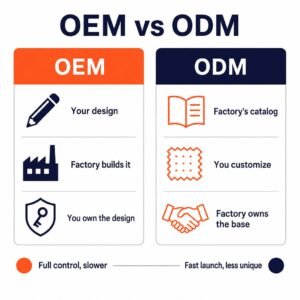
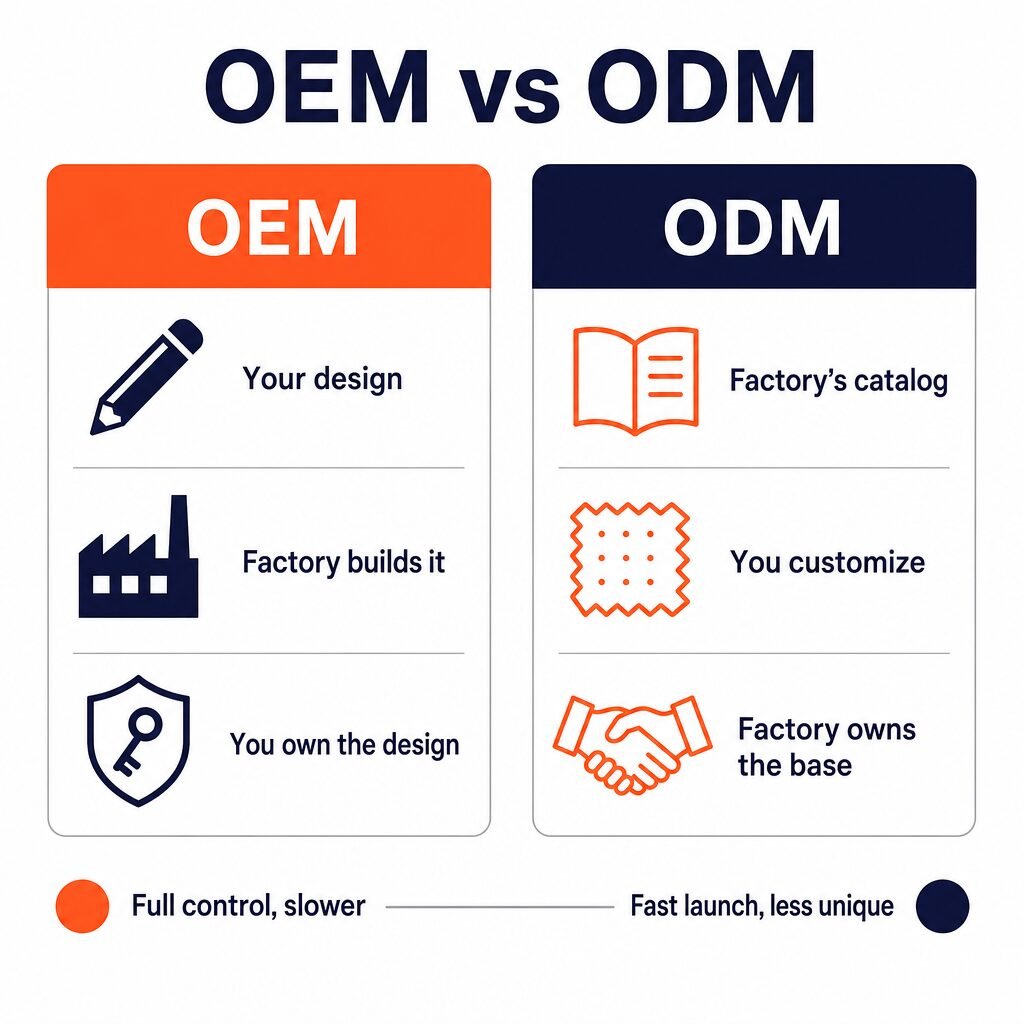
OEM, original equipment manufacturing: the factory builds your design. You bring the drawings, the specs or the reference sample, and the factory engineers it into production. You own the design and the tooling you paid for.
ODM, original design manufacturing: the factory already has the design. You pick a product from its catalog, change the fabric, color, size and logo, and it goes into production under your brand. The factory owns the base design.
Both models put your logo on the final product. The difference is who authored the product itself, and that difference follows you into pricing, exclusivity and reorders.
Who searches this and why
Mostly first-time brand founders and junior product managers, at the moment a factory asks “OEM or ODM?” on a call and the answer has budget consequences. The second group is Amazon FBA sellers comparing a custom product against a private-label catalog item, where the choice is really between margin and speed. For both, the practical questions are the same: what does each model cost to start, how long before first delivery, and what happens to the product if they switch factories later.
OEM vs ODM, side by side
| OEM | ODM | |
|---|---|---|
| Design author | You | The factory |
| Design changes | Anything the product allows | Limited to materials, colors, size, branding |
| Startup cost | Higher: development, sampling, tooling | Lower: catalog product, existing patterns |
| Time to first order | Weeks to months of development | Fast: the line already runs |
| Exclusivity | Yours by contract | Usually none: cousins of your product sell elsewhere |
| Unit price at volume | Lower at scale | Fixed by the factory’s catalog math |
| Typical time to stock | One to six months of development | One to four weeks from order to production |
There is a third column worth knowing even if you never use it. Contract manufacturing goes further than OEM: you design the product from scratch, source components, and hire the factory purely for its lines. The classic case is Apple contracting Foxconn to build the iPhone to exact specifications. Time to first stock runs three to twelve months because the manufacturing lines are built for the product. Most soft goods brands never need this model, but the word appears in the same conversations, and it marks the far end of the control-versus-speed spectrum.
What nobody tells you about each model
OEM: the hidden cost is not the tooling, it is the iterations. First samples come back wrong, seams sit where the drawing did not expect them, and each round costs weeks. Factories that quote “free design support” are quoting ODM disguised as OEM: real OEM development is engineering work and shows up in the sample fees. The upside is that the finished product is yours. If the factory relationship sours, the tech pack and patterns move with you.
ODM: the hidden cost is commoditization. The same chassis under a different logo is on someone else’s store next season, sometimes at a lower price, because another buyer picked the same catalog item with cheaper fabric. Exclusivity is negotiable: many factories will pull a design from the open catalog for a committed volume, but it has to be written into the agreement, with a duration.
How to choose in five questions
- Do you have a working design or tech pack already? If yes, OEM is the natural path. If what you have is a mood board, ODM gets you to market this year.
- Is the product your brand, or a product your brand sells? A signature design that defines the brand belongs in OEM. A catalog extension, like a sixth storage size, is ODM territory.
- What can your cash survive? OEM spends more before the first revenue. ODM keeps early cash free for marketing, which is usually where a young brand actually wins.
- Does anyone else sell something close? If the market is crowded, a catalog product fights on price. A distinct OEM design can hold margin even at lower volume.
- What happens at reorder? OEM reorders repeat cleanly because the patterns are fixed. ODM products can drift: factories quietly revise catalog designs, and your reorder differs from your first batch unless the revision is locked by an approved sample.
The middle path most brands actually take
In practice, soft goods brands run a hybrid. The first order is ODM: a catalog storage bag with custom fabric and logo, small quantity, testing the market. If it sells, the second generation moves toward OEM: structural changes, a custom mold for hardware, a pattern the factory has never run. This staging spreads development cost across revenue instead of front-loading it, and it lets the factory learn the brand on low-risk orders first.
Two contract details matter on this path. First, the approved sample is the contract for every reorder, regardless of model: what you signed is what ships. Second, if you paid for tooling or pattern development, list those items in the agreement as buyer property, or the factory can legally run them for the next customer.
Protecting the design before you share it
Before drawings leave your inbox, sourcing practice is an NNN agreement rather than a plain NDA. NNN stands for non-disclosure, non-use and non-circumvention: the factory cannot share your design, cannot run it for another customer, and cannot sell around you direct to your buyers. A standard NDA covers only the first of those three, which is why experienced buyers treat it as insufficient for manufacturing.
Two further points that come up repeatedly in practice. Contracts intended for enforcement in Chinese courts need a Chinese-language version; an English contract that a factory signs can still be unenforceable locally. And file trademarks in the markets where you actually sell, not only where you produce, because enforcement happens at the destination. For anything you consider core IP, that review belongs with a lawyer who works in the target market. For soft goods specifically, most protectable value sits in trademarks and copyrightable prints; a utility patent rarely covers a bag construction.
OEM, ODM and the words around them
Private label sits closest to ODM: your brand on a factory-designed product, usually with lighter customization. White label is the same product sold as-is to many brands, no changes at all. Contract manufacturing is the formal name for the OEM relationship when the factory runs entirely to your spec. The words blur in sales conversations, so anchor the discussion to the one question that matters: who owns the design if we part ways.
FAQ
Is OEM better quality than ODM?
No. Quality comes from the factory’s process control, not the business model. An ODM product from a disciplined factory beats an OEM product from a sloppy one every time. Audit the factory, not the label on the relationship.
Can an ODM product become my own design?
Partly. You can own your colorways, prints, sizes and packaging outright. The base construction usually stays the factory’s unless you pay for a structural redesign and have that ownership written into the contract.
Do I need a patent or just a contract?
In soft goods, most protectable value is in trademarks and copyrightable prints rather than utility patents. The contract covers the practical layer: pattern ownership, exclusivity windows and who keeps the tooling. A lawyer should review anything you consider core IP.
Why is OEM unit price lower at scale?
Because you design for your own economics. You can drop features the market ignores, choose materials priced for your volume, and build the product around your carton size. ODM pricing carries the factory’s design decisions, including the expensive ones.
What does ODM mean for MOQ?
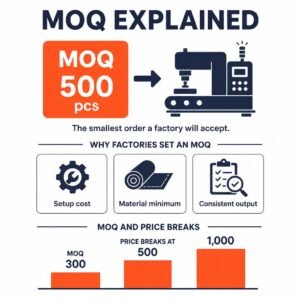
ODM minimums usually run lower, because the patterns exist and the materials are stocked. OEM development is worth the factory’s setup only at volume, so minimums climb. If you need 200 pieces of a custom design, expect the conversation to be about price, not possibility.
Related reading
MOQ meaning (how minimums behave under each model) · What is oxford fabric (the material decision inside every ODM catalog pick)