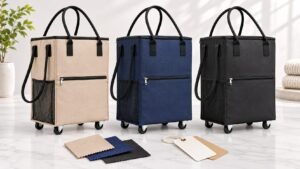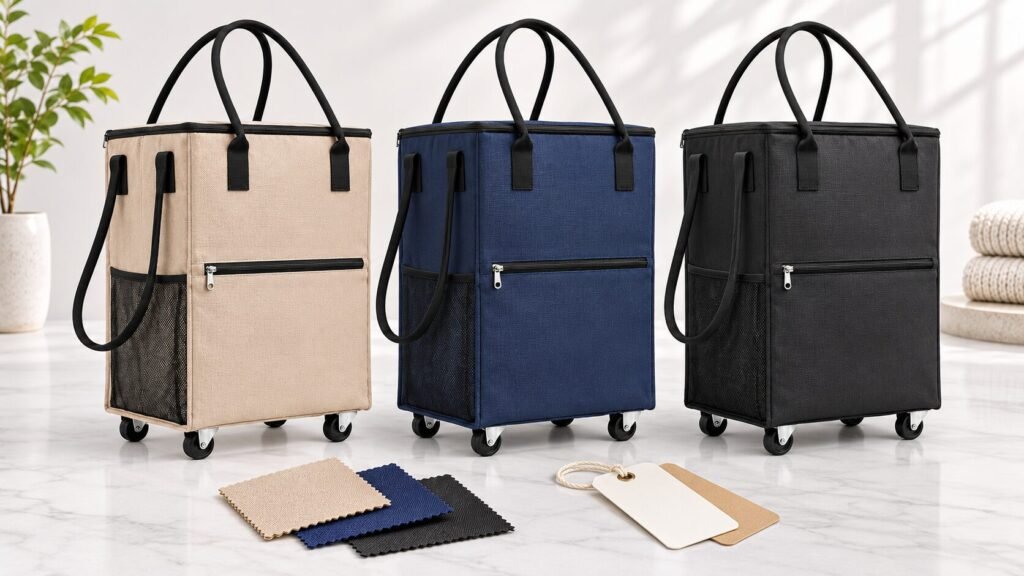
Launching a private-label rolling tote bag involves more than choosing a color and adding a logo. The wheel assembly, base support, handle attachments and folded packaging all affect how the bag performs, what customers experience and how much it costs to sell.
Quick answer: To customize rolling tote bags for your brand, define your target customer and selling channel, select a bag structure, agree on the wheel and handle configuration, approve your branding and packaging, and validate a production sample before placing a bulk order. Ask the manufacturer to quote against the same approved specification so that later changes do not undermine quality or margins.
This OEM/ODM guide is for retail buyers, brand owners and e-commerce sellers developing a soft-sided rolling shopping tote: a fabric bag with a wheel-bearing base, carry handles and a pulling handle or strap, rather than a conventional metal-frame shopping trolley.
1. Choose the right customization route: OEM or ODM
Decide how much of the product you want to develop before requesting prices. A new wheel system or base structure is a different project from simply changing the color of an existing design.
| Development route | What changes | When to choose it |
|---|---|---|
| Private label on an existing model | Approved colors, logo, label and packaging | Testing a new category with fewer structural changes |
| ODM customization | Adapting an available design, such as its dimensions, pockets or trim | Building a differentiated range without developing every component from scratch |
| OEM development | Manufacturing to your own approved drawings and specifications | Launching a distinct product that requires a new or substantially revised construction |
Confirm design ownership, permitted use of existing components, tooling requirements and any applicable intellectual property restrictions in writing. The terms OEM and ODM alone do not determine exclusivity or ownership. For a broader explanation, see our OEM vs. ODM guide.
2. Which rolling tote bag features can you customize?
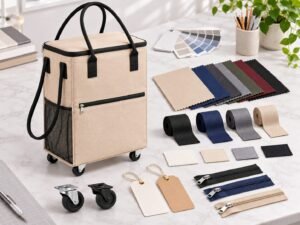
Start with the features that influence customer experience. A coordinated color range can make your assortment more distinctive, but a wheel that binds or a handle that tears can quickly become a return or negative review.
| Feature | Customization options | Buyer approval point |
|---|---|---|
| Bag body | Dimensions, fabric, colors, opening and pocket layout | Capacity, ease of access and appearance when loaded |
| Wheels | Available wheel size, type, mounting and color | Smooth movement, turning and stability on intended surfaces |
| Base support | Board or base assembly appropriate to the selected design | Ground clearance and resistance to sagging under the intended load |
| Handles | Webbing length, grip, pulling strap and attachment construction | Comfort and secure stitching when carrying or pulling |
| Branding | Printed logos, woven labels or other feasible branding methods | Artwork, placement, color and appearance on the actual fabric |
| Packaging | Hangtags, labels, protective bags or retail cartons | Presentation, barcode placement and packed dimensions |
Not every combination is compatible with every model. A larger body can require changes to base stiffness or handle attachment, and a different wheel assembly may affect ground clearance and folded size. Review these changes together before approving the sample. Our grocery bags with wheels size and design guide provides additional guidance on selecting dimensions.
3. Turn customer complaints into measurable quality requirements
For retailers and online sellers, product reliability matters more than a long list of technical specifications. Translate likely failure points into sample acceptance checks before ordering. The following is a suggested buyer checklist, not a report of completed Great Shine tests or a claim that every model meets a particular load rating.
| Potential customer complaint | What to check on the sample |
|---|---|
| Wheels wobble, jam or detach | Roll the loaded bag on agreed surfaces, including turns and suitable thresholds. Inspect mounting points afterwards. |
| Base bends or scrapes the floor | Distribute the agreed load inside the bag and check base deflection, clearance and wheel alignment. |
| Carry handle or pulling strap tears | Check attachment points and perform repeated lifting or pulling under the agreed conditions. |
| Bag is difficult to close or fold | Test access at the intended fill level and repeat the folding sequence. Check zipper operation if a zipper is included. |
| Reorders differ from the first shipment | Approve the component specification, color reference and pre-production sample; agree how substitutions must be authorized. |
For each performance requirement, agree the load, surface, number of cycles, sample quantity and acceptance criteria. A rolling-load result does not automatically establish a safe hand-carrying load. Claims about waterproofing, stair climbing or load capacity should only be made for configurations with relevant supporting evidence.
4. Create a retail-ready design without increasing avoidable costs
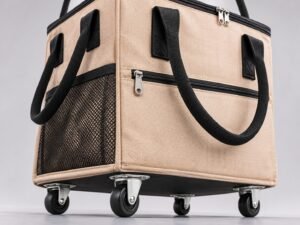
Chain retailers often need a consistent assortment, accurate labels and predictable replenishment. E-commerce brands also need to consider parcel dimensions, buyer expectations and the appearance of the product in listing images.
Start with one or two well-defined models rather than too many small variations. Use a coordinated color and branding system across the range, and review which components can be shared without compromising performance.
Before approving the packaging, measure the actual folded and packed sample. Check that the wheel assembly, handles and coated surfaces are protected. Confirm individual packaging, barcode location, carton quantity and carton dimensions. A more compact package is useful only if the bag arrives undamaged and can be unfolded easily by the customer.
For more than one sales channel, consider whether the same product can use different retail or e-commerce packaging without changing the approved product itself.
5. How to develop a custom rolling tote with a manufacturer
A clear development process reduces the risk of approving a sample that cannot be reproduced consistently in bulk.
- Send a product brief: describe the intended user, sales market, reference design, target quantity and price range.
- Review the construction and quotation: confirm size, wheels, base, handles, branding, packaging and any new tooling before sampling.
- Develop and review a physical sample: check appearance, dimensions, functionality and agreed performance requirements.
- Approve the final specification: record the accepted sample, artwork, components, packaging and any revisions in writing.
- Confirm bulk production: agree order quantities, lead time, inspection requirements and acceptable tolerances before production begins.
- Inspect before shipment: verify the agreed quality plan, product labeling and export packing against the approved specification.
Great Shine Houseware Ltd. supports custom fabric bag development for brand owners, wholesalers and retail programs. We can review a reference image or design brief and discuss feasible customization options before making a sample. Explore our custom shopping bags and trolley carts manufacturing program for the available product directions.
6. What affects MOQ, price and lead time?
A meaningful custom rolling tote bag quotation depends on the selected model, order quantity, material, wheel system, branding method and packaging. Custom colors, new components or molds may have separate minimum order requirements and development costs.
Ask for quantity-based pricing using identical specifications. Confirm whether the quote includes branding, individual packaging, tooling or sample charges, and identify the agreed delivery terms. Do not compare a reinforced rolling tote with a visually similar lower-cost bag until the wheel, base and handle construction have been checked.
For many sewn-product projects, a 1,000-piece order per model is a typical starting point at Great Shine; selected existing designs and available stock colors may allow a 500-piece trial order after review. Final MOQ, sample charges and delivery schedule depend on the specific rolling tote configuration and supplier component requirements.
7. Send these details to get a useful bulk quote
To reduce quotation revisions, prepare the following information:
- Target market and sales channel, such as chain retail, Amazon or a direct-to-consumer brand.
- Reference photos or drawings and desired bag dimensions.
- Intended carrying load, rolling surfaces and performance expectations.
- Preferred colors, logo artwork and branding placement.
- Expected quantity per model and color, including trial and repeat-order plans if available.
- Retail or e-commerce packaging requirements, delivery destination and target launch date.
If you only have a product concept, send the reference and your target market first. We can discuss an appropriate specification and the development route before confirming the sample arrangement.
Frequently asked questions
Can I put my own logo on a rolling tote bag?
Yes, private-label branding can be reviewed for a suitable model. Logo method and placement depend on the fabric, printing surface and artwork. Approve a physical sample or agreed branding reference before bulk production.
Can I customize the wheels and base?
Available wheel and base configurations can be evaluated against your intended use. New wheel housings or base designs may require engineering review, tooling and higher minimum quantities.
How do I prevent quality problems in repeat orders?
Keep an approved sample and a written specification for the bag body, components, stitching, branding and packaging. Agree inspection criteria and require approval for significant substitutions before production.
Can you offer a lower MOQ for a trial order?
A trial order may be feasible using an existing design and available materials or colors. The final minimum depends on component availability and customization requirements, so request a project-specific confirmation.
Develop a rolling tote bag collection for your brand
A successful rolling tote collection combines a recognizable design with dependable functional construction and practical commercial terms. Start with the customer experience, approve the product as a complete system, and confirm the production specification before ordering.
Request a custom rolling tote bag quote from Great Shine. Share your reference photos, target quantity and market so we can review your product requirements.