You open a supplier page, find the product you want, and the first thing you hit is “MOQ 500”. If you are new to wholesale, that number is a wall. This guide explains what MOQ means, why factories set one, what typical minimums look like across product categories, and what you can actually do when the number is higher than you need.
What MOQ means
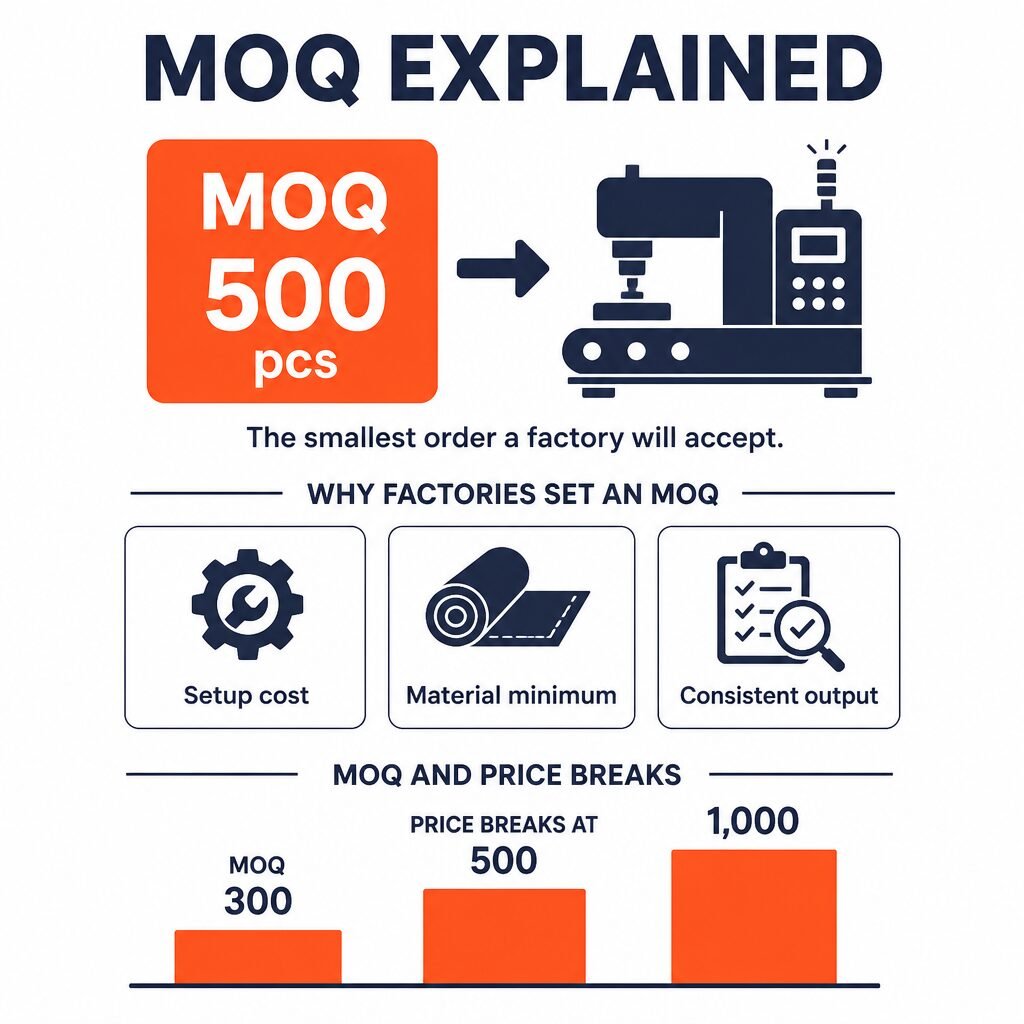
MOQ stands for minimum order quantity. It is the smallest order a supplier will accept in a single purchase, counted either in units or in order value. The definition is agreed across sourcing and inventory references: a supplier uses the MOQ to make sure each order covers its production setup and stays profitable (Netstock, Inventory Planner, Inbound Logistics).
Two versions exist. A simple MOQ is one number of units, like 500 pieces. A high-low MOQ is a range tied to pricing tiers, where ordering at the low end costs more per unit.
Either way, the MOQ is the entry ticket to the supplier’s production line, not a price by itself. Pricing tiers sit above it, and which tier you buy at matters more to your unit cost than the entry number does.
Who is really asking “what does MOQ mean”
Search data shows two very different groups type this query. Small retail buyers and first-time importers want to know if the number blocks them from ordering at all, and what happens below it. Buyers with a product idea already know the abbreviation and want to know how to get under it, because their forecast says 200 pieces and the factory says 500.
Both groups hit the same wall for the same reason: a factory does not sell pieces, it sells machine time and material rolls. Once you see the MOQ as the size of the smallest production run that makes sense for the factory, the negotiation options below become obvious.
Why suppliers set an MOQ
Four costs sit behind every minimum:
- Setup and changeover: cutting tables, printing cylinders or screens, and sewing lines are set up once per order. A 100-piece order carries the same setup cost as a 5,000-piece order, so small runs lose money unless the unit price rises sharply.
- Material economy: fabric comes in rolls and dyeing has minimums of its own. Ordering 100 meters of a custom color costs the mill a changeover, so the price per meter can double below the roll threshold.
- Quality consistency: the first pieces off a line are setup pieces. A run that is too short never reaches the stable section of the curve, so the factory cannot guarantee consistent output or quote a fair defect rate.
- Inventory and cash: some suppliers hold stock or pre-book material against your order. A tiny order freezes their cash for weeks on a small margin.
What MOQ levels look like by product type
These ranges come from public B2B platform listings and are a realistic starting map, not a rulebook. In custom soft goods, the numbers are driven by cutting efficiency and printing minimums rather than by the sewing itself:
| Product type | Typical MOQ range | What drives it |
|---|---|---|
| Custom non-woven or polyester storage bags | 300 – 1,000 pcs | Cutting table yield per fabric roll |
| Custom-printed lunch or cooler bags | 500 – 1,000 pcs | Screen or heat-transfer print setup |
| Simple cotton or canvas pouches | 100 – 500 pcs | Low setup, simple construction |
| Pet carriers with frames or padding | 300 pcs and up | Frame molding and multi-step sewing |
As a real anchor point, Made-in-China listings for custom storage and pet bags commonly quote $3.50 to $8.30 per piece at 300-piece minimums, with price breaks at 500 and 1,000 pieces. When you compare suppliers, compare the whole curve, not just the entry number.
Five ways to work with a high MOQ
- Meet the material MOQ, split it across variations. If fabric dyeing needs 500 meters total, order 250 black and 250 navy. The factory hits its material minimum and you get two SKUs instead of one giant one.
- Separate product MOQ from packaging MOQ. Custom printed boxes and hang tags carry their own minimums, often higher than the bag itself. Standard packaging for the first order, custom packaging at reorder, keeps the entry cost down.
- Offer a trial-order frame. Commit to a total volume across two or three releases: 300 pieces now, the rest at reorder. Suppliers accept staged volume more often than one-off small runs, because the total still fills their line.
- Accept a price adjustment instead of a lower MOQ. Below the efficient run size, some factories will run a smaller batch at a higher unit price. Ask for that quote explicitly rather than walking away.
- Consolidate SKUs. Three products sharing one fabric and one production line can add up to the MOQ even when no single SKU reaches it. This works especially well for storage sets, where the same material appears in three sizes.
How to calculate the order quantity that works for you
If you are the one planning orders, the standard starting point is the economic order quantity, EOQ. It balances two costs that fight each other: ordering cost, which falls when you order less often, and holding cost, which rises the longer stock sits. The formula is textbook inventory math:
EOQ = √(2 × D × S ÷ H)
| Variable | Meaning |
|---|---|
| D | Annual demand, in units |
| S | Cost per order: sourcing, samples, freight consolidation, admin |
| H | Holding cost per unit per year: storage, capital, insurance, obsolescence |
Worked example, labeled as an example rather than a real case: a brand sells 1,200 storage bags a year, each order costs about $80 in sourcing and freight admin, and holding one bag for a year costs about $1.50 in storage and tied-up cash. EOQ = √(2 × 1,200 × 80 ÷ 1.50) = √128,000, which lands near 358. Ordering roughly 360 pieces at a time minimizes the combined cost, before any supplier minimum enters the picture.
The raw EOQ is then adjusted the way inventory planners do it: check it against storage space, cash availability, shelf life or seasonality, and finally against the supplier’s MOQ. If your EOQ sits below the factory’s minimum, the five negotiation moves earlier in this guide are the bridge. If it sits above, the MOQ is not your constraint at all and the decision belongs to your cash cycle.
Reading an MOQ in a quote
When a quote lands, check three things. First, whether the MOQ counts units or order value, because a “100 pcs” MOQ and a “$1,000” MOQ behave very differently for low-priced items. Second, whether the price shown is at the MOQ tier or at a larger tier, which is where misleading comparisons come from. Third, whether tooling, printing plates or sample fees are inside or outside the MOQ price. A quote that looks 10% cheaper can cost more once a $300 print setup lands outside the unit price.
What MOQ means for landed cost
MOQ decides more than the invoice. A 300-piece order and a 1,000-piece order of the same bag ship at different freight-per-unit because carton sizes cube out differently. If you are comparing MOQ tiers, compare them at the destination: unit price plus freight plus duty, not factory price alone. FBA sellers feel this first because dimensional fees punish bulky-but-light goods, and a higher MOQ tier that cubes better can land cheaper per unit than the tier you barely qualified for.
FAQ
Is MOQ the same as a wholesale discount tier?
No. The MOQ is the entry gate. Discount tiers sit above it. A supplier with MOQ 300 and breaks at 500 and 1,000 is describing one production curve, and the MOQ is simply where the curve starts.
Can I order below MOQ?
Sometimes, at a higher unit price or with simplified customization. Some factories also run a small-stock program for standard designs. It is worth asking, but plan on the listed MOQ as the baseline case.
Does a low MOQ mean the supplier is better?
No. A low MOQ can mean stock programs, simpler production, or a trading company reselling stock. It can also mean a factory that is hungry. Judge the supplier on samples, certifications and communication, not on the entry number.
Do MOQs apply to samples?
Not in the same way. Samples are usually priced per piece at a multiple of the bulk unit price, and the fee is often credited against the first bulk order. Sample MOQs of one are normal; the MOQ in this article is about bulk production.
Why did two factories quote different MOQs for the same bag?
Different cutting efficiency, different stock fabric positions, and different order books. A factory mid-season with open line capacity quotes lower minimums than one running full. Same bag, different economics at that moment.
Does MOQ ever change after the first order?
Often. Reorders of a confirmed design skip printing setup and fabric booking, so many factories drop the reorder MOQ below the first-order minimum. Ask what the reorder minimum is before you commit.