
When choosing stackable fabric storage bins, check how the assembled box supports another filled bin, where the two boxes touch and how you will reach the contents. A lid may keep dust off without providing support for stacking. Ask for the intended stacking conditions for the exact size and construction, then review a sample with representative contents before ordering.
If each bin will sit in a separate shelf compartment, the shelf supports it. Placing one bin directly on another requires the lower bin to support the upper one. Decide which arrangement fits your space and routine before comparing products.
Can you stack fabric storage bins?
Some fabric bins are designed for direct stacking; others depend on shelving to keep them separate. Fabric describes the covering, while the panels, frame, joints and contact surfaces determine how the assembled structure behaves.
Look for a clear answer about the particular product you want to buy. A photograph of empty boxes stacked together does not establish what happens when they are filled or when someone opens the lower box. Likewise, a removable bottom board can help a bin hold its shape without making its lid suitable for supporting another bin.
If the supplier cannot confirm direct stacking for the configuration, choose individual shelf spaces or another design with documented conditions. Do not work out a supposed limit by adding boxes until a sample collapses.
Check the sides, base and lid as one structure
Ask the supplier to identify each supporting component in a drawing or an open sample. Hidden inserts are easy to miss in a finished product photo, and similar exteriors can contain different constructions.
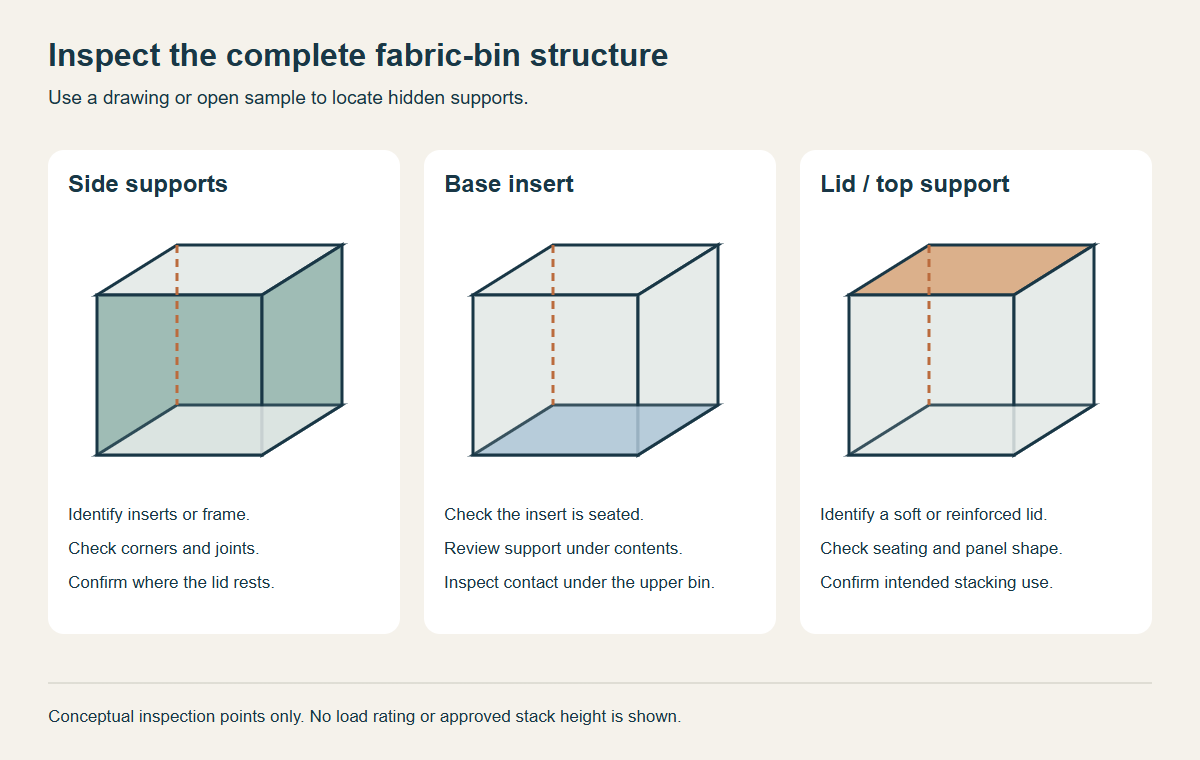
Conceptual structure diagram. The components shown are inspection points, not a specification or stacking approval for a particular model.
Side panels and frames
Side panels help the bin retain its upright shape. Depending on the design, inserts or a frame may also form part of the support beneath the lid. Check where the lid rests and how any corners, joints or removable supports connect.
Ask which panels contain inserts, what those inserts are and how they remain in position after unfolding. A fabric sleeve, cardboard panel and metal frame should not be treated as interchangeable simply because the outside dimensions match.
The bottom insert
The base supports the contents and helps maintain the bottom shape. It needs to sit in the intended position without curling up or leaving an unsupported corner. Confirm whether it is removable, folded into sections or permanently enclosed.
Check the bottom of the upper bin as well. It should contact the supporting area intended by the design. A smaller box sitting in the middle of a broad lid may load that lid differently from a matching box whose edges line up with the supports below.
The lid panel and its seating
A cover can be soft, reinforced or supported by a separate frame. Ask which construction is supplied and whether the lid is part of the stacking design. A zipper, hook-and-loop closure or fitted edge does not establish that point by itself.
Review the closed lid on a filled sample. Note gaps, bowing and whether it sits evenly. Bulging contents should not be used to prop up a lid that would otherwise lack support.
What a documented lidded box does and does not tell you
One Great Shine project specifies a lidded fabric box with external dimensions of 40 × 50 × 25 cm, 80 gsm non-woven outer fabric, 2 mm cardboard reinforcement and a front PVC window. These details describe a configuration buyers can discuss when comparing materials and access.
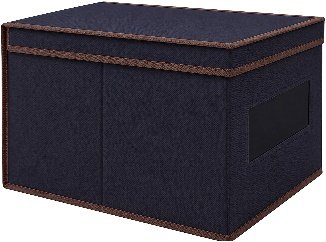
Project reference image, not a stacking test. The material record identifies the configuration; the image does not show the location of every hidden insert.
Neither the board thickness nor the presence of a lid gives this example a verified stacking capacity. A buyer who needs direct stacking should ask for the relevant panel arrangement and sample assessment for that use. Do not transfer a claim from a different size, board material or frame design.
Match the structure to what you will store
Describe the contents in enough detail for the supplier to understand their shape and distribution. Two bins that look equally full can place very different demands on the base and supporting structure.
For folded clothing, check whether the sides stay straight and the lid closes without compressing the contents. Puffy garments should not push the lid upward. If items are frequently removed, review the bin when partly full as well as normally filled.
For toys, identify the largest rigid objects and whether smaller pieces gather in one corner. Check for hard edges pressing against the lining or window. If children will use the product, discuss that intended use separately; a general household storage bin is not automatically a child-specific toy chest or a surface to climb on.
For books, tools or other concentrated loads, ask whether the design is intended for them at all. A bin presented with clothing should not inherit an assumed rating for dense objects. Include the actual item list and measured filled weight in the sample brief, rather than inventing a limit from the bin’s volume.
Decide how you will reach the lower bin
Top access usually means removing the boxes above before opening a lower one. That can suit occasional seasonal storage if the individual units can be handled as instructed. It can be inconvenient for clothing or toys used every day.
A front opening may improve access, but inspect what happens when it opens. Confirm whether the design permits opening the lower unit while another bin remains above, and whether its supporting structure stays in place. A viewing window alone is not an opening.
Measure the space needed to operate the flap or zipper and lift out the largest item. Check that handles, window edges or adjacent furniture do not obstruct the action. Avoid pulling a lower bin forward while it supports other boxes unless the supplier’s instructions expressly permit that operation.
Record the sample conditions before a bulk order
Agree on the proposed configuration and review method with the supplier before loading or stacking samples. Use a level supporting surface and follow the product instructions. An informal sample check can identify problems; it does not replace any formal testing required for a performance claim.
Record the conditions alongside your observations so the supplier can repeat the review:
| Check | Conditions to record | What to observe |
|---|---|---|
| Sample identity | Model, size, revision, insert materials and assembly instructions | Missing, loose or incorrectly seated parts |
| Contents | Item list, measured filled weight, distribution and fill level | Bowed sides, an uneven base or pressure against the lid |
| Contact between bins | Matching or mixed sizes, orientation and intended contact areas | Offset edges, gaps or an upper bin pressing on unsupported fabric |
| Proposed arrangement | Supplier-agreed arrangement, supporting surface and observation period | Changes in alignment, panel shape or lid seating |
| Access | Opening used, items removed and whether upper units must come off first | Obstructed zippers, difficult retrieval or movement during normal access |
| After unloading | Condition after the agreed review and normal folding procedure | Lasting distortion, damaged joints or inserts that no longer seat correctly |
Take photographs from the same positions before and after the agreed review. Record an observation such as “lid no longer sits flush at the front corner,” rather than only writing “failed.” Stop if the assembly leans, a panel buckles or a joint moves, and send the record back for review.
Any change to size, board construction, lid, opening or frame should trigger a review of the earlier conclusion. Keep the approved sample version with the instructions and the agreed conditions.
Prepare a useful product enquiry
Send the available storage dimensions, intended contents, access frequency and proposed arrangement. Include whether you want direct stacking or individual shelf support, and whether the lower bin needs front access.
Review Great Shine’s custom storage boxes and fabric bins to discuss the relevant structure. Ask us to confirm the configuration before applying any stacking description to your retail listing. For the rest of an order brief, use the fabric storage bin specification checklist.
Frequently asked questions
Can bins of different sizes be stacked together?
Only use combinations supported by the product’s instructions or a specific supplier assessment. Check where the upper base rests. Matching colors or being sold in the same range does not establish compatible contact areas.
Does a rigid lid make an open-top cube stackable?
Adding a lid changes the construction but does not confirm how the sides and joints support it. Review the assembled design; do not use an unrelated lid as a substitute for a stacking system.
Does the carrying-handle rating also apply to stacking?
Carrying and stacking load different parts of a bin. Confirm each intended use separately. A handle assessment does not establish how much load the lid, frame or side panels can support.

