A retail specification for fabric storage bins tells the supplier what to make and the inspection team how to check it. Record the finished dimensions and measurement method, fabric and support panels, handles, labels, packing arrangement and acceptance criteria. Give the document a revision date and identify the sample it describes.
A photo can explain appearance, but it leaves important details open. A bin may look right and still fail to fit the intended shelf, arrive without its base insert or carry the wrong barcode. The specification should resolve those questions before production begins.
Quick answer: what belongs in the specification?
Use one specification for each distinct SKU, with shared construction details referenced where appropriate. Include the product in its assembled state and the complete pack that the retailer will receive. For every requirement, record the supplier’s response, the agreed check and the approval status.
The fill-in sheet below covers dimensions, support boards, handles, labels, packaging and inspection. Complete it with your supplier; its blank fields are deliberate spaces for your order requirements, not suggested product values. No universal board thickness, dimensional tolerance or handle load applies to every fabric bin.
Start with the retail unit and intended use
Identify exactly what the shopper buys. One retail unit might be an open bin with a removable base, a lidded box or a set of two bins. List loose parts as well as the main body so that packaging and receiving checks use the same definition.
Describe where the product will be used and how it will be handled. A bin pulled forward on a closet shelf presents a different handle requirement from one carried between rooms while full. The intended contents also affect how the base and walls should be assessed.
Keep the SKU allocation explicit. If the order contains several colors or sizes, record quantities for each combination. A shared photograph should not make the inspection team guess which sample represents a particular carton.
For format selection, Great Shine’s custom storage boxes and fabric bins page presents collapsible, lidded and windowed constructions. Once a format is selected, the written specification needs to identify its actual materials and components.
Define dimensions so two people measure the same thing
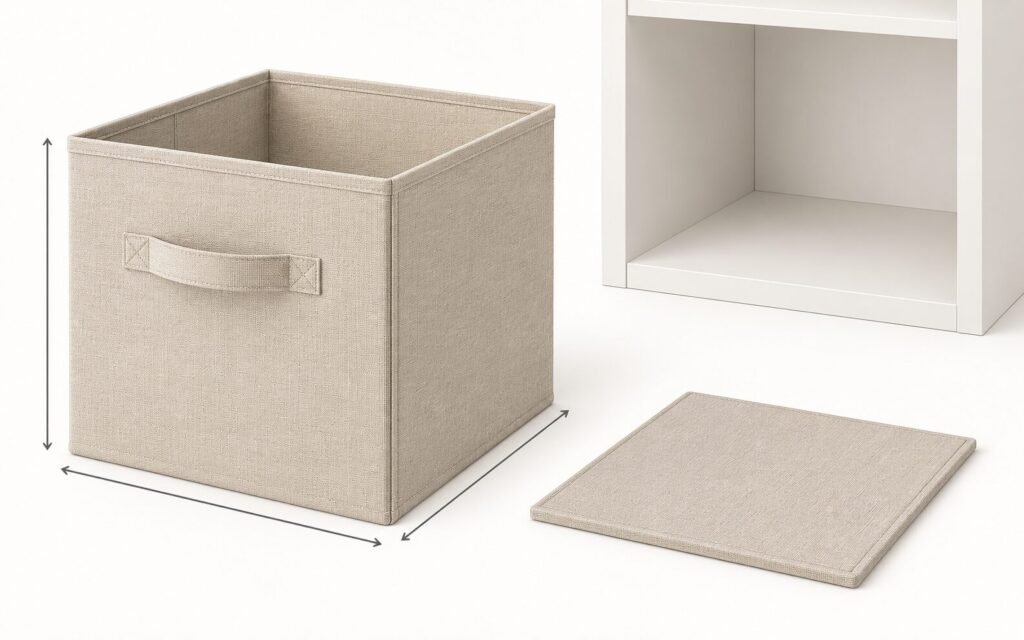
Record length, width and height with units and a simple drawing that identifies each direction. State whether the dimensions describe the outside of the assembled bin, the usable interior or the folded product. Those measurements answer different questions and should have separate fields.
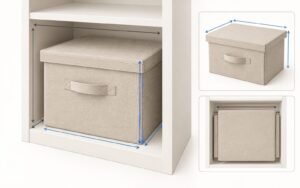
If shelf fit matters, provide the clear opening of the intended shelf and identify protruding handles, lids or trim. Matching a nominal width alone may not establish whether the bin can slide in and out comfortably.
Agree on the measurement condition. For a collapsible bin, that may mean assembled, empty, standing on a level surface with the base insert installed and the fabric smoothed without stretching. Use a different condition if the intended feature requires it, but write it down.
Set tolerances around the requirement
A tolerance is the permitted variation from the target measurement. Agree on it with the supplier for each measurement that matters. Do not copy one allowance across every size or apply a convenient percentage without considering shelf fit.
If the bin must fit a fixed opening, record the maximum acceptable outside dimension as well as the target. The buyer and supplier should resolve whether the construction can meet that condition before approving it. A sample that fits once does not define the permitted variation for the order.
Keep the measurement method with the tolerance. Otherwise, an empty bin measured at its base and a filled bin measured at the top may appear to disagree even when both parties are using the stated dimensions.
Specify support boards by location and construction
Record the support panel in each location: base, side walls and lid where applicable. Include material, thickness, panel dimensions, covering and whether the panel is fixed or removable. A description such as “strong board” does not identify what the supplier should purchase.
For a removable base, confirm how the user inserts and removes it and where it sits inside the bin. Check that the panel fits without forcing the corners apart and that it is included in the retail pack. For fixed panels, review the covering and edge finish where accessible.
Do not approve a material substitution by name alone. A switch between cardboard and PP board, for example, needs a review of the proposed grade, dimensions, construction and intended use. The material name does not establish the finished bin’s strength or care method.
Check folding as part of the product
Confirm the folding sequence and which parts must be removed. Review an assembled sample and a folded sample in the proposed retail pack. A bin that stands correctly on a desk may still be awkward to unpack or assemble after shipment.
Record the folded dimensions separately from the assembled dimensions. Any storage or stacking claim should apply to a defined configuration and be supported by an agreed evaluation, rather than inferred from the presence of rigid panels.
Describe handles as functional parts
Specify the number of handles, their locations, material, finished dimensions and attachment. Use a drawing or approved sample to define the position. A photograph may show a fabric loop without revealing how it is sewn into the wall.
State whether the handle is intended for pulling the bin from a shelf, carrying it or both. Review the attachment and surrounding panel together. A handle check that ignores the wall connection does not evaluate the whole assembly.
If the retailer requires a load claim, agree on the load, how it is distributed, the handling method and the pass/fail criteria. Record the procedure and sample version. Avoid adding a weight claim to packaging before it has supporting evidence for the finished construction.
For samples, inspect placement, grip clearance, loose threads and attachment consistency. These visual checks are useful, but they do not replace any agreed performance evaluation.
Keep labels, artwork and packaging in the same approval file
List each label or printed item separately: brand label, care information, hangtag, barcode, instruction insert and carton mark where required. Record the file version, placement and attachment method, then review the applied result on the relevant product or pack.
Separate the retail-unit identifier from carton markings. Confirm that the approved code identifies the correct SKU and pack quantity. A readable barcode can still be the wrong barcode; include both data verification and the buyer’s required scan check.
For the retail pack, record the folding method, included parts and packaging format. Confirm whether the base insert and lid are inside the bin, alongside it or in another specified position. The pack should make missing components visible during the agreed check.
For distribution, record units per inner pack and master carton, carton dimensions, gross weight and markings. Use the retailer’s actual receiving requirements. Do not assume that one chain’s packing rules apply to another buyer or market.

Copy this retail specification confirmation sheet
A quoted bin configuration: what can already be filled in?
A Great Shine quotation dated March 25, 2025 lists a storage bin with dimensions of 27 × 27 × 28 cm, 80 gsm non-woven fabric and 1.5 mm paperboard. Its retail packaging is a PP bag with a color insert sheet. The quotation records 24 units per carton and carton dimensions of 30 × 29 × 45 cm.
These are details from a historical quotation, not a current offer or a specification for every bin. Customer details and prices are omitted. The configuration provides a useful starting point for the sheet: size, material, board thickness and packing can be transcribed without guessing.
Other fields still require agreement. The quote line does not define measurement conditions, tolerances, the board’s location in each panel, handle construction or acceptance criteria. Its carton gross-weight field is blank. A buyer should confirm those items before treating the quotation as a complete production specification.
For this example, enter the listed dimensions under product size, then confirm their orientation and measurement basis. Record the quoted board thickness, but leave its placement unresolved until there is a drawing or sample reference. Do not turn a blank weight field into zero or assume a handle load from the board thickness.
Fill-in sheet
Use one copy for each SKU or reference a clearly identified variant schedule. Enter the requirement first, then ask the supplier to confirm it or record an exception. Complete the acceptance column with an agreed method and criterion; “check quality” is not a usable inspection instruction.
Mark a field “not applicable” when appropriate, with a reason if needed. A blank field remains unresolved; it should not be interpreted as permission for the supplier to choose any value. Keep inspection reports separate and identify which version of this sheet they assess.
Turn requirements into checks the receiving team can use
For each important requirement, state what will be checked and what counts as acceptable. The requirement, method and result should be distinguishable.
For shelf fit, the requirement might be compatibility with a specified opening. The method could be an agreed fit check with the bin assembled in the stated condition. The acceptance rule should identify the clearance or fit outcome that both parties approved. These are illustrative fields, not a fixed test for every order.
For retail-pack completeness, list every included component and the quantity of each. The check then compares the packed unit with that list. “One bin set” leaves room for disagreement if the lid or base is treated as an optional part.
Decide how inspection findings will be handled before shipment. Record defect definitions, the sampling plan where used, and who reviews a failed result. ASQ’s acceptance-sampling guidance explains that a plan includes sample sizes and acceptance or non-acceptance criteria. It does not supply a universal acceptance rule for fabric bins or guarantee a defect-free order.
Close exceptions before releasing the order
Review the supplier’s exceptions before approval. If the supplier proposes a different board, label position or carton quantity, record whether you accept the change and update the affected specification fields.
Record which sample and files are approved, what remains open and whether any work may proceed while it is unresolved. Send the same revision to purchasing, the supplier and the inspection team. Keep older versions marked as superseded so they cannot be mistaken for the production reference.
This article focuses on the order specification. For broader sourcing questions, use the existing fabric storage bin buying and QC guide.
Frequently asked questions
Can one sheet cover several colors?
Yes, if the shared construction is clear and a variant schedule identifies the color reference, artwork, SKU and quantity for each option. A color-specific exception should remain visible rather than being hidden in the shared specification.
Is an approved sample enough without a written specification?
The sample helps show appearance and construction, but it may not identify quantities, measurement methods, tolerances, packing instructions or approved artwork versions. Keep those requirements in writing and connect them to the sample ID.
Should the support-board thickness be public on the product page?
The order specification needs an agreed value even if the retail product page does not publish it. Decide separately which details help consumers choose the product and which belong in the supplier’s production record.
Can packaging be confirmed after the bin sample?
It can be reviewed in a separate approval step, provided its status remains clear. Confirm the complete retail pack and carton arrangement before the relevant packing work begins. Product approval alone should not imply that unseen packaging is approved.
Who decides dimensional tolerances?
The buyer explains the fit requirement, and the supplier confirms what the proposed construction can achieve. Both parties then agree on the target, permitted variation and measurement method. Unilateral assumptions can create avoidable rejection disputes.
What should happen when a specification changes after approval?
Issue a new revision, identify the affected SKUs and ask the supplier to confirm the impact on samples, production, packaging and delivery. Keep the earlier approval traceable, but make clear which revision controls the order.
Prepare the specification for your retail program
Complete the sheet with your SKU plan, shelf requirements, construction details and packing instructions. Use sample references for details that are difficult to describe, while keeping measurable requirements in writing. When discussing a fabric-bin order with Great Shine, send the sheet with the relevant product reference so unresolved choices can be reviewed together.