Bamboo is a group of plants in the grass family, Poaceae. Many familiar bamboos produce hard, woody stems called culms, which can be used to make household goods, furniture, and building materials. Bamboo is a grass botanically, even when a finished product looks and feels like wood.
Quick answer: The word bamboo can describe a living plant or the source material in a product. A bamboo pole, a laminated bamboo board, and rayon made from bamboo are different materials after processing. To understand a product, identify which part contains bamboo and how that material was made. The American Bamboo Society’s introduction to bamboo explains its place in the grass family and the woody stems familiar in many species.
Is bamboo a grass or a tree?
Bamboo is a grass. Its height, hard stems, and tree-like appearance do not change its botanical classification.
This can be surprising because everyday language often associates grass with lawns and wood with tall plants. Botanical groups are based on more than size and appearance.
A bamboo plant can therefore be described as a woody grass without contradiction. “Woody” describes the character of its stems; “grass” describes the plant group to which it belongs.
For a household product buyer, the distinction helps explain why bamboo is often placed beside wood products in a store. It can serve some similar functions while coming from a different kind of plant.
Why the distinction matters in product descriptions
A product description should answer two questions: what is the raw material, and what form does it take in the finished item?
Calling a bamboo frame “wood” may communicate its general appearance, but it loses the material identity. Calling it “bamboo” is more specific, provided the frame actually contains bamboo.
The same care applies to a mixed-material item. A bamboo handle does not turn an attached fabric bag into a bamboo textile. The description should identify each relevant part.
What the word bamboo cannot tell you
The plant name does not tell you the finished material’s thickness, density, coating, adhesive, or intended use. It also does not establish the quality of the assembled product.
Two items can both contain real bamboo while behaving differently. A narrow basket slat and a thick laminated shelf have different dimensions, construction, and jobs.
Read the material name together with the component description. Knowing that a shelf uses a laminated panel or that a basket uses narrow slats gives the buyer a more useful basis for comparison.
Is bamboo wood?
Bamboo is not tree wood in the usual botanical sense. It is often used as a wood substitute, and terms such as “bamboo wood” appear in everyday trade language.
A bamboo board can be cut into furniture parts much like a wood board. Similar uses explain the trade language, although the boards differ in raw material and manufacturing process.
For a shopper, “bamboo frame” is usually clearer than “wooden frame” when bamboo is the actual material. For a buyer reviewing specifications, the description may need to go further and identify strips, layers, or another construction.
A wood-like appearance does not establish composition
Color and surface pattern can make different materials look similar. A photograph of a pale brown panel does not establish whether it is bamboo, another plant material, a wood-based board, or a printed surface.
Look for a component description and, where needed, a sample edge or cross-section. The visible face may not reveal what is beneath it.
For a customer choosing bamboo specifically, name the component that contains it. A matching color or surface pattern cannot supply that information.
Similar uses do not mean identical care
A product used in the same room as wooden furniture may still need its own care instructions. Its finish, joints, backing, and other materials influence the appropriate cleaning method.
Do not transfer a treatment from one surface to another simply because both look natural. An oil, polish, or cleaner suitable for one product may be unsuitable for another.
The seller’s instructions for the finished item should take priority over a general rule about bamboo. Material identity helps frame the question; the product construction supplies the usable answer.
What are the main parts of a bamboo plant?
The most useful terms are culm, node, internode, shoot, and rhizome. They describe the visible stem, its sections, new growth, and the underground stem system.
INBAR’s manual for sustainable management of clumping bamboo provides illustrated definitions of these parts. Knowing the terms makes raw-material descriptions easier to follow.
Culm, node, and internode
The culm is the above-ground stem. Nodes form the joints or rings along it, and an internode is the section between neighboring nodes.
Many bamboo species have hollow spaces within the internodes, though this should not be treated as a rule for every species or every part of a culm.
Those visible features may remain in a product made from a whole or split pole. They may be much less obvious after the material is cut into narrow strips or processed into a board.
Shoots and rhizomes
A shoot is new growth that develops into a culm. Rhizomes are underground stems associated with the plant’s growth and spread.
The Royal Horticultural Society distinguishes running bamboos, which produce spreading rhizomes, from clump-forming types. Its bamboo growing guide also explains that growing conditions vary between plants.
For product buyers, this shows why bamboo should not be treated as one uniform crop. A general plant description is not a specification for every source of industrial material.
Why plant anatomy is useful to know
Terms from the living plant sometimes appear in supplier documents. A description of culm diameter or wall thickness concerns the raw stem, not necessarily the dimensions of the final component.
A finished handle may have been cut, shaped, joined, and coated. Its appearance and performance cannot be read directly from the original culm description.
When reviewing information, keep those stages separate. A statement about the harvested stem should not quietly become a claim about the complete retail product.
Does bamboo grow quickly?
Some bamboos grow rapidly, but growth rates depend on the species and growing conditions. A dramatic rate reported for one bamboo should not be presented as a fixed rate for every plant.
The American Bamboo Society notes both rapid growth and the influence of soil and climate. The RHS also describes a range of plant sizes and growing needs in its overview of bamboo.
For material buyers, rapid growth raises a different question: when is the material suitable for its intended use? Height alone does not answer that question.
Growth and material readiness are different questions
A tall stem may look ready to turn into a product, but a manufacturer still needs material appropriate for the planned process. Selection, preparation, drying, and other steps depend on the application.
A statement about how quickly a plant grows cannot establish how quickly a finished item can be produced. Manufacturing includes stages beyond growing the raw material.
Read growth claims alongside the production description. They answer different questions: one concerns the plant’s development, while the other explains how it becomes a usable component.
Avoid a single harvest-age rule
The age suitable for one bamboo species and use should not be assumed suitable for every other application. A craft material, an engineered panel, and a structural pole may involve different selection criteria.
If harvest age is relevant to a product claim, ask for the source and scope of that information. Otherwise, keep the consumer explanation at the level that can be supported.
There is no need to attach a precise age to every bamboo household item. Unsupported precision can make a simple material description less reliable.
Regrowth is not the whole environmental story
The way bamboo produces new culms can be relevant to resource management. It does not tell the buyer everything about land use, processing, transport, or the finished item’s service life.
A product made with bamboo still requires an assessment appropriate to the claim being made. A photograph of a growing plant cannot establish the environmental impact of a coated, assembled product.
Brands can explain the raw material’s growth using an appropriate botanical source. Claims about the finished item’s environmental performance need evidence that also accounts for its production and other components.
What forms of bamboo material are used in products?
Bamboo can appear as a pole, split strip, slat, woven element, engineered board, or processed fiber source. These forms differ in their structure and in the other materials used with them.
The word bamboo on its own leaves those differences unresolved. A clear product description names the form that matters to the customer’s use.
Whole and split culms
A product made from whole or split culms retains more of the original stem’s shape. Nodes, curvature, and changes in diameter may remain visible.
This can be part of the appearance, but it also means the design must account for the chosen material. A straight rectangular part requires a different approach from a round pole.
When evaluating such a product, look at how the natural form joins to other parts. The connection matters just as much as the visible bamboo surface.
Strips and slats
Strips and slats are narrower pieces prepared from bamboo. They can form repeated surfaces, such as the sides of a basket, or serve as elements within another construction.
A slatted body may also use fabric backing, binding, or a supporting base. The bamboo pieces do not necessarily provide every part of the structure.
Inspect how the strips join and where their edges remain exposed. Run the sample review through the intended handling actions so that surfaces touched by the user receive attention.
Laminated bamboo
Laminated bamboo joins prepared pieces into a larger section or panel. The direction and arrangement of those pieces contribute to the resulting appearance and construction.
A research paper in BioResources describes laminated bamboo flooring built from layers of bamboo strips and distinguishes it from scrimber flooring. See the study of laminated and scrimber bamboo flooring.
For a household product, “laminated bamboo” therefore describes more than a polished piece of a plant. The buyer should also understand the joining system and surface finish where those affect use.
Strand-based and other composites
Some engineered materials use bamboo bundles, strands, or particles combined through a manufacturing process. Their properties depend on that process and the other ingredients.
Research on wide-bundle bamboo scrimber illustrates how the arrangement and processing of bamboo elements form part of engineered-material design. It should not be treated as a performance certificate for an unrelated household product.
If a specification says “bamboo composite,” ask what that means for the particular item. The term can be too broad to support a meaningful comparison without composition and construction details.
Bamboo as a textile feedstock
Bamboo may also provide the cellulose source used to make a regenerated textile fiber. That processing route is different from using a bamboo strip or mechanically obtained plant fiber.
The finished textile needs its correct fiber description. A soft fabric should not be assumed to retain the structure or properties of the original bamboo stem.
This distinction is especially relevant for bedding, clothing, and removable fabric components sold alongside bamboo frames. The shared source word can otherwise make very different materials seem identical.
Is bamboo fabric the same as solid bamboo?
Bamboo fabric and solid bamboo components are different material categories. A bamboo frame retains a solid plant-derived structure, while a textile may use regenerated fiber made from bamboo as a cellulose source.
In the United States, the FTC says textiles can be called bamboo only when made directly from actual bamboo fiber. Rayon or viscose derived from bamboo should be described accordingly, such as “rayon made from bamboo.” See the FTC’s bamboo textile guidance.
That is US guidance, not a complete description of labeling requirements in every European market. Businesses selling in several markets should confirm the rules that apply to the actual textile and destination.
Read the fiber label separately
A basket’s bamboo frame tells the buyer nothing definite about the liner’s fiber composition. The liner could use a different material entirely.
Likewise, a bamboo-colored textile is a color choice unless its composition says otherwise. Appearance cannot establish the source or type of fiber.
The product listing should separate these facts. A short component description can identify the frame material, liner composition, and any other part relevant to care.
Do not transfer plant properties to processed fabric
A property discussed in relation to the source plant does not automatically survive a manufacturing process. It also does not establish the performance of the finished textile.
This matters for claims about antibacterial effects, moisture behavior, and environmental benefits. Each claim should address the actual material or product being sold.
When that evidence is unavailable, accurate composition and care information remain useful. A product does not need a broad performance promise to explain what it is.
Keep the description understandable
Technical accuracy should help the customer choose. A clear phrase naming the fiber and its source is more useful than a dense explanation of every production stage.
Where a product combines bamboo and fabric, describe the components in the order the customer sees or uses them. Then add the relevant care instruction for each.
For example, a frame description can sit beside the frame’s care instruction, with a separate line for the liner. Customers can find the instruction for the part they are about to clean.
How strong is bamboo?
Bamboo does not have one universal strength value. The species, part of the stem, processing method, component dimensions, and direction of loading all matter.
A study of moso bamboo hosted by the US Forest Service found differences in selected physical and mechanical properties across positions within the sampled culms. The findings concern those materials and test conditions. See Selected Physical and Mechanical Properties of Moso Bamboo.
This supports a practical reading of material claims: the word bamboo cannot establish how much weight a finished shelf, handle, or basket can support.
Separate material strength from product strength
A finished item can fail at a joint, fastener, seam, or base even when its bamboo component remains intact. The complete design determines where loads travel.
Consider a fabric bag with bamboo handles. Its carrying performance depends partly on the handles, but also on the fabric and the way the handles attach.
A test result for a bamboo specimen does not establish the carrying limit of that assembled bag. A useful claim needs evidence connected to the complete product and intended action.
Compare the same property under relevant conditions
“Stronger than wood” is too broad to guide a purchase. It does not identify the wood species, bamboo form, test method, sample size, or loading direction.
A comparison may also confuse stiffness, strength, hardness, and resistance to wear. These are different characteristics, even though product descriptions sometimes use them as if they were interchangeable.
For a household item, begin with the action that matters. A handle must tolerate carrying; a shelf must suit its stated load; a moving joint must keep working through its intended use.
Thickness is only one part of the answer
A thicker component may look more substantial, but appearance alone does not establish performance. Shape, joining, preparation, and the surrounding assembly also contribute.
Two parts with the same outer dimensions can have different internal construction. A sample photograph cannot establish the load rating; check the information supplied for the actual assembled product.
When the supplier offers a tested value, confirm what was tested. The relevant model, configuration, and conditions should match the product being described.
Natural variation needs a practical definition
Bamboo surfaces can show differences in color and pattern. Buyers should decide which variations are acceptable for the intended design and which indicate a problem requiring review.
For example, a natural tonal difference may be acceptable in a visible slat, while a rough edge in a hand-contact area raises a separate workmanship concern.
Keeping those issues separate makes evaluation more useful. “Natural material” should not become a blanket explanation for every defect, and a minor color variation should not automatically be treated as a structural failure.
How does bamboo respond to moisture?
The response depends on the bamboo form, processing, finish, and exposure. A finished bamboo product should not be assumed waterproof merely because its surface feels smooth or has a coating.
INBAR’s guide to post-harvest treatment, preservation, and storage identifies those preparation stages as important to the durability of bamboo culms. It does not provide a universal waterproof rating for finished consumer goods.
For household products, look at the complete construction and the intended environment. A coated surface, unsealed edge, fabric backing, and metal fitting may each respond differently to use.
A water-resistant surface is not a waterproof product
A surface may tolerate limited contact with water while the assembled item remains unsuitable for soaking or repeated wetting. Joints and cut edges deserve attention alongside the visible face.
The wording should identify the claim’s scope. “Wipe with a lightly damp cloth,” when supported by care instructions, describes an allowed action. “Waterproof” promises much more.
This distinction helps customers avoid using a product in conditions it was not designed to handle. It also helps buyers ask for evidence that matches the planned description.
Indoor placement still matters
Indoor use covers a wide range of conditions. A dry bedroom, a steamy bathroom, and an unheated storage space may expose a product to different moisture levels and temperature changes.
The material name cannot settle suitability for all three. The supplier should state the conditions intended for the particular item.
For product photography, choose a scene that matches those conditions. A beautiful image beside a shower can imply a use that the care instructions do not support.
Drying and storage belong in the explanation
A product’s condition before packing can affect what happens during storage and transport. Packaging protects against some hazards but can also limit how moisture escapes.
The relevant process depends on the product, so avoid a universal drying time or moisture threshold without a suitable specification. Buyers should ask how preparation and storage are controlled for their actual goods.
For consumers, the practical message is simpler: follow the cleaning instructions and let permitted cleaning moisture dry before putting the item away or covering it.
A finish does not remove maintenance needs
Coatings and treatments are part of a design, not permission to ignore care. Repeated abrasion, damage, or exposure may change how a surface behaves.
A visible scratch can also expose material that was previously covered. The appropriate response depends on the finish and the seller’s repair guidance.
Do not recommend a home treatment simply because it is common for a different natural material. The original product instructions should guide maintenance of the finished item.
What is bamboo used for?
Bamboo is used in a wide range of products, including baskets, household organizers, furniture components, panels, and selected building applications. The form used changes with the job.
A use category does not mean every bamboo material is suitable for every item in that category. A decorative slat and an engineered structural element need different specifications.
Storage and organization
Storage products may use bamboo for a frame, side wall, lid, handle, or divider. The material can provide a visible surface or a supporting part, while fabric and other materials perform different functions.
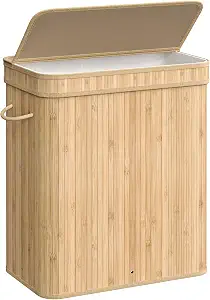
For example, a hamper may use bamboo legs to support a removable textile bag. Another may use bamboo slats around most of its body.
Both contain bamboo, but the customer uses and cleans them differently. A good product description identifies the role of the bamboo component instead of relying on the category name.
Furniture and household fittings
Bamboo can be used in parts that need a shaped or flat form, including certain shelves, small furniture components, and household accessories. The manufacturing route determines how that form is achieved.
A panel may consist of joined pieces rather than a single wide portion of a stem. This helps explain why the edge and construction details can be as informative as the visible face.
The buyer still needs product-specific information about assembly and intended load. The material’s use in furniture elsewhere does not establish the performance of the item being considered.
Woven and decorative goods
Narrow plant elements can create surfaces with gaps, patterns, or curved forms. When a product is described as woven bamboo, the description should still identify any supporting frame, backing, or binding.
The weaving method and the raw material are separate facts. Similar-looking woven goods can use different plant materials or synthetic strands.
Name the strand material and supporting structure when describing a woven item. Customers can then compare its appearance and care needs with other woven products in the range.
Engineered panels and construction products
Engineered bamboo can serve applications that differ substantially from a small household accessory. Those products need their own design, testing, and installation requirements.
The fact that bamboo is used in a structural project should not be used as evidence that an unrelated basket or shelf is strong. Different forms of the material may be involved.
For a general material guide, the useful point is that processing can expand the forms available. It does not make every bamboo product interchangeable or suitable for structural use.
Textiles and other processed uses
Bamboo can be a raw-material source for products in which the original stem structure is no longer visible. Regenerated textile fiber is one example.
The final material should be described according to what it has become. A shared plant source does not mean a textile behaves like a solid strip or board.
Within a broad bamboo range, compare textiles with textiles and solid components with the relevant solid-material alternatives. Their care needs and performance claims require different evidence.
Is bamboo the same as rattan or wicker?
Bamboo and rattan come from different plant groups. Rattan is associated with climbing palms, while bamboo belongs to the grass family.
Kew describes rattans as climbing palms whose flexible stems supply material for furniture and woven goods. See its research on identifying rattans in trade.
Wicker is commonly used to describe a woven style or construction rather than one definite plant species. A woven appearance therefore does not identify bamboo, rattan, or a synthetic substitute on its own.
Check material and construction separately
A useful description names both what the product uses and how it is formed. “Woven bamboo” gives different information from “bamboo frame with fabric body.”
If a listing says only “natural wicker,” a buyer may still need to ask what the strands and frame contain. The visual style does not provide a complete material specification.
This distinction is particularly useful for retailers carrying several natural-looking collections. Clear names help customers compare products without assuming they all have the same care needs.
Avoid ranking materials without a task
It is not useful to call bamboo universally better than rattan, wood, or plastic. Each comparison needs a product, use, and relevant performance question.
A shopper choosing a visible laundry container may care about appearance and liner removal. Someone choosing a container for repeated wet cleaning may prioritize a different construction.
The material decision should follow those needs. A broad ranking hides the conditions that make one option suitable and another inconvenient.
Is bamboo an environmentally friendly material?
Bamboo can be a renewable raw-material source, but that does not establish the environmental performance of every bamboo product. The sourcing, manufacturing, other ingredients, use, and end-of-life route need to be considered.
Specific claims are more useful than a broad environmental label. A buyer can evaluate a documented sourcing claim or a verified material percentage more clearly than a promise that the whole item is “good for the planet.”
Start with a defined comparison
An environmental comparison needs to say what is being compared and on what basis. Two products should serve a comparable function over an appropriate period.
A study of a flooring process cannot establish the impact of a laundry basket simply because both contain bamboo. The materials, energy use, product life, and disposal route can differ.
The BioResources flooring study cited earlier found that processing stages mattered to the impacts of the products it examined. Its results belong to those studied systems, not every bamboo item.
Include the complete product
A household product may combine bamboo with adhesive, a coating, fabric, metal hardware, plastic feet, and packaging. Each part can matter to the claim being made.
For example, a statement about plant-based material should identify the component concerned. A bamboo handle does not make the entire attached bag plant-based.
The same applies to recycled content. If only the packaging contains recycled material, the product itself should not be described as recycled on that basis.
Treat certification as a specific claim
Certification should be checked for the relevant organization, material, and transaction. A logo in a general presentation does not establish that every product in a range carries the same claim.
FSC explains how its forest-material claims and chain-of-custody system work and provides a route to check certificate holders. See FSC’s explanation of labels and claims.
For a bamboo item, buyers should confirm which component the claim covers and what documentation accompanies it. This is more reliable than assuming that the use of bamboo itself implies certification.
Consider service life and repair
Service life depends on design, maintenance, and use. If a brand gives an expected lifespan, buyers should ask what evidence and conditions support it.
Replaceable liners, fittings, or other parts can be helpful when they are actually available and compatible. A removable component is not automatically replaceable through the seller.
For a brand, the practical task is to make that information clear. Customers need to know whether a replacement exists, how to identify it, and which product version it fits.
Do not assume home compostability
A bamboo-containing item may include materials that require different disposal routes. Coatings, adhesives, textiles, and fittings mean the finished product is not equivalent to an untreated plant cutting.
Avoid directing customers to compost or recycle the entire product without evidence and an appropriate local route. Collection rules and available facilities also differ by location.
The FTC’s summary of the Green Guides explains why broad environmental claims require care and why qualifications matter. For US-facing copy, the guidance is a useful starting point for describing the actual supported benefit.
How can you read a bamboo product description accurately?
Read a bamboo product description in layers: identify the component, its material form, the claimed function, and the care conditions. This turns a broad material label into information that can guide a purchase.
The process does not require specialist laboratory knowledge. It requires clear questions and a willingness to distinguish what is stated from what is merely suggested by the images.
Find the component named by the claim
“Bamboo basket” may describe the main shell or only a visible frame. Look for a more detailed sentence that identifies the body, handles, liner, base, and lid where relevant.
If the description does not say, do not fill the gap with an assumption. A photograph may show only the outside and conceal a backing or support material.
For retailers, a concise component list can resolve the ambiguity before customers ask. It is often more useful than adding another general benefit paragraph.
Identify the material form
Look for terms such as slats, laminated panel, frame, veneer, composite, or rayon. These words explain how far the product has moved from the original plant form.
A description that uses only “natural bamboo” may leave important construction details unclear. Natural origin does not mean the item has no adhesive, finish, or other materials.
The required detail depends on the decision. A consumer may need only a clear care instruction, while a buyer comparing suppliers may need a more complete component specification.
Separate appearance from measurable function
A warm color, visible pattern, or smooth surface can be described directly. Those features do not prove waterproofing, antibacterial performance, load capacity, or resistance to repeated cleaning.
When a claim includes a measurable function, ask what supports it. The evidence should relate to the exact product or component and the use being described.
This prevents a familiar chain of assumptions: the material looks natural, therefore it must have several unrelated benefits. Each benefit needs its own basis.
Check that care matches the proposed use
A product shown in a wet setting should have care and use instructions that support that setting. A washable liner should be distinguished from a frame that needs another method.
Contradictions are worth resolving before purchase. “Easy to clean” does not explain whether the product can be wiped, washed, soaked, or machine cleaned.
For a retail listing, the best description gives customers an action they can follow. It does not leave them to infer a cleaning method from a broad adjective.
How would you interpret three different bamboo labels?
A label becomes easier to understand when you connect it to a visible component. The following descriptions are hypothetical examples of wording, not specifications for a Great Shine product.
“bamboo frame with removable polyester liner”
This description assigns a material to each of two parts. The bamboo forms the frame, while polyester identifies the liner’s fiber.
Several practical details still need checking. The wording does not say whether the frame folds, how the liner attaches, or whether the liner can be machine washed.
Those are reasonable follow-up questions. There is no need to assume that the liner is bamboo-based because the overall product belongs to a bamboo collection.
“laminated bamboo shelf”
This label identifies a processed bamboo form and a product function. It suggests that the shelf uses joined bamboo elements, but it does not establish the complete installation system or load capacity.
The buyer should read the accompanying dimensions, mounting instructions, and supported load information. Any coating or care restrictions should also be described where they affect use.
The label is useful because it identifies the material form. It cannot answer every question about the finished shelf, and it should not be treated as doing so.
“bamboo-look storage box”
This wording describes an appearance. It does not, by itself, claim that the box contains bamboo.
The material specification should explain the actual body and finish. A shopper may still prefer the appearance, but that is a different decision from choosing a product made with a particular plant material.
If the composition is unclear, ask for it. Guessing from color or a printed pattern can lead to an incorrect care assumption as well as an incorrect material claim.
Use the same reading method across a product range
First identify what the label explicitly says. Then list the details that matter to the intended use but remain unanswered.
This method keeps comparisons fair. A detailed description should not appear less attractive simply because a competing listing makes broader claims with fewer qualifications.
For brands, precise labels also make it easier to maintain consistency across packaging, instructions, and online descriptions. Each version should describe the same components and the same supplied product.
What does bamboo mean in a laundry basket?
In a laundry basket, bamboo may provide the outer shell, a supporting frame, handles, or a lid. The liner and fittings often serve different roles and may use other materials.
Great Shine’s bamboo laundry basket product page illustrates several such constructions, including bamboo-frame and removable-liner designs. These are examples of how a material can appear within a complete household product.
Read one example component by component
Consider a hypothetical hamper with a bamboo frame and a removable fabric bag. The frame supports the opening and gives the product its visible structure.
The fabric bag contains the laundry. Its fiber composition and care instructions need their own description, while the joints determine how the frame assembles or folds.
That component-based explanation tells the customer more than calling the entire item “100% bamboo.” It also makes the practical questions clearer: what can be removed, what gets cleaned, and what the user carries.
Keep the material lesson separate from product selection
Knowing what bamboo is helps the buyer read the specification. Choosing a particular basket also requires dimensions, opening style, handling details, and suitability for the intended room.
Those are product-selection questions. They should be answered using the actual model, rather than generalized from bamboo’s botanical identity.
For the hamper example, the next useful information is the liner’s composition, the frame’s construction, and the supplied care instructions. Those details connect the material name to everyday use.
Frequently asked questions about bamboo
Is bamboo a grass even when it grows tall?
Yes. Bamboo belongs to the grass family, and height does not change that classification. Many familiar species produce hard, woody culms. That explains why a bamboo plant can resemble a tree and why its stems can be used in products associated with wood.
Why do stores sometimes call it bamboo wood?
The phrase often reflects a wood-like appearance or use. Bamboo can be processed into boards and parts that serve similar functions to wood products. For an accurate material description, identify the item as bamboo and explain its form when that information affects the buying decision.
Is all bamboo hollow?
No. Many bamboo species have hollow internodes, but the pattern is not universal across every species or part of a stem. Finished bamboo boards and handles may also use processed, joined material. Their internal construction should not be inferred from the familiar image of a hollow pole.
Is bamboo naturally waterproof?
A finished bamboo product should not be assumed waterproof. Suitability depends on processing, finish, joints, other components, and the intended exposure. Follow the product’s care instructions and ask for evidence when a seller makes a specific water-resistance or waterproofing claim.
Is rayon made from bamboo the same as bamboo fiber?
The terms should not be treated as interchangeable in US textile descriptions. The FTC distinguishes actual bamboo fiber from rayon or viscose produced using bamboo as a source. Read the fiber composition and describe the finished textile accurately, rather than relying only on the plant name.
Is bamboo stronger than wood?
There is no useful universal answer without specifying the materials, property, and test conditions. A comparison might concern strength, stiffness, hardness, or an assembled product’s load capacity. Evaluate the property relevant to the item and avoid transferring a raw-material result to an unrelated finished product.
Can bamboo products be recycled or composted?
The answer depends on the complete product and the available local route. Adhesives, coatings, fabric, and fittings can affect disposal. Do not assume that a bamboo-containing item belongs in home compost or household recycling. Follow supported product instructions and the receiving facility’s requirements.
What should buyers ask when a product is described as bamboo?
Ask which component contains bamboo, what form it takes, what other materials are present, and how the finished item should be used and cleaned. If performance or environmental claims influence the purchase, request evidence that applies to the specific product and the wording being used.