For a direct-to-consumer home brand, a Christmas tree storage bag is more than a seasonal container. It is a product customers may see in a garage, closet or attic for most of the year. That makes design, handling and visual trust important alongside capacity and construction.
The strongest DTC product concepts usually begin with a clear brand point of view: calm home organization, premium seasonal care, practical family storage or a coordinated holiday collection. The bag then supports that idea through its shape, fabric, colors, trims, packaging, photography and instructions. A logo added at the end is not the same as a product that feels designed for the brand from the beginning.
For product teams, the practical question is how to create a branded Christmas tree storage bag without turning a seasonal item into an overcomplicated custom project. The answer is to separate the decisions into three layers: customer use, brand expression and production control.
Start With the Customer’s Post-Holiday Moment
Christmas storage products are used at an inconvenient time. The customer has just taken down decorations, sorted multiple tree sections and found that the original carton is damaged, missing or difficult to reuse. They want a storage process that feels more orderly, not another bulky object that creates work.
Before discussing colors or logo placement, write down the storage moment your brand wants to improve:
- A family is packing a full-size artificial tree after the holidays.
- A small-space customer needs a more manageable way to store seasonal items.
- A customer wants the tree and accessories organized together.
- A design-conscious homeowner wants practical storage that does not look disposable.
- A customer needs clearer instructions for folding and storing the tree between seasons.
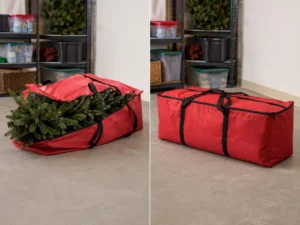
These situations lead to different product choices. A horizontal bag for disassembled sections will not tell the same story as an upright cover for a mostly assembled tree. A structured bag may support neat closet storage, while a flexible bag may fold more compactly when empty. The product format should follow the use case before it follows the mood board.
Define a Brand Role for the Product
A DTC brand should decide what job the Christmas tree bag has in its assortment. It can be a standalone seasonal product, an add-on to an artificial tree collection, a companion to holiday decoration storage or part of a wider home-organization system.
| Brand Role | Product Direction | Content Opportunity | Main Question to Confirm |
|---|---|---|---|
| Standalone seasonal product | One clear tree-storage solution | Show the problem, loading process and finished storage result | Which tree profile is the core fit? |
| Companion to artificial trees | Sizes matched to the brand’s own tree range | Demonstrate the tree and bag as one ownership journey | Do the bags fit the actual packed tree sections? |
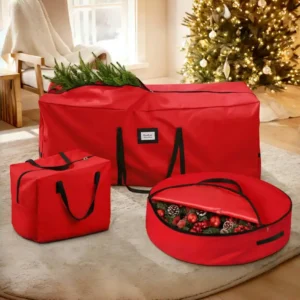
| Holiday storage collection | Tree bag plus wreath, ornament or gift-wrap storage | Present a coordinated storage system | Can colors, trims and packaging work across products? |
| Home-organization extension | Neutral, year-round visual language | Connect seasonal storage with broader organization content | Will the product still feel consistent outside the holiday campaign? |
This decision affects the number of sizes, the packaging hierarchy, the photography plan and the amount of customization worth approving. It also prevents the product from becoming a generic bag with a seasonal print added to it.
Build a Simple Design System Before Sampling
Branding is easier to control when the product brief separates permanent design elements from seasonal graphics.
Permanent Elements
These are the parts that should remain consistent if the brand later develops related storage products:
- Base color or neutral color family.
- Logo position and approximate scale.
- Webbing, binding and zipper-pull direction.
- Label format and care/instruction placement.
- Packaging hierarchy and photography style.
- Product naming and size-label logic.
Seasonal Elements
These can change by campaign or collection:
- Printed pattern or holiday motif.
- Accent color.
- Giftable insert card.
- Limited seasonal hangtag.
- Campaign photography and copy.
Keeping these layers separate gives the brand room to refresh the holiday story without redesigning the entire bag each year. It also helps the supplier understand which details must be repeated accurately and which details are open to variation.
Choose Materials for the Intended Brand Experience
Material selection should be discussed in terms of the customer experience, not only a fabric name. Oxford fabric, polyester, non-woven fabric, canvas, PVC and mesh can each support different product directions, but the finished result also depends on weight, backing, coating, construction, trims and reinforcement.
For a DTC brief, ask the supplier to prepare material options that answer these questions:
- How does the material look under close-up photography?
- Does it fold in a way that matches the expected storage method?
- Does the surface work with the proposed logo or print method?
- Does the material support the intended level of structure?
- Will the color and texture coordinate with the rest of the holiday collection?
- Does the packed sample remain practical for the planned retail packaging?
Avoid choosing a material only because it sounds heavier or more premium. A heavier option may change the folded size, package cost, sewing method and handling feel. The final decision should be made with a physical sample and a confirmed product promise.
Be precise with protection claims. If the intended use is indoor seasonal storage, the product copy should reflect that environment unless an agreed test supports a broader claim. Terms such as waterproof, weatherproof, tear-proof or pest-proof should not be used as decorative language.
Design the Bag Around Loading, Not Only the Finished Image
Some product photos make a Christmas tree bag look attractive when empty, but the customer’s real experience begins when the tree sections are being loaded. The opening, zipper path, handles and internal space need to work together.
Ask the supplier to review:
- The packed dimensions of the target tree sections.
- The widest section and the size of the opening.
- Whether the tree stand, cords or accessories need separate storage.
- Whether the handle position keeps the filled bag balanced.
- Whether support panels are needed for the intended presentation.
- Whether the bag will be carried, stored on a shelf, placed in a closet or rolled across a floor.
Do not use the word “universal” unless the fit range has been defined and verified. A more helpful product page can explain which tree sizes the bag was developed around, whether the tree should be disassembled, and what customers should measure before ordering.
Create a Product Story That the Website Can Demonstrate
Independent brands have more control over the buying journey than marketplace sellers. They can use educational content, comparison sections, email flows, product quizzes and post-purchase instructions. The product should provide enough real detail for those assets to be useful.
The core content set for a branded Christmas tree storage bag can include:
- A size guide showing the tree profile and packed sections the bag is designed around.
- A short loading sequence showing how branches are folded and sections are placed inside.
- Close-up photos of the zipper, handles, seams, logo and material surface.
- A comparison between flexible, structured, rolling and upright formats where relevant.
- A storage-location image showing the product in the type of space the customer is likely to use.
- A care and storage instruction card that customers can keep with the bag.
This content does not need to make the product sound extraordinary. It needs to remove uncertainty. A customer who understands the fit, format and storage process is more likely to choose the right product and less likely to feel misled by the product page.
Make Packaging Part of the Brand, Not an Afterthought
Packaging is one of the few physical brand touchpoints customers see before using the product. For a DTC program, it should protect the bag, communicate the product clearly and fit the way the product is sold.
Possible directions include a polybag with a color insert, a header card with a polybag, a color box, a mail-order box, a shrink-wrap format or another packaging structure agreed with the supplier. The right option depends on the product size, visual goals, shipping route and customer unboxing expectations.
Before approving the packaging, review the finished packed sample rather than a flat artwork file alone:
- Can the customer identify the product and target size quickly?
- Does the package communicate the real product format?
- Is the logo visible without making the packaging feel crowded?
- Does the packed product remain clean and presentable after handling?
- Can the packaging be used consistently for related wreath or ornament products?
- Are the package dimensions and weight compatible with the shipping plan?
If the brand sells through a direct website, the package should also be photographed in its real packed state. A beautiful unfolded concept is not enough if the item arrives bulky, creased or difficult to understand.
Use a Small, Coherent Collection Instead of Too Many SKUs
Seasonal products can become difficult to manage when every variation receives a separate fabric, print, size and packaging treatment. A smaller collection is often easier to explain and maintain.
A starting range might be organized by customer need:
- One core horizontal bag for the main tree profile.
- One larger version for fuller or taller packed sections.
- One complementary organizer for wreaths, ornaments or accessories.
The exact assortment should be based on the brand’s products and customer data. Do not assume that more colors or more sizes automatically create a stronger collection. Each added variation should have a clear reason to exist, a defined fit or a clear merchandising role.
Sample Approval Should Cover Brand and Use
A sample review should have two separate checklists. The first checks whether the product works. The second checks whether it looks and feels like the brand.
Use Review
- Load the target tree sections and any agreed accessories.
- Check opening access and zipper operation while filled.
- Lift the bag by each intended handle.
- Check balance, contact points and the storage position.
- Record packed dimensions and weight.
- Fold and repack the bag using the planned packaging.
Brand Review
- Confirm color against the approved reference.
- Check logo scale, position and edge quality.
- Review binding, webbing, zipper pulls and labels as a complete set.
- Compare the finished material with the approved swatch.
- Photograph the sample in the planned website style.
- Check whether the product works beside other planned holiday storage items.
Keep the approved sample, artwork, material references and packaging specification together. That record makes future seasonal updates easier to compare and reduces the chance that a small visual change is treated as unimportant.
What to Include in a DTC Christmas Storage RFQ
An effective RFQ should give the supplier enough information to discuss both development and production:
- The brand role of the product and target customer.
- Target tree profile, packed sections and intended storage position.
- Preferred bag format: flexible, structured, rolling or upright.
- Target finished dimensions and opening direction.
- Material direction, surface feel, color and print requirements.
- Logo artwork, placement and preferred decoration method.
- Handle, zipper, pocket and accessory-storage requirements.
- Retail or mail-order packaging direction.
- Planned sizes, colors and estimated quantities.
- Sample purpose, approval deadline and test checklist.
- Target market, destination and any required packaging information.
- Related holiday products that may need to share colors, trims or packaging.
Ask the supplier to identify which items are confirmed, which are recommendations and which still require sampling. This makes the development conversation more useful than a quote based only on a product name.
Final Takeaway
For a DTC home brand, a Christmas tree storage bag should feel like part of the brand’s approach to home organization. That does not require an elaborate design. It requires a clear customer moment, a believable fit, a coherent visual system, practical packaging and content that shows how the product is really used.
Start with one defined product role and one target tree profile. Build the design system around the core bag before adding seasonal variations. Then approve the product through both a real-use test and a brand review. This gives the website team a product they can explain honestly and the customer a storage experience that feels considered after the holiday season is over.
Great Shine develops custom Christmas and holiday storage products for private-label, home-organization and retail programs. The Christmas tree storage bag category can be used as a starting point for discussing materials, size, structure, handles, zippers, logo placement and packaging. Share the target tree profile and brand direction to begin a custom product brief.
FAQ
Can a DTC brand customize the color and logo of a Christmas tree storage bag?
Color, pattern, logo placement, labels, trims and packaging can be discussed as part of a private-label product brief. The exact method and result should be confirmed with artwork review and a physical sample.
Should a DTC brand launch one size or several sizes first?
Start with the size that matches the clearest customer need and the best-supported tree profile. Add more sizes only when each one has a defined fit, product-page explanation and merchandising reason.
How can a Christmas tree storage bag feel premium without becoming overdesigned?
Use consistent color, material, trims, logo scale, packaging and photography. Premium perception usually comes from coordinated details and clear use instructions, not from adding every possible feature.
What should the website show before a customer buys?
Show the target tree profile, packed dimensions, loading method, opening, handles, material surface, storage position and the actual package. Explain whether the tree must be disassembled and what accessories fit inside.
Can the same design system be used for wreath and ornament storage?
It can be planned that way. Confirm that the colors, trims, labels and packaging hierarchy work across each product’s different size and structure before approving the full collection.