By Grace Ji, Sales Director at Great Shine · Updated July 2026
I’ve spent the last 5 years watching Amazon FBA sellers walk the same path in slow motion:
Month 1 — launch a beautiful storage bag with a great supplier. Product ranks page 8 within a week.
Month 2 — pump PPC spend. Rankings creep to page 4. ACoS is 65%.
Month 3 — the first negative review lands: “Zipper broke on second use.”
Month 4 — return rate hits 8%. Amazon suppresses the listing. IPI score drops. Sales freeze.
Month 5 — the seller emails their supplier: “We need to talk about quality.”
The supplier replies: “You approved the sample. We shipped exactly what you approved. Not our problem.”
I’ve had this conversation from both sides — as an Amazon seller during a brief stint, and as a manufacturer supplying dozens of FBA private-label brands. The uncomfortable truth is that most listing failures on Amazon aren’t marketing failures. They’re supply chain failures dressed up as marketing problems.
If your storage bag listing isn’t ranking — or is ranking but not converting — here are the 8 upstream issues that cause it, and exactly what your manufacturer should be doing about each one.
Issue 1: Your Hero Image Doesn’t Meet the New 2025 Amazon Standards
Amazon quietly rolled out stricter image requirements in 2024–2025. Most sellers don’t know about them until their listing gets flagged.
The current 2025 hero image rules:
- Pure white background (RGB 255, 255, 255)
- Product occupies 85% of the frame minimum
- No text, no logos, no watermarks, no props, no additional accessories
- No lifestyle context (that goes in image slots 2–7)
- Minimum 1600 × 1600px for zoom function
- No transparent background (must be white, not clear PNG)
A shocking number of hero images I audit — from sellers spending $50k+ per month on ads — fail on at least one of these rules. When Amazon’s algorithm flags a listing for image compliance, it silently drops your ranking.
What your manufacturer should be doing:
At Great Shine we shoot every OEM buyer’s hero image to 2025 spec by default, on our own product photography set, and provide it free with every bulk order. When Amazon updates their rules (as they did in October 2024), we re-shoot for existing buyers within 30 days at zero cost. If your supplier can’t do this — or worse, sends you a photo of the bag on a “clean background” that’s actually off-white — you’re going to keep bleeding rankings.
Issue 2: Your Product Video Isn’t Uploaded (Or It’s Wrong Format)
The Amazon main product video slot converts 34% higher than a listing without one (Amazon’s own 2024 conversion benchmark data). But most storage bag sellers I audit either don’t have one uploaded, or have uploaded a video that violates spec.
Amazon main video requirements:
- 16:9 aspect ratio
- 720p minimum, 1080p recommended
- 30 seconds to 3 minutes
- No text overlays in the first 4 seconds
- No competitor mentions, no external links
- MP4 or MOV format
- Product should be visible in the first 3 seconds
- Subtitles required for accessibility (huge ranking factor since 2023)
If you’re outsourcing video creation to a $500 videographer, they usually miss 2–3 of these. Your video plays, but Amazon’s algorithm quietly deprioritizes it.
What your manufacturer should be doing:
Look for a supplier who shoots product videos in-house as part of the OEM package. They already have your samples on hand. They already know your product’s best angles. They can shoot in 4–5 different formats (16:9 for Amazon main, 9:16 for TikTok, 1:1 for Instagram feed) in one session. And they should be providing subtitle files (.SRT) with every video by default.
Sellers who work with us get every video in 4 aspect ratios, all with English subtitles, all Amazon-compliant, all free with bulk orders. This alone saves $1,500–2,500 per SKU per year in outsourced video production.
Issue 3: Your Bullet Points Aren’t Keyword-Optimized
Amazon’s A9 algorithm scores your listing partly on how well your bullet points cover the search terms buyers actually use. Most storage bag listings I audit fail because the seller wrote bullets based on features, not keywords.
A weak bullet point:
“Made with high quality 600D Oxford fabric with strong zipper.”
A strong bullet point:
“HEAVY-DUTY STORAGE FOR CLOSET & UNDER BED: Made with reinforced 600D Oxford fabric and rust-resistant metal zipper, this large storage bag holds 4 heavy blankets or 15 folded sweaters without stretching or tearing. Ideal for closet organization, seasonal clothes storage, and under-bed storage.”
The second version:
- Front-loads a high-search-volume phrase in caps (“HEAVY-DUTY STORAGE FOR CLOSET & UNDER BED”)
- Includes 5–6 long-tail search terms naturally (“closet organization,” “seasonal clothes storage,” “under-bed storage”)
- Quantifies benefits (“4 heavy blankets or 15 folded sweaters”)
- Addresses common concerns (“without stretching or tearing”)
What your manufacturer should be doing:
Your supplier probably won’t write your bullets for you (that’s usually your job). But a strong manufacturer will:
- Share their competitive intelligence — they see hundreds of similar listings and know what claims perform
- Provide accurate capacity claims backed by real testing (e.g., “holds 4 heavy blankets” — measured and verified)
- Share which construction features their engineering team recommends highlighting (“reinforced 600D vs standard 420D”)
At Great Shine, our OEM engineers give each buyer a “recommended selling points” document with each product — pulling from Amazon review mining of the top 20 competitors in that category. It’s not writing your bullets, but it’s giving you the raw material to write world-class ones.
Issue 4: Your Backend Search Terms Are Wasting 60% of the 250 Bytes
Amazon gives you exactly 250 bytes of backend search terms — hidden keywords that Amazon indexes but shoppers never see. Most sellers I audit either:
- Repeat keywords already in title/bullets (wasted space)
- Use commas or semicolons (Amazon ignores punctuation, wasted characters)
- Include brand names (violates TOS, gets you suppressed)
- Miss common misspellings and international terms
Correct backend search term strategy:
- No punctuation, no repetition of visible keywords
- Include common misspellings (“organiser” for UK / AU / NZ, “organizador” for Spanish market)
- Include synonyms and related terms your title/bullets can’t fit
- Include use-case terms (“dorm room,” “moving,” “seasonal storage”)
- Include seasonal / holiday terms if relevant (“Christmas,” “back to school,” “gift for mom”)
What your manufacturer should be doing:
Real manufacturers who serve Amazon sellers keep a database of high-performing backend search terms by category. When we deliver a listing kit to a buyer, we include a “recommended backend keywords” file with 40–60 verified search terms in the correct format, ready to paste into Seller Central.
Issue 5: Your Package Design is Killing Your Return Rate
Here’s a hidden cost most sellers never track: 15–25% of storage bag returns aren’t about the product — they’re about the packaging.
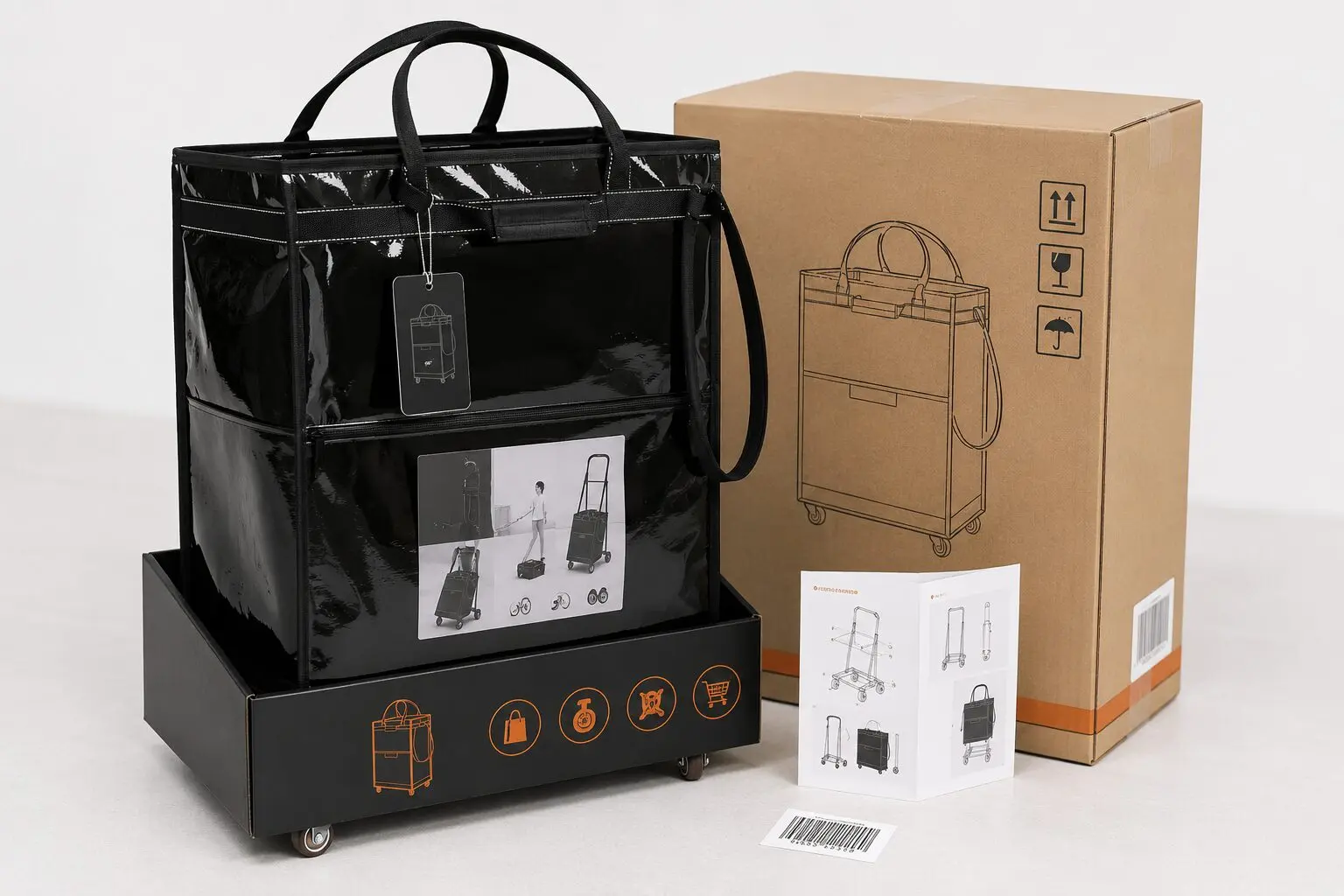
Common packaging problems that trigger returns:
- No unboxing “wow” moment → buyer feels the product is cheap → returns for “not as described”
- No care instructions → buyer machine-washes it → shrinks → returns for “quality issue”
- No FNSKU sticker or wrong sticker size → Amazon FBA rejects the shipment (huge cost)
- No suffocation warning on poly bag → Amazon flags for compliance → listing suppressed
- Retail-ready gift box for a utility product → excessive packaging waste → 1-star reviews about “environmental waste”
What your manufacturer should be doing:
A serious OEM factory will consult with you on packaging strategy before production. At Great Shine we ask every buyer:
- Is this a gift item or utility item? (drives packaging premium level)
- What’s your target ASP? (affects packaging budget)
- Are you shipping to FBA directly? (requires specific labeling)
- What market? (US/EU/JP have different labeling requirements)
- Do you want retail-ready or bulk-shippable packaging?
Based on your answers, we recommend one of 4 packaging tiers, provide packaging design mockups for your approval, and ensure every FBA compliance requirement (FNSKU, suffocation warnings, ISPM-15 for wooden packaging) is met.
Issue 6: Your MOQ is Making PPC Impossible
Here’s a math problem I’ve watched sellers fail hundreds of times:
- Product cost per unit: $8
- FBA fees + shipping: $6
- Amazon commission (15%): $4
- Sell price: $28
- Gross profit per unit: $10
Now factor in PPC:
- Average ACoS in storage category: 35–45%
- PPC cost per sale: $10–12
- Your net profit per sale: 0to−2. You’re paying to acquire customers.
The single lever most sellers overlook: MOQ. If you ordered 500 units at $8 per unit, your unit profit is $0. But the same product at 5,000 units costs $5.20 per unit, and your unit profit jumps from $0 to $12.80. Suddenly PPC math works.
What your manufacturer should be doing:
A good manufacturer offers tiered MOQ pricing with real cost transparency:
At Great Shine we start OEM at 500 pcs but always share the full tiered pricing so buyers can plan their scaling strategy. Suppliers who quote flat pricing regardless of quantity are usually traders — they can’t influence factory pricing at higher volumes.
Issue 7: Your Product Copy is All Feature, No Amazon-Specific Benefit
Amazon shoppers scan, they don’t read. In the first 2 seconds, they decide: “Is this what I need?”
Weak copy (feature-focused):
“Premium 210T polyester fabric with heat-sealed seams and dual-carry handles.”
Amazon-optimized copy (benefit-focused):
“FITS INTO 24-INCH SUITCASE — 4-piece compression packing cube set saves 40% suitcase space compared to loose folding. Perfect for 7-day trips without checked baggage fees.”
The second version:
- Front-loads specific dimensions Amazon shoppers search
- Quantifies benefit (“40% space savings”)
- Addresses financial concern (“avoid checked baggage fees”)
- Includes a specific use case (“7-day trips”)
What your manufacturer should be doing:
Your supplier should provide product specification data in Amazon-friendly format, not just technical drawings:
- Dimensions that map to common shopper searches (fits carry-on / fits under bed / fits closet shelf)
- Capacity in real-world terms (holds X shirts / X pairs shoes / X blankets)
- Compatibility claims tested and verified (fits standard hangers / fits Rubbermaid organizers)
- Weight in imperial + metric
Great Shine provides every buyer with a “Product Data Sheet for Amazon Listings” that translates technical specs into shopper-friendly language, ready to paste into product copy.
Issue 8: Your Return Rate is Above 5% and You Don’t Know Why
Amazon’s IPI (Inventory Performance Index) is heavily influenced by return rate. High returns = restricted storage = fewer units allowed inbound = revenue ceiling.
Most sellers see the return rate number but don’t diagnose the causes. Common storage bag return triggers:
- Sizing — buyer expected different dimensions (“smaller than I thought”)
- Material — buyer expected sturdier fabric (“flimsy,” “not what pictured”)
- Function — zipper/handle broke early (“broke on first use”)
- Odor — chemical smell from packaging or fabric treatment
- Instructions — buyer didn’t know how to fold/use (“confusing”)
What your manufacturer should be doing:
A good supplier partners with you on return analysis:
- Requests scan of top 20 negative reviews monthly
- Identifies which issues are product vs listing vs shipping
- Proposes engineering changes to reduce recurrence
- Provides updated samples for A/B testing
At Great Shine we run a monthly “review audit” for our top FBA buyers — mining Amazon reviews for both their listing and top 5 competitors, then recommending specific product improvements. When we made this analysis a standard service in 2023, our buyers’ average return rate dropped from 6.8% to 3.1% within 90 days.
Bringing It All Together
Amazon FBA success in storage bag category isn’t about hacking the algorithm. It’s about controlling the 8 upstream levers most sellers accept as fixed:
- Photography that passes 2025 Amazon spec
- Multi-format Amazon-ready video with subtitles
- Keyword-informed bullet points
- Optimized backend search terms
- Packaging engineered for FBA and shopper unboxing
- MOQ pricing tiers that make PPC math work
- Product data in Amazon-friendly language
- Ongoing return rate diagnosis and product iteration
The single biggest determinant of whether you can execute all 8 is your manufacturer. A supplier who only ships bulk cargo is a commodity. A supplier who partners with you on listing optimization, provides free listing kits, iterates products based on Amazon review data, and offers tiered pricing that unlocks profitable scaling — that’s an unfair advantage.
If you’re currently getting bulk cargo and calling it OEM, and your listing isn’t ranking or converting the way you need it to, you probably don’t need a new listing consultant. You need a new manufacturer.
If you’d like a free audit of your current storage bag listing (I’ll personally review your photos, video, bullets, and back-end and send you a specific list of upstream fixes), request it here — no charge, no obligation.
Amazon storage category rewards sellers with unfair supply chain advantages. Build yours.
Grace Ji is Sales Director at Great Shine, a Chinese OEM manufacturer specializing in storage bags, packing organizers, cosmetic bags, and seasonal storage products for Amazon FBA private-label brands. Every OEM package includes free Amazon-ready photography, multi-format product video, keyword-informed data sheets, and monthly review mining audits. Contact her at sales11@g-shine07.com.