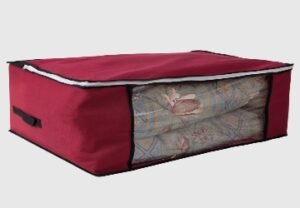
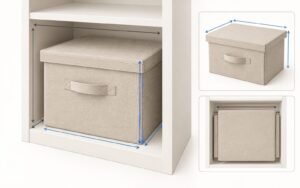
Under-bed storage bag sizes are useful only when you compare them with the smallest opening beneath the bed and the space the filled bag will occupy. Measure floor-to-frame clearance, the route past the bed legs, and the usable footprint. Then check the bag with its intended contents inside, allowing room to grip the handle and pull it out.
A bag labelled 120 × 50 × 15 cm is not guaranteed to fit beneath a bed with 15 cm clearance. Soft sides can bulge when filled, the floor may be uneven, and the frame can hang lower along the route than it does at the edge.
Quick answer
Check fit in this order: measure the access opening, map the clear space beneath the bed, measure the filled bag, and test insertion and removal. Use the lowest clearance along the whole route. A close match between the nominal bag height and the measured gap needs a physical fit check; there is no universal allowance that works for every soft bag and bed frame.
For retailers, this same process helps produce accurate size diagrams and customer instructions. It is more useful than labelling a product “fits most beds” without compatibility evidence.
Measure the bed’s usable clearance
Measure from the floor surface on which the bag will rest to the lowest fixed obstruction above it. Check several positions, including the entrance, the centre of the route and the intended storage position.
The visible side rail may not be the lowest part of the bed. Brackets, crossbars, centre supports and other components can reduce the available space. On carpet, test on the actual surface: a soft floor can affect sliding resistance and how the filled bag sits.
Write down separate measurements for:
- The lowest height along the insertion route.
- The width between legs or other obstructions at the entrance.
- The clear length and width of the intended storage area.
- The accessible floor space beside the bed for removing the bag.
Do not use the mattress size as a substitute. A bed’s nominal sleeping area says little about the positions of its supports or the route into the space beneath it.
Check the path into the space
A bag can fit beneath the bed once inside and still be difficult to get through the opening. Plan whether it will enter from the side or the foot of the bed, and identify which dimension faces the entrance.
For a 120 × 50 cm footprint, one approach may present the 50 cm side to the opening. Another may require room for the 120 cm side. Turning the bag around a centre leg takes additional space. A soft bag may flex, but an overfilled bag can lose much of that flexibility.
Place a tape outline on the floor or use a flat template to check the footprint. This can reveal a support leg or blocked corner before ordering. A flat template does not test filled height, handle access or the force needed to move a loaded bag; those checks still need a sample.
Avoid planning a fit that depends on crushing the contents or pulling hard on the zipper. The bag should move through the route in the condition in which it will be used.
A 120 × 50 × 15 cm example
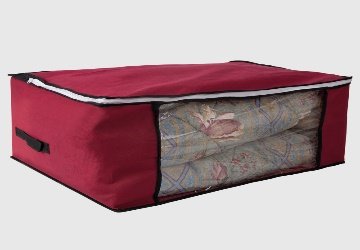
Great Shine’s documented bedding-storage configuration measures 120 × 50 × 15 cm in assembled external length × width × height. It uses 80 gsm PP non-woven fabric, a front clear PVC window, a zipper with two sliders and a fabric handle on each side.
These dimensions are approximately 47.2 × 19.7 × 5.9 inches. They describe the reference product’s exterior, not a guaranteed internal space or tested load.
Consider this hypothetical fit check:
- The lowest point along a bed’s access route measures 18 cm.
- The bag is nominally 15 cm high, leaving a nominal difference of 3 cm.
- Once packed with the intended bedding, its highest point measures 17 cm.
The actual measured height difference is then 1 cm. Whether removal remains comfortable depends on the surface, the frame and the bag’s movement. This example is arithmetic, not a recommended clearance or a test result for the product.
For a tight fit, try a lower bag, reduce the fill or choose another storage position. Do not promise fit based on the unfilled height alone.
External dimensions are not usable capacity
External dimensions describe the envelope around the product. Internal usable space depends on seams, folds, the shape of the opening and the way the contents sit inside it.
Multiplying 120 × 50 × 15 cm gives a rectangular external volume of 90,000 cubic centimetres, or 90 litres. That calculation does not verify a 90-litre usable capacity. A soft bag is not a perfectly rigid rectangular container, and packing it into that shape may put pressure on the closure.
Bedding also varies in thickness and compressibility. A list of items such as “two duvets and four pillows” is meaningful only if those items and the packing method are defined. For a retail listing, show the external dimensions clearly and use a filled sample to support any capacity description.
Keep these four measurements separate:
- Assembled external dimensions for checking the space the bag occupies.
- Internal usable dimensions or a documented capacity method, if provided.
- Folded product dimensions for storage when empty.
- Retail-pack and shipping-carton dimensions for packaging and logistics.
Carton dimensions cannot be substituted for the folded size of a single bag. A carton also includes the packing arrangement and multiple units.
Measure the bag after filling it
Fill the sample with the type of clothing or bedding it is intended to hold. Close the zipper without forcing it, then place the bag on a level surface and measure its maximum height and width.
Look for a raised centre, bulging sides or a corner that catches beneath the frame. Measure the widest and highest points rather than pressing the fabric down to match the nominal dimensions.
Try the full access cycle:
- Put the filled bag through the chosen opening.
- Slide it into its intended position without catching it on the frame.
- Reach the handle from the position a user will normally stand or kneel in.
- Pull the bag out far enough to open it.
- Remove an item and close the bag again.
This check can reveal that a shorter bag is more convenient even when a longer version technically fits. For a retailer choosing between sizes, access and retrieval can be more useful comparison points than maximum nominal volume.
Leave room to use the handles and zipper
Handle position determines where the user needs access. The documented 120 × 50 × 15 cm version has handles on its two sides. Check the sample or drawing to see exactly which panels carry them, then match that position to the intended direction of removal.
A handle pressed against a bed leg may be difficult to grip. A handle at the far end of the bag may be inaccessible once the bag is pushed fully beneath the bed. Allow space for the user’s hand, not only the fabric handle itself.
A pull handle also does not establish that a full bag can be lifted by that handle alone. Ask for the intended handling method and any relevant load evidence. In use, avoid dragging a snagged bag by one attachment point.
The zipper needs access too. If the opening is on top, plan to remove the bag before opening it unless the bed provides enough working space. Two sliders can change where the opening starts, but they do not eliminate the need to reach it.
A fit record buyers can copy
Record the measurements below for each bed or intended retail use. Use one unit consistently and label every dimension on a simple sketch.
- Bed or installation reference.
- Floor surface: hard floor, rug or carpet.
- Entry direction: side or foot of bed.
- Minimum entry height and width.
- Lowest clearance farther along the route.
- Clear storage footprint and locations of support legs.
- Bag model and assembled external length × width × height.
- Contents used for the fit check.
- Maximum filled height and width.
- Handle location and space available to grip it.
- Whether the bag can be removed and opened comfortably.
- Photograph of the filled sample beside the measuring tape.
For a custom order, send this record to the supplier with the desired size. Agree how finished dimensions will be measured and what tolerance is acceptable before approving the sample. A tolerance suitable for an open floor area may be unsuitable for a tight bed opening.
Frequently asked questions
Will a 15 cm high bag fit a 15 cm gap?
A nominal match does not guarantee fit. Check the filled bag’s maximum height, the lowest obstruction along the route and whether the bag can move without rubbing or catching.
Can I squeeze a soft storage bag beneath a low bed?
Some empty or lightly filled bags flex, but fit should not depend on forcing the closure or compressing the bag against the frame. Check the intended filled condition and choose a lower profile if access is difficult.
Do all beds of the same size have the same storage space?
No. Bed legs, crossbars, centre supports and frame height vary. Measure the individual bed instead of using mattress dimensions to predict compatibility.
Is the 120 × 50 × 15 cm version a 90-litre bag?
Those external dimensions multiply to a 90-litre rectangular envelope. They do not establish tested usable capacity. Describe the external size unless a separate capacity method has been agreed and checked.
Should the window face the entrance?
Face it toward the user’s viewing position where the layout permits. Check that this orientation also leaves the handles accessible and allows the bag to pass the bed supports.
Choose a size for the actual space
Compare Great Shine’s under-bed and bedding storage bag options using your clearance measurements and intended contents. For a retail order, include the access direction and the filled-sample check in the specification so that the product dimensions and customer instructions describe the same use.