Wholesale buyers should specify an underbed storage bag by its assembled size, material, zipper, handle arrangement and retail pack. Confirm the filled product fits the intended storage space, then compare quotations against that same construction. A low nominal height or a “large capacity” description does not establish bed compatibility, usable volume or carrying strength.
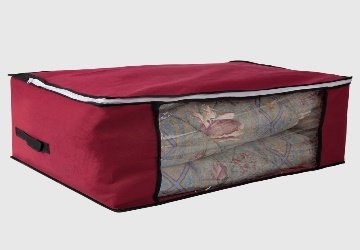
Great Shine’s documented 120 × 50 × 15 cm bedding bag provides a concrete reference: 80 gsm PP non-woven fabric, a front clear PVC window, two zipper sliders and a fabric handle on each side. The project packing was a CPP bag with a hanging slot and printed insert, with 24 pieces per carton.
For these bedding-bag styles, the minimum order is 500 pieces per style, with mixed colours allowed within the same style. Confirm the quantity by colour and the final packing arrangement in the quotation. A different material or structure needs a separate specification review.
The first image is a style reference from the product development file; its colour is not the final project colour. The wheeled designs shown later are separate products. The dimensions, materials and packing counts in this guide apply to the specified soft bedding bags.
Choose dimensions around the intended contents and space
Choose a low-profile bag for the measured space beneath the bed, and check it with the intended clothing or bedding inside. The dimensions of the empty bag alone cannot predict the highest point after filling.
The source project includes two related bedding-bag sizes:
- 120 × 50 × 15 cm: a long, low-profile configuration to assess for under-bed use.
- 60 × 42 × 28 cm: a deeper bedding-storage configuration that requires substantially more vertical space.
Both are assembled external length × width × height. They do not establish internal capacity or the number of duvets a bag can hold. The deeper version should not be marketed as universally suitable beneath beds merely because it belongs to the same storage range.
For an under-bed retail product, check the access opening, centre supports, floor surface and direction of removal. Measure the filled bag at its highest point and confirm that a user can reach the handle. Include those checks in the sample brief before producing compatibility claims.
Agree the finished-dimension tolerance and measurement condition. If the product must fit a tight opening, a small variation can affect use even when the sample looks acceptable on an open floor.
Specify fabric, zipper, window and handles as one construction
The documented bedding bags use 80 gsm PP non-woven fabric with matching-weight non-woven binding and side handles. The front clear PVC window allows part of the contents to be seen, and the zipper has two sliders.
Record each component in the specification. “Non-woven underbed bag” does not tell the supplier the window size, opening layout, handle location or whether the body needs internal support.
The reference construction does not provide a verified carrying load, waterproof rating or service-life figure. Agree any performance claim with supporting evidence for the complete product. A window and zipper do not make a textile bag airtight, and a denser alternative fabric would not automatically establish stronger handle attachments.
Check the opening with the intended contents
Pack the sample, then open and close the zipper without pushing the contents away from the teeth or forcing the sliders around corners. Check stitching at the zipper ends and where the window meets the fabric.
Two sliders let the user adjust where the opening starts. Their presence does not establish zipper grade, smoothness or cycle life. Specify those separately if the retail programme requires them.
Check how the bag will be moved
Confirm which side panels carry the handles and which handle remains accessible beneath the bed. Inspect the attachment on the filled sample using an agreed handling method.
A handle used to pull a bag across a clear floor faces a different task from lifting the entire contents. Do not label a design suitable for heavy lifting without relevant evidence. If the range needs rigid support, dividers or wheels, request those as a separate construction rather than assuming they are included in this soft bedding bag.
Confirm MOQ and the colour breakdown
The confirmed order condition for the bedding-bag styles described here is 500 pieces per style, with colours mixed within the same style. Ask the supplier to identify each style on the quotation and confirm any minimum quantity per colour.
Do not pool the 120 × 50 × 15 cm and 60 × 42 × 28 cm versions into one MOQ without agreement. A size or construction change can create a different style, even when the fabric colour remains the same.
Keep these quantities separate:
- Pieces ordered for each style.
- Pieces in each colour.
- Pieces in one retail selling unit, especially if a set is proposed.
- Pieces in each shipping carton.
The reference carton quantity of 24 pieces does not divide evenly into a 500-piece order. Twenty full cartons contain 480 pieces; the remaining 20 require an agreed packing arrangement. Where full cartons are required, confirm the order quantity or revised carton packing before issuing the purchase order.
For another size or material, request the applicable MOQ in writing. The 500-piece arrangement above applies to these bedding-bag styles; it should not be copied to a different storage product without confirmation.
Approve retail packaging before calculating freight
The documented individual pack was a CPP bag with a hanging slot and printed insert. The project specified 24 pieces per carton for both bedding-bag sizes, but the products had different shapes and packing arrangements.
Approve a folded and packed sample. Confirm the fold does not place an avoidable crease through the main viewing area, the insert fits the pack and the display slot works with the intended hook. Product size, folded size and retail-pack size should each have a separate field.
The handover notes require the factory to confirm actual carton dimensions. Treat the listed carton sizes as project planning information until the final pack has been checked. Gross weight also needs confirmation before a freight calculation.
Ask the supplier to return:
- A photo of the packed product with dimensions.
- Insert artwork size, barcode position and product identification.
- Carton count and arrangement of units.
- Final external carton dimensions and gross weight.
- Carton marks and protection used during transport and opening.
The project instructions included protective sheets at the top and bottom of the carton to help prevent opening cuts. Confirm whether this protection is included in your quotation. A low unit price with different retail packaging or carton protection is not the same offer.
Inspect the sample against the buying brief
Sample approval should resolve fit, access and workmanship before bulk production. Keep the approved sample with a dated specification and the final packing reference.
Size and filled profile
Measure assembled length, width and height at the agreed points. Record the tolerance and sample condition. Then pack the intended contents and check maximum filled height against the required clearance.
Material, colour and seams
Compare the body, binding and handles with the approved material and colour references. Check for skipped stitches, frayed binding and loose threads. Agree workmanship limits and any required strength checks before production.
Zipper and window
Operate the complete opening on the packed sample and confirm the slider arrangement. Inspect the window’s visibility, attachment and fold marks against the agreed position, dimensions and appearance standard.
Handles and packaging
Check handle placement and attachment using the intended handling method and any agreed load test. Separately, compare the retail insert, barcode, fold and carton count with the approved retail and shipping specification.
The project notes specifically warn against frayed binding and weak seams. Inspect those details on the sample and include them in the shipment review. If formal inspection is required, agree the sampling plan and acceptance criteria in advance.
Prepare an RFQ that suppliers can compare
State the use, selected size, material, window and opening requirements. Add the quantity by colour and the retail-pack format. Give the destination market and ask the supplier to identify what is included in the price.
For the documented low-profile version, a useful request is:
Please quote the 120 × 50 × 15 cm bedding storage bag with 80 gsm PP non-woven fabric, a front clear PVC window, two zipper sliders and side handles. Confirm the 500-piece MOQ per style and the permitted colour split. Quote the CPP bag with hanging slot and printed insert separately from any packaging alternative. Please confirm carton packing, final carton dimensions and gross weight after a packing check.
For changes to the window, handle construction or fabric, request a revised specification and sample assessment. Confirm sampling and production timing for the selected materials and artwork; the reference project does not establish a fixed lead time for every order.
Frequently asked questions
Does 120 × 50 × 15 cm mean the bag has 90 litres of usable capacity?
Multiplying the external dimensions gives a 90-litre rectangular envelope. It does not establish usable capacity. Seams, fill shape and closure pressure affect what the bag can hold.
Can all colours count toward the 500-piece MOQ?
Mixed colours are allowed within the same bedding-bag style under the confirmed arrangement. Agree the quantity per colour and any material or custom-colour restrictions in the quotation.
Is 24 pieces per carton the minimum order?
No. It is the project packing count. MOQ, order quantity and pieces per carton are separate terms and should appear separately on the quotation.
Are the side handles suitable for lifting bedding?
The reference specification confirms the handles, but does not establish a tested lifting load. Agree the intended handling method and any required load test for the selected construction.
Can this bag replace a vacuum storage bag?
This is a zippered textile bedding bag with a clear window. It does not have the specified airtight closure and valve system used for vacuum compression. Select a separate vacuum-bag construction if compression is required.

Review Great Shine’s underbed and bedding storage bag configurations and send your selected size, quantity by colour and retail packaging brief. Use the same specification for the quotation, approved sample and final shipment check.