TL;DR
A PPWR-ready RFQ should do more than ask a supplier whether its packaging is compliant. It should define the finished packaging, identify every component, state the EU market and legal roles, list the evidence required before shipment, and prevent unapproved material changes.
The most useful procurement model is a specification-to-evidence chain: every packaging claim must connect to a controlled specification, a named supplier or manufacturing plant, supporting evidence, an approved sample and a shipment or batch reference. This gives the EU importer a retrievable record when authorities, retailers or marketplaces ask questions.
Important: PPWR documentation is project-specific. The checklist below helps buyers organise sourcing information but does not replace a legal conformity assessment.
Why is “PPWR compliant packaging required” a weak RFQ instruction?
Because it does not define the packaging, the applicable requirement or the evidence the buyer expects.
Two suppliers can read that sentence differently. One may send a general material declaration. Another may provide an unrelated test report. Neither document proves that the final printed, labelled and packed configuration has been assessed.
Regulation (EU) 2025/40 generally applies from 12 August 2026. For EU importers, the practical file may need to support conformity assessment, technical documentation, an EU declaration, economic-operator identification, labels, restricted-substance limits, traceability and corrective action. Later requirements add recyclability performance, recycled-content and packaging-minimisation considerations.
The RFQ is the earliest point at which a buyer can prevent evidence gaps. It should convert legal topics into product data that a factory can quote, sample and control.
What information should the buyer provide before requesting a quote?
Start with the market, product, packaging function and sales channel. Without this context, the supplier cannot distinguish a retail pack from transport or e-commerce packaging.
Commercial and market information
- importing legal entity and target EU Member States;
- intended sales channels: retailer, marketplace, own website or B2B distribution;
- private-label brand and economic-operator details;
- expected order quantity and delivery pattern;
- product use and whether the packaging remains with the product after sale;
- retailer or marketplace packaging standards in addition to PPWR.
Product and packing information
- finished product dimensions and weight;
- required folded, nested or compressed size;
- units per inner carton and master carton;
- known protection points and expected logistics route;
- barcode, label, instruction and display requirements;
- whether the sales package also functions as the e-commerce package.
This information should be issued with one RFQ number and revision date. New dimensions or materials should create a new revision, not an informal email change.
What packaging components should appear in the RFQ bill of materials?
List every physical component separately, including items buyers often treat as “small accessories.”
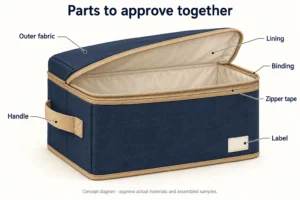
For a fabric storage product or custom bag, the packaging bill of materials may include:
| Component | Specification fields | Evidence or decision needed |
|---|---|---|
| Main sales bag or pouch | Polymer or fabric, coating, thickness, dimensions and weight | Material declaration; recyclability and recycled-content review |
| Clear window | Polymer, thickness, size and attachment method | Compatibility and separability assessment |
| Zipper or closure | Tape, teeth, slider and puller materials | Component composition and necessity review |
| Paper insert or sleeve | Fibre source, coating, lamination, ink and weight | Recyclability and labelling inputs |
| Printed label | Substrate, adhesive, ink and placement | Separability and artwork approval |
| Inner/master carton | Board grade, dimensions, weight and units per carton | Right-sizing and transport data |
| Tape and void fill | Material, width, weight and quantity | Empty-space and material-minimisation review |
| Pallet wrap or straps | Polymer, weight and use per pallet | Transport-packaging record |
Weights should refer to the finished component, not only nominal raw-material density. Where a supplier cannot provide a final weight at quotation stage, mark it as a pre-production confirmation item.
Which PPWR evidence should a buyer request from a supplier?
Request evidence by requirement and packaging version, not a random certificate bundle.
Use three evidence levels:
Level 1: supplier-controlled product data
- signed packaging specification;
- component material declaration;
- finished component weights;
- manufacturing site and subcontractor identification;
- artwork and label approval;
- declaration of no unapproved material substitution.
Level 2: upstream or external evidence
- resin, film, paper or board supplier documentation;
- recycled-content chain-of-custody records where a claim is made;
- relevant laboratory test reports;
- calculation worksheets required by the applicable methodology;
- evidence linked to the actual material grade and plant.
Level 3: conformity file
- applicable conformity-assessment records;
- technical documentation structured for Annex VII requirements;
- EU declaration of conformity;
- traceability and retention records;
- corrective-action procedure and contact.
The EU economic operator should decide which documents are legally required and whether the evidence is sufficient. A supplier can provide inputs, but a broad “PPWR certificate” should not replace the correct assessment route.
How should buyers specify heavy metals and material claims?
State the requirement, evidence format and material scope. Article 5 limits the sum of lead, cadmium, mercury and hexavalent chromium in packaging or packaging components to 100 mg/kg, subject to the regulation’s provisions.
An RFQ should identify whether the request covers the complete packaging or specified components, such as printing ink, zipper hardware, coated paper or coloured plastic. Ask for a declaration linked to the material grade and require testing where the buyer’s risk assessment justifies it.
For recycled content, do not simply write “35% PCR required.” First identify the packaging category. Article 7 sets different targets, exclusions and methodologies. The 35% headline applies to “other plastic packaging” on the staged deadline of 1 January 2030 or three years after the relevant implementing act enters into force, whichever is later.
When a recycled-content claim is required, specify:
- post-consumer rather than generic recycled content;
- component and packaging format;
- target percentage and tolerance;
- calculation boundary and manufacturing plant;
- verification documents;
- approval process if appearance or performance changes.
How should recyclability be discussed before the 2030 methodology is finalised?
Ask for design information and alternatives, not an unsupported recyclability grade.
From 2030, PPWR introduces packaging recyclability performance grades under the applicable methodology: A at 95% or more, B at 80% or more, and C at 70% or more by weight. Packaging below 70% is treated as technically non-recyclable for this purpose. From 2038, grade C packaging may no longer be placed on the market.
Before the detailed assessment is confirmed for a project, ask suppliers to disclose:
- all material layers and coatings;
- adhesives and printing coverage;
- labels, windows, closures and reinforcements;
- whether components can be separated by the user or recycling process;
- mono-material or simplified alternatives;
- weight and performance trade-offs for each option.
This produces useful engineering data without presenting a speculative grade as a fact.
How can an RFQ address packaging minimisation and empty space?
Set measurable packed dimensions and ask for at least one right-sized option.
Article 24 establishes a maximum 50% empty-space ratio for grouped, transport and e-commerce packaging on its staged deadline. Filling materials count as empty space. The exact calculation follows the relevant implementing methodology.
Add these fields to the RFQ:
- product dimensions before and after folding or compression;
- sales-package internal and external dimensions;
- master-carton dimensions and units per carton;
- e-commerce package dimensions for a one-unit order;
- void-fill type and estimated quantity;
- reason each protective element is needed;
- carton utilisation or package-volume comparison between options.
For custom storage boxes and fabric bins, changes to board placement, handles or folding sequence can affect packed volume. These decisions are easier to test during sampling than after retail packaging has been printed.
What should be approved at the sample stage?
Approve both the product sample and its full packaging configuration. A loose product sample cannot confirm the finished sales and transport package.
The sample approval sheet should record:
- RFQ and specification revision.
- Finished dimensions and component weights.
- Material construction and colour references.
- Logo, label and barcode artwork.
- Folded product and package dimensions.
- Units per carton and carton construction.
- Required evidence received and evidence still pending.
- Approved deviations, owner and expiry date.
- Physical reference sample location.
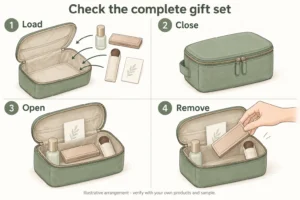
Photographs should show the product, open package, closed package, labels, carton packing and measurement points. Photos support traceability but do not replace technical documents.
How should buyers prevent undocumented supplier changes?
Make change control a purchase-order condition. Require written approval before changing material supplier, resin or fibre grade, recycled-content source, coating, adhesive, ink, dimensions, component weight, production site or packaging method.
For repeat orders, request a short declaration confirming that production matches the approved revision. If a change occurs, decide whether the sample, test evidence, conformity file, declaration or artwork needs updating before shipment.
Great Shine’s OEM, ODM and private-label process can be used to organise specification, sample and production discussions. Buyers should state their evidence requirements early enough for them to be priced and scheduled.
What does a complete PPWR packaging RFQ checklist look like?
The final RFQ should be answerable line by line.
| RFQ section | Buyer input | Supplier response |
|---|---|---|
| Market and role | EU countries, importer, brand and sales channel | Manufacturer/site details and responsibility confirmation |
| Packaging scope | All sales, grouped, transport and e-commerce components | Complete component list |
| Technical specification | Dimensions, weights, materials, printing and revision | Proposed construction and tolerances |
| Design options | Material restrictions, right-sizing and simplification goals | Base option plus alternatives and trade-offs |
| Evidence | Required declarations, reports and technical-file inputs | Availability, issuer, scope and lead time |
| Sample approval | Measurements, artwork, packing and test points | Sample plan and deviations |
| Production control | Batch reference and inspection requirements | Traceability method |
| Change control | Changes requiring written approval | Named supplier contact and notification process |
| Final release | Documents required before shipment | Delivery date and file index |
Attach this table to the quote request rather than relying on a later compliance questionnaire. Suppliers can then identify missing data before cost and timing are committed.
FAQ
Is there an official PPWR certificate suppliers can provide?
PPWR establishes conformity obligations and documentation; buyers should not assume that one generic “PPWR certificate” proves every requirement for the finished packaging. Confirm the applicable assessment and evidence route.
Should buyers request laboratory testing for every component?
Not automatically. Testing should be driven by the requirement, material, supplier evidence and risk assessment. The report must cover the relevant material grade, component and production source.
Can an old test report be reused for a new order?
Only after confirming that the tested material, supplier, manufacturing site, specification and final package remain relevant. A report for a visually similar material may not support the current packaging.
Who should prepare the EU declaration of conformity?
The responsible manufacturer prepares the declaration under the applicable PPWR conformity route. Importers must verify it before placing relevant packaging on the market and retain it for the required period.
When should PPWR documentation be discussed with the supplier?
At RFQ stage. Evidence can affect material selection, testing, sample timing and price. Asking after production creates avoidable delays and substitution risk.
Request an RFQ Review
Send Great Shine your product drawing, target dimensions, sales channel, EU destinations, materials, logo artwork, quantity, packing limits and evidence checklist through the contact page. The team can help turn the brief into a manufacturable specification and sample plan.