Buying the wrong size pet carrier wastes a trip in two directions: too small and the pet cannot turn around, too tall and the gate agent stops you at the door. The fix is a two-step measurement, your pet first, the airline second, with working room added between. This guide shows both steps with the published airline numbers in one table.

Step 1: measure your pet
Two measurements decide the carrier size. Both are taken with the pet standing square on the floor, not sitting, not lying down.
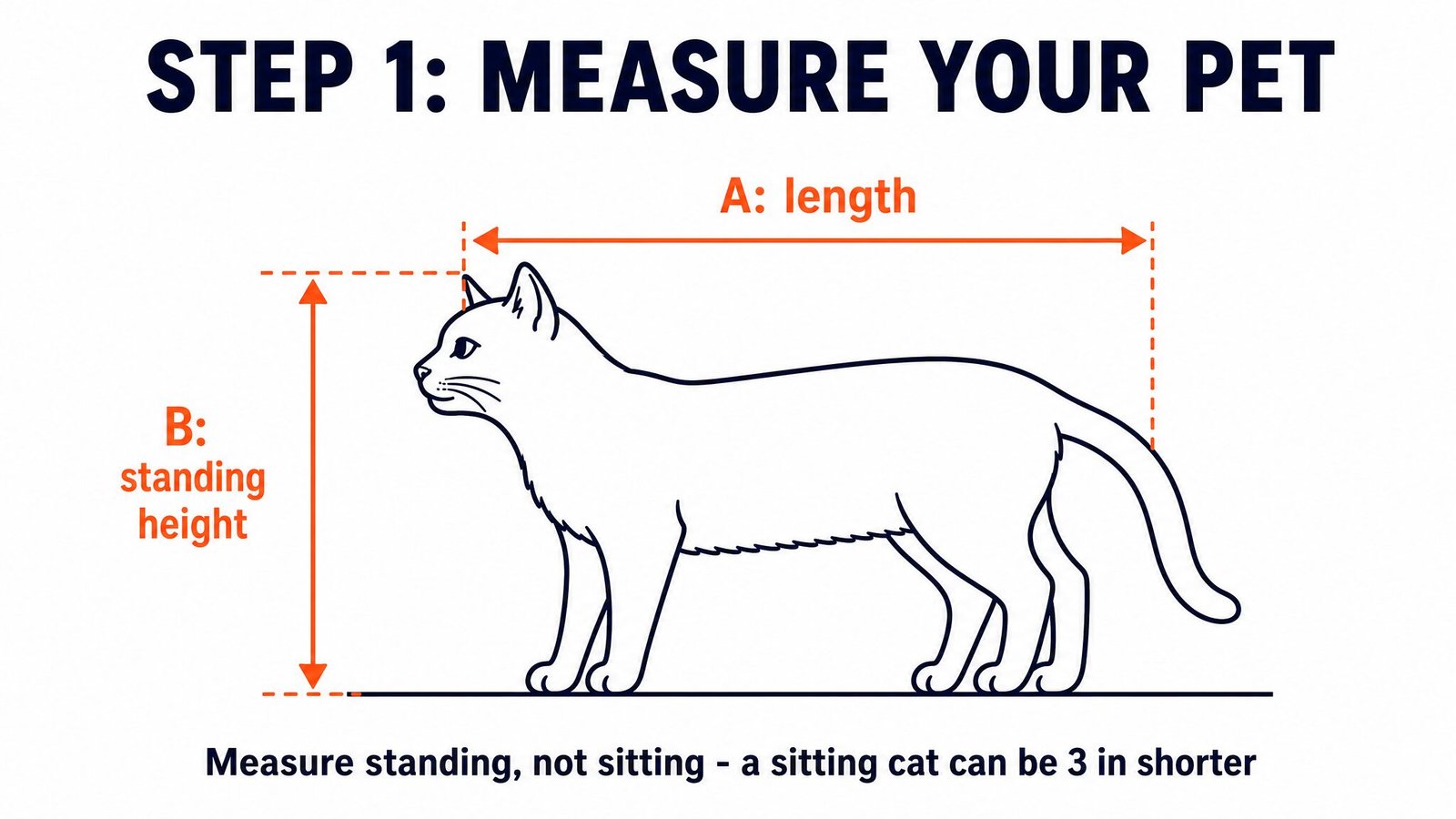
A. Length. From the tip of the nose to the base of the tail, where the tail meets the body. Do not include the tail itself. This is the number that sets the carrier’s floor length.
B. Standing height. From the floor to the top of the head, ears included. A cat that flattens its ears when picked up still gets measured ear-up. This sets the carrier’s interior height requirement.
C. Working room. Add 2 to 3 inches to the length so the pet can lie down, shift position and stand without pressing against the ends. Delta’s own policy states the pet must be able to move around without touching or sticking out from the sides, which is the standard your measurement should satisfy.
For girth, a tape around the widest part of the chest tells you whether a top-load or side-load opening is easier. It does not change the carrier’s external size, but it changes which opening style the pet tolerates.
Step 2: check the airline before you choose
The carrier has to fit two constraints at once: the pet inside it, and the under-seat space in front of it. These are the published limits.

| Airline | Soft carrier limit | Published notes |
|---|---|---|
| Delta | 18 x 11 x 11 in recommended | Must be leak-proof, ventilated on 3 sides domestic / 4 sides international; pet must move without touching the sides |
| United | 11 x 18 x 11 in soft-sided | Boeing 737 MAX: carrier no more than 10 in tall |
| American | Varies by aircraft; soft collapsible recommended | Up to 20 carriers per narrowbody flight |
| Lufthansa | 55 x 40 x 23 cm | Height limit about 9 in, lower than US carriers |
| easyJet | 45 x 36 x 20 cm | Height limit under 8 in |
Read the table as a ceiling, not a target. A carrier that exactly equals 18 x 11 x 11 has no margin for a thick pad or a pet that shifts during the flight. For US domestic programs, building to about 17 x 10.5 x 10.5 leaves margin inside every published limit. For programs that sell into Europe as well, the European height numbers (23 cm and 20 cm) are the binding constraint, and many brands run two size variants rather than one compromise size.
Matching the measurement to the carrier type
Cabin soft carrier (17-18 in class). Fits pets whose length plus working room stays under about 15 in: most cats and small dogs. The standard cabin class sold across US retail.

Backpack (front-window type). Interior height is the constraint, not length. Check the pet’s standing height plus an inch of headroom against the window opening.
Sling. No airline will accept a sling for in-cabin stowage. Slings are for ground transport, walks and vet visits, sized by pet weight class rather than dimensions.
XL double carrier. Exceeds every under-seat limit. Use is car transport and hotel rooms, not flights. If a two-pet flight program is the goal, Delta allows two same-breed pets 8 weeks to 6 months in one kennel, which is a different product entirely.
Common sizing mistakes
Measuring a sitting or lying pet. A sitting cat can be 3 in shorter than the same cat standing. The carrier is sized to the standing animal.

Measuring the carrier flat or folded. A soft carrier measured folded flat reads several inches shorter than assembled with the frame or board in place. Measure assembled, zippers closed.
Using the external size as the internal size. Walls, padding and frame consume 1 to 2 in of each dimension. A carrier listed at 18 in external gives roughly 15-16 in of floor.
Ignoring the loaded profile. Soft sides bulge outward with the pet and pad inside. The gate agent sees the loaded carrier, so the loaded measurement is the one that matters.
Sizing to the pet’s cute curled-up footprint. Pets travel lying down but enter the carrier and shift standing up. The working room exists for the standing moment.
Quick reference: worked examples
| Pet | Measured A + B | Carrier floor needed | Class that fits |
|---|---|---|---|
| Cat, 10 in nose to tail base, 10 in standing | A 10, B 10 | 12-13 in floor | Standard cabin carrier (17-18 in class) |
| Small dog, 12 in length, 11 in standing | A 12, B 11 | 14-15 in floor | Large end of cabin class; check loaded height |
| Medium dog, 16 in length, 14 in standing | A 16, B 14 | 18-19 in floor | Exceeds cabin class; backpack or car class |
The examples are arithmetic, not a size chart for any specific brand: your measurements go in the left column, the airline ceiling caps the right column, and the class between them is the answer.

What this means for brands ordering custom carriers
The same two-step logic runs a custom program, reversed: start from the airline ceilings and the target pet weight class, then set the internal dimensions so the class of pet fits with working room, then choose fabric and frame to keep the loaded external size inside the ceiling. A sample measured assembled and loaded closes the loop before bulk production. If your program targets both US and European retail, decide the height strategy (two variants or one European-height build) at the spec stage, not after the first production run.

FAQ
What size carrier fits under an airplane seat?
In the US, 18 x 11 x 11 inches is the published soft-sided ceiling on Delta and United. European carriers publish lower heights: Lufthansa 55 x 40 x 23 cm, easyJet 45 x 36 x 20 cm.
How do I measure my cat for a carrier?
Two numbers with the cat standing: nose to tail base (length) and floor to top of head with ears (height). Add 2-3 in of working room to the length.
Do airlines weigh pets in the cabin?
US carriers state the pet plus carrier must fit under the seat with room to move; some airlines list a combined weight check, so verify your airline’s current policy page before booking.
Is a bigger carrier always better?
No. Past the under-seat ceiling, a larger carrier is a rejected carrier. The target is the smallest size that holds the pet with working room inside the airline limit.
Can two pets share one carrier on a flight?
Delta permits 2 same-breed pets between 8 weeks and 6 months in one kennel, charged as one pet. Outside that exception, one pet per kennel is the rule.
Related reading
What “airline approved” pet carriers actually mean (the limits behind these numbers and why compliant carriers still get refused) · Custom Pet Carriers Manufacturer (carrier configurations and sampling terms)