Every pet carrier listing says it. Few buyers know what it is worth. This article lays out what the phrase can honestly mean, what each airline actually publishes, what a pet ticket costs, why carriers that meet the numbers still get turned away at the gate, and, for brands and sellers, what to print on your own listing instead.

What “airline approved” can and cannot mean
There is no approval. No airline certifies carrier models, no factory holds an airline approval, and no regulator issues one. When a listing says airline approved, the strongest claim behind it is that the carrier’s assembled dimensions fit the published under-seat limits of at least one major airline. That is a fit statement, not a certification, and any factory that promises “airline approval” for your custom design is promising a decision that belongs to the airline and its gate staff.

What the airlines actually publish
US carriers: limits and pet fees
| Airline | Soft-sided carrier limit | In-cabin pet fee (each way) | Notes from the policy pages |
|---|---|---|---|
| Delta | 18 x 11 x 11 in (fits most aircraft) | $150 domestic (tickets issued on/after Apr 8, 2025); $200 international | Fee rose from $95 to $150 in 2025 |
| United | 11 x 18 x 11 in soft-sided; 9 x 17.5 x 12 in hard-sided | $150 | On Boeing 737 MAX aircraft the carrier can be no more than 10 in tall |
| American | Soft-sided collapsible recommended; limits vary by aircraft | $125 | Maximum 20 pet carriers across all cabins on narrowbody flights |
| Alaska | Soft-sided that fits under the seat; specific limits vary by aircraft | $95 to $100 | Widely cited as one of the more pet-friendly US carriers |
Two details in that table decide real disputes. First, United’s policy page states a 10-inch height ceiling on 737 MAX aircraft, lower than its own general limit: the same compliant carrier can be too tall for a specific plane. Second, American caps the number of carriers per flight, so a compliant carrier can still be refused because the cabin pet count is full.
European carriers
| Airline | Published pet bag limit |
|---|---|
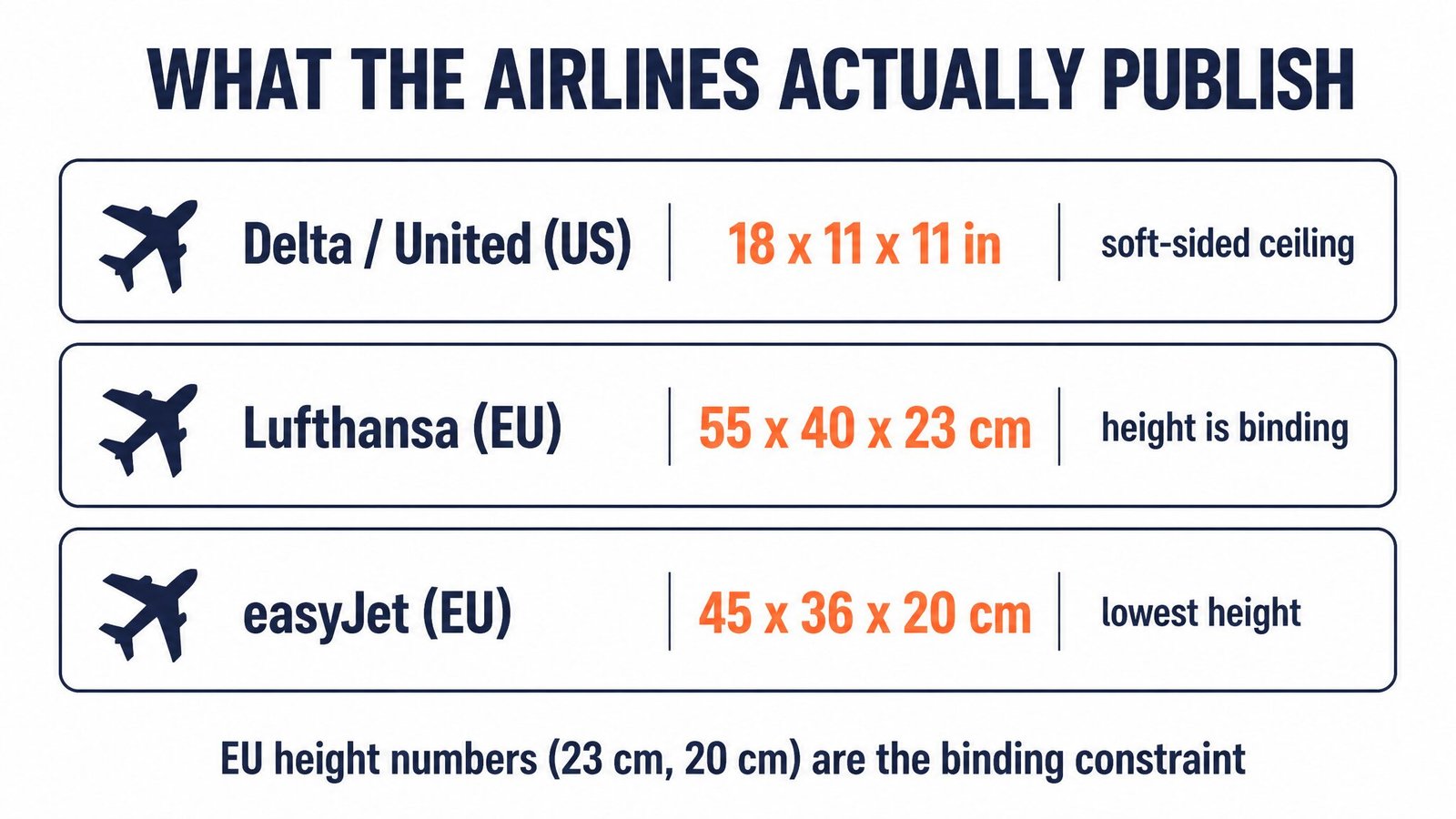
| Lufthansa | 55 x 40 x 23 cm (soft-sided, must fit under the seat) |
| Swiss | 55 x 40 x 23 cm |
| easyJet | 45 x 36 x 20 cm |
European limits run smaller in height than the US 11-inch figure: 23 cm is about 9 inches, and 20 cm is under 8. A carrier built to the US ceiling can fail Lufthansa’s height check. Brands selling into both markets usually build to the stricter European height or run two size variants.
Why a compliant carrier still gets turned away
The aircraft type. Under-seat height varies across the fleet, and United publishes a specific lower ceiling for the 737 MAX. A carrier that fits a 737-900’s middle row may not fit a regional jet or a MAX.
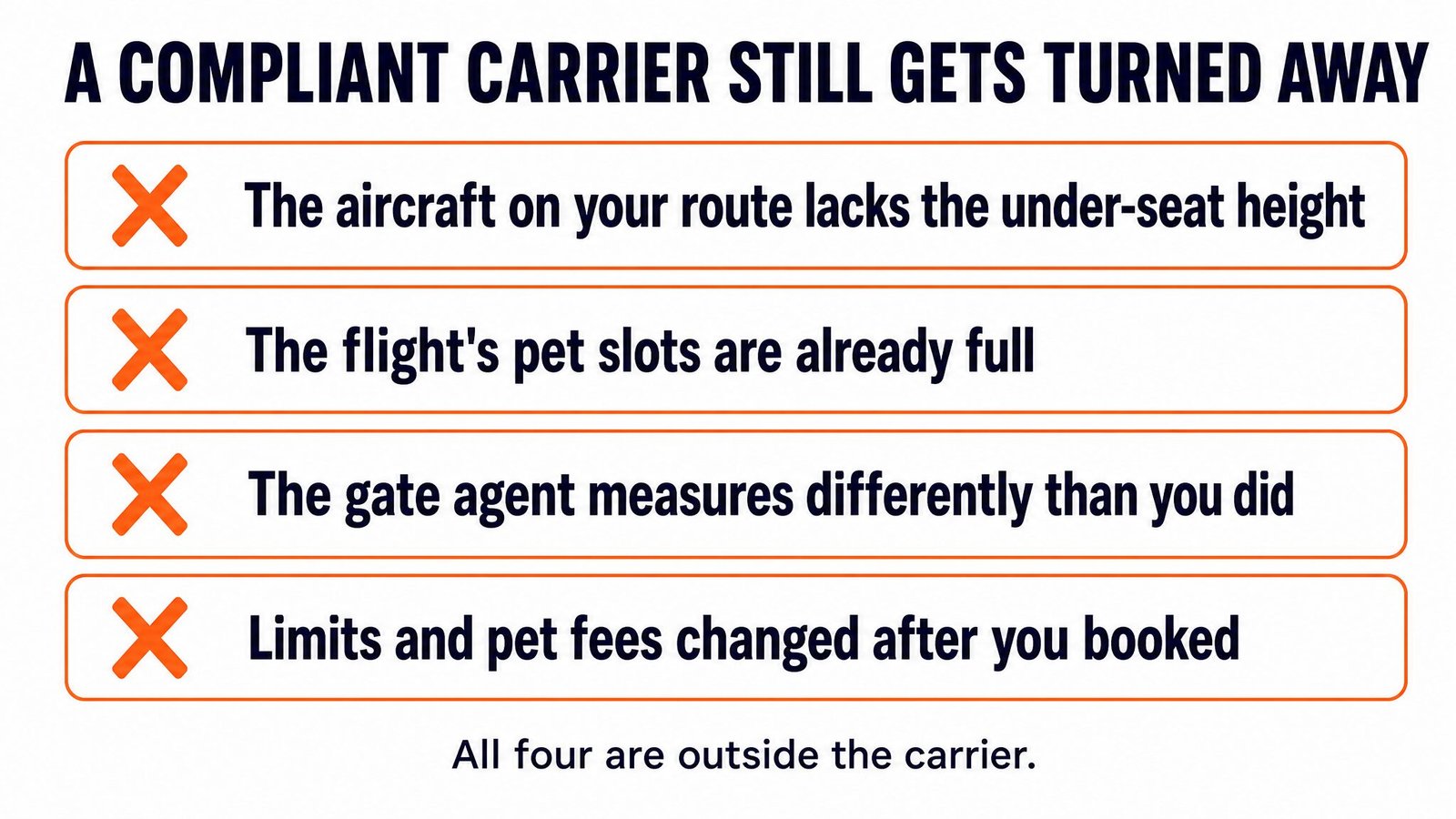
The seat position. Bulkhead rows have no under-seat storage in front; exit rows prohibit carriers entirely; on some United aircraft in Economy, only window seats (757-200) or aisle/window seats work. Where the passenger sits can decide the outcome before the carrier is measured.
The cabin pet count. American allows up to 20 carriers per narrowbody flight and fewer in premium cabins on some aircraft. The pet fee is paid, the carrier fits, and boarding is still refused because the flight’s pet slots are full.
The loaded profile. Soft carriers flex. A carrier measured empty at 18 inches can bulge past the limit with a pet and pad inside. Gate staff see the loaded carrier, not the spec sheet.
The gate agent. Final judgment on fit is the agent’s. Policies describe limits; people apply them, with a tape measure or by eye.
How to measure your carrier the way the airline will
- Measure assembled: frame installed, zippers closed, not folded flat.
- Measure loaded: with the pet’s weight and the pad inside, since soft sides bulge outward under load.
- Take the tallest and widest readings, not the averages, and compare them against the strictest limit among the airlines you fly.
- Leave working room: a carrier that exactly equals the limit leaves nothing for a thick pad or a pet that shifts.
What a factory can and cannot promise
As a manufacturer, this is where our boundary sits. For a cabin carrier program we can commit to everything inside the product: assembled dimensions built to the numbers you specify, frame behavior under load, mesh grade, zipper locking, pad construction. Those are manufacturing commitments, verifiable on a sample you can measure yourself.


We cannot commit to anything outside the product: which airline accepts it, whether the aircraft on that route has the under-seat height, whether the flight’s pet slots are full, or what the gate agent decides. So when we build a carrier for cabin use, the workflow is: you name the target airlines, we take the published limits, we build to the strictest of them (European height if the program sells into Europe), and the sample is measured assembled and loaded. The result is a carrier that fits the numbers. The honest listing claim is “fits the published under-seat limits of Delta, United and American,” which a buyer can verify, instead of “airline approved,” which no one can.
What to write on your listing instead
| Avoid | Write instead | Why |
|---|---|---|
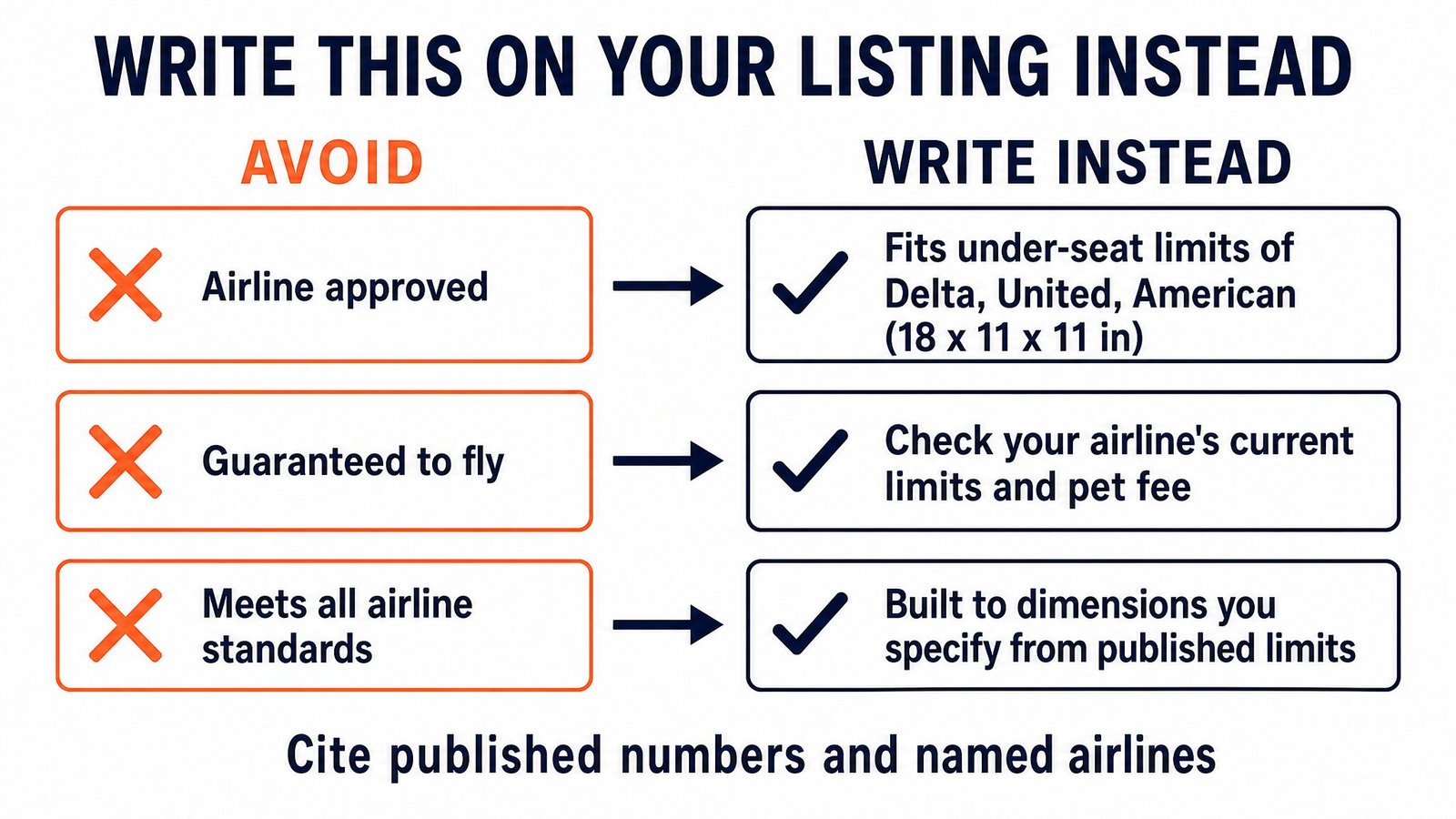
| “Airline approved” | “Fits under-seat limits of Delta, United and American (18 x 11 x 11 in)” | Cites published numbers and named airlines |
| “Guaranteed to fly” | “Check your airline’s current limits and pet fee before booking” | Airlines revise limits; fees recently rose |
| “Meets all airline standards” | “Built to the dimensions you specify from published airline limits” | There is no single standard; there are per-airline limits |
FAQ
Is any pet carrier officially airline approved?
No. No airline certifies carrier models. “Airline approved” is a marketing label meaning the dimensions fit at least one airline’s published limits.
What size carrier fits under an airplane seat?
In the US, 18 x 11 x 11 inches is the common soft-sided ceiling (Delta, United). European carriers publish lower heights: Lufthansa 55 x 40 x 23 cm, easyJet 45 x 36 x 20 cm.
How much does it cost to fly with a pet in the cabin?
Recent published fees: Delta $150 each way domestic ($200 international), United $150, American $125, Alaska $95 to $100. Fees have been rising; check at booking.
Can an airline reject a carrier that meets the size limit?
Yes. Aircraft type (United’s 737 MAX allows only 10 in of height), seat position, the flight’s pet-slot cap, and the gate agent’s judgment can each end the trip regardless of dimensions.
Should a listing ever say “airline approved”?
The safer claim names the airlines and the numbers: “fits the published under-seat limits of Delta, United and American.” It is verifiable and it does not promise an approval that does not exist.
Related reading
Custom Pet Carriers Manufacturer (cabin carrier configurations, sampling terms and the fit checks we run on samples) · What determines the factory price of a custom pet carrier