Storage Boxes: Material, MOQ, Packaging, and QC Checklist for Wholesale Buyers
For buyers searching for wholesale storage boxes, the real sourcing question is not only which box looks good in a catalog. The better question is whether the material, structure, logo method, packing format, and quality-control plan can support your retail channel, target margin, and customer use case.
A storage box program for a US retailer, European importer, Japanese lifestyle brand, or South Korean private label seller may look simple at first: choose a size, choose a fabric, add a logo, and request a quote. In practice, small specification gaps can change cost, carton efficiency, sample approval time, and after-sales risk. A foldable fabric storage box for seasonal closet use has different requirements from a toy storage bin, document organizer, drawer bin, or gift wrap organizer.
This guide gives sourcing managers a practical RFQ checklist for custom storage boxes. Use it to compare OEM/ODM suppliers, prepare clearer quotation requests, and decide when to ask a manufacturer for sampling support.
1. Start With The Retail Use Case, Not Only The Box Size
Before asking a storage box supplier for price, define the business scenario. A supplier can quote more accurately when the product function, channel, target market, and packaging expectation are clear.
For retail buyers, the most common sourcing scenarios include:
- A private label home organization line that needs several sizes in the same design language.
- A wholesale storage box program for seasonal promotion, back-to-school, closet organization, or moving storage.
- An OEM storage box based on the buyer’s existing sample, with updated material, logo, color, or packaging.
- An ODM storage box where the buyer wants supplier suggestions for structure, handle, lid, window, or folding method.
- A distributor order that needs cost control, stable packing, and clear carton marking for warehouse handling.
The same outer size can perform very differently depending on material thickness, board support, sewing quality, handle reinforcement, zipper quality, and whether the product is shipped folded or assembled. A sourcing brief should therefore explain how the end customer will use the box: clothes storage, toy storage, bedding, documents, pantry items, seasonal decor, travel accessories, or mixed household goods.
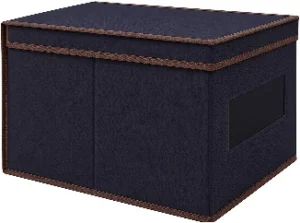
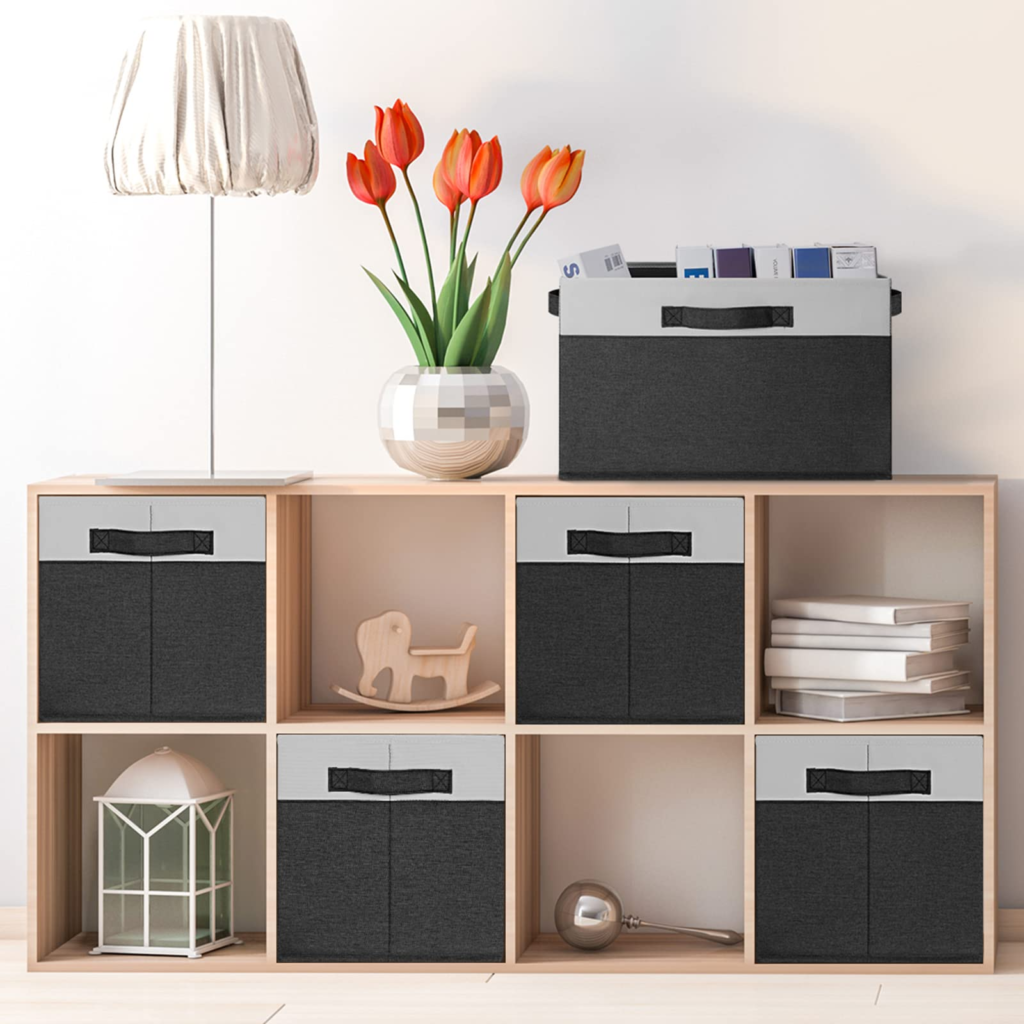
Review the storage box and fabric bin range to identify the structure you want quoted. Record the selected style alongside your material, size, support-panel and packaging requirements.
2. Key Product Specs Buyers Should Confirm
Material Selection
Material is one of the largest drivers of appearance, hand feel, durability, and cost. For fabric storage boxes, buyers commonly compare non-woven fabric, polyester, canvas-style fabric, Oxford fabric, felt, clear PVC windows, mesh panels, and laminated materials. Each option creates a different positioning.
Non-woven fabric is often used for lightweight home storage and promotional retail programs. Polyester or Oxford fabric can support a stronger appearance and better wear resistance for repeated use. Felt may suit premium lifestyle collections, while clear PVC or transparent windows help customers identify contents without opening the box.
The RFQ should not simply say “fabric storage box.” Instead, ask the supplier to propose material options by target retail positioning: entry-level, mid-range, premium, or specialty use. If there are market-specific requirements for material, labeling, or restricted substances, treat them as confirmation points with the supplier and your compliance team rather than assumptions.
Structure And Support
Storage boxes may use cardboard, PP board, MDF-style inserts, wire frames, bamboo accents, or soft foldable construction depending on the product. Structure affects stackability, foldability, carton size, and customer experience.
For wholesale storage boxes, buyers should confirm:
- Whether the box is fully collapsible, semi-rigid, or rigid.
- Whether the bottom panel is removable or sewn in.
- Whether side walls can keep shape after loading.
- Whether the lid is attached, separate, transparent, zippered, or open-top.
- Whether handles are stitched, riveted, reinforced, or cut-out style.
- Whether the design is suitable for shelf display, e-commerce fulfillment, or warehouse club packaging.
A common sourcing mistake is approving a sample for appearance only, then discovering that the side panels deform under normal retail use. Ask the manufacturer to confirm the structure recommended for your expected contents and selling channel.
Size, Color, Logo, And Private Label Details
Custom size is usually possible, but it should be linked to real constraints: shelf dimensions, closet depth, drawer size, export carton optimization, or container loading efficiency. Even a small size change can affect material yield and carton quantity.
For private label storage boxes, prepare the following details before quotation:
- Finished product size and acceptable tolerance.
- Color reference, such as Pantone or approved fabric swatch.
- Logo method, such as woven label, printed logo, heat transfer, embroidery, patch, hang tag, or packaging print.
- Label location and size.
- Product set configuration, such as single unit, 2-pack, 3-pack, nesting set, or mixed-size kit.
- Any barcode, warning label, care label, or market-specific label requirement that your team needs.
If you need broader OEM, ODM, or private label development support, the page on OEM/ODM and private label bag manufacturing is a useful internal reference for the development process and customization decisions.
3. How MOQ Usually Changes In Storage Box Sourcing
MOQ is not only a factory policy. It is often influenced by material purchasing, dyeing, printing setup, logo method, packaging, color count, and whether the style is a standard design or a fully custom structure.
Because no single MOQ fits every storage box project, buyers should avoid asking only, “What is your MOQ?” A better RFQ asks the supplier to explain MOQ by option.
For example, you can ask:
- What is the MOQ for an existing style with custom logo?
- What is the MOQ for a custom size using available material?
- What is the MOQ if we require a custom color fabric?
- Does each color or each size count separately toward MOQ?
- Does custom retail packaging increase MOQ?
- Is there a different MOQ for a trial order, sample order, or repeat order?
This approach gives the buyer a more usable comparison. A supplier with a low headline MOQ may become less competitive if every color, size, or package version has a separate setup requirement. A supplier with a higher MOQ may still be suitable if the quotation is more stable for a multi-SKU program.
4. Sampling: What To Approve Before Bulk Production
Sampling is where many wholesale storage box projects succeed or fail. A good sample review should go beyond color and logo placement.
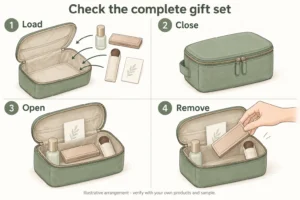
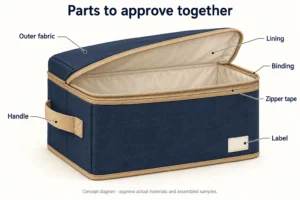
When reviewing a sample, check size accuracy, shape retention, stitch consistency, handle strength, zipper movement if applicable, lid fit, folding method, label placement, packaging fit, and whether the product looks acceptable after being folded and reopened.
For e-commerce or retail shelf products, also inspect the product after sample packaging. A box that looks clean before folding may look creased, uneven, or compressed after being packed. If retail presentation is important, ask the supplier to provide packing photos or a packed sample so your team can evaluate the real customer unboxing condition.
If the storage box will be sold in Japan or South Korea, buyers may place higher importance on neat stitching, compact packaging, clean labels, and consistent color. For US and European channels, carton strength, barcode accuracy, retail-ready packaging, and warning label alignment may be especially important. These are general sourcing considerations, so buyers should confirm exact market requirements with their own quality or compliance teams.
5. Packaging Choices That Affect Cost And Retail Execution
Packaging is not a final detail. It changes landed cost, shelf presentation, carton efficiency, and damage risk.
Common options for wholesale storage boxes include polybag packing, belly band, color card, insert card, hang tag, kraft box, display box, mailer carton, or multi-pack bundle. The right choice depends on sales channel.
For a mass retail shelf, buyers may need printed cards, barcode placement, product photo, and clear feature callouts. For online sales, compact packing and product protection may matter more than shelf impact. For a private label gift or lifestyle collection, packaging material and print quality may influence perceived value.
Ask the supplier to quote packaging separately when possible. This helps your team compare the base product cost against packaging upgrades. It also prevents confusion when one supplier quotes bulk polybag packing and another quotes full retail packaging.
6. Comparison Table: Common Storage Box Sourcing Options
| Sourcing Option | Best Fit | Main Advantages | Buyer Questions To Confirm |
|---|---|---|---|
| Existing style with custom logo | Trial orders, distributors, fast assortment testing | Lower development complexity, easier sampling, fewer structural decisions | Which sizes and colors are already available? Can logo and packaging be customized? |
| Custom size based on existing structure | Retailers needing shelf or closet fit | Better match to product line and market needs | Does the size change affect material usage, carton size, or MOQ? |
| Fully custom OEM design | Private label brands with defined specs | Greater control over material, structure, branding, and packaging | What files, samples, and technical details are needed before sampling? |
| ODM supplier-recommended design | Buyers who know the retail goal but need product suggestions | Supplier can propose material, structure, and feature options | What parts are standard and what parts are customized? |
| Multi-SKU storage box set | Retail programs with coordinated collections | Stronger shelf story and higher basket value | Can colors, labels, packaging, and carton marks stay consistent across SKUs? |
7. Buyer Checklist For RFQs And Supplier Comparison
Use this checklist before sending a wholesale storage box RFQ:
- Define the target market: United States, Europe, Japan, South Korea, or another market.
- Identify the channel: retail shelf, e-commerce, distributor, promotional program, or private label collection.
- Confirm product type: fabric box, rigid box, foldable bin, drawer bin, toy box, bedding organizer, document box, or seasonal storage.
- Provide finished size, quantity target, and size tolerance if known.
- Specify material preference or ask the supplier to recommend options by price tier.
- Confirm structure: lid, handle, window, zipper, frame, bottom board, foldability, and stackability.
- Share logo method, color reference, label requirements, and packaging concept.
- Ask whether MOQ changes by size, color, logo, material, or packaging.
- Request a sample plan and ask what will be confirmed at sample stage.
- Ask for carton packing details, carton marks, barcode placement, and retail packaging options.
- Define QC checkpoints: material, dimensions, stitching, logo, packaging, carton condition, and functional inspection.
- Ask which documents, product photos, or pre-production approvals are needed before bulk production.
This checklist helps both sides avoid vague pricing. It also makes supplier comparison more accurate because each manufacturer is quoting the same scope.
8. QC Points Buyers Should Include In The Purchase Process
Quality control for storage boxes should focus on function, appearance, and packing accuracy. A good QC plan can be simple, but it should be written before production starts.
Common QC checkpoints include:
- Material inspection: color, texture, thickness, odor, and visible defects.
- Dimension inspection: length, width, height, folding size, and set matching.
- Sewing inspection: stitch density, loose threads, skipped stitches, handle reinforcement, and seam alignment.
- Hardware inspection: zipper, puller, rivet, frame, button, or label attachment if included.
- Printing and logo inspection: placement, color, clarity, peeling risk, and consistency across units.
- Function inspection: foldability, lid fit, handle comfort, window clarity, and shape retention.
- Packaging inspection: barcode, label, insert card, polybag, retail box, carton quantity, and carton marks.
If your company requires specific testing, inspection standards, or compliance documents, provide those requirements in the RFQ. If proof is not provided by the supplier, phrase it as a confirmation point rather than treating it as guaranteed.
9. When To Request A Quote From Great Shine
You should request a quote when your team has a product direction but needs manufacturer feedback on material, structure, sampling, packaging, and MOQ drivers. You do not need a perfect technical file before starting the discussion, but the more complete your brief is, the more useful the first response will be.
Great Shine Home Storage Supplier works with home storage and organizer product categories, including custom storage bags, storage boxes, fabric bins, closet organizers, packing cubes, garment bags, makeup bags, and toiletry bags. Buyers can use the company as a sourcing partner for OEM, ODM, wholesale, and private label product development.
For a retail order, use the fabric storage bin specification checklist to record the agreed dimensions, support panels, handles, labels and packaging. Use that approved specification when checking the sample and bulk shipment.
To start a project, send your target product type, estimated quantity, size, material preference, logo requirement, packaging idea, and target market through the Great Shine contact page. Ask for material suggestions, MOQ explanation, sample steps, and QC confirmation points so your team can make a better RFQ decision before committing to bulk production.
FAQs About Wholesale Storage Boxes
What information should I send when requesting a quote for wholesale storage boxes?
Send the product type, size, target quantity, material preference, logo method, packaging style, target market, and any sample photos or reference products. If details are not final, ask the supplier to quote several material or packaging options.
Can a storage box manufacturer support custom size and private label packaging?
Many OEM/ODM storage box manufacturers can discuss custom size, logo, labels, and packaging. The key is to confirm how each customization affects MOQ, sample cost, production setup, and carton packing before approval.
How should buyers compare MOQ between suppliers?
Compare MOQ by size, color, material, logo method, and packaging version. A single MOQ number can be misleading if each SKU or color has separate requirements.
What should be checked on a pre-production sample?
Check dimensions, material, color, logo placement, stitching, handles, lid fit, folding method, packaging fit, barcode placement, and carton packing plan. The sample should represent the approved bulk production standard.
What QC points are most important for fabric storage boxes?
Important QC points include material consistency, stitching quality, handle reinforcement, size tolerance, shape retention, logo accuracy, packing correctness, and carton condition. Any market-specific test or label requirement should be confirmed before production.
Use acceptance checks that match the box construction
Record the agreed construction beside each inspection item. A fabric box needs checks for support panels, base fit, seams and folding; a rigid box may instead need checks for rim fit, moulded edges or lid engagement. Apply the checks relevant to the quoted product rather than assigning the same defect list to every storage box.
Record the approved sample reference, measurement method and agreed acceptance limits before inspecting the order. For a fabric-bin specification, use the fabric storage bin material and QC checklist for the detailed construction fields.