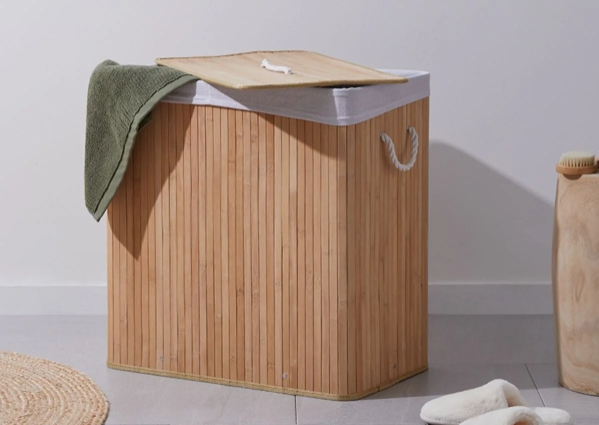
Is a Bamboo Laundry Basket Right for Your Home?
A bamboo laundry basket can keep clothes within reach while fitting into a bedroom or bathroom. A removable liner can help on wash day, and a lid can hide the contents. But a basket that looks right in a photograph may be awkward to empty beneath a shelf or carry downstairs.
Quick answer: Choose a bamboo laundry basket if its size, opening, carrying method, and care needs fit your routine. Keep the bamboo structure in conditions permitted by the manufacturer, and check the liner’s care label separately. The material name alone does not establish that a basket is waterproof, antibacterial, lighter than every plastic alternative, or suitable for leaving wet towels inside.

What practical benefits can a bamboo laundry basket offer?
A bamboo laundry basket can provide a visible collection point, a supported opening, and convenient access to your clothes. The benefit of each feature depends on the design and where you use it.
A visible place for laundry
Laundry storage often sits in a bedroom, bathroom, or hallway where you see it throughout the day. A bamboo surface can suit that space if you prefer its grain, color, or woven texture to another finish.
Appearance matters when it helps you put the basket where you actually change clothes. A container hidden in an inconvenient cupboard may be used less consistently than one within easy reach.
Look at the whole product, including the liner that shows around the rim and the handles on each side. Those details affect its appearance as much as the bamboo itself.
A defined shape for collecting clothes
A rigid body or supporting frame can keep the opening accessible as clothes accumulate. This can be useful if your current laundry bag collapses or needs to be held open with one hand.
The result depends on the construction. A woven shell, a slatted body, and a folding bamboo frame hold their shape in different ways.
Check how the basket stands when empty and partly filled. A product photographed with a full load may not show whether the opening remains convenient at the start of the week.
A removable bag for wash day
A removable liner can let you move laundry while leaving the outer basket in place. That is useful when the outer structure is awkward to carry or when it normally stays beneath a shelf.
The liner needs to be suitable for the carrying task. Some liners have handles intended for lifting, while others mainly separate clothing from the basket body.
Before treating the liner as a laundry bag, check its instructions, attachment method, and permitted load. A removable lining is not automatically designed to be carried while full.
Coverage when you want laundry out of sight
A lid can hide the contents and make a basket look more settled within the room. It may be useful beside a bed or in another visible location.
The lid still needs room to open, and you need a comfortable way to remove the contents. Its usefulness depends on that routine, not only on how the closed basket looks.
A covered design does not establish odor control or waterproof storage. Keep those questions separate from the benefit of hiding laundry from view.
Does bamboo describe the whole basket?
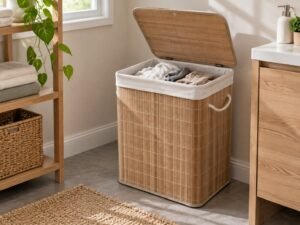
Bamboo may form the body, the frame, the handles, or a combination of parts. Many baskets also contain a textile liner, a separate base, coatings, fittings, or other materials.
That is why two products described as bamboo laundry baskets can feel different in use. One may be a woven container with an inner bag; another may be a fabric hamper supported by a bamboo frame.
For a fuller explanation of these constructions, see what a bamboo laundry basket is. For daily use, concentrate on which part you touch, which part you lift, and which part you clean.
The shell or frame provides support
A basket body surrounds the laundry, while a frame supports a separate fabric container. The frame may leave much of the fabric exposed, even when the product name emphasizes bamboo.
Look beneath the liner when the design permits it. This helps you understand the base, the inside corners, and the way the bag attaches.
A smooth outer face does not tell you what the interior looks like. The surfaces that contact the liner should also be suitable for the product’s intended use.
The liner contains the clothes
The liner’s material and construction affect removal, cleaning, and how it fits back into place. It may use a different fiber from anything suggested by the word bamboo.
As a concrete example, IKEA lists bamboo main parts, a polyester inner bag, and polyethylene feet for its SALUDING laundry basket. This illustrates a mixed-material construction; it does not identify the materials in every bamboo hamper. IKEA SALUDING materials and care
Read the description component by component. A statement about the bamboo body should not be assumed to describe the liner, its handles, or its washing instructions.
The connections affect everyday handling
Handles, hinges, ties, and folding joints determine how the parts work together. A substantial-looking body can still be inconvenient if the liner attachment is difficult to release.
Check the movement you will repeat most often. You may open a lid several times a day but fold the frame only when moving home.
Try to picture those frequent actions before choosing. A folding feature may be useful during a move, while an awkward lid will affect you every day.
Is a bamboo laundry basket good for a bathroom?
It can suit a bathroom when the particular product permits that setting and has a position where it can stay appropriately dry. A bathroom label does not mean the basket should sit in splash water or remain in contact with a wet floor.
Look at the actual position
A dry corner across the room from a shower is different from the narrow gap beside the shower door. Consider where water reaches during bathing and floor cleaning.
Check the base as well as the sides. A basket can avoid direct splashes while its lower edge remains against a damp mat or floor.
Measure the space with the lid open and the liner being removed. A dry location is only useful if you can reach the laundry without moving the basket into a wetter area each time.
Separate product permission from general assumptions
Manufacturers can give specific advice for individual designs. IKEA, for example, permits its SALUDING basket in the bathroom while advising against soaking the bamboo and specifying a clean, dry cloth for the basket. Those are instructions for that model, not a care rule for all bamboo products. SALUDING care guidance
If the seller gives no guidance for a damp setting, ask before placing the basket there. A photograph in a styled bathroom is less informative than clear care instructions.
Consider the base, joints, and liner as well as the visible finish. A coating on the bamboo does not protect every seam and connection.
Consider an adjacent dry location
You may not need to keep the hamper in the bathroom itself. A bedroom corner or a suitable spot outside the bathroom can still be convenient for collecting clothes.
Think about where people undress and how laundry reaches the washing machine. A slightly different position may reduce repeated wetting without making the routine difficult.
If the only available place is regularly wet, a different storage arrangement may be more practical. Choose for the conditions in the room.
What should you do with damp towels and exercise clothes?
Handle damp items according to their care needs and your wash schedule. A laundry hamper is a collection point; its lid, liner, or bamboo structure should not be treated as a system for drying a dense pile of fabric.
Separate immediate washing from waiting
If an item is going straight into an appropriate wash, it does not need to spend time in the hamper. When it must wait, avoid packing wet items tightly into the basket and leaving them there.
Use an appropriate drying or airing arrangement where needed, with attention to the garment’s care instructions. The basket can then hold items in a condition suited to waiting for the next wash.
The same distinction applies to a swimsuit after a pool visit and a towel after a shower. The fact that both belong in the laundry does not make a closed hamper the best place for them while wet.
Ventilation openings have limits
Gaps between slats or an open top can leave routes for air, but the liner and packed contents affect the space inside. A large pile can remain dense even in a basket with visible openings.
Do not assume that more gaps automatically eliminate moisture concerns. Consider the room, the amount of laundry, and the time items remain inside.
A useful routine is to empty and inspect the basket regularly as laundry is washed. This gives you an opportunity to notice damp areas or a liner that needs cleaning before putting it back.
Odor is not a material test
If a basket develops an unwanted smell, look at the contents, liner, cleaning routine, and surrounding conditions. Smell alone cannot identify a specific material defect or confirm whether a product has antimicrobial properties.
Empty the basket and follow the approved care method for each component. If the problem persists or the product shows damage or unusual growth, seek the manufacturer’s guidance on continued use, cleaning, or replacement.
Avoid relying on perfume or a deodorizing accessory to explain away a recurring problem. First identify whether damp contents or an unsuitable location are keeping the basket from drying as intended.

Is a bamboo laundry basket with a lid better?
A lid is useful when you want to conceal laundry, but it adds an opening action and requires clearance. Whether it improves the routine depends on where the basket stands and how frequently you use it.
A hinged lid needs space above and behind
Check the path of the lid through its full opening. A shelf, towel rail, or wall projection may stop it before you have enough access to remove the liner.
The basket can fit neatly in a gap while the lid cannot open properly. Measure both conditions before deciding that the space is suitable.
Also consider how the lid stays open. You may need a hand for the lid while lifting the liner, which can make a full bag awkward to remove.
A lift-off lid needs somewhere to go
A separate lid gives access to the opening without a hinge at the back. During unloading, however, you need a clean, convenient place to put it.
Imagine removing laundry while standing in a narrow bathroom. If the only place for the lid is a wet floor or the top of another unstable object, the design may create extra work.
Check whether the lid has a suitable handle and whether it fits securely when replaced. A loosely positioned lid may be irritating even when it looks attractive in a product photo.
An open top favors frequent access
An open basket lets you add or remove clothes without handling a lid. This can suit a household that values immediate access or uses the basket mainly for transport.
The contents remain visible, so placement and appearance become different considerations. An open basket behind a suitable door may work well without needing a separate cover.
Choose a lid for a clear reason, such as keeping laundry out of sight. Do not choose one on the assumption that closing the top prevents odors or makes wet contents suitable for storage.
How useful is a removable liner?
A removable liner can simplify emptying and cleaning when it detaches easily, suits the intended load, and can be refitted without difficulty. The details around its opening often matter more than the fact that it is removable.
Check how the liner attaches
Some liners fold over a rim, while others use ties, loops, tabs, or another attachment. The connection needs to hold the bag in its intended position as laundry enters.
If the bag slips down whenever you add clothes, you may end up reaching inside to pull it back up. An attachment that is secure but difficult to release can create a different problem on wash day.
Look for a clear view of the rim and attachment in product images. A photograph of a liner placed beside the basket does not show how it behaves when installed.
Check the removal path
A full liner can be wider or less flexible than an empty one. It should pass through the opening using the method intended by the design.
Consider the lid, hinges, and shelf above the basket. An easy vertical lift requires more clear space than simply dropping one shirt into the opening.
Avoid filling the bag so tightly that you have to tug it past the frame. A comfortable fill level is one that still allows ordinary removal within the product’s load instructions.
Know which handles are for carrying
The outer basket may have handles while the liner has only small loops for attachment. Those loops should not be assumed to carry the weight of a full load.
Where the liner is intended for transport, check the grip and instructions. You may need to carry it with both handles or support it in a particular way.
Think about the route to the laundry area. A bag that is easy to lift a short distance can still be inconvenient if it brushes the floor or swings against your legs on stairs.
Refitting matters too
After cleaning or emptying, the liner should return to the correct position without stretching or twisting. Follow any orientation marks or fitting instructions.
A replacement liner needs compatible dimensions and attachments. A generic bag that fits inside the basket may not sit correctly at the rim or work with the lid.
If replacements are important to you, check availability for the specific model. A removable component does not necessarily mean replacements are sold separately.
How much capacity do you actually need?
Useful capacity is the amount of laundry the basket can hold within its stated limits while remaining easy to empty and move. A volume in liters or gallons does not tell you the safe carrying weight or the number of washing-machine loads.
Start with the interval between washes
Think about how much laundry normally gathers before you empty the basket. A household washing frequently may need less collection space than one that stores several days of clothing.
Separate the types of items in that estimate. Towels and bedding occupy space differently from light clothing, and damp contents may require a different routine altogether.
A larger basket can reduce overflow, but it also allows a heavier collection to accumulate. Consider whether you will carry the whole basket, lift a liner, or transfer smaller amounts to another container.
Volume and weight are different measurements
A spacious hamper can hold bulky, light items without approaching the same weight as a dense pile of clothing. The stated volume describes space rather than a lifting limit.
Follow any maximum load specified for the basket and the removable bag. If the seller gives only a volume, do not convert it into a weight limit yourself.
Washing machines also differ in their capacity and guidance. A full hamper should not automatically be treated as one appropriate machine load.
Compartments divide the available space
A double hamper can separate items as they are collected, but each section has its own available space. One side may fill before the other if your laundry groups are uneven.
Consider how the compartments empty. Separate liners can make it easier to remove one group, while a fixed divider inside one container may still require lifting or sorting the whole load.
Choose the division around your routine. A household separating towels from clothing may need a different balance from one separating laundry by person.
Leave room to remove the contents
Filling to the rim can interfere with the lid, liner handles, or the opening through which laundry must pass. A basket that still closes is not necessarily convenient to empty.
Allow the working space needed by the design. Handles tucked beneath a tightly packed pile will be difficult to reach on wash day.
If overflow is frequent, reconsider the collection schedule or arrangement. Compressing more clothes into the same hamper may make the daily task harder without solving the underlying shortage of space.
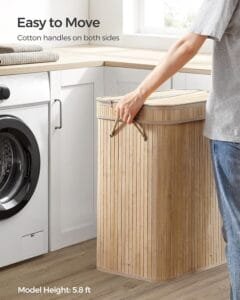
Is a bamboo hamper comfortable to carry?
Carrying comfort depends on the complete basket, its contents, and the route you take. Bamboo hampers vary in size and construction, so the material name does not tell you how heavy or manageable a filled product will feel.
Include the empty basket’s weight
The weight you lift includes the container as well as the laundry. A large rigid body and lid can change the task compared with carrying a removable fabric bag.
If the outer basket stays in one room, that weight may matter mainly during cleaning or relocation. If you carry it upstairs every wash day, it becomes part of a repeated task.
Choose around the intended handling method. A decorative collection hamper and a basket for moving wet laundry between appliances have different jobs.
Check grip and body clearance
Handles should be accessible when the basket is filled to its intended level. Check whether your fingers have enough room and whether the edges feel suitable for holding.
The body’s shape affects how close you can keep it while walking. A broad basket can be awkward in a narrow passage even when its weight is manageable.
Think about visibility too. A tall basket held in front of you may make it harder to see the floor. Use an arrangement you can handle comfortably, and transfer smaller amounts if necessary.
Consider stairs and doors
A route with stairs or several doors can make carrying a bulky container inconvenient. You may need a separate transport bag or basket while leaving the bamboo hamper at its collection point.
A removable liner can help if it is intended for carrying and its shape suits that route. Otherwise, transferring laundry into a suitable carrier may be the more practical option.
Check handles and their attachments while the basket is empty. If a connection is damaged or loose, address it before carrying a load by that handle.
How do you clean it without confusing the parts?
Clean the bamboo structure and the liner according to their own instructions. A washable bag does not make the surrounding basket washable, and a wipe-clean exterior does not describe every hidden component.
Empty and identify the components
Remove the laundry and detach the liner only as the design permits. Look at the base, rim, corners, and attachment points where dust or loose fibers can gather.
Check the care label before choosing water or a cleaning product. The appropriate method can depend on the finish and the way the basket is assembled.
If the instructions are unclear, ask the seller for guidance tied to the model. A general cleaning tip for bamboo furniture may not account for a fabric backing, adhesive, or enclosed support panel in your hamper.
Follow the method for the bamboo body
Some products specify dry wiping, while others permit a clean damp cloth. John Lewis, for example, lists damp-cloth care for its own slatted bamboo laundry bin and gives separate guidance for washing the lining. That is a model-specific instruction. John Lewis slatted laundry bin care
Where damp wiping is allowed, follow any directions about drying before replacing the liner. Avoid leaving cleaning moisture trapped beneath the bag or around the base.
Do not assume that immersion, steam cleaning, abrasive scrubbing, or a strong chemical cleaner is appropriate. If the approved method does not resolve a problem, seek further guidance before escalating to a treatment that could damage the product.
Read the liner’s label separately
The liner may permit machine washing, hand washing, or another method. Follow its temperature, detergent, and drying instructions rather than choosing a cycle based only on its appearance.
Handles, stiffeners, coatings, and trim can affect care. Remove detachable parts only when the instructions tell you to do so.
Refit the liner in the condition required by its label, generally after it has dried fully. A damp bag pressed against the outer body can prolong contact with moisture.
Make inspection part of emptying
An empty basket is easier to inspect. Check for rough edges, damaged slats, loose fittings, or changes in the way a folding frame stands.
Also inspect the liner near its handles and attachment points. A tear in a concealed area may become obvious only when the bag is removed.
You can do this as you empty the basket, without setting up a separate maintenance routine.
What limits should you expect from bamboo laundry baskets?
Moisture exposure and handling can limit where a basket works well. Claims about waterproofing, hygiene, lifespan, or environmental benefits also need more detail than the word bamboo provides.
They are not automatically waterproof
A finished surface may tolerate a particular care method without making the whole basket watertight. Openings, joints, fabric parts, and the base can behave differently.
Look for instructions that describe the actual use, such as permitted bathroom placement or cleaning. Treat a vague water-resistant claim as a reason to check its scope.
If your routine involves putting soaking-wet laundry directly into a container, confirm that use specifically. A dry-clothing collection hamper should not be assumed suitable for that task.
A natural material does not establish antibacterial performance
The word bamboo identifies a material in the product. It does not tell you whether the finished basket has been assessed for a specific antibacterial claim.
A product that contains a bamboo frame, a fabric liner, and several other components needs to be understood as that complete assembly. A broad statement about a raw plant material does not describe every surface that touches the laundry.
For normal household use, follow the care instructions and manage damp contents. Do not rely on an unverified antibacterial label as a substitute for cleaning or timely washing.
Lifespan cannot be assigned to the whole category
A lightly used basket in a suitable room faces different conditions from one frequently overloaded, dragged, or exposed to water. Construction and maintenance matter alongside the material.
There is no useful universal promise that a bamboo hamper lasts a particular number of years or always outlasts plastic. Compare the actual products and the conditions they are intended to handle.
Availability of suitable replacement liners or fittings can be worth checking. Keep the model information so you can identify a compatible part later, if the seller offers one.
Bamboo does not make every component environmentally preferable
A finished basket may include fabric, coatings, adhesives, plastic parts, and packaging. A claim about bamboo’s origin does not automatically describe the whole product or its disposal options.
Look for clear statements about the component concerned and any supporting sourcing information. Specific information is more useful than an unexplained eco-friendly label.
Keep a serviceable basket in use where practical, and follow local disposal guidance when it reaches the end of its useful life. Do not assume that a mixed-material hamper belongs in a garden compost bin or household recycling collection.
How does it compare with plastic and fabric laundry baskets?
Compare the specific designs against the same household task. Bamboo, plastic, and fabric can appear in different structures, so the material alone cannot identify a winner for every home.
For a visible collection point
You may prefer bamboo’s visible texture and color in a bedroom. A fabric hamper can also provide a softer appearance, while a plastic basket may suit a utility space where appearance matters less to you.
Keep convenience in the comparison: how far will someone walk with their clothes, and can they reach the opening easily?
Compare the product at its normal fill level. An open top, a lid, and a fabric bag folded over the rim create different appearances once the basket is in use.
For moving laundry
Compare empty weight, grip, overall shape, and the permitted carrying load. A bamboo-frame hamper with a transportable liner presents a different option from carrying a rigid bamboo shell.
Also consider where the carrier is set down. A route involving wet surfaces needs a product suited to those conditions, regardless of which material you prefer visually.
You can use different products for collection and transport. Keeping a lidded hamper in the bedroom while carrying laundry in a separate suitable basket may fit the household better than asking one container to do both jobs.
For cleaning and storage between uses
Read the care instructions for the actual product. Some fabric bags are washable, while others contain parts or finishes that restrict washing; plastic and bamboo products also need appropriate care.
If compact storage matters, compare the folded or nested form. A collapsible bamboo-frame hamper may still occupy space in its folded state, while a rigid body will retain its basic volume.
Ask yourself how often the empty basket will be put away. A folding feature adds little convenience if the hamper stays assembled in the same position throughout the year.
What should you measure before choosing a design?
Measure the standing space, the opening clearance, and the route used to remove laundry. These measurements answer different questions and help prevent a basket from fitting physically while remaining awkward to use.
The footprint and nearby furniture
Measure the usable floor area, including baseboards, door movement, and projecting furniture parts. Account for handles or feet that extend beyond the main body.
A round basket and a rectangular one use a corner differently. Compare their actual outlines rather than judging capacity from width alone.
Leave the access required for the basket’s intended position. A container wedged tightly between a cabinet and a wall may be difficult to clean around or move when necessary.
The opening and liner clearance
Check the height needed for a hinged lid and the vertical space needed to lift out the bag. The closed height alone will not show that space.
If the hamper sits under a counter, find out whether it must be pulled forward before opening. That changes the daily task and the floor space needed in front.
A photograph with the lid removed may hide this limitation. Look for the complete opening sequence or a diagram that shows the lid in use.
The path to the laundry area
Measure narrow gaps if you expect to carry the whole basket through them. Include door handles and turns where a wide container may need extra room.
If only the liner moves, consider its filled shape instead. A soft bag can become wider or longer than it looks when empty beside the hamper.
Keep the route clear enough for comfortable movement. A smaller load or a separate carrier may be more useful than a larger collection basket when the path is awkward.
When is a different arrangement more practical?
A bamboo basket is one option within a laundry routine. A different material, location, or combination of containers can make more sense when the available space or handling task conflicts with the chosen design.
A small bathroom with a frequently wet floor
The best-looking corner may also receive splashes or stay damp after cleaning. Before placing a bamboo hamper there, check the manufacturer’s guidance and the room during normal use.
If you cannot provide a suitable position, consider collecting clothes in a nearby dry area. Use an appropriate arrangement for wet towels until they can be washed or dried as required.
Changing the lid or capacity will not resolve a location that repeatedly wets the base.
A home with laundry on another floor
A rigid hamper can remain a collection point while a suitable removable bag or separate basket handles transport. This may be more convenient than carrying the entire outer structure up and down stairs.
Check whether the liner is designed for that use and whether its filled size remains manageable. If it is only a lining, transfer laundry into a carrier intended for the task.
This arrangement can preserve the appearance you want in the bedroom without making it the only container available for laundry day.
A hamper that must fold away between uses
A folding design can suit a spare room that serves several purposes. Check what folding actually involves: the bag may need to come off, a base panel may need removal, or the frame may close while some parts remain attached.
Keep the instructions and any removable fittings together. Before putting the hamper back into service, assemble it on a level surface and make sure its supports are in the position specified by the manufacturer. Do not load a partly opened frame.
Consider where the folded parts will stay. A narrow gap may accommodate the frame but leave no room for the lid or base. The packed dimensions should describe the complete set of parts you need to store.
A household that separates several laundry groups
A divided hamper may help when the groups are predictable and the compartments are the right size. It can be less useful when one group fills its section much faster than the others.
Separate smaller containers may allow more flexible placement and emptying. A single larger hamper with sorting at wash time may suit another household better.
Choose the arrangement around how people actually use it. A divider does not help if everyone must stop and reorganize the contents each time they add a garment.
What should the product description tell you?
A useful description explains the construction, dimensions, carrying method, and care instructions. It should let you picture the full routine from adding clothes to returning a clean liner.
Look for:
- Which parts are bamboo and which are fabric or another material.
- The assembled size and usable opening, including lid clearance.
- Whether the liner is removable, washable, and intended for carrying.
- Any stated limits for the outer basket and inner bag.
- The permitted storage environment and separate cleaning instructions.
- Whether folding, assembly, or replacement parts are relevant to that model.
Check that the photographs show the same configuration as the product you are considering. A range may contain both divided and single-compartment models, or different liners that are not interchangeable.
Treat capacity photos as illustrations of an arrangement. The actual size and weight of your laundry will differ from the carefully folded contents used in a studio image.
If an important detail is absent, ask the seller about that specific point. A question such as whether the filled liner can be carried by its handles is easier to answer than whether the basket is high quality.
Frequently asked questions
Are bamboo laundry baskets good for everyday use?
They can be, when the construction, capacity, position, and cleaning needs fit the household. A lid or removable liner can add convenience, but those features need to work with your routine. The material name alone does not establish performance or lifespan.
Is a bamboo laundry hamper better than a plastic basket?
That depends on the particular products and the task. Compare appearance, empty weight, grip, care instructions, and the environment where each will be used. A stationary collection hamper and a basket for carrying wet laundry may need different features.
Can a bamboo laundry basket get wet?
Follow the instructions for the specific model. Some products permit limited damp wiping, but that does not establish suitability for soaking, repeated splashing, or a wet floor. The base, liner, finish, and joints also affect the answer.
Can you machine wash a removable liner?
Only when its care label permits machine washing. Removable describes how the liner detaches, not its washing method. Check any requirements for handles, stiffeners, temperature, and drying before putting it back in the basket.
Does a lid stop laundry smells?
A lid conceals the contents, but it should not be treated as a guarantee of odor control. The condition of the laundry, time between washes, liner care, and surrounding environment all matter. Address damp contents and cleaning needs rather than relying on enclosure alone.
Does bamboo prevent mold or bacteria?
The presence of bamboo does not prove that a finished laundry basket prevents mold or has verified antibacterial performance. Such claims need product-specific evidence and clear conditions. Follow the approved care instructions and avoid treating the material name as a substitute for them.
Is a bamboo basket always lightweight?
Weight varies with the body’s construction, size, liner, lid, and fittings. Check the empty product weight if lifting matters, then consider the added laundry. A removable carrying liner may offer a different routine from moving the entire hamper.
Can I use one for clean laundry too?
It may be suitable if its design and care instructions allow that use and the surfaces contacting clothes are clean and dry. Consider whether the liner has just held dirty laundry and whether it needs cleaning before receiving freshly washed items.
Are all bamboo laundry baskets foldable?
Some bamboo-frame designs fold or dismantle, while rigid or woven bodies may retain their shape. Check the actual folding method and packed size. Follow the instructions rather than forcing a joint that is not intended to move.
Can I sit on a lidded bamboo hamper?
Only use a product as seating if the manufacturer explicitly designs and rates it for that purpose. A flat lid and a sturdy appearance do not establish a seating load. An ordinary laundry lid should not be treated as a stool or step.
Find the features that fit your routine
Start with the place where laundry collects and the route to the washing machine. Then choose a bamboo basket with an accessible opening, a manageable way to empty it, and care instructions you can follow.
Explore Great Shine’s bamboo laundry basket collection to see open, lidded, bamboo-frame, and removable-liner configurations. Compare the structures with your available space and handling needs, then check the details for the particular design you are considering.