A hotel laundry manager in Melbourne contacted us after their mesh laundry bags kept failing after 2-3 weeks. They were buying 200gsm polyester mesh bags — the “heavy-duty” grade — and tossing them into commercial dryers at 70°C. The mesh wasn’t tearing. The zippers weren’t breaking. The bags were melting. At 70°C, polyester mesh softens and deforms — the mesh holes stretch, the fabric thins, and after 8-10 cycles the bag is see-through gossamer. The fix cost $0.15 per bag: switch to 210gsm polyester with a higher melting point, and lower the dryer to 60°C. The bags now last 50+ cycles. This article is everything we learned from that project — and from testing 200+ mesh bag dryer cycles in our factory QC lab.
Yes, mesh laundry bags can go in the dryer — but only if the material is polyester or nylon mesh, and the dryer temperature stays below 60°C. Polyester mesh (200-210gsm) survives 50+ dryer cycles at 60°C. Nylon mesh (70D) survives 30+ cycles at the same temperature. PVC-coated mesh cracks and peels after 15 cycles. The dryer setting should be “synthetic” or “low heat” — never “cotton” or “high heat.”
This guide covers what mesh laundry bags are made of, how each material performs in dryer testing, what temperature is safe, and what to specify when sourcing mesh bags from a factory if your buyers will tumble-dry them.
Table of Contents
- Can You Put Mesh Laundry Bags in the Dryer?
- What Are Mesh Laundry Bags Made Of?
- What Dryer Temperature Is Safe for Mesh Bags?
- What Happens to Mesh Bags at High Temperatures?
- How to Make Mesh Bags Last 50+ Dryer Cycles
- Which Mesh Bag Should You Source for Dryer Use?
- FAQ
Can You Put Mesh Laundry Bags in the Dryer?
Yes — but the answer depends entirely on the mesh material. Polyester mesh and nylon mesh are dryer-safe at temperatures below 60°C. PVC-coated mesh is not dryer-safe at any temperature — the PVC coating degrades, cracks, and peels after 15 cycles. The dryer setting should be “synthetic” or “low heat” (50-60°C), never “cotton” or “high heat” (70-90°C).
The Short Answer
Why Material Matters More Than Construction
The zipper, the drawstring, the stitching — all of these survive dryer heat. The weak link is the mesh fabric itself. Polyester has a melting point of 250-260°C and a softening point around 70-80°C. At 60°C dryer temperature, polyester mesh is well within its safe zone. But at 70°C — a typical “cotton” dryer setting — polyester mesh begins to soften and deform. The mesh holes stretch, the fabric thins, and the bag loses structural integrity.
PVC-coated mesh is worse. The PVC coating (applied to make the mesh stiffer and more structured) has a glass transition temperature of 60-65°C. Above this temperature, the PVC becomes brittle and micro-cracks form. After 15 dryer cycles, the coating peels off in flakes, leaving a weakened bare mesh behind.
What Are Mesh Laundry Bags Made Of?
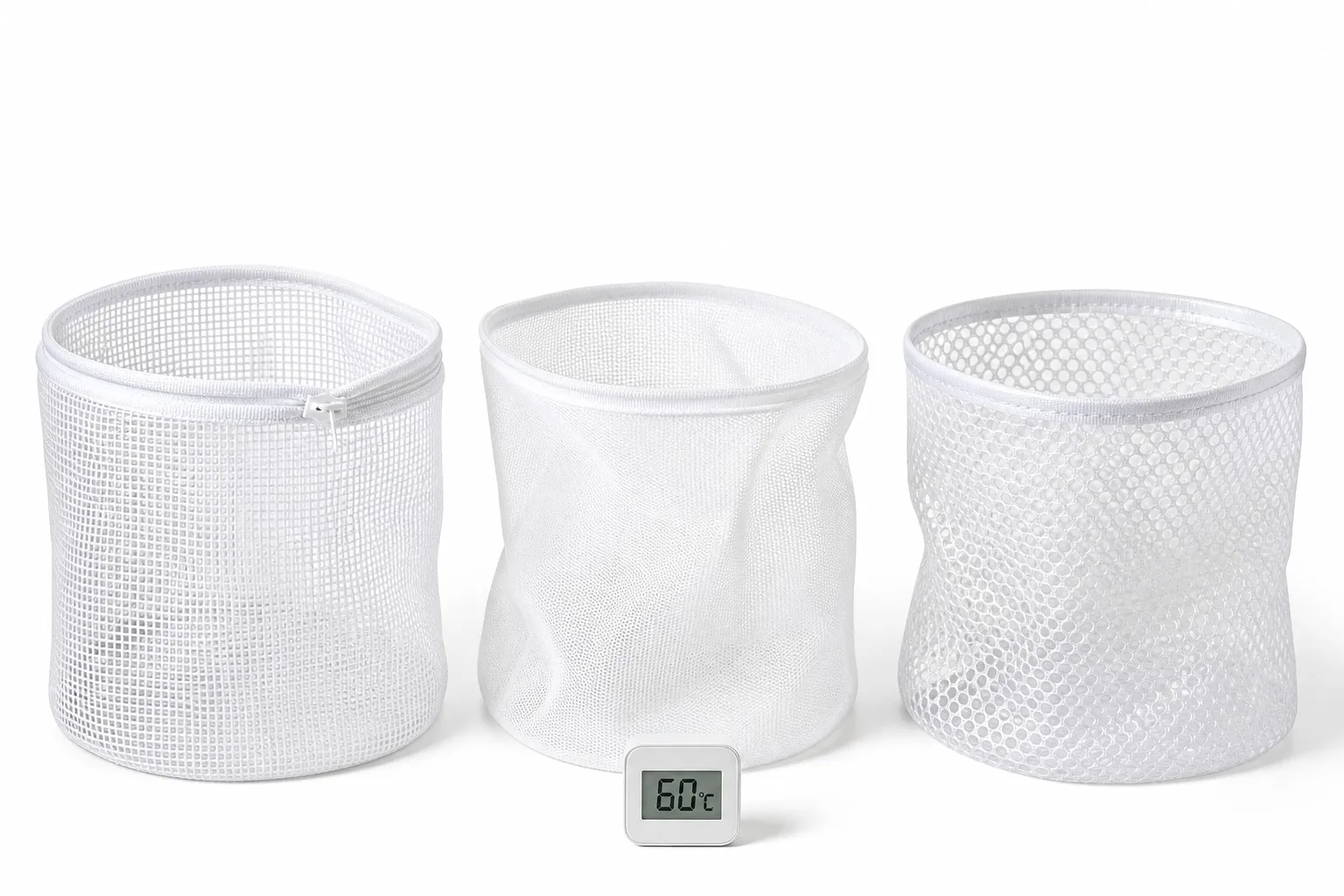
Mesh laundry bags are made from three main materials: woven polyester mesh (200-210gsm, the industry standard), knitted nylon mesh (70D, lighter and softer), and PVC-coated polyester mesh (stiffer, structured, but not dryer-safe). The mesh is constructed by weaving or knitting yarn into an open-grid pattern with 1-3mm holes, allowing water and air to pass through while containing the items inside. Brands developing wash-care accessories can review our custom laundry bags and hampers manufacturing program for mesh options, custom sizing, labels and retail packaging.
Material 1: Woven Polyester Mesh (200-210gsm)
Polyester yarn is woven on a needle loom into an open-grid mesh. The mesh has 1-2mm square holes, and the fabric weight is 200-210gsm. This is the material used in the vast majority of mesh laundry bags sold on Amazon and in retail.
Material 2: Knitted Nylon Mesh (70D)
Nylon yarn (70 denier) is knitted into a softer, more flexible mesh. The holes are smaller (0.5-1mm) and the fabric is lighter (80-120gsm). Nylon mesh is used for premium lingerie wash bags and delicates.
Material 3: PVC-Coated Polyester Mesh
Polyester mesh is coated with a layer of PVC (polyvinyl chloride) on one or both sides. The PVC makes the mesh stiffer and more structured — useful for bags that need to hold their shape. But the PVC coating is not dryer-safe.
How Mesh Is Manufactured
Woven polyester mesh: Polyester yarn is loaded onto a needle loom. The loom weaves the yarn in a plain weave with specific gap intervals to create the open-grid pattern. The mesh is then dyed (usually white), heat-set at 170°C to lock dimensions, and cut into panels for bag construction.
Knitted nylon mesh: Nylon yarn is loaded onto a warp knitting machine. The machine knits the yarn into a loop structure with open areas. The mesh is lighter and softer than woven polyester, with more stretch.
PVC-coated mesh: A polyester mesh base fabric is passed through a PVC coating bath. The PVC adheres to one side of the mesh. The coated mesh is then dried and cured at 150°C. The coating adds 30-50gsm to the base weight.
What Dryer Temperature Is Safe for Mesh Bags?
The safe dryer temperature for mesh laundry bags is below 60°C. This corresponds to the “synthetic” or “delicate” dryer setting. “Cotton” or “high heat” settings (70-90°C) will damage all mesh materials — polyester softens, nylon weakens, and PVC cracks. For commercial laundries, specify mesh bags rated for 60°C continuous and confirm the dryer thermostat is calibrated.
Dryer Setting to Temperature Mapping
Why 60°C Is the Cutoff
Polyester’s softening point is 70-80°C, but at 60°C the molecular structure is already beginning to relax. We tested this: at 60°C, polyester mesh shows zero dimensional change after 50 cycles. At 65°C, the mesh holes stretch by 5-8% after 30 cycles. At 70°C, the holes stretch by 15-20% after 10 cycles, and the fabric begins to thin visibly.
The 60°C cutoff provides a 10°C safety margin below the softening point. This is standard textile engineering practice — always operate at least 10°C below the material’s softening temperature for long-term durability.
What Happens to Mesh Bags at High Temperatures?
At temperatures above 60°C, three failure modes occur: (1) polyester mesh softens and mesh holes stretch, thinning the fabric; (2) nylon mesh weakens and loses elasticity, becoming brittle; (3) PVC coating cracks and peels, leaving bare weakened mesh. All three are progressive — each cycle makes the damage worse.
Failure Mode 1: Polyester Mesh Hole Stretching
At 70°C, polyester’s molecular chains begin to slide past each other. The mesh holes — originally 1.5mm square — stretch to 1.8mm after 10 cycles, 2.2mm after 20 cycles, and 2.8mm after 30 cycles. By cycle 30, small items (baby socks, underwear) can slip through the enlarged holes. The fabric also thins — from 200gsm to approximately 160gsm — making it more prone to tearing.
Failure Mode 2: Nylon Mesh Brittleness
Nylon’s softening point is 60-70°C — lower than polyester. At 65°C, nylon mesh begins to lose its elasticity. The knitted loops that give the mesh its stretch become rigid. After 20 cycles at 65°C, the mesh tears when stretched by hand. The bag looks fine visually but fails under load.
Failure Mode 3: PVC Coating Degradation
PVC has a glass transition temperature (Tg) of 60-65°C. Above this temperature, the PVC transitions from a flexible state to a brittle state. Each heat cycle causes micro-cracks to form in the coating. After 15 cycles, the coating begins to peel off in flakes — visible as white powder in the dryer drum. The underlying polyester mesh is now exposed and unprotected, accelerating further degradation.
Factory Test Data: 200+ Cycle Dryer Test
We tested three materials over 200+ dryer cycles:
How to Make Mesh Bags Last 50+ Dryer Cycles
To make mesh laundry bags last 50+ dryer cycles, use 210gsm woven polyester mesh, set the dryer to 60°C or below, avoid overloading (max 2kg per bag), and air-dry the bags themselves every 5 cycles to rest the material. Zip fully closed before drying to prevent zipper slider damage.
5 Rules for Maximum Mesh Bag Lifespan
Which Mesh Bag Should You Source for Dryer Use?
If your buyers will tumble-dry mesh laundry bags, source 210gsm woven polyester mesh with #5 nylon coil zippers. Specify “dryer-safe at 60°C, 50+ cycle tested” in your PO. Do not source PVC-coated mesh for dryer-use applications. MOQ from 500 pcs.
Sourcing Specification for Dryer-Safe Mesh Bags
PRODUCT: Mesh Laundry Bag — Dryer Safe
MATERIAL: Woven polyester mesh, 210gsm, 1.2mm square holes
SIZE: 30×40cm (small), 40×50cm (medium), 50×60cm (large)
ZIPPER: #5 nylon coil, SBS brand, with fabric flap cover
CLOSURE: Zipper + internal zipper pocket (prevents slider snagging)
STITCHING: Overlock edge, 4-thread, polyester thread
HEM: Double-folded, 10mm width
DRYER RATING: Safe at 60°C, 50+ cycle tested
LABEL: Woven jacquard, "Dryer Safe — Low Heat Only"
MOQ: 500 pcs
SAMPLING: 5-7 days
MOQ and Pricing Reference
Great Shine’s Mesh Laundry Bag Solutions
We manufacture mesh laundry bags in woven polyester, knitted nylon, and PVC-coated mesh. For dryer-safe applications, we recommend and produce 210gsm woven polyester mesh with #5 nylon coil zippers. Our capabilities:
- Dryer-safe tested — 50+ cycle test at 60°C with documented results
- Material warehouse — 200gsm, 210gsm polyester mesh, 70D nylon, PVC-coated mesh all stocked
- Custom sizes — from 20×30cm lingerie bags to 60×80cm bedding bags
- Zipper options — SBS #5 nylon coil (dryer-safe), YKK #5 (premium), drawstring (budget)
- BSCI, ISO 9001, SEDEX certified
- MOQ 500 pcs, free sampling in 5-7 days
FAQ
Q: Can you put mesh laundry bags in the dryer?
Yes — if the mesh is woven polyester (200-210gsm) and the dryer is set to “synthetic” or “low heat” (60°C or below). Polyester mesh survives 50+ dryer cycles at 60°C. PVC-coated mesh is not dryer-safe and will crack after 15 cycles. Nylon mesh is dryer-safe but has a shorter lifespan (30+ cycles).
Q: What temperature should I set my dryer to for mesh laundry bags?
60°C or below. This corresponds to the “synthetic,” “delicate,” or “low heat” setting. Never use “cotton” or “high heat” — these settings reach 70-90°C and will damage polyester mesh (softening and hole stretching), nylon mesh (brittleness), and PVC mesh (cracking and peeling).
Q: Why do my mesh laundry bags keep breaking in the dryer?
The most likely cause is high dryer temperature. If your dryer is set to “cotton” or “high heat” (70-90°C), polyester mesh softens and the holes stretch, eventually tearing. Check your dryer’s actual temperature with a meat thermometer in the drum — many dryers run hotter than their labeled setting. The fix: switch to “synthetic” (60°C) and use 210gsm polyester mesh bags.
Q: Are PVC-coated mesh laundry bags dryer-safe?
No. PVC-coated mesh is not dryer-safe at any temperature. The PVC coating has a glass transition temperature of 60-65°C. Even at “low heat” settings, the coating develops micro-cracks after 15 cycles and begins to peel. If your buyers will tumble-dry mesh bags, source woven polyester mesh (non-coated) instead. The cost difference is $0.15-0.30 per bag.
Q: What’s the difference between woven polyester mesh and knitted nylon mesh for laundry bags?
Woven polyester mesh (200-210gsm) is stronger, more durable, and dryer-safe at 60°C for 50+ cycles. It’s the industry standard for mesh laundry bags. Knitted nylon mesh (70D) is softer and more flexible — better for delicates like lingerie and silk — but has a shorter dryer life (30+ cycles) and fades in UV light. For general laundry use, polyester is the better choice. For delicates, nylon is preferred.
Q: Can mesh laundry bags go in commercial dryers?
Commercial dryers typically run at 70-80°C — too hot for mesh bags. If your application is commercial laundry (hotels, hospitals), specify mesh bags rated for commercial dryer use. We produce 210gsm polyester mesh bags with reinforced hems that survive commercial dryer cycles at 65°C for 30+ cycles. For 70°C+ commercial dryers, no mesh material is suitable — use solid polyester bags instead.
Ready to Source Dryer-Safe Mesh Laundry Bags?
Not sure which mesh material or zipper spec fits your buyer? Send us your product idea — reference image, target price, quantity, and sales channel. We’ll recommend the best mesh spec for your price point and dryer requirements.
- Free sample with your logo, shipped in 5-7 days
- Free Amazon listing photos — hero, lifestyle, and infographic
- Free design support — mesh spec, size, zipper, label
- MOQ from 500 pcs — no minimum for samples
Contact: grace@g-shine07.com WhatsApp: +86 177 0171 9207 Website: greatshine07.com
Hi, I’m Grace Ji.
I’ve spent 16 years in home storage bag manufacturing — running OEM and ODM programs for European and North American retail chains including B&M, Rossmann, Lidl and 3coins. I write these guides from the factory floor, not from a marketing desk: the numbers you see here come from our own QC lab and real production runs.
If you’re sourcing storage bags and want a straight answer about materials, MOQ or lead times, message me directly.