A Christmas tree bag is the difference between a January of dragged branches and a tree that comes out of storage next December looking the way it went in. Most people buy the wrong size the first time, because the size on the label is about the tree height while the fit depends on how the tree disassembles. This guide covers the sizes that fit each tree height, the four bag types, how to pack a tree so it survives ten months in an attic, and what retailers and importers should check before ordering these in bulk.
What size bag fits your tree
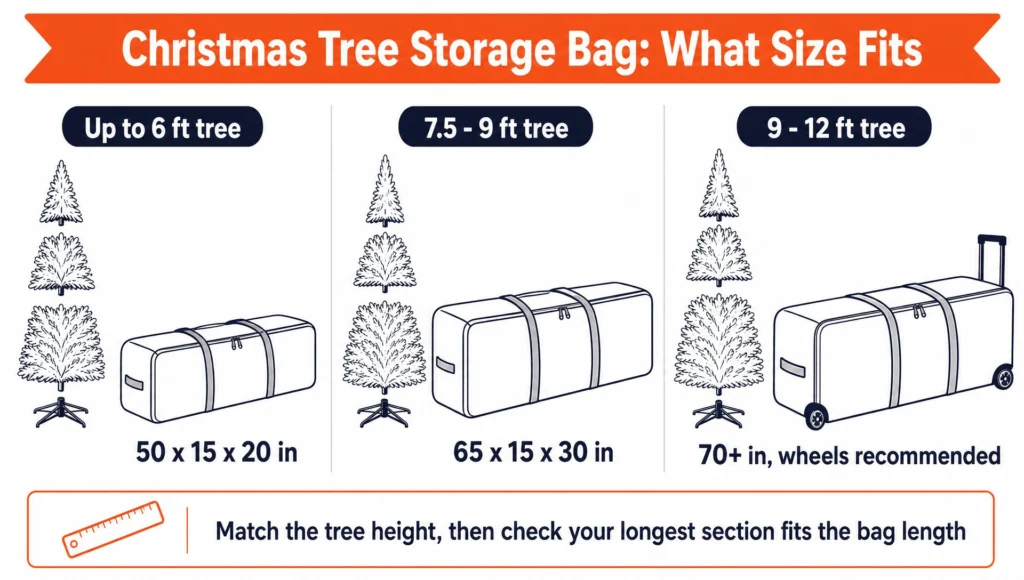
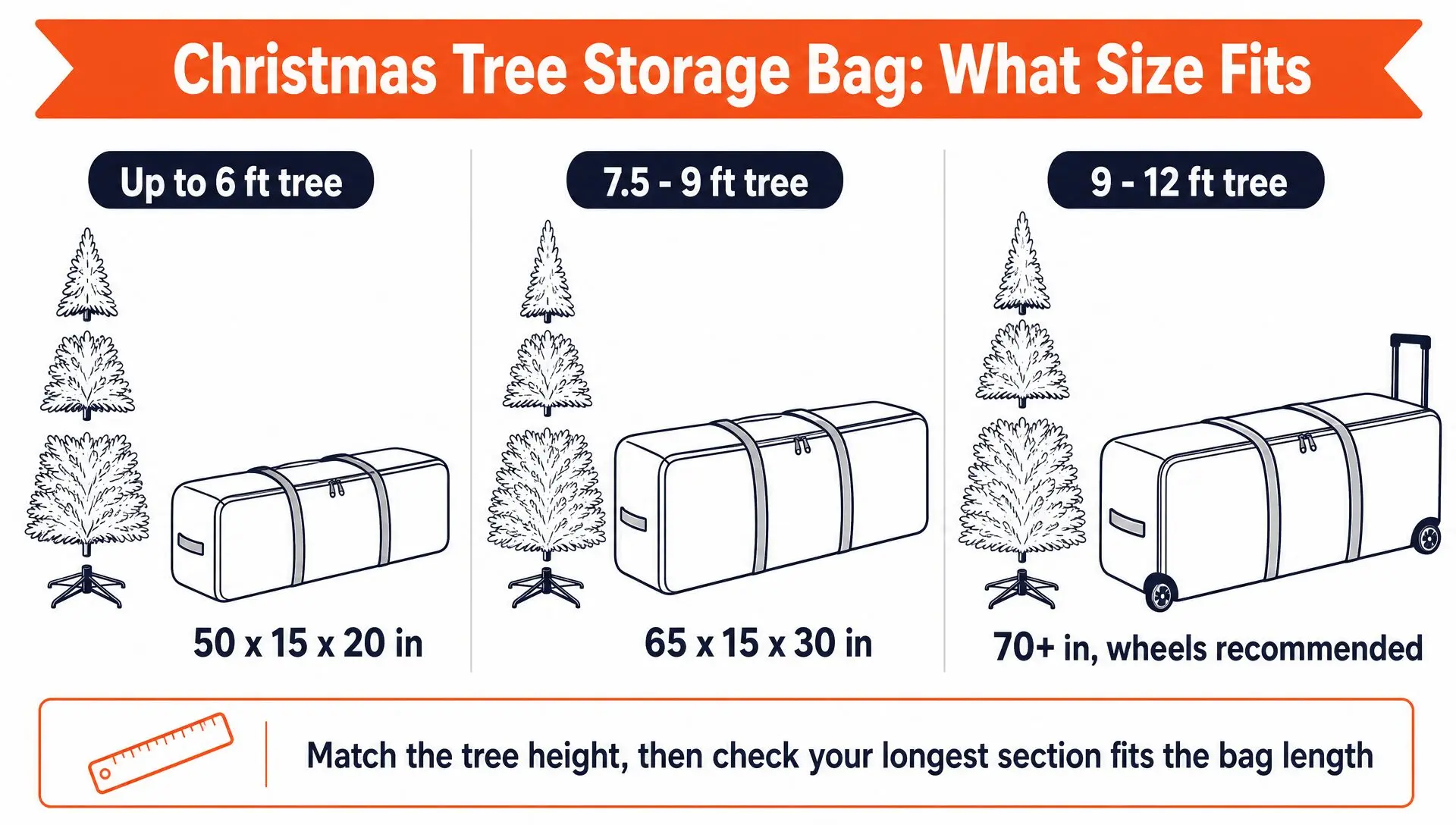
Two numbers decide the bag: the tree’s height and its largest disassembled section. A 7.5 ft tree usually breaks into a base plus two or three stacked sections, and the widest section is what the bag has to swallow.
| Tree height | Typical bag size (L x W x H) | What fits |
|---|---|---|
| Up to 6 ft | 50 x 15 x 20 in | Tree plus a strand of lights and a tree topper, or a disassembled 6 ft tree with room to spare |
| 6.5 – 7.5 ft | 56 x 15 x 24 in class | Two to three sections; the most common household size |
| 7.5 – 9 ft | 65 x 15 x 30 in | Three sections plus lights, garland and a skirt in the same bag |
| 9 – 12 ft | Rolling duffel class, 70+ in | Large trees; wheels recommended because a loaded bag at this size can pass 50 lb |
Read the dimensions the strict way: a “9 ft bag” holds a 9 ft tree that disassembles into sections no longer than the bag’s length. If your tree’s longest section runs longer, buy by section length, not by the height on the box.
Why height alone is not enough
Some trees come apart into short stacked sections; hinged branches fold down and the whole section stays long. A 7.5 ft hinged tree can have a bottom section close to 40 in long. Before buying, measure the longest section with branches folded, then check it against the bag’s length and width. This single check prevents most returns in this category.
Four bag types, four use cases
Flat duffel. The standard type: a long zippered duffel the sections slide into. Simple, cheap to produce, fits attic shelves. What most households own.
Upright bag with drawstring. You loosen the stand, pull the bag up over the still-assembled tree, cinch the drawstring and carry it away. No disassembly at all. Faster, but the bag diameter has to match the branch span, so it fits one tree profile.
Rolling duffel. Wheels on one end and a telescoping or top handle. For 9 ft and larger trees, and for anyone storing a tree anywhere other than a garage shelf. The wheel base and handle attachment are the parts that carry load, which is where construction quality shows.
Bag + box hybrid. A fabric bag with structured walls that stand up like a box. Sits open in a closet during packing, stacks cleanly in storage. Costs more to make; sells to buyers who store in living spaces.
Tree bag, tree storage box or the original carton: what each fits
Artificial tree storage comes down to three containers, and most households own the wrong one first.
The original carton protects the tree through its first year and then fails: cardboard crushes in attics, takes more shelf volume than the collapsed tree, and has no handles. A plastic tree storage box keeps its shape and stacks, which suits a dry basement shelf, but it is rigid cargo to move and its length fixes which sections it carries.
A tree bag wins on the two things the others cannot do: it compresses around the tree instead of forcing the tree to fit a box, and it carries by handles. For artificial christmas tree storage in attics and garages, coated fabric also handles the humidity swings that warp cardboard. A tree storage bag program usually covers the household range with three sizes, the same size ladder as the chart above, and adds a rolling duffel at the 9 ft tier.
The full configurations, from flat duffels to rolling hybrid bags, are listed on the Christmas tree storage bag manufacturer page.
How to pack a tree so it survives storage
1. Go while the tree is warm. Pack soon after the holidays rather than in spring. Branches left decorated for months take a set that no storage bag reverses.
2. Lights first, in one pass. Wind lights off the tree directly onto a cord reel or into the side pocket. Label the strand by tree section so next year’s setup is one pass.
3. Compress from the top down. Fold the top section’s branches upward against the trunk, then work down the tree. Each section compresses smaller than it looks assembled.
4. Sections in length order. Longest section at the bag’s bottom, base at the top where the zipper opening is widest. Heavy base pieces near the wheels or the carrying handles, not the fabric end.
5. Zip and carry by the webbing. Carry from the reinforced webbing handles, not the zipper tape. A loaded bag carried by its zipper is the most common failure in this category, and it fails the bag and the zipper both.
What fails, and what a good bag does about it
The three failure points are always the same. Seams split when the bag is overfilled past its real capacity, so the seams should be double-stitched at the ends where the sections press outward. Zippers fail when the bag is dragged by the zipper tape or the slider catches grit from a garage floor, so a quality bag uses a large-tooth zipper with dual sliders and a fabric flap over the tape. Handles tear out when the bag is carried loaded by a thin strap, so load-rated webbing handles, box-x stitched into the body, are the sign of a bag built to be carried full.
On material: 600D polyester is the category standard for a reason, and coated 600D adds moisture resistance for attic and garage storage. Thinner uncoated bags exist at lower prices and they carry the price difference in exactly the places above.
For retailers and importers
The category’s retail band runs roughly \$28 to \$45 for a quality rolling duffel in the US market, with flat duffels below that band. A few things move the number for a bulk program: size tier (9 ft bags cost more than 6 ft), wheels and handle hardware, coated vs plain fabric, and whether the bag ships compressed flat or boxed.
Program decisions worth making at the spec stage: the size ladder (most programs run 6 ft and 9 ft, some add a 7.5 ft middle), the wheel option on which sizes, the zipper spec, and the carton mix for mixed-size programs. A sample measured loaded, with the seams and handle attachment checked under load, tells you more than any spec sheet. If the program sells into climates where attic storage is standard, coated fabric is not an upgrade, it is the baseline.
As a manufacturer of storage bags we run these checks on samples for tree bag programs: section-length fit at each size tier, loaded carry from the webbing, zipper cycling, and seam behavior filled to capacity. Our Christmas tree storage bag page lists the configurations we build, and the holiday storage program page covers ornament and wreath storage for full-season programs.
FAQ
What size christmas tree storage bag do I need?
Match the tree height first: 50 x 15 x 20 in for trees up to 6 ft, 65 x 15 x 30 in for 7.5-9 ft. Then check your tree’s longest disassembled section against the bag’s length.
Can a 9 ft bag hold a 7.5 ft tree?
Yes, with room left for lights and a skirt. Sizing up one tier is the safer buy; sizing down never works.
Are tree storage bags better than the original box?
Boxes crush in attics and take more shelf space. Bags compress, carry by handles, and protect against dust. A damaged box is the most common reason people switch.
Do I need wheels on a tree bag?
Below 9 ft, optional. At 9 ft and above, or for storage far from the living space, wheels move the bag from awkward to manageable.
Can the tree stay assembled in the bag?
Only in an upright drawstring bag, which is built for exactly that. Standard duffels require disassembly into sections.
Related reading
Christmas Tree Storage Bag Manufacturer (configurations and sampling terms) · Holiday storage programs (ornament and wreath storage for full-season lines)