A buyer comparing pet carrier factories sees a spread of public listings from about $2.70 to $12 per piece and no explanation of what moves the number. This article breaks the range down by carrier style, then by cost factor, then shows how quantity, size and packaging move the total, and closes with how to read a factory quote so that two suppliers’ prices are actually comparable.

Factory prices by carrier style
These figures are public B2B platform listings (Made-in-China, Alibaba) collected in October 2026. They are market references, not quotes, and they say what the market’s floor and middle look like.

| Carrier style | Public listing range | MOQ seen | What drives the position in the range |
|---|---|---|---|
| Pet sling | $2.70 – $4.00 | 50 – 300 pcs | Fabric and mesh area are small; no frame; strap padding and safety leash are the main variables |
| Cabin soft carrier | $3.50 – $5.30 | 300 pcs | Fabric grade, number of mesh panels, board vs wire frame, zipper count |
| Pet backpack | $3.14 – $7.06 | 50 – 300 pcs | Frame support, strap structure, window type (mesh vs bubble), ventilation area |
| Structured / bucket carrier | $6.00 – $11.24 | 300 pcs | Rigid structure, heavier fabric, more hardware, load-bearing specification |
| XL double-pet carrier | $6.00 – $8.30 | 200 – 300 pcs | Roughly double the fabric and mesh of a cabin carrier, anti-collapse frame, divider, larger carton |
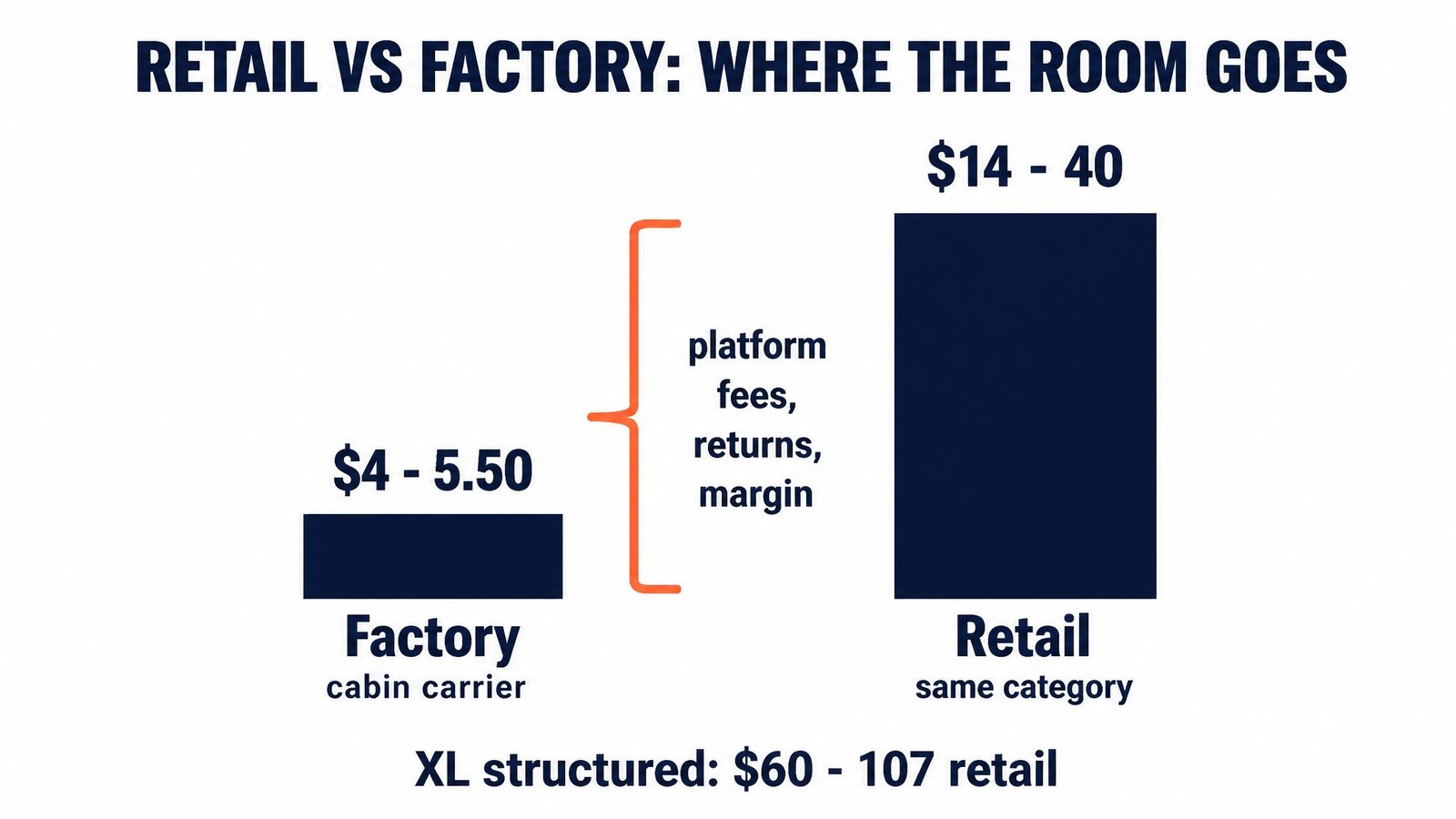
Two listings anchor the range as concrete examples: a foldable soft-sided carrier at $4.00 to $5.30 with a 300-piece MOQ, and an Oxford soft crate line at $3.50 to $7.50, also 300 pieces. Slings anchor the floor: a 50-piece sling program at $2.70 to $4.00, and a 300-piece breathable sling at $3.10. On the retail side, the same categories list at $14 to $40 for standard cabin carriers and $60 to $107 for XL structured models, which is where the margin structure later in this article comes from.
The six cost factors inside the carrier
1. Outer fabric
Polyester and Oxford weaves are standard, quilted finishes above them. Cost moves with fabric weight and coating: a coated or laminated face costs more than plain weave. Two carriers that look identical in photos can differ by a dollar or more per unit on fabric alone, which is why a quote that does not name the fabric weight is not comparable.

2. Mesh
Mesh is sold by grade, and grade is what separates a window that survives a determined cat from one that runs after a season. Higher-denier, tighter-weave mesh costs more per square meter, and a carrier with three ventilated panels uses more of it than one with a single top window. Mesh is the component most often downgraded to hit a target price, and the one that most often returns as a warranty claim.
3. Frame and structure
Three structures, three cost tiers. A sewn soft structure with no insert is cheapest. A PP board insert adds shape at modest cost. A wire frame with anti-collapse behavior, the structure behind XL double-pet carriers, adds material and assembly time, and is the main reason a $60-retail carrier needs a $7 factory price rather than a $4 one.
4. Zippers and hardware
Standard and lockable sliders are different price classes, and lockable zippers on every opening multiply the difference. Hardware adds quietly: D-rings, tether clips, buckle quality. A carrier with four lockable sliders and a security leash clip can carry more hardware cost than its outer fabric.
5. Padding and lining
A removable fleece pad costs more than a sewn lining, and a firm base pad costs more again. Lining choice also decides the care claim: washable claims are only honest for removable parts, so a program that wants a washable listing needs the removable pad designed in from the start.
6. Printing and branding
Screen print, woven label, embroidery and rubber patch are four price points with different quantity behavior. Woven labels carry a setup cost spread across the run; embroidery prices by stitch count. On a 300-piece run, the branding method can swing unit price more than a fabric upgrade.
The factors around the bag
Quantity tiers. Cutting and sewing setup amortizes across the run. The step from 300 to 3,000 pieces is where unit prices drop most visibly; one public sling listing shows $3.10 at 300 pieces stepping down further at 3,000 and above. The step from 50 to 300 is smaller but real.
Size tier and freight. An XL double-pet carrier uses roughly twice the fabric and mesh of a cabin carrier, and it packs into bigger cartons. Freight per unit climbs with the size tier even when the factory price gap looks modest.
Packaging. A poly bag is near-free. An insert card plus hang tag adds printing and an assembly step. Retail-ready packaging with FNSKU labels adds a labor step per unit.
Compliance testing. REACH or CPSIA test reports for the finished carrier are program costs quoted per design, not folded into unit price. A program that needs documented compliance carries this as a separate line.
A worked landed-cost example
To show how the pieces combine, here is a worked example for a 300-piece cabin carrier program. The factory price used is a mid-range public listing figure ($4.65, the midpoint of the $4.00-5.30 listing), and the logistics figures are illustrative planning numbers, not a quote for your program.

| Line | Basis | Per-unit effect |
|---|---|---|
| Factory price, cabin carrier, 300 pcs | Public listing midpoint | $4.65 |
| Sea freight, shared LCL carton | Illustrative planning figure | ~$0.40 |
| Import duty (US, HTS 4201.92 band, textile carrier) | Illustrative planning figure | ~7-17% of declared value |
| Domestic handling and inbound freight | Illustrative planning figure | ~$0.30 |
| Estimated landed cost before platform fees | Sum of the above | ~$5.50 – 6.00 |
Against a $14 to $40 retail band for standard cabin carriers, that landed cost leaves the room that platform fees, returns and margin consume. The purpose of the example is the shape of the math, not the exact numbers: duty band, freight mode and quantity change them, and every serious program re-runs this with its own figures.
How to read a factory quote
Quotes from different factories are comparable only when they name the same things. A quote that lists “Oxford fabric carrier, $4.20” and a quote that lists “600D Oxford body, three ventilation panels in specified mesh grade, PP board frame, two lockable zippers, removable fleece pad, screen-printed logo, poly bag, $4.20” are not the same product at the same price. Ask every factory to quote against the same specification sheet, and treat any quote that does not itemize mesh grade, frame type, zipper type and pad construction as a number that will move after sampling.

Three questions catch most of the ambiguity. What exactly is included in the unit price: packaging, labeling, or neither? What tolerance applies to the quoted dimensions, since soft goods are commonly quoted at 0.5 to 1 cm per dimension? Which claims will the factory state on the spec sheet: coating scope, pad removability, zipper locking? The answers separate a $4.20 that holds from a $4.20 that drifts to $5.10 after the sample round.
FAQ
How much do pet carriers cost from a factory?
Public B2B listings run from about $2.70 for simple slings to $8.30 for XL double-pet carriers, with structured bucket-style carriers up to about $11. MOQs on those listings are typically 50 to 300 pieces.
Why do two factories quote different prices for the same design?
Usually because the specs behind the numbers differ: fabric weight, mesh grade, frame type, zipper type and pad construction. Quotes are comparable only against the same itemized specification sheet.
Does a higher MOQ always lower the unit price?
The largest step is around the 300-to-3,000-piece range, where cutting and sewing setup amortizes. Below 300 pieces, small-run programs trade price for flexibility.
Is compliance testing included in the unit price?
Normally not. REACH or CPSIA reports for a finished carrier are program costs quoted per design and listed separately.
What does a pet carrier cost at retail vs factory?
Standard cabin carriers list at $14 to $40 retail against a $4 to $5.50 factory band; XL structured models list at $60 to $107. The gap is freight, duty, fulfillment, platform fees, returns and margin, not one party’s profit.
Related reading
Custom Pet Carriers Manufacturer (our configurations, sampling terms and customization options) · What “airline approved” pet carriers actually mean (the limits a cabin program must build to)