When you source garment bags from a manufacturer, the difference between a smooth program and a delayed one usually comes down to three things: whether the factory actually makes the body fabric or assembles from bought-in components, whether the sample process catches fit problems before bulk, and whether the quote you receive at the start matches what you pay at the end.
This guide is for brand managers and sourcing leads who are evaluating garment bag manufacturers for wardrobe storage covers, closet hanging bags, and dustproof suit covers. If you are comparing suppliers, the questions below will help you separate factories that can develop your product from those that only assemble pre-made components.
What a garment bag manufacturer should tell you up front
A manufacturer worth working with answers these questions before you pay for a sample:
Can they make the body fabric, or do they buy it?
Some factories produce non-woven fabric, polyester, and Oxford cloth in-house. Others purchase fabric from third-party mills and focus on cutting and sewing. In-house fabric production gives you more control over weight, color consistency, and lead time. A factory that buys fabric can still produce good bags, but material lead time and minimum fabric order quantities become a factor in your schedule.
What closure and opening options do they actually work with?
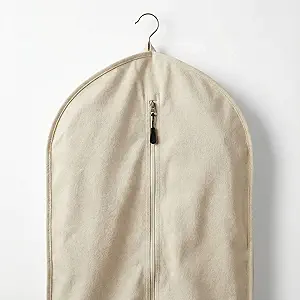
Garment covers attach to wardrobe rails in several ways: hook-and-loop wrap, fabric sleeve, or metal grommet. The front opening can be a T-shaped zipper, a center vertical zipper, or a side-zip layout. A manufacturer should tell you which options they produce regularly and which would require new tooling or sampling.
Do they produce the clear window panel, or source it?
Clear PEVA or PVC viewing panels are a standard feature on many wardrobe covers. Some factories extrude or source these panels in-house; others buy pre-cut panels. The window material affects clarity, thickness, and how it bonds to the body fabric during sewing.
If a manufacturer cannot answer these questions in the first quote, they may be a trading company rather than a factory. That is not necessarily a problem, but it affects pricing transparency and lead time control.
The sample process: what should happen before bulk
A garment bag program that skips proper sampling ends with covers that do not fit the target hangers, zippers that fail at the corners, or top closures that do not wrap around the buyer’s wardrobe rail.
What you should receive at the sample stage
The manufacturer should send you a physical sample and a written specification sheet. The spec sheet records the dimensions, material, fabric weight, closure type, zipper specification, window position and size, color reference, and packaging format. You review the sample against the spec sheet and record any changes before approving production.
What to check on the sample
Check the following on every sample you receive:
- Does the cover fit the target wardrobe rail? Measure the rail diameter and confirm the top closure wraps around it without forcing.
- Does the zipper run the full length of the opening without catching at corners? Open and close it several times.
- Does the clear window sit flat against the body fabric with no bubbling or separation at the seams?
- Does the cover hang straight when loaded with the target garments? Load it and check for leaning.
- Are the dimensions within tolerance of the spec sheet? Measure width, depth, and hanging height.
How changes are approved
If the sample needs changes, the manufacturer should produce a revised sample. For minor changes like color, logo, or packaging, a full new sample may not be required, but the modification still needs written approval. Color is confirmed by swatch, logo by print proof, and packaging by spec sheet and sample pack. Structural changes to dimensions, opening layout, closure type, or gusset depth require a new sample before bulk production.
What affects price and MOQ

Garment bag pricing depends on more than the unit cost of the bag. The following factors all affect the final quote:
- Body material and fabric weight (non-woven, polyester, Oxford, canvas)
- Dimensions and gusset depth
- Window size and material (PEVA vs PVC, full panel vs partial)
- Zipper specification (brand, size, direction)
- Top closure method (hook-and-loop, fabric sleeve, grommet)
- Logo method (screen print, heat transfer, woven label, embroidery)
- Packaging format (poly bag, insert card, hang tag, barcode, carton marks)
- Order quantity
A manufacturer should list which of these items affect the MOQ. Custom Pantone colors and special fabric requirements are the most common reasons for a higher MOQ. Stock colors and standard materials keep the MOQ lower.
When you receive estimated pricing
Ask for an estimated price range and estimated production lead time at the quotation stage, before you commit to sampling. This lets you decide whether the program is viable before paying sample charges. Final pricing and production lead time are locked after sample approval, when the specification, quantity, and packaging are fixed.
Questions to ask when comparing manufacturers
Use this checklist when evaluating garment bag manufacturers:
- Do you produce body fabric in-house, or source it from third-party mills?
- Which closure types, opening layouts, and window materials do you produce regularly?
- What is your MOQ per style, and does it change with custom colors or special materials?
- What is your sample lead time, and when does the clock start?
- Do you provide an estimated price range before sampling?
- How are minor changes (color, logo, packaging) approved without a full new sample?
- What quality checks do you perform during and after production?
- Can you share a spec sheet from a current or recent program (under NDA if needed)?
- What certifications does your factory hold (BSCI, ISO 9001)?
- What is your process if the bulk order does not match the approved sample?
What Great Shine makes
Great Shine Houseware manufactures garment storage covers for wardrobe rails, including non-woven dustproof suit covers, clear-window wardrobe covers, and gusseted closet bags. Body fabric, including non-woven material, is produced in-house. The factory holds BSCI and ISO 9001 certifications and operates a 10,000 square meter facility in Shanghai.
The MOQ is 500 pieces per style. Sample production takes approximately one week after the specification is confirmed and the sample charge is agreed. The garment storage bag product page shows current product views, construction details, and the full configuration table for material, dimensions, closure, window, color, logo, gusset, and packaging options.
For a quote, send a reference product, target dimensions, quantity, and destination market through the inquiry form on the site.