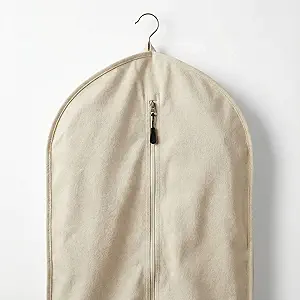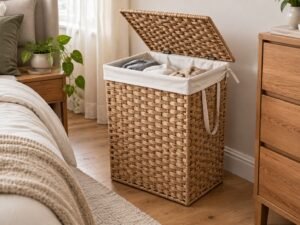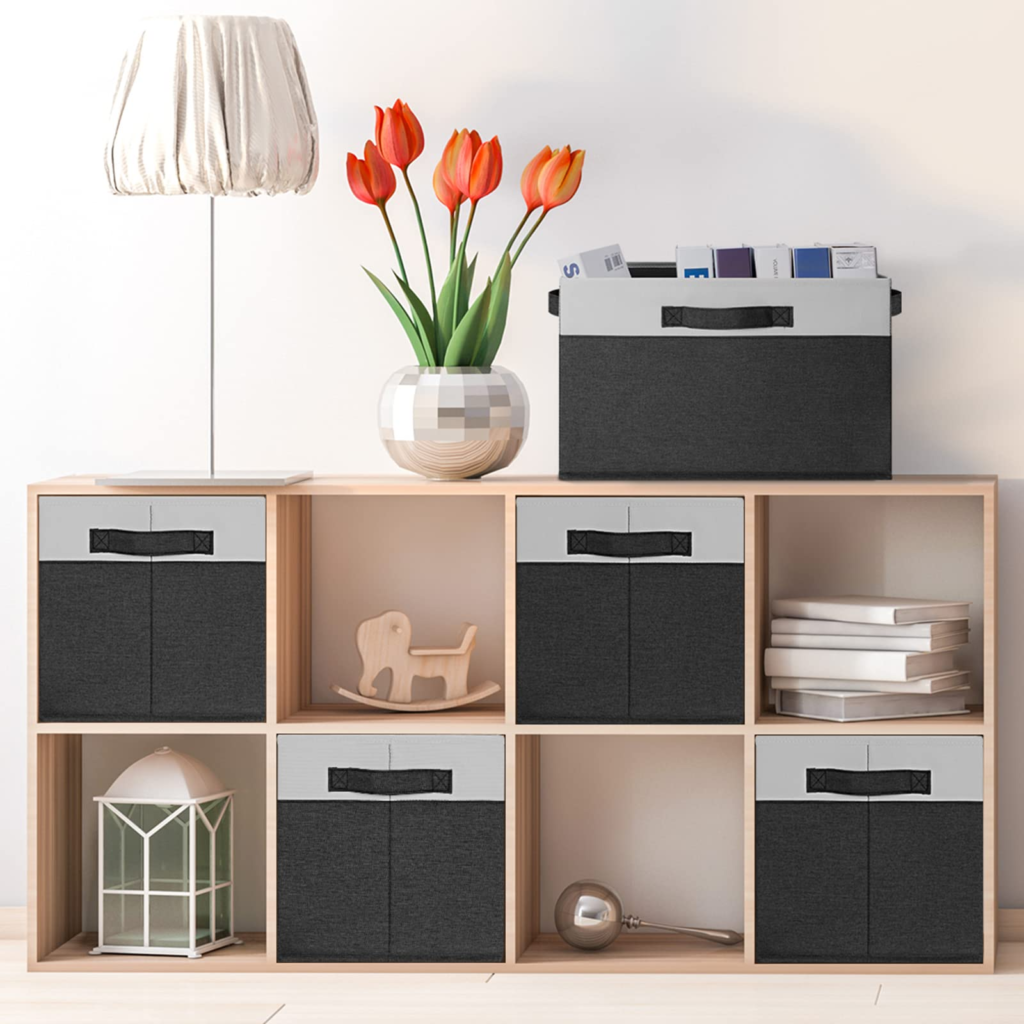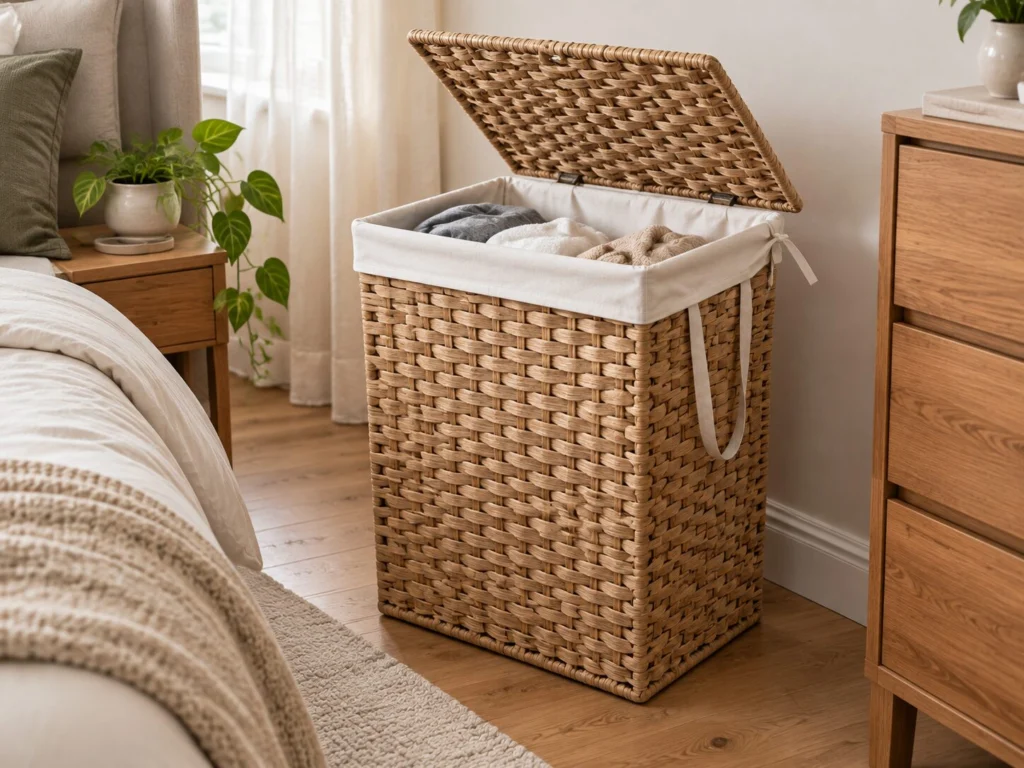
Quick answer: Choose a laundry hamper with lid by checking where it will stand, how the lid opens, and how the laundry reaches the washing machine. The lid should close over a realistic load without blocking access or trapping the removable liner. Also review ventilation, cleaning instructions, stability, and the grip used to move the laundry. A covered top conceals clothing; it does not establish odor control or airtight protection.
For brands, retailers, wholesalers, and Amazon sellers, these details help explain the differences between similar-looking hampers. Review the full routine on a sample, from adding clothes to emptying the liner. Use those observations to define the specification and show customers how the product works.
When does a laundry hamper with lid make sense?

A lidded hamper makes sense when customers want to collect laundry in a visible room and prefer the contents covered between wash days. It should still allow clothing to be added, removed, and carried with little effort.
Start with the room and the laundry route. A hamper beside a wardrobe serves a different routine from a large sorter next to the washing machine.
Understand the reason for the lid
Some customers want a tidier appearance in a bedroom. Others share a bathroom and want laundry contained in a defined space.
For these uses, the lid’s appearance and fit matter, but so does the action needed to open it. A customer holding clothes in both hands may find a particular opening inconvenient even when it looks attractive.
Ask how often the lid will be used and where it rests while open. These questions help determine whether a hinged, lift-off, or soft closure suits the product.
Check whether the room can accommodate it
A hamper must fit on the floor and leave space for doors, drawers, and people to move. The lid may need additional room above or behind the body.
A tall, narrow profile can help in one layout while being difficult to reach in another. A wide lid may also project into a walkway when open.
Use measurements from the intended setting. A product described as suitable for a small bathroom still needs to fit that bathroom’s specific gaps and fixtures.
Decide how the laundry will be carried
A hamper may remain in place while a removable bag carries laundry to the machine. Another design may be intended to move as a complete unit.
Decide which action the product supports. A decorative grip used to reposition an empty hamper should not be represented as a handle for carrying a full load unless the design supports it.
This distinction affects the body, base, liner, and handle specification. It also changes the product images customers need before purchase.
Which lid style is easiest to use?
A lid is easier to use when its opening suits the available space and leaves access to the laundry. Evaluate the grip and attachment on a hamper filled to its intended level.
A lid should be reviewed as part of the assembled product. Looking at it separately misses how the rim and body affect its fit.
Hinged lids keep the top attached
An attached lid avoids the need to find a separate place for it during use. Check how far it opens and whether it interferes with a wall, shelf, or nearby cabinet.
Observe how it behaves while someone removes the liner. The lid should not force the user to hold an awkward position or pull the bag against a hard edge.
Different hinges and fabric attachments behave differently. Describe the selected construction rather than assuming that every attached lid stays open on its own.
Lift-off lids need somewhere to go
A removable top can provide broad access to the hamper opening. The customer still needs a convenient place to put it while taking out laundry.
Check whether the lid has an easy grip and whether the fit is obvious when replacing it. A lid that can sit crooked may make the product look poorly assembled even when its parts are intact.
For a small-room product, demonstrate the full removal action. A narrow gap beside a washing machine may fit the body while offering no useful place to set the top.
Soft closures behave differently from rigid lids
A fabric flap or drawstring top can suit a flexible body. It may fold away more compactly than a rigid lid, but it creates a different opening and appearance.
Check whether the closure catches on garments or requires repeated adjustment. If a cord or fastening component is involved, review the design and instructions for the intended household use.
Do not photograph a soft closure as though it produces the same rigid, level surface as a hard lid. The image should show how the supplied product behaves.
Review the lid when the hamper is filled
Fill the hamper to its intended usable level. Check whether the lid still meets the rim and whether fabric or liner material obstructs it.
An overfilled sample may conceal the rim problem beneath the clothing. A nearly empty sample may fail to reveal how body shape changes under load.
Test several ordinary fill conditions in a practical review. Record any gap, twist, rubbing point, or difficulty opening the top, and discuss the relevant change with the supplier.
Confirm the lid’s intended use
A hamper lid should not be advertised as a seat, step, or shelf unless the complete product was designed and evaluated for that additional use. A flat surface alone does not establish a load capacity.
Style the product without suggesting those uses accidentally. Heavy objects placed on top in a promotional photograph can create an expectation the specification does not support.
If the design includes a separate supported shelf, describe it accurately and distinguish it from the movable hamper lid.
How do you choose capacity without misleading customers?
Choose capacity from the clothing routine and the available space, then verify the usable interior of the assembled hamper. External dimensions and a large-looking photograph cannot establish how much laundry fits.
A capacity figure becomes more useful when customers can connect it to a clear load demonstration and the product’s actual compartments.
Measure after the frame and liner are fitted
Frames, shaped bases, sloping walls, and liners can reduce the space available inside the body. Record the finished configuration used for measurement.
For a laundry sorter, measure the usable compartments separately. A large total volume does not mean that one section can accept a bulky item.
If the liner narrows at the opening, check whether laundry can pass through comfortably. The space below the opening is less useful when removal becomes awkward.
Distinguish a volume calculation from a load example
A simple length-times-width-times-height calculation describes a rectangular space. It can overstate the interior of a rounded or tapered hamper.
If using a calculated figure, define its basis and account for the actual shape. If using a measured method, record that method so the result can be reproduced.
A clothing demonstration answers a different question. Show the particular mix of garments and how the lid closes over it, rather than presenting the example as a universal household capacity.
Avoid treating liters as a wash-load guarantee
The amount of laundry collected depends on garment size, fabric thickness, towels, bedding, and how loosely items are placed inside. Washing machines also have their own loading instructions.
A hamper’s volume should therefore not be converted into a fixed number of machine loads without a defined basis. That conversion can create expectations unrelated to the customer’s routine.
For product photography, a representative load is more informative when accompanied by accurate dimensions. Customers can compare it with the clothing they normally wash.
Review the height of the opening
A tall hamper may hold a useful volume, but the bottom can be difficult to reach without a removable liner. Consider the person retrieving small items that settle there.
A wide opening may improve access while requiring a wider lid. Check how that choice affects the space the product occupies when open.
For a slim laundry hamper, depth deserves attention as well as width. A narrow front can hide a body that extends farther into the room than the customer expects.
Use a simple fit example
Imagine a proposed hamper intended for a gap beside a wardrobe. Its closed body fits the measured floor space, but the lid needs to swing toward the wardrobe door.
If the door and lid cannot open comfortably in the same arrangement, a smaller body alone may not solve the problem. A different lid direction or closure could be more useful.
This is an illustrative layout problem, not a specification for a particular model. Measure the actual location and operate the filled sample before choosing the format.
Does a lid help control laundry odors?
A lid can conceal laundry, but odor performance depends on the clothing condition, time before washing, room conditions, and the complete hamper design. Do not treat a covered top as evidence that odors are removed.
For product selection, review how air can move around the contents and how easily the customer can clean the surfaces that contact laundry.
Review the complete airflow path
A mesh panel only helps explain one part of the construction. Consider whether the liner blocks it and whether clothing pressed tightly against the panel changes the arrangement.
A breathable-looking fabric does not establish a measured airflow result for the entire hamper. Coatings, backing layers, liner materials, and panel placement all matter.
Use specific descriptions such as a mesh body or ventilation openings when those features are present. Reserve broader performance claims for results supported by an appropriate evaluation.
Keep damp clothing in the care discussion
A closed hamper is not a drying appliance. Clothing that needs prompt washing or drying should be handled according to its care needs.
The US Environmental Protection Agency explains the importance of moisture control in its guidance on mold and moisture. For hamper selection, that supports checking the storage environment and cleaning routine instead of promising that a lid or panel eliminates moisture problems.
Avoid recommending fragrance as a substitute for addressing dampness or cleaning. The product instructions should explain the intended routine plainly.
Make the liner’s role precise
A liner can simplify removal and cleaning when it is designed for those tasks. Its usefulness depends on its opening, attachment, material, and care instructions.
A removable bag is not automatically machine washable. A washable fabric does not automatically make every attached handle, coating, or fastening suitable for the same treatment.
Confirm the finished liner’s care method and explain it where customers can find it. If the liner must dry before being returned to the hamper, include that step in the instructions.
Describe the verified features
A lid, vent panel, and washable liner are different features. Each can be described without claiming that the hamper disinfects clothing or prevents every odor.
If a brand wants to make a specific odor-control claim, define the performance being claimed and request suitable evidence for the final construction. Do not transfer a result from one material to a different assembled design.
For many retail offers, clear feature descriptions and realistic care instructions provide the information customers need to make a choice.
What makes a removable liner useful?
A useful liner is easy to detach, carry as intended, empty, clean, and refit. It should work with the hamper’s opening and lid throughout that sequence.
A laundry hamper with removable liner needs more than a bag placed inside a frame. The relationship between the liner and body determines much of the experience.
Check how the liner attaches
The attachment should hold the liner in the intended position without making removal needlessly complicated. Compare the supplied clips, ties, loops, or folded rim arrangement on the assembled sample.
Look for places where the liner catches as it is lifted. A generous body can still have an awkward exit if a fastening or frame component narrows the path.
Ask an unfamiliar user to detach and replace it. Repeated difficulty can indicate that the attachment needs clearer instructions or a different design.
Evaluate the carrying method
If the liner is intended to carry a filled load, review the handles and their attachment under agreed conditions. The main hamper’s handle rating does not automatically apply to the liner.
Check whether the grip stays accessible when clothing reaches the intended fill level. A handle buried beneath laundry adds an avoidable step.
Also review the opening during transport. A wide, unsupported mouth may let items fall out in a route that includes turns or stairs, depending on the design and loading.
Confirm that emptying is straightforward
Try transferring the sample load to the intended washing area. Observe whether small garments become caught around seams or attachments.
The liner should be manageable when partially full as well as when filled for a photograph. A stiff, oversized bag may be awkward in a compact laundry space.
Check that the opening lets the user empty the load without catching clothing or having to pull hard on the liner.
Review refitting after care
After any permitted cleaning trial, check the liner’s fit and the position of its attachments. Follow the actual instructions and agreed evaluation method.
Inspect whether the liner still reaches the rim without pulling hard on the frame. Check whether its edge interferes with the lid.
If replacement liners are offered, verify their dimensions and compatibility before mentioning that option. A similar-looking bag may not fit the same attachment arrangement.
Which body materials and structures suit a lidded hamper?
Choose the body for the intended room, cleaning method, and handling routine. Then check whether it supports the chosen lid and liner.
Material selection is part of this decision, but the assembled structure matters just as much. Two fabric hampers can behave differently because of their inserts, base, rim, and attachments.
Fabric bodies need a defined support method
A fabric body may use structured panels, a frame, a reinforced rim, or another support arrangement. Confirm how it takes shape after unpacking.
Look at the sample empty and with a realistic load. Clothing should not be the only thing concealing a structural problem in a product advertised as freestanding.
For folding models, review the position of creases and the way inserts fit. A lid that sits correctly before folding may need another check after the product is packed and reopened.
Bamboo components need clear description
A bamboo hamper may combine bamboo strips or a frame with a fabric liner and other materials. Describe those parts accurately instead of suggesting that the entire product has one construction.
Examine surfaces that contact the liner or clothing, and confirm the intended cleaning method. The finish and joins can matter to maintenance as well as appearance.
Avoid using a material name as proof of water resistance, sustainability, or suitability for every bathroom. Those are separate claims that need appropriate support.
Mesh formats have their own role
Mesh can provide visibility and an open body construction. A covered mesh design still needs a lid and attachment suited to its frame.
A lightweight pop-up format serves a different task from a large structured sorter. Review how it stands, folds, and carries its intended load.
If the product is meant to collapse for storage, make the folding steps clear. The sample review should include reopening it into a usable shape.
Match the range to actual product options
Great Shine’s custom laundry hamper range includes lidded, foldable, mesh, bamboo, slim, and sorter formats. The page also discusses combining selected features through sample review.
Use those categories to narrow the product brief. Confirm the selected construction, dimensions, liner, lid, and handling requirements before treating a category description as a finished specification.
How should a full hamper move to the laundry area?
Choose the transport method around the route between the collection point and the washing machine. A removable liner, a carried body, and a wheeled frame each have different requirements.
Measure the narrow points on that route and consider changes in floor level. The easiest option in one room may be inconvenient elsewhere.
Carrying the whole hamper
A carried hamper needs accessible grips and a structure intended for its loaded use. Check whether the lid stays attached or must be removed before carrying.
Observe where the user’s hands go and whether the load obstructs their view. A tall hamper held in front of the body may behave differently from a compact basket carried at the side.
Handle strength should be assessed using an agreed method. A photograph of someone lifting an empty product does not support a claim about carrying a full load.
Carrying only the liner
A detachable liner lets the outer body remain in place. This can be useful when the hamper has a decorative structure or occupies a fitted space.
Check the liner on the actual route. Its size, flexibility, and handles affect how it moves through a doorway or around furniture.
The lid should also leave enough room to remove and replace the bag. Review these actions together rather than assessing the liner on a separate table.
Rolling the hamper
Wheels can help where the route is suitable, but floor surfaces, thresholds, and turning space affect operation. A wheeled laundry sorter also needs enough clearance to maneuver.
Check how the product starts, stops, and turns under the agreed load. If brakes are supplied, confirm their operation and the intended parking arrangement.
Do not imply that wheels make the product suitable for stairs. A route with steps needs a separate handling plan and a product designed for that plan.
Consider the return journey
After laundry is removed, the customer needs to return the hamper or liner and prepare it for the next load. A product should remain stable and easy to handle when empty.
Check whether the liner can be refitted without moving the outer body away from its usual position. If the lid or frame must be disassembled each time, make that requirement clear.
Include the return journey in the sample demonstration so the review covers refitting the liner and preparing the hamper for its next load.
When is a lidded laundry sorter worth the extra space?
A lidded sorter is useful when separate compartments support a routine the customer already follows. It occupies more space, so each section should have a clear purpose.
A split interior should make sorting easier without creating compartments too small for the intended load. More sections do not automatically improve the product.
Choose categories from actual washing needs
Separate clothing according to relevant care requirements. The American Cleaning Institute’s laundry basics guidance explains the role of care labels and sorting in laundry preparation.
A fixed dark-light-color label system may be useful for some customers, while another household needs different categories. Consider whether the label format can accommodate that variation.
Avoid claiming that a compartment system eliminates the need to check garment labels before washing. Pre-sorting helps organize laundry, but the final wash load still needs appropriate care decisions.
Compare a shared lid with separate lids
A shared lid exposes every compartment at once. Separate lids can allow one section to be used without opening the others.
Check whether the customer can reach each section comfortably and whether adjacent lids interfere. The arrangement needs to work where the hamper will actually stand.
If there are removable bags, confirm that one can be taken out without dislodging neighboring bags. A sorter loses convenience when emptying one section requires reorganizing the whole frame.
Check uneven loading
Households will not necessarily fill all compartments at the same rate. Review the sample with one section fuller than the others.
Observe how the frame stands and how the lid meets the rim. For a wheeled design, include the uneven load in the agreed practical review.
Document any restrictions that apply to loading or moving the product. The marketing image should not imply a use that the instructions exclude.
Compare the sorter with a single compartment
A single lidded hamper may suit customers who sort clothing near the machine and prefer a smaller footprint. It can be a better fit when the room has limited floor space.
Offer a sorter because its separate sections serve a clear need. Explain that difference so customers can choose the format that fits their routine.
What should buyers check on a lidded hamper sample?
Review the sample assembled, partly filled, filled to its intended level, emptied, and packed again if it is sold as foldable. The lid should be included in every relevant step.
The checks below are suggested evaluation activities. They do not represent completed tests or fixed industry acceptance thresholds.
Begin with unpacking and assembly
Use the packaging proposed for the order. Check whether the customer can identify the parts and understand the assembly sequence.
Note any insert that can be fitted backward or any fastening that is difficult to see. An illustrated instruction may solve some problems, while others require a design change.
Inspect the finished shape before adding clothing. Record whether the body and lid align without using the load to force them into place.
Review assembly with the lid in place
A customer may understand how to unfold the body yet be unsure which way the lid attaches. Check that the instruction drawing shows the same orientation as the supplied parts.
Ask the person assembling the sample to stop before adding laundry and compare the result with the illustration. This makes it easier to distinguish an unclear step from a part that does not fit correctly.
If a base panel, lid insert, or fastening can be reversed, consider how the design or labeling can prevent confusion. The user should not need to guess which side faces the clothing.
Repeat the relevant assembly steps after any change to the lid or rim. An attachment that works on a separately supplied sample may be harder to reach after the body has been fully assembled.
Review the opening through repeated ordinary use
Agree a practical or formal cycle plan according to the claim being assessed. Record the method and the sample version.
Observe the lid attachment, grip, rim, and any closure components during the review. Note changes in alignment or operation rather than relying only on a final photograph.
If the product is advertised for one-handed use, assess that exact action with representative users and conditions. Do not infer it from the lid being light.
Fill the hamper using a defined clothing set
Use the load planned for the listing demonstration and record it. Check the shape of the body and whether the lid closes normally.
Then remove part of the load. Assess whether the liner stays positioned and whether the structure still stands as intended.
For divided products, repeat with different compartment loads. This helps identify whether the layout remains practical when household laundry varies.
Complete the handling route
Carry the liner, move the full hamper, or roll the frame according to the design. Use the intended route where possible, or a clearly described representative setup.
Record any contact between the lid and nearby objects. Inspect handles, attachments, and the base after the agreed handling sequence.
A practical route review can identify problems to investigate. A rated capacity or durability promise requires a suitable documented evaluation beyond an informal demonstration.
Apply the stated cleaning instructions
Review the finished product’s care directions before any cleaning trial. Different components may need different treatment.
Check fit and function afterward where the evaluation requires it. A liner that becomes difficult to attach or a lid that no longer meets the rim deserves follow-up.
Keep the instruction version with the sample record. If the care directions change, assess whether the supporting review still matches what the customer will do.
Record the location and cause of each issue
Use photographs and short notes that identify the location and condition of each issue. “Lid rubs against rear wall when fully opened” gives a supplier a clearer problem than “lid needs improvement.”
Separate appearance preferences from functional defects. Both may matter, but they lead to different decisions.
Confirm revisions on the updated sample before approving the final specification. Keep the relevant product images consistent with that version.
How do different room layouts change the choice?
The room determines the available opening space, the appearance customers expect, and the route laundry follows. Use distinct settings to compare products without claiming that one format suits every home.
The examples below are hypothetical buying scenarios. They can guide a sample review and help a retail team explain the range.
A bedroom with visible laundry storage
A customer wants laundry collected near the wardrobe while keeping the room visually tidy. A lidded fabric or bamboo-component design may be relevant if it suits the available space and cleaning routine.
Check whether the lid opens while the wardrobe doors are in use. Then review whether the liner can be removed without shifting surrounding furniture.
For the product image, show enough of the room to establish scale. A tight crop can hide the clearance that makes the layout workable.
A narrow bathroom gap
The customer has a small floor area between fixtures. A slim format may fit, but the lid’s direction and removal path become especially important.
Measure the gap at more than one height if the fixtures or wall details project into it. Also check whether the product sits on a level surface.
The care instructions need to suit the selected product in that setting. A bathroom label should not imply that every fabric, insert, finish, or frame can tolerate standing water.
A family laundry room
The household wants to separate clothing before washing. A lidded sorter may help if each section has a useful size and the family understands the categories.
Compare removing one liner with moving the entire frame. The best arrangement depends on where the machine is and how much room remains around it.
Use the actual compartment dimensions in the product description. A total capacity figure can hide the practical limits of an individual section.
An apartment with shared laundry facilities
The customer collects clothes inside the apartment and carries them elsewhere to wash. The route may include doors, stairs, or a lift.
A removable bag could be useful if its shape and handles suit that route. A wheeled product needs its own route assessment rather than an assumption that wheels solve every transport problem.
Show the carrying component clearly in the listing. Customers need to know whether they are expected to move the entire hamper or only its liner.
Which details should be fixed in a custom product brief?
Fix the dimensions, lid construction, liner arrangement, and handling method before finalizing colors and branding. These decisions define how the product works.
For a private-label project, the specification should be detailed enough that the approved sample, packaging, and next production order describe the same item.
Describe the room and routine
Provide a reference image or sketch and explain where the hamper will stand. State how the customer adds clothing, removes laundry, and cleans the product.
Include restrictions such as limited opening height or a narrow passage. These are more useful than a broad request for a compact design.
If there are several target uses, identify the main one. Trying to serve incompatible layouts with a single structure can create compromises that customers need to understand.
Define the finished dimensions
Record width, depth, and height with the hamper assembled. Add the space needed with the lid open where it affects use.
For folding products, keep folded product dimensions and packed retail dimensions separate. The retail pack may include inserts, the lid, instructions, and other components.
Specify how dimensions and usable capacity will be checked. The method should match the claims planned for the product.
Describe each component separately
List the body material, support structure, lid, liner, handles, and fastenings. Include the relevant finish or care requirement for each part.
A broad phrase such as fabric hamper leaves too much uncertainty about the inserts and attachments. Likewise, a bamboo description does not identify the liner or fastening construction.
Ask the supplier to explain which proposed changes need a new sample. A different lid attachment or liner arrangement can affect more than appearance.
Agree the relevant evidence
Identify any claim about carrying, repeated opening, folding, cleaning, or other performance. Agree how it will be supported for the final product.
Do not add an impressive load figure simply because another hamper listing uses it. The construction and intended handling method may differ.
Keep the evidence tied to the approved version. A change in frame, handle attachment, or lid structure may require the affected checks to be repeated.
How should retailers present a laundry hamper with lid?
Show the hamper closed, open, and in the action that matters most to the customer. Pair those views with accurate dimensions and a clear explanation of the supplied parts.
A buyer should be able to understand the product before ordering it. That includes how it fits into the room and how laundry leaves it.
Use the closed view to show appearance
A closed image can communicate the overall shape, finish, and lid fit. Use the assembled product rather than digitally correcting a poorly fitted top.
Show a realistic scale reference in at least one lifestyle image. Avoid placing a large hamper in an oversized room that makes its footprint difficult to judge.
If several colors are offered, keep the construction consistent across images or identify differences. Customers may otherwise assume that a visible feature is included in every variant.
Use the open view to explain access
Show how the lid moves and how much of the opening is available. Include the liner attachment if that is a buying feature.
For a sorter, let customers see the actual compartments. A photograph filled with one undivided pile cannot explain a divided interior.
When the lid must be removed entirely, make that operation apparent. The image should not imply a hinge that the product does not have.
Show the carrying or emptying action
If a removable liner is the main convenience feature, demonstrate its removal and intended grip. Keep the load realistic and consistent with the instructions.
If the whole hamper moves, show the handling method supported by the design. Wheels, handles, and lids should appear in the positions customers will use.
Avoid staging a load beyond the product’s documented limits. The displayed load and handling method should match the instructions.
Give customers usable care information
State the confirmed care method for the outer body and liner. Explain any necessary separation of components.
Keep this information consistent with the instruction card and labels. A listing that says machine washable while the insert says wipe clean creates avoidable uncertainty.
When the product has a care limitation, make it visible before purchase. That helps customers choose a hamper they can maintain in their own home.
Compare versions by meaningful differences
If the range includes a single hamper and a sorter, explain the compartment layout and floor space. If it includes slim and wide versions, give their dimensions.
Distinguish a removable liner from a fixed lining, and a folding frame from a rigid one. Similar photographs should not conceal different routines.
Explain which room and handling routine each version suits. Clear differences between a slim single hamper and a wider sorter help customers choose the relevant option.
Frequently asked questions about laundry hampers with lids
Does a laundry hamper with lid stop smells?
A lid covers the contents, but it does not establish odor removal. The clothing condition, ventilation, time before washing, and cleaning routine all affect the result. Look for clear construction and care information instead of assuming that a closed top solves odor problems.
Is a removable liner always washable?
No. Confirm the care instructions for the finished liner, including its handles, coatings, and fastenings. Some designs allow machine washing, while others require a different method. The outer hamper may have separate instructions from the removable bag.
What size laundry hamper should a household choose?
Start with the available space and the laundry collected between wash days. Check the usable interior and the opening, then compare a realistic clothing load. Household size alone does not determine capacity because clothing types, towels, and washing routines vary.
Can a lidded hamper stand in a bathroom?
It can if the particular product and its care instructions suit the location. Check the floor space, lid clearance, ventilation, and exposure to water. A general bathroom description does not mean that every insert, frame, fabric, or finish tolerates damp conditions equally.
Are laundry hampers with wheels easier to use?
They can be easier on a suitable route, but thresholds, floor surfaces, steps, and turning space affect the result. Assess the filled product where it will move. Wheels do not automatically make a hamper appropriate for stairs or remove the need for suitable handles.
Should a hamper lid stay open by itself?
That depends on the design and its stated use. If hands-free access is part of the offer, evaluate that action on the assembled sample. Otherwise, explain whether the user holds, folds back, or removes the lid during emptying.
Is a laundry basket the same as a hamper?
The terms overlap in retail use. A basket often serves carrying and unloading tasks, while a hamper often collects laundry between washes. Choose by the actual structure and routine. A lidded hamper may still need a separate carrying liner or basket.
What is the most useful sample demonstration for a buyer?
Complete the full routine: assemble the hamper, fill it, operate the lid, remove or move the laundry, empty it, and return it to use. Then review the care instructions and any folding process. Record the sample version and the conditions behind the observations.
Explore lidded laundry hampers for your product range
Begin with the customer’s room and laundry route. Select the lid, liner, and body that support that routine, then confirm the dimensions and handling requirements on a representative sample.
View Great Shine’s lidded hampers, laundry sorters, and related custom styles to compare the product formats shown. Use the same room and clothing scenario when assessing the models so the differences remain clear.