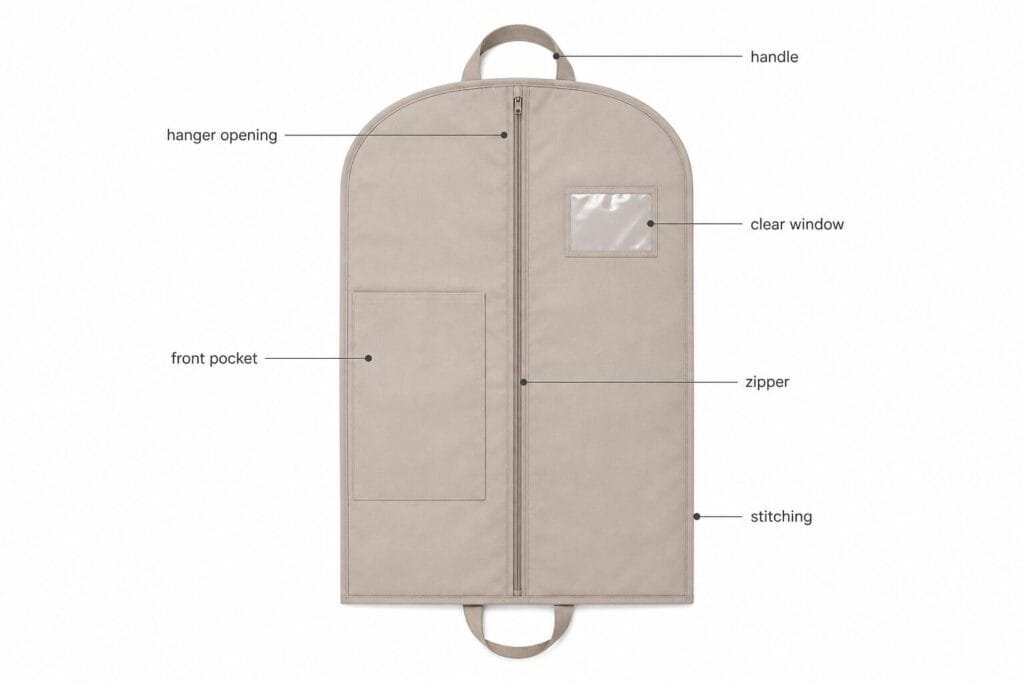
When sourcing garment bags wholesale, confirm the garment size, fabric, opening and retail packaging before comparing prices. A cover with a clear panel and one zipper slider is a different specification from a wider polyester cover with two sliders, even if both suppliers call the product a garment bag.
For the standard styles discussed here, use 500 pieces per style as the starting MOQ reference and request a written colour breakdown. Mixed colours within a style depend on the material route and the quotation. Retail-pack and carton quantities are separate requirements; they do not define the MOQ.
Choose the garment and handling task
Start with the clothing the cover must hold and how it will be handled. A retail wardrobe cover, a suit-delivery cover and a bag carried during travel can need different structures.
For wardrobe storage, check hanging length, shoulder space and access to the zipper. For customer delivery, consider how the garment will be handed over and whether the folded pack or hanger arrangement matters. A travel brief requires separate attention to carrying handles, folding attachments and any other parts that support the load.
If your range includes both wardrobe covers and travel garment bags, compare our custom garment bag options before choosing the structure for your order.
Write the use into the RFQ. “Cover for a long coat stored on a hanger” gives the supplier a clearer starting point than “large garment bag”. Include the hanger type and the intended number of garments; neither can be inferred from a flat size alone.
Compare a defined material and construction
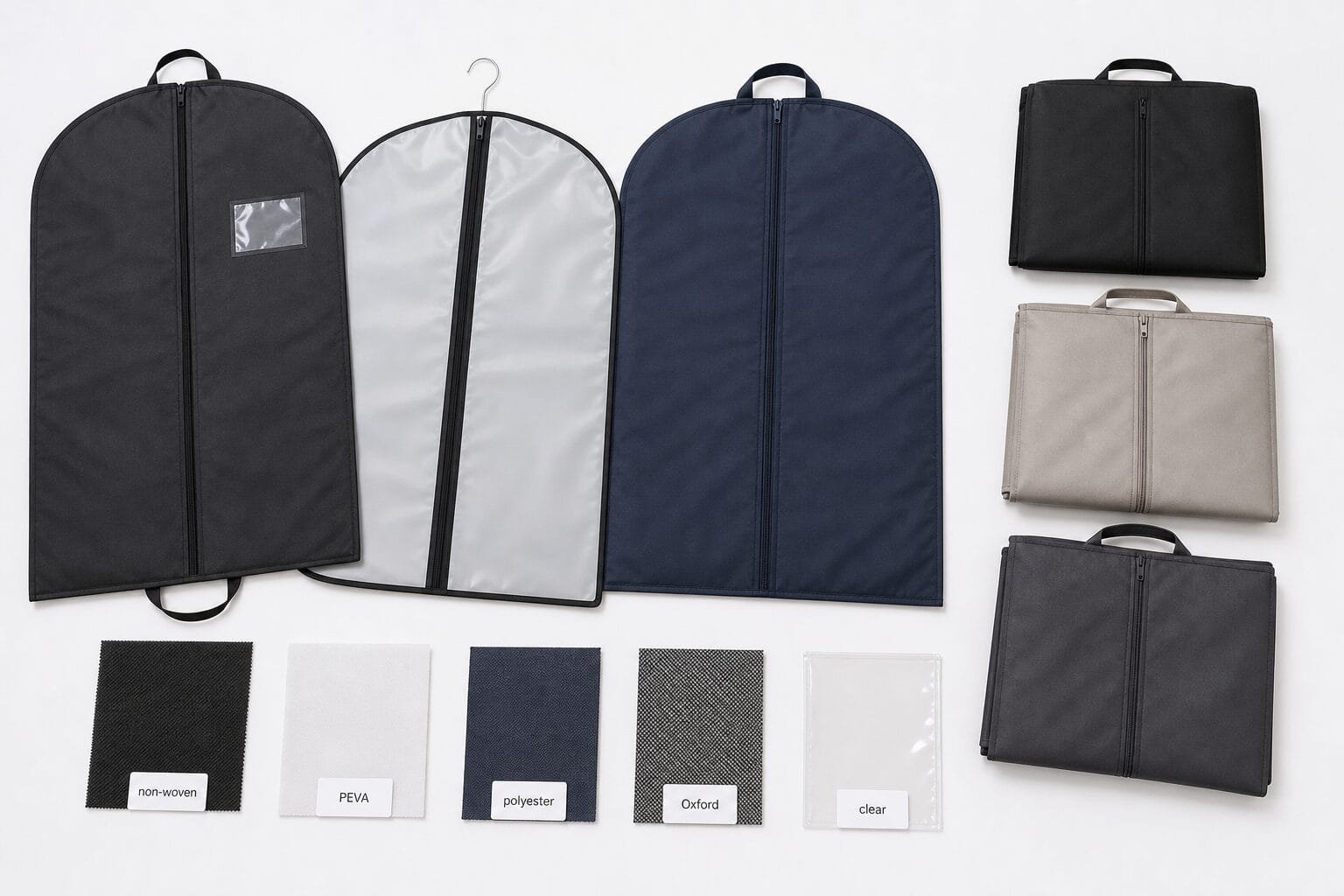
Great Shine’s May 2026 product handover record includes the following garment-cover configurations. These examples show how a buying specification can connect the fabric to the size, zipper and packing format.
| Reference configuration | Listed product dimensions | Zipper | Individual packaging | Project carton quantity |
|---|---|---|---|---|
| 80 gsm PP non-woven body with PVC clear material | 60 × 100 cm | Single slider | CPP bag, hanging slot and printed insert | 24 pieces |
| 80 gsm PP non-woven body with PVC clear material | 60 × 135 cm | Single slider | CPP bag, hanging slot and printed insert | 24 pieces |
| 210D polyester Oxford body | 65 × 100 cm | Two sliders | CPP bag, hanging slot and printed insert | 24 pieces |
| 210D polyester Oxford body | 65 × 150 cm | Two sliders | CPP bag, hanging slot and printed insert | 24 pieces |
Confirm width and length on the drawing before ordering. The listed sizes do not establish gusset depth, usable internal capacity or a tested carrying load. The project record describes the polyester body as 210D Oxford; the confirmed product brief identifies polyester as the fibre material.
The non-woven versions specify matching-weight non-woven binding and a contrasting zipper. Colour, clear-panel layout and trim placement still need to follow the chosen sample. A sample photo showing the general shape should not override the written colour specification.
These configurations do not establish waterproofing, machine-washability or a fixed service life. If one of those claims is part of the retail brief, agree the evidence needed for the complete cover before printing it on the pack.
Compare gsm and denier correctly
Gsm describes fabric mass per unit area; denier describes yarn linear density. An 80 gsm fabric and a 210D fabric cannot be ranked by comparing the two numbers. Specify fibre material and fabric construction, then check the sample for the actual use.
Material alternatives can change appearance, seam behaviour, the folding arrangement and the quotation. Ask suppliers to list those changes explicitly. Where price comparisons matter, keep size, clear-panel area, zipper and packaging consistent between the alternatives.
Confirm dimensions and functional details before sampling
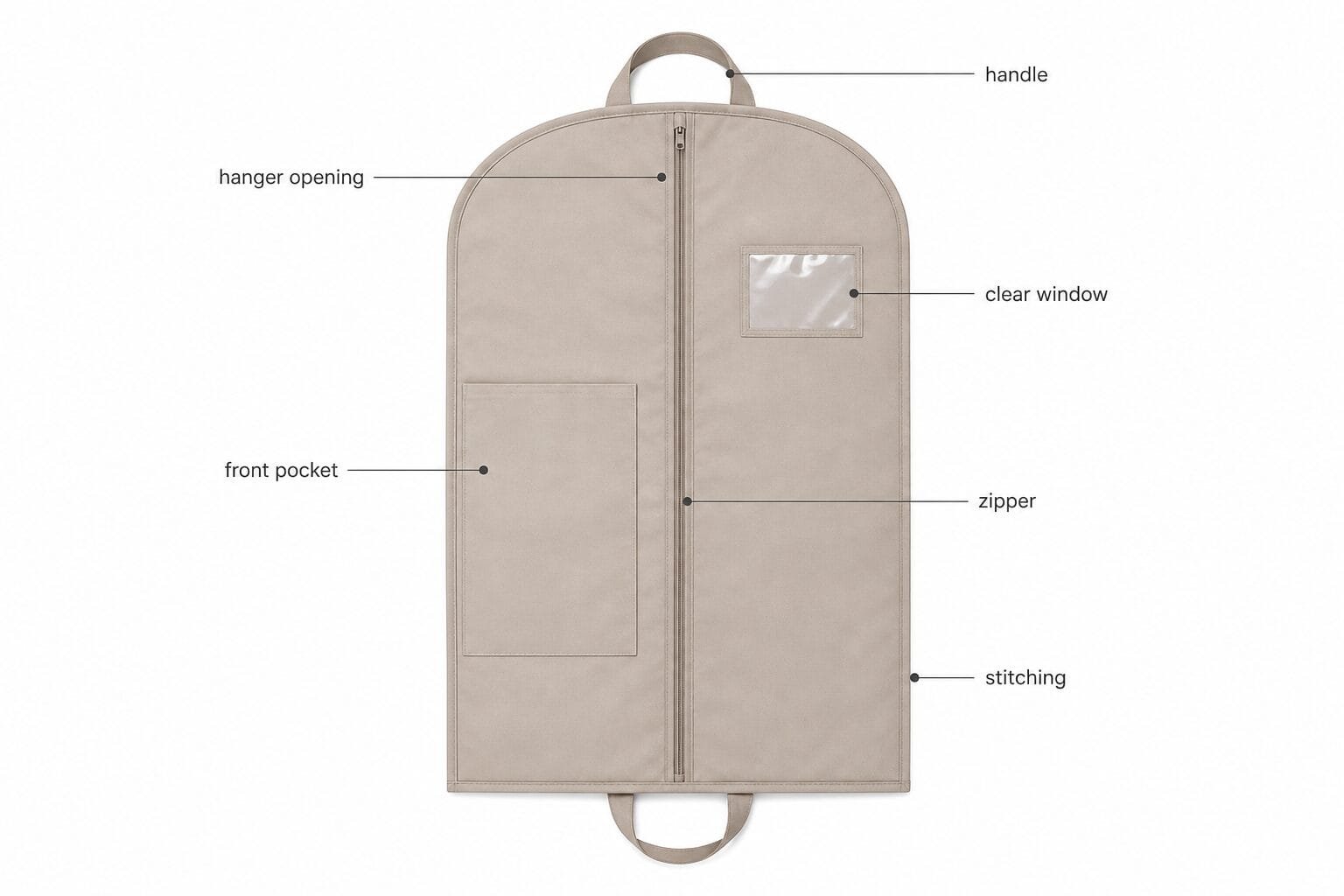
The size specification should identify the measurement points, whether the cover lies flat or holds a garment during measurement, and the permitted tolerance. Place the intended garment on its hanger inside the sample before accepting the final dimensions.
Review these details together:
- Body width and length, plus gusset depth if included.
- Hanger opening position and finish.
- Zipper length, slider count, colour and opening direction.
- Clear-panel material, placement and visibility.
- Binding width and the finish of corners and seam ends.
- Handles, pockets or folding attachments, if the chosen design includes them.
Adding a handle is a structural change when the buyer expects it to carry the filled product. Record how it attaches and how it will be checked. A handle shown in a concept drawing does not establish a safe carrying load.
For a clear panel, assess how it looks both hanging and after unpacking. Check that the chosen fold avoids unnecessary creasing across the most visible part of the panel.
Separate MOQ, colour split and carton quantity
Great Shine lists a starting MOQ of 500 pieces per style for garment covers. The same-style mixed-colour arrangement needs to be confirmed for the selected material route; custom colours, special materials or construction changes can alter the order conditions.
Do not combine several sizes or constructions into one 500-piece total without agreement. Ask whether a size change creates a separate style and whether each colour has its own minimum. List the quantity for every size and colour in the purchase order.
The 24 pieces per carton in the reference project is a packing quantity. A 500-piece order does not divide evenly into cartons of 24: 20 full cartons contain 480 pieces, leaving 20 pieces. If full cartons are required, agree whether to change the total quantity, the packing count or the final-carton arrangement. Do not silently round a customer’s order up.
Use separate lines in the quotation for:
- MOQ per style and the definition of a style.
- Quantity by size and colour.
- Individual retail-pack format.
- Pieces per master carton and whether partial cartons are allowed.
Include the approved colour split and carton arrangement in the purchase order so that the warehouse can pack the agreed quantity without making a separate rounding decision.
Approve retail packaging with a packed sample
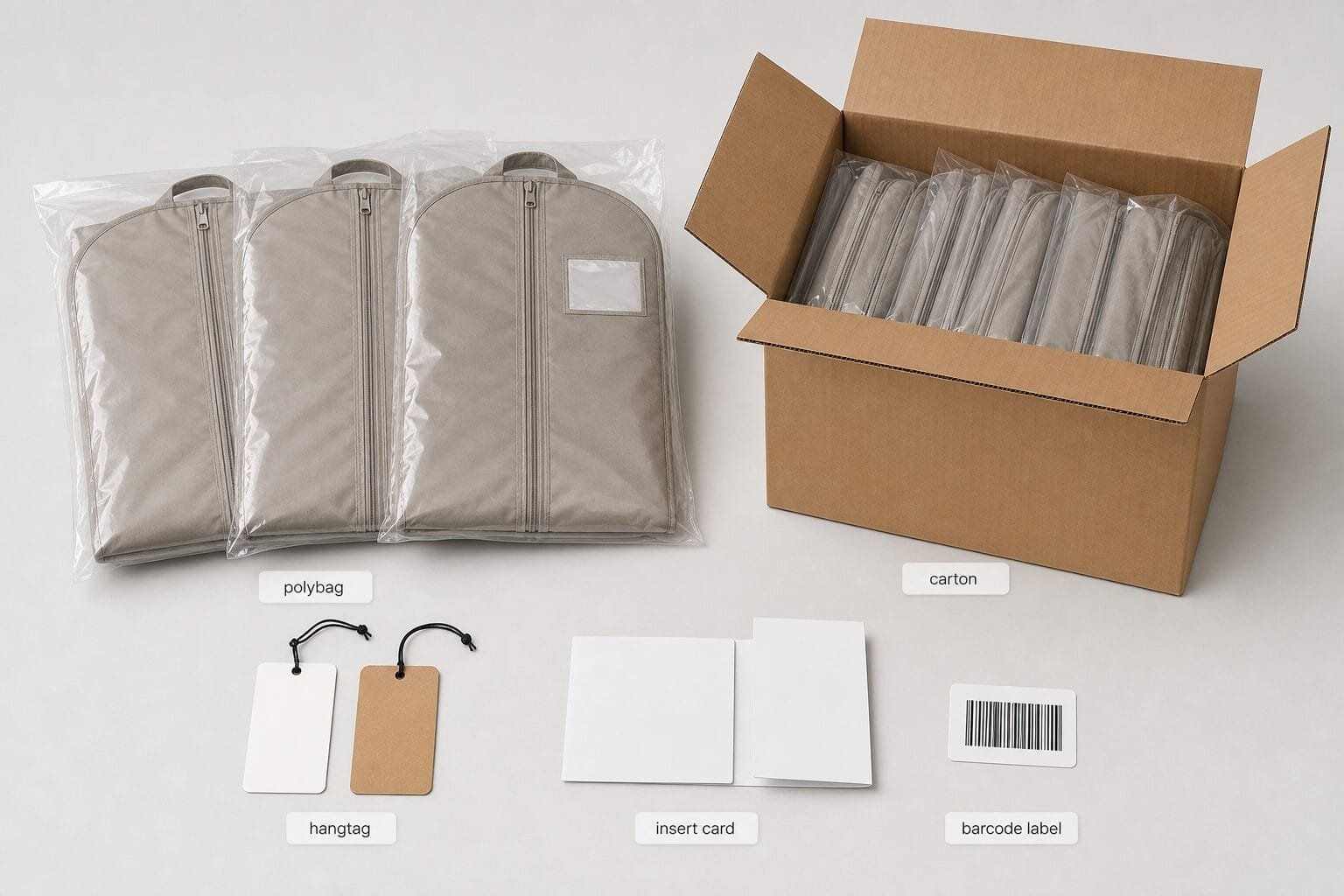
The reference covers used a CPP retail bag with a hanging slot and printed insert. Approve the package after the actual cover has been folded and packed, because the insert and display hook must work with the finished pack.
Check that the insert fits without curling, identifies the correct size and shows any care information agreed for that construction. A barcode should remain readable in its final position and should match the correct style and colour. Separate the product code from any shipping-carton identifier.
The source project notes require actual carton dimensions to be checked after packing. They also call for protective sheets at the top and bottom of the carton to help prevent the contents being cut during opening. These are project packing requirements, not a promise that every future order uses the same pack.
For a new order, request:
- A photograph and dimensions of the finished individual pack.
- The approved insert artwork and barcode position.
- The quantity and arrangement inside the carton.
- Confirmed external carton dimensions, net weight and gross weight.
- Carton marks, protective packing and any destination-specific retail requirements.
A price based on a plain bag is not directly comparable with one including a printed insert and a display-ready hanging format. Ask the supplier to identify the packaging included in each quotation.
Approve the sample against a written specification
Sample approval should cover both appearance and function. Keep the approved sample, dated specification and artwork version together so that the production reference is clear.
Try the cover with the intended garment. Open and close the zipper through its full travel, inspect the hanger opening, and check that the binding lies flat. If the cover has a window, examine its attachment and its appearance after the agreed folding process.
Record changes in writing. Replacing a fabric, enlarging a window or changing the zipper arrangement can affect more than appearance. Ask whether the change needs another sample or a revised pre-production check before authorising bulk production.
Confirm sampling and production dates for the chosen construction and artwork status. A project handover sheet does not establish a standard lead time for every material, colour or packaging change.
Use a practical QC checklist before shipment
Inspect against the agreed sample and specification. Decide the inspection scope, sampling method and acceptance criteria before production; an informal checklist alone does not establish a formal inspection standard.
| Check | How to inspect | What to agree with the supplier |
|---|---|---|
| Finished dimensions | Measure at the agreed points and sample condition | Nominal dimensions and tolerances |
| Body fabric and colour | Compare the sample, material record and approved colour reference | Fabric identity, weight or denier and acceptable shade variation |
| Zipper | Operate the full opening and inspect end stitching | Slider count, zipper specification and functional acceptance |
| Seams and binding | Check skipped stitches, loose threads, fraying and uneven edges | Workmanship limits and any required strength test |
| Hanger opening | Check position and feel for rough edges | Opening dimensions and finishing method |
| Clear panel | Inspect visibility, attachment and unpacked appearance | Panel layout and acceptable marks or creases |
| Added handles or pockets | Check placement and attachment | Agreed use and test conditions where applicable |
| Branding | Compare with approved artwork | Position, size, colour and clarity |
| Retail pack and carton | Check insert, barcode, count, marks and protection | Approved packing specification |
The project handover specifically calls attention to binding fraying and weak stitching. Include both in the sample review and shipment check. A tick beside “self-inspected” does not replace documented acceptance criteria or prove a particular test result.
Prepare a comparable RFQ
Send the supplier enough information to quote the same product you intend to approve. You can copy this request and replace the descriptions with your selected requirements:
Please quote garment covers for our retail range. We will provide the intended garment and hanger, a dimensioned drawing, the selected fabric, clear-panel layout and zipper arrangement. Please confirm MOQ per style, the permitted colour split, packaging included in the price and pieces per carton. Show any specification alternatives separately. Before production, we need to agree the sample, artwork, inspection criteria and final packing dimensions.
Attach your quantity breakdown and intended destination market. If a specification is undecided, ask for separate alternatives rather than leaving the supplier to assume which option is included.
Frequently asked questions
Is the garment bag MOQ 500 pieces across the whole order?
The starting reference is 500 pieces per style. Multiple styles, sizes and material changes need their own confirmation. Ask the supplier to define a style in the quotation.
Can colours be mixed within one style?
The colour split depends on the selected material route and the quotation. Confirm the total and quantity per colour, especially when requesting a custom shade or special material.
Does 24 pieces per carton apply to every garment cover?
It is the recorded packing quantity for the four reference configurations in this project. Confirm the carton count for your final size, fold and retail packaging.
What should buyers check first on a sample?
Check garment fit and zipper access before approving appearance. Then compare the fabric, clear panel, hanger opening, seams and retail pack against the written specification.
Can a wardrobe cover also be sold as a travel bag?
Assess the carrying and folding structure for that use. A hanging wardrobe cover does not establish the performance needed for transport, and any carrying claim needs evidence for the selected design.
Request a quotation for the selected configuration
Review Great Shine’s wholesale garment storage bag options and send your chosen size, material, quantity by colour and retail-pack requirements. Use the approved specification to compare the quotation, sample and shipment on the same terms.