When sourcing bamboo laundry baskets wholesale, start with the construction and finished specification. Confirm which parts are bamboo, how the liner attaches, the assembled dimensions and how the product will be packed. These details help buyers compare quotations and check whether the sample suits their retail range.
Decide how the customer will use the product before comparing prices. A hamper that stays in a bedroom and one carried to the washing machine need different handling arrangements. Include sorting needs and the intended placement in the inquiry so the supplier can propose a suitable frame, liner and packaging.
Choose the basket construction
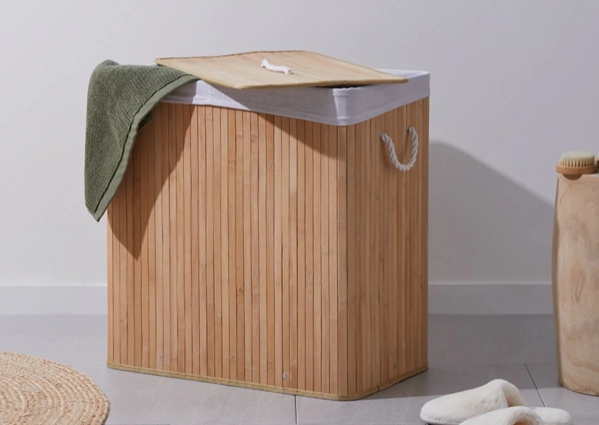
Identify the body, supporting structure and fabric components separately. A bamboo slat shell surrounds the laundry; a bamboo frame supports a fabric bag. A fabric hamper with bamboo handles is another construction, even when all three appear under the same product category.
Great Shine’s bamboo basket range lists the configurations below. Use the listing name to identify a starting option, then confirm its component specification on the quotation and sample. The range listing does not establish current stock availability.
| Construction to compare | Configuration listed in Great Shine’s range | Selection and packing questions |
|---|---|---|
| Bamboo shell with a fabric liner | Foldable Bamboo Laundry Basket; Removable-Liner Bamboo Hamper | How do the shell, rim and base hold their shape? Which parts detach or fold? Check protection for slat edges, the rim and any separate base. |
| Bamboo frame supporting a fabric container | Collapsible Bamboo-Frame Laundry Hamper; Large Bamboo-Frame Laundry Hamper with Lid | How is the frame assembled and secured in use? Does the bag detach before folding? Confirm fasteners, instructions and the complete packed size. |
| Fabric hamper with bamboo handles | Double Laundry Hamper with Bamboo Handles | Confirm the material that supports the walls and base, how compartments are formed and which handles carry which parts. Check whether liners pack separately or remain installed. |


A divided design adds a sorting function, but it also changes usable space and emptying. Ask whether each compartment has a separate removable bag or whether a fixed partition divides one container. Review whether a customer can empty one section without disturbing the other.
Check the construction in its empty, partly filled and intended loaded states. A product photo with a full bag may conceal a rim that collapses when empty. Ask the supplier to demonstrate the folding or assembly sequence, including loose parts, rather than relying on the word “foldable.”
For a bathroom-oriented range, define the permitted environment during development. The base may touch a damp floor even when the sides avoid splashes. Ask for care guidance covering the bamboo, joints, finish and liner. A lid or surface coating alone does not establish waterproofing, odor control or antibacterial performance.
Specify dimensions and usable capacity
Record the assembled external dimensions, usable interior and folded dimensions separately. Add the retail-pack dimensions once the packaging method is selected. A description such as “large capacity” cannot tell the buyer whether the hamper fits beneath a counter or whether its filled liner can be removed.
Use a sample drawing or photograph with the front face identified. Mark these measurements and ask the supplier to return the actual sample results:
- External width, depth and closed height, including projecting feet, handles and lid edges where relevant.
- Usable internal dimensions with the liner, base and dividers installed, plus the size of the opening.
- Space needed to open or remove the lid and lift the filled liner out.
- Folded dimensions of the complete product, with the location of the lid, base and loose components specified.
- Dimensions of one complete retail pack and the external dimensions of the closed master carton.
For a round model, identify diameter and height instead of forcing its shape into an unclear width-by-depth description. Use one measurement unit as the controlling reference and agree on the permitted variation and measurement condition.
Check the space needed to use the basket
A closed hamper may fit below a shelf while its lid cannot open there. Decide whether the customer must pull the basket forward before emptying it. Include that movement in the sample review, especially if the design will be positioned as suitable for narrow rooms or under-counter storage.
Measure the liner opening and review removal with representative contents within the proposed load limits. A full fabric bag can become wider than its empty shape. Hinges, a narrow rim or dividers may obstruct it even when the basket has enough internal volume.
If the product will carry a liter-capacity claim, agree on the usable fill level and how capacity will be determined. External width × depth × height describes a bounding box, not necessarily usable capacity. Volume also does not establish a safe lifting weight or the number of washing-machine loads.
For divided baskets, state each compartment’s usable space where it matters to the product offer. An evenly divided outer body does not guarantee equal liner capacity. Record the actual dimensions for the selected model before approving product artwork.
Check the liner, lid and handles
Assess these parts through the customer’s likely movements: adding laundry, releasing the liner, carrying it where permitted and putting it back. A removable liner is useful only if its attachment, opening and care method suit that routine.
Buyer checklist for the liner
- Confirm the fiber composition and construction. A bamboo frame does not mean the liner is bamboo-derived fabric.
- Identify the fixing method, such as ties, tabs, sleeves or a rim attachment, and check how it releases.
- Remove the liner with the agreed contents inside. Look for catching, excessive pulling or the need to dismantle the frame.
- Check the seams at the base, attachments and any carrying handles. Confirm which parts are intended to support a load.
- Obtain separate wash and dry instructions for the liner. If it is sold as washable, agree on a wash-care check and inspect fit and refitting afterward.
- Confirm whether replacement liners are available for that model if they are part of the intended retail offer.
The surrounding basket and inner bag may need different care methods. A washable liner does not make the bamboo structure washable. Check how the user reaches the base and corners for cleaning, and whether the liner can be refitted dry without stretching or twisting.
Retain moisture guidance in the retail instructions where it applies. A closed hamper is not a drying system for wet towels. Ask the supplier to define suitable contents, placement and cleaning for the selected construction, instead of inferring performance from ventilation gaps or the bamboo name.
Lid operation and carrying points
Check whether the lid is hinged, loose or attached by a fabric connection. Open and close it in the intended placement. Review alignment, grip, movement at the connection and whether it interferes with liner removal.
Distinguish outer-basket handles, liner carrying handles and small attachment loops. They may perform different jobs. If a liner loop only holds the bag against the frame, it should not be presented as a carrying handle.
For any carrying claim, agree on a finished-product evaluation: the load, its distribution, lifting method, number of repetitions and acceptance criteria. Check the surrounding fabric or bamboo joint as well as the handle itself. Do not assign a carrying limit from a photograph or transfer a rating from another model.
Compare retail packaging requirements
Compare packaging for the complete selling unit. An assembled basket, a folding shell and an unassembled frame can require different protection and customer instructions. Compact product construction does not establish a particular freight saving until the actual packed dimensions and weights are confirmed.
For an assembled product, review how the pack supports the shape and protects the lid, edges and handles. For a folding product, confirm the folding direction and where the liner and base sit. For a product supplied in separate parts, check that fittings remain contained and that instructions match the parts in the box.
Use this packaging specification table for each model. Enter the selected requirements and ask the supplier to confirm exceptions before approving the pack.
| Packaging field | What to specify or request | Buyer requirement / supplier confirmation |
|---|---|---|
| Selling-unit contents | Basket or frame, liner count, lid, base, dividers and every included fitting | |
| Condition on arrival | Fully assembled, folded or supplied as separate parts; state required customer assembly | |
| Folding or assembly reference | Approved sequence, illustrated instructions and any tool requirement | |
| Protection | Protection for corners, bamboo edges, lid, finish and hardware; separate parts that could rub | |
| Retail presentation | Selected bag, sleeve or box; artwork revision; visible product information | |
| Labels and barcode | Correct SKU data, placement, scan requirement, care information and intended language | |
| Retail-pack measurements | Finished packed dimensions and gross weight for one complete selling unit | |
| Master carton | Units per carton, packing layout, closed external dimensions, gross weight and marks | |
| Transport review | Agreed evaluation suited to the distribution route and inspection of the unpacked product |
For online retail, establish whether the retail box is also intended to ship directly to the customer or needs an outer pack. For store supply, follow that retailer’s actual display and receiving requirements. A generic claim of “retail-ready packaging” does not define either arrangement.
Request photographs of the completed pack, the parts before packing and the carton layout. Check that the photos and measurements refer to the same model and revision. Packing quantity and container loading should be calculated from confirmed data for the selected order.
Inspect the sample before a bulk order
Inspect the sample against a written specification and the intended use. Record actual findings, photographs and unresolved changes. Agree on acceptance criteria before the review so that “good quality” does not become the only pass/fail instruction.
The following checks help structure that discussion. They are proposed buyer checks, not a report that a Great Shine model has already passed them. Sample quantity, test conditions and production inspection arrangements need separate agreement.
| Inspection item | How to check the sample | Standard to agree with the supplier |
|---|---|---|
| Bamboo edges and surfaces | Inspect exposed edges, underside, rim and areas contacting the liner; check for splinters, rough patches and damage | Approved edge finish, unacceptable defects and reference photographs |
| Joints and fasteners | Assemble according to the instructions and inspect connections for gaps, looseness or missing fittings | Correct hardware, secure assembly and permitted joint variation |
| Stability and support | Place the basket on a level surface; review it empty and with agreed representative contents | Setup, loading arrangement and acceptable movement or deformation |
| Dimensions and access | Measure at the specified points; open the lid and remove the liner in the target space | Dimensional ranges, measurement condition and required clearances |
| Liner seams and attachment | Inspect seams and fixing points; remove and refit the bag with agreed contents | Seam and attachment requirements, usable removal method and defect criteria |
| Liner care and refitting | If a washable claim is intended, use the agreed care procedure and check fit afterward | Wash and dry conditions, evaluation extent and acceptable change in fit or appearance |
| Lid and closure | Operate the lid through the agreed review sequence and inspect its connection | Alignment, opening method, operation count and acceptable condition afterward |
| Handles and lifting | Evaluate only the designated carrying points using an agreed load and handling procedure | Supported component, load, distribution, repetitions and failure criteria |
| Folding and complete assembly | Fold, unpack and reassemble as intended; compare included parts with the packing list | Repeatable instructions, complete hardware and correct final support positions |
| Packaging and unpacked condition | Check the approved pack and examine the product after any agreed transport evaluation | Packing arrangement, evaluation method and acceptable product and pack condition |
Separate natural variation in color or grain from unacceptable damage. Agree on reference samples or photographs for appearance, especially where multiple baskets will be displayed together. A finish sample may help define color, but the completed basket still needs inspection for joints, edges and operation.
If a sample arrives with an unusual odor, damp areas or visible damage, document the condition and ask for investigation before approval. An odor by itself does not identify a cause or verify a material claim. Review packing, storage and product care alongside the findings.
Record agreed changes in a dated specification and identify the approved sample. Review affected checks after a change to the frame, liner, finish or packaging. Use the approved version as the reference for the bulk inspection agreed with the supplier.
Prepare a comparable RFQ
Send each supplier the same configuration and ask them to identify deviations. A quotation for a bamboo shell, removable liner and retail box cannot be compared directly with one covering only a fabric hamper and basic bag packaging.
Copy the following request into your inquiry and add the model-specific details or attachments:
Please quote a wholesale bamboo laundry basket for our retail range using the requirements below. Identify any missing information or proposed substitution before pricing.
- Product reference: model name, photographs or drawing, with the bamboo components identified.
- Intended use: stationary collection, sorting or transport; target placement and expected contents.
- Construction: shell or frame, base support, compartments, assembly and folding method.
- Dimensions: assembled exterior, usable interior, opening and lid clearance, folded size and agreed tolerances.
- Order quantity: units per model, size and color; clearly define the contents of one retail unit.
- Liner: material, number of bags, attachment, carrying function and required care instructions.
- Lid and handles: construction, positions and the handling requirements to evaluate.
- Bamboo finish: color or finish reference, acceptable appearance variation and intended care conditions.
- Branding and packaging: logo position, artwork, inserts, instructions, barcode, retail pack and master-carton requirements.
- Destination: country, sales channel and relevant retailer documentation requirements.
- Sample review: requested sample configuration, dimensional report, agreed checks and approval process.
- Quotation basis: currency, price per complete retail unit, delivery terms, quote validity and separately charged work.
Please confirm the applicable minimum order quantity and estimated sample and production timing for this specification and quantity. Provide the proposed packing data and list any details that remain unconfirmed.
When the offers arrive, compare what is included before comparing unit prices. Check whether the liner, lid, hardware, instructions and branded packaging are included in each offer. Keep any alternative construction on a separate quote line so that a lower price does not conceal a changed product.
Review Great Shine’s wholesale bamboo laundry basket options to choose a starting configuration, then send the specification and packaging requirements for that model.
Confirm the packaging for the actual sales channel
For shelf retail, check how the shopper identifies the basket size and set contents without opening the pack. For parcel delivery, review the packed sample for movement and protection around rigid parts. For a multi-item offer, reconcile liners, lids and accessories with the advertised set. Agree any transport-test method and acceptance criteria before approving the pack.