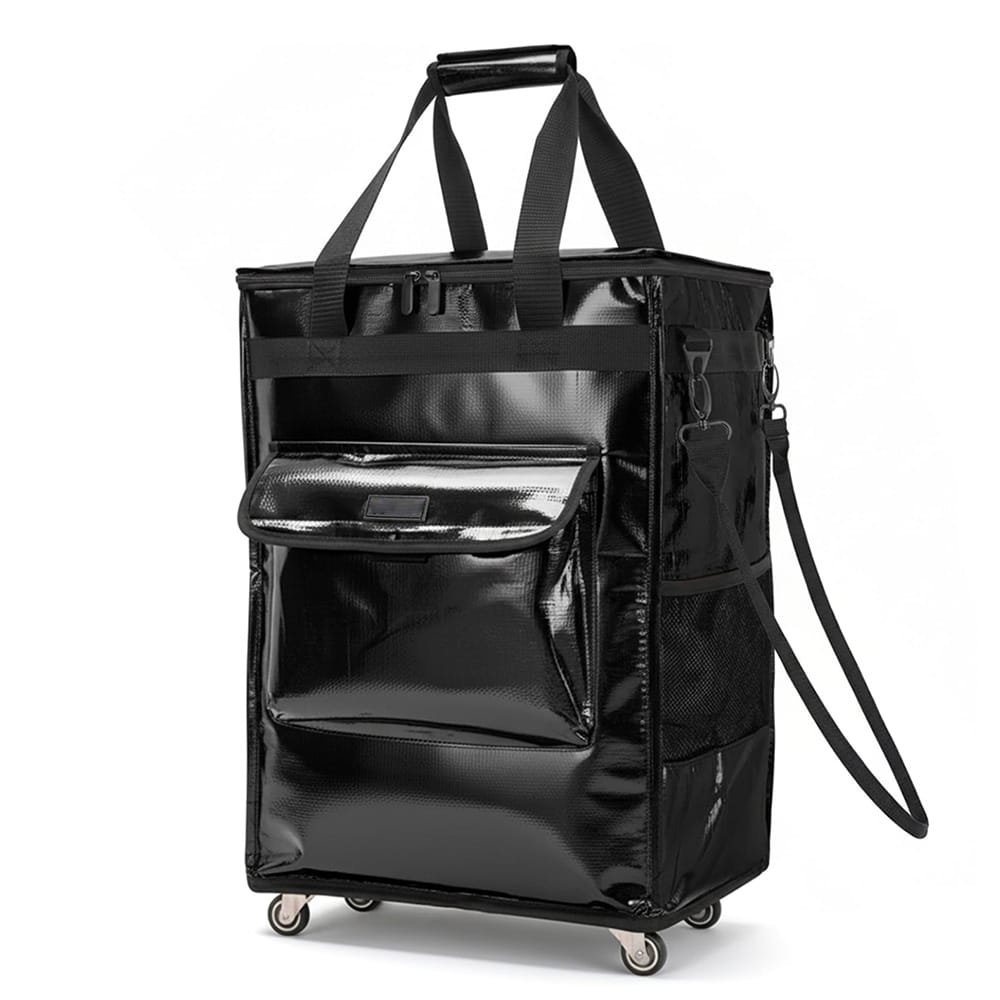
A wheeled reusable grocery bag, often called a shopping trolley, lets you roll groceries along suitable surfaces. Whether it helps depends on the route between the shop and your kitchen, including curbs, steps, public transport, and places where you must lift the bag.
Quick answer: Choose a wheeled grocery bag by its stated load limit, wheel and frame design, handle fit, and folded size. Plan for the difficult part of the journey before considering capacity. A larger bag is useful only if you can control it, lift it when needed, and store it between trips.
Check the route from shop to kitchen
Walk through your usual route in order. Note smooth pavement, uneven joints, narrow entrances, stairs, and the point where groceries move into a car or bus.
A bag that rolls comfortably across a shop floor may behave differently at a curb. Small obstacles matter because the user must either guide the wheels over them or lift the loaded product.
Consider the return journey with groceries inside. An empty demonstration does not show how a bag steers or balances under a representative load.
Think about unavoidable lifting
Car trunks, station steps, and building entrances can all interrupt a rolling route. Check whether the bag has an intended lifting method and whether the filled weight will be manageable for you.
With a detachable design, you may be able to lift the bag separately from the frame if the instructions allow it. Check both the loaded bag’s weight and its intended carrying points.
Plan smaller loads if the lifting stages would be difficult. The useful benefit of wheels is the carrying they replace along the parts of your route where the cart can roll.
Understand the main constructions
A fabric shopping bag with small integrated wheels differs from a trolley frame carrying a detachable bag. The supporting structure affects loading, parking, folding, and how the product transfers between surfaces.
A two-wheel design may be pulled at an angle, while some other layouts allow more upright movement. Follow the product’s intended handling method and check how it behaves at the angle you naturally use.
Check the base and the parked position
A bag should have a clear way to stand while you load or unload it. Look at the base, support foot, and any locking mechanism.
Unevenly placed groceries can change balance. A product that stands empty may lean when a heavy bottle is placed high or toward one side.
Keep the load within the instructions and stop if the assembly is unstable. Hanging extra shopping bags from the handle can alter the intended loading arrangement.
Treat stair-climbing designs as a separate choice
Some carts use wheel clusters or another mechanism intended for stairs. That feature needs to match the steps and the manufacturer’s instructions; an ordinary wheeled bag should not be assumed suitable for stair use.
Consider step depth, landings, available handrail access, and the need to control the loaded cart. A product label cannot establish that every staircase or user will be a good match.
For a walk-up apartment, this question belongs near the beginning of the decision. Large capacity will not help if the final flight of stairs makes the bag impractical.
Compare wheels and handle comfort together
Wheel diameter, tread, axle construction, and the complete frame influence how the bag rolls. “All terrain” is too broad to describe performance without stating the surfaces and conditions involved.
Look for information relevant to your route. Pavement joints, gravel, and wet surfaces create different demands, and a demonstration should reflect the claimed use.
The handle affects control too. Check the grip height while the bag is in its rolling position, not only while standing upright. A handle that feels comfortable when empty may be awkward after the load changes the angle.
Try a representative load where permitted
If a retailer provides a safe demonstration, assess normal starts, turns, and stops. Notice whether your heel contacts the cart and whether the bag tracks predictably beside or behind you.
A brief handling check is personal fit information, not proof of durability or an independent product test. For a stated load rating, rely on the product instructions and supporting product information.
Choose capacity you can use comfortably
Volume describes space; it does not establish the safe weight for the frame, wheels, bag, or handle. Dense groceries can reach a weight limit while much of the bag still looks empty.
Check the permitted load for the complete product and any separate bag component. Do not assume that adding reinforcement or replacing the bag preserves the original rating.
Think about the kinds of shopping you do. Bulky bread and paper goods occupy space differently from bottles, cans, and rice.
Leave room for a sensible packing order
Place suitable heavier items low and balanced, following the cart’s loading guidance. Keep fragile groceries where they will not be crushed and contain products that could leak.
The closure should work without pressing on the groceries or forcing a zipper around an overfilled top. A closed bag can help contain loose items, but it is not a substitute for correct loading.
For mixed shopping, a small separate bag may still be useful. One large compartment does not have to hold every type of purchase.
Keep chilled food a separate consideration
A shopping bag with wheels is not necessarily insulated. Even an insulated version needs a suitable cold-packing routine when transporting perishable foods.
Look at the lining and the stated intended use, then plan cold sources and transport time accordingly. Do not infer food-temperature performance from the thickness of the outer fabric or a reflective-looking surface.
If your shopping route includes other errands, account for the time groceries remain out of refrigeration. Use adequate cooling and put perishables away promptly on arrival. USDA’s food transport guidance explains the time limits for perishable food outside refrigeration.
Check rain protection without assuming waterproofing
Water-resistant fabric can offer limited protection under specified conditions, while seams, openings, and the base may allow water through. A zipper or top flap does not automatically make the complete bag waterproof.
For a route exposed to rain, ask what the product description actually promises. Keep items needing reliable water protection in suitable separate packaging.
After wet use, empty the bag and dry it as directed. Folding it while damp can leave moisture in the fabric and around the frame.
Measure the folded product before choosing it
A folding frame still has a footprint. Compare the complete folded dimensions with the cupboard, car space, or hallway location where it will stay.
Check which parts need removing and how they are stored together. A detachable wheel or bag can be convenient, but only if the additional handling fits your routine.
Open and close the mechanism according to the instructions. Keep fingers clear of folding joints and verify that required locks or supports are engaged before loading.
A bag that is difficult to retrieve may get left at home. The most useful storage position is one you can reach easily before an ordinary shopping trip.
Clean the bag and running parts as instructed
The bag, frame, and wheels may require different care. A removable fabric part is not automatically machine washable, and a wipeable lining does not establish that the whole assembly can be soaked.
Remove crumbs and inspect the inside after shopping. Address spills with the permitted cleaning method, and let the bag dry before storing it closed.
Check wheel areas for trapped debris and inspect handle connections or fastenings when the product is empty. If a part is damaged, use the manufacturer’s repair or replacement guidance rather than continuing to load it normally.
When might an ordinary tote be more convenient?
A short trip for a few light items may not justify the bulk of a frame. A tote can be easier to fold into a pocket or carry inside another bag.
A wheeled design becomes more relevant when rolling opportunities are frequent and its lifting requirements are manageable. The decision depends on the route and load, not on a universal claim that wheels are always easier.
For a reusable product, ease of storage and maintenance matters too. Choose a bag you are likely to bring on ordinary trips and can keep in usable condition.
Frequently asked questions
Can a wheeled grocery bag carry heavy shopping?
Only within the stated limits for the complete product. Check the frame, bag, and intended handling guidance, and consider what you can manage at curbs or lifting points. A large volume does not establish a high weight capacity.
Can I pull an ordinary trolley up stairs?
Do not assume that use is supported. Check the specific product instructions and the staircase conditions. Stair-climbing designs have different mechanisms, but they still need appropriate use and control of the loaded cart.
Is a detachable bag useful?
It can help when transferring shopping, cleaning, or storing the product. Check how it attaches and whether it is intended to be carried separately while loaded. Detachable does not automatically mean washable or suitable for every lifting method.
Will the wheels work on gravel?
That depends on the wheel system, load, and surface. Ask for product information relevant to loose ground. Avoid general all-terrain assumptions based on a smooth-floor demonstration.
Does an insulated trolley keep groceries cold all day?
No duration can be assumed from insulation alone. The contents, cold sources, weather, openings, and complete construction affect temperature. Use a cold-packing plan suitable for the food and journey.
What should I compare first?
Compare route suitability, lifting requirements, stated load, and folded storage size. Then assess pockets, appearance, and other details. Those first checks determine whether the product will work for your ordinary shopping routine.
Explore the relevant cart structures
Great Shine’s rolling shopping bag and trolley range includes several cart directions. Compare their structures with the route you need to cover, and confirm model-specific load, folding, and care information before making a selection.