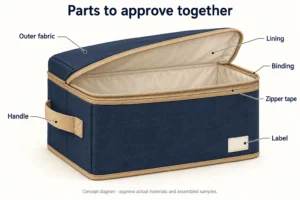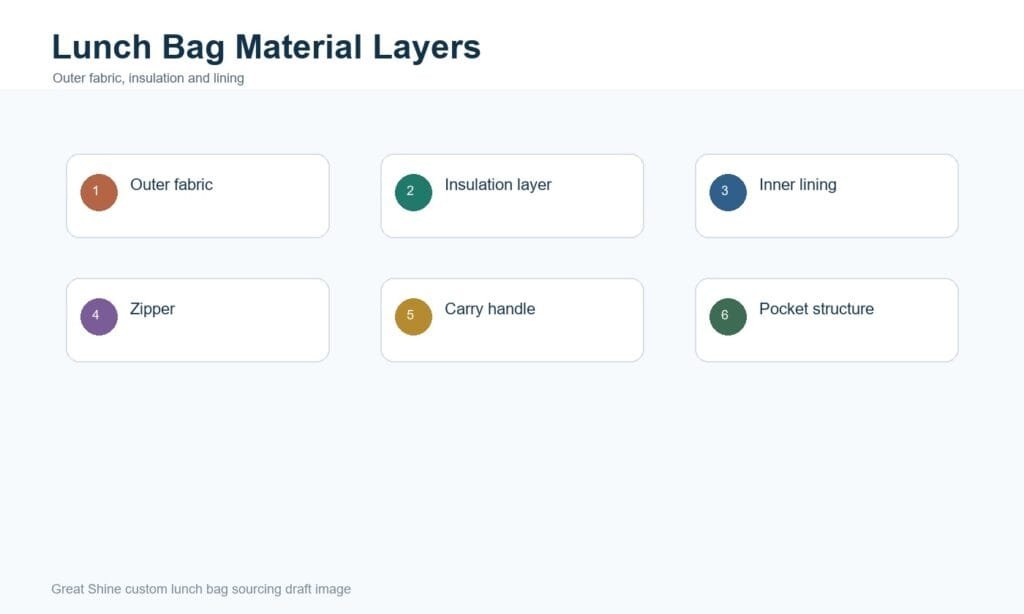
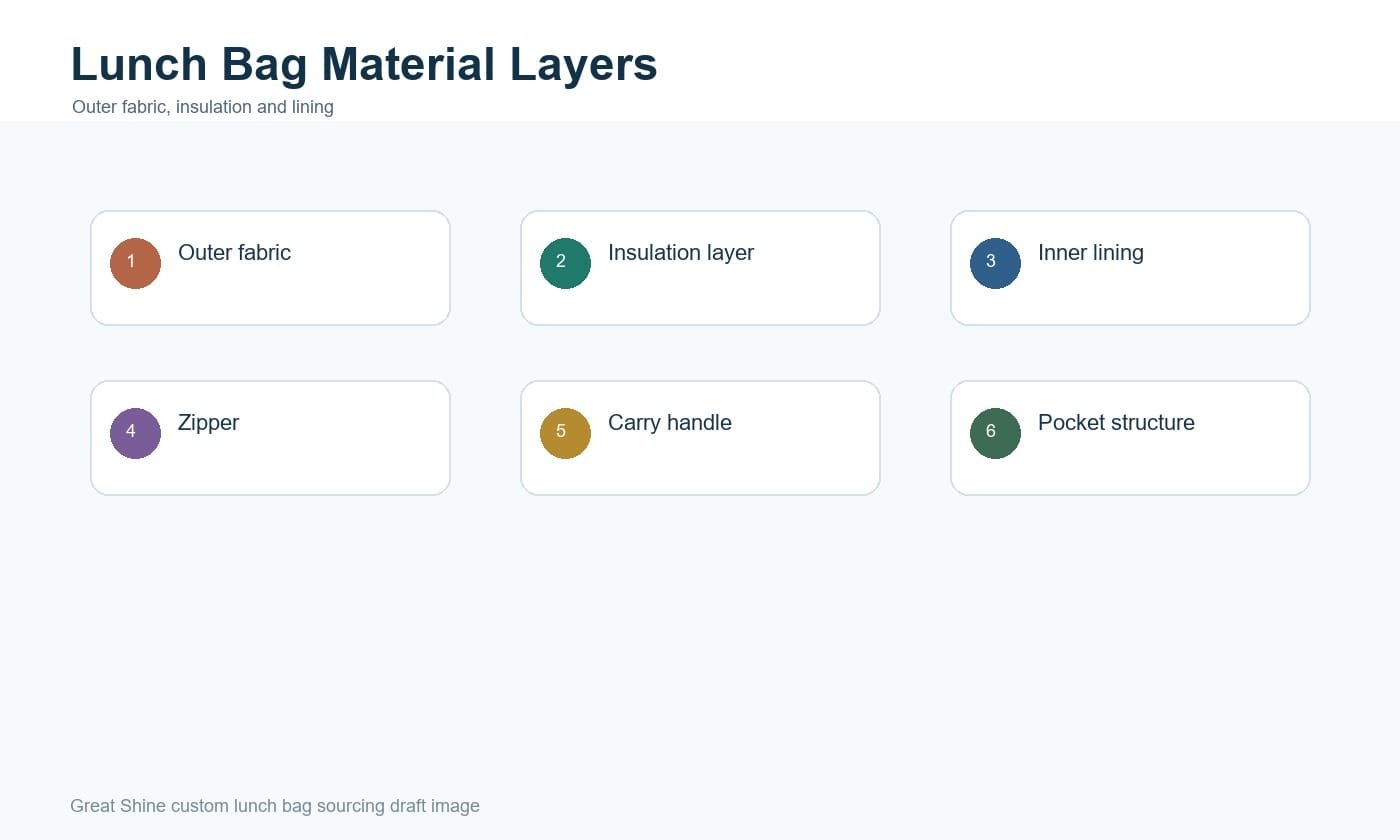
An insulated lunch bag usually combines an outer fabric, a foam insulation layer and an inner lining. Polyester is a common outer fabric; PE foam provides insulation, while PEVA or a foil-faced laminate forms the interior surface. These layers do different jobs. A shiny lining alone does not tell you how long the finished bag will keep its contents cold.
Lunch bag materials at a glance
| Part | Common options | What to check |
|---|---|---|
| Outer fabric | Polyester, including Oxford constructions; canvas or textured fabric for selected designs | Fiber composition, fabric weight, coating, cleaning instructions and logo finish. |
| Insulation | PE foam; the specification may identify expanded PE (EPE) | Foam type, thickness and coverage, including the lid and base. |
| Inner lining | PEVA film or a foil-faced laminate | Exact material, backing, seams, cleaning method and resistance to repeated folding. |
| Closure and handles | Zipper or flap closure; fabric or webbing handles | Opening width, gaps at the closure and attachment strength under the intended load. |
Use this as a construction guide, not a fixed Great Shine specification. Material availability and the complete layer combination should be confirmed for the selected design.
Choosing the outer fabric
Polyester and Oxford fabric
Polyester describes a fiber. Oxford describes a fabric construction, so the two terms can appear in the same specification. A description such as “600D Oxford” is incomplete without the fiber, coating and other material details. Denier describes yarn size; it does not directly state fabric weight, waterproofness or the life of the finished bag.
For a printed promotional bag, review the logo on the actual fabric and coating. For a bag that will be wiped frequently, inspect the surface after cleaning. A water-resistant outer fabric also needs suitable seams and closures before the whole bag can make a water-resistance claim.
Canvas, corduroy and other textured fabrics
These fabrics can suit a softer tote or a more tactile retail design. Ask for the fiber composition and care instructions: “canvas” and “corduroy” do not identify every material in the fabric. Check whether spills leave marks and whether the selected printing or embroidery method stays clear on the texture.
A recycled-polyester option should come with documentation supporting the intended recycled-content claim. Recycled content alone does not establish insulation performance, food-contact suitability or finished-bag durability.
PEVA lining versus aluminum foil lining
PEVA is a polyethylene-vinyl acetate material used as a flexible interior liner. A smooth liner can be wiped after a spill, but liquid can still escape through an unsealed seam or a zipper. Check the assembled lining as well as the film.
“Aluminum foil lining” is often used as a broad product description. Ask whether the proposed material contains actual aluminum foil or a metallized film, and what it is laminated to. The reflective face, backing and adhesive together determine how the laminate behaves when folded and cleaned.
| Option | Useful feature | Sample check |
|---|---|---|
| PEVA lining | A smooth interior surface that can be used in a wipe-clean construction. | Inspect corners and seams; wipe a representative spill using the proposed care method. |
| Foil-faced lining | A reflective surface that can form part of an insulated laminate. | Check the backing and inspect for cracking, peeling or wear after repeated folding. |
| Either option | Can be combined with a separate foam layer. | Compare complete bags under the same conditions before making a temperature-retention claim. |
Neither name alone proves that the material is suitable for direct contact with unpackaged food. Define whether the bag carries closed food containers or has a direct food-contact role, then obtain documentation for the actual material and intended use.
What the insulation layer does
Foam helps slow heat transfer through the bag. Its material, thickness and continuity matter, as do the opening and the amount of insulation compressed at seams. A thicker layer also takes up internal space and changes how the bag folds.
Reflective insulation reduces radiant heat transfer and depends on its assembly. The U.S. Department of Energy explains that a reflective surface needs an adjacent air space. That general principle is not a performance rating for a lunch bag. A silver-colored lining is not enough evidence for a “keeps cold for X hours” claim.
For a published construction example, Thermos lists polyester, closed-cell PE foam and a heat-sealed PEVA lining for its Lunch Lugger cooler. This illustrates how a brand specifies separate layers; it is not evidence of Great Shine’s materials or results.
How to compare two lunch bag samples
Put the same containers and cooling packs in each bag. Record the starting temperature, ambient conditions, load, pack placement and opening schedule. Agree on the measurement method and acceptance criterion before testing. Changing these conditions makes a temperature-retention comparison difficult to interpret.
- Check the lid and base as well as the side walls for insulation coverage.
- Open the bag fully and load the intended lunch box without forcing it through the zipper.
- Inspect seams and corners for gaps. If spill containment is required, define a separate leak check for the finished bag.
- Follow the proposed cleaning instructions, let the bag dry and inspect the liner and decoration afterward.
Choose the structure around the intended use
| Use | Design priority | Decision before sampling |
|---|---|---|
| Daily office lunch | Fit the lunch box and cooling pack; make the interior easy to reach. | Measure the loaded interior and specify the cleaning method. |
| Retail lunch tote | Balance fabric appearance, carrying comfort and usable space. | Approve the decorated fabric and a fully loaded sample. |
| Promotional program | Keep the logo readable and the construction consistent across the order. | Review the print proof, agreed material specification and packing format. |
| Larger lunch cooler | Support the load and provide access to multiple containers. | Check handle attachments, opening width and insulation coverage. |
Great Shine’s custom insulated lunch bags page is the next step for discussing the design and customization. For broader cooler formats, see our cooler and insulated bag range.
What to include in a material brief
- The actual lunch-box dimensions, cooling-pack size and intended load.
- Outer fabric composition, color, coating and logo artwork.
- Foam type and proposed thickness; lining construction and seam treatment.
- Cleaning requirements and any performance claim that needs testing.
- Quantity, destination market, packaging and target cost.
You can send a product brief to Great Shine with a reference photo and these details. Confirm the selected materials and sample requirements in writing before production.
Frequently asked questions
Is a fabric lunch tote always insulated?
No. A fabric outer shell does not identify the layers inside. Check whether the bag includes insulation and where that layer is fitted.
Does PEVA lining make a lunch bag leakproof?
No. The lining film, seam construction and closure must work together. A stitched corner or ordinary zipper can remain a leak path even when the film itself resists water.
Can I put a lunch bag in a washing machine?
Use the care instructions for the complete bag. A washable outer fabric does not establish that the foam, laminate, adhesive or decoration can tolerate machine washing.
Which lunch bag material is best?
Choose the full construction around the containers, cleaning needs, carrying load and required performance. Compare samples with the same load and conditions rather than choosing from a lining name alone.