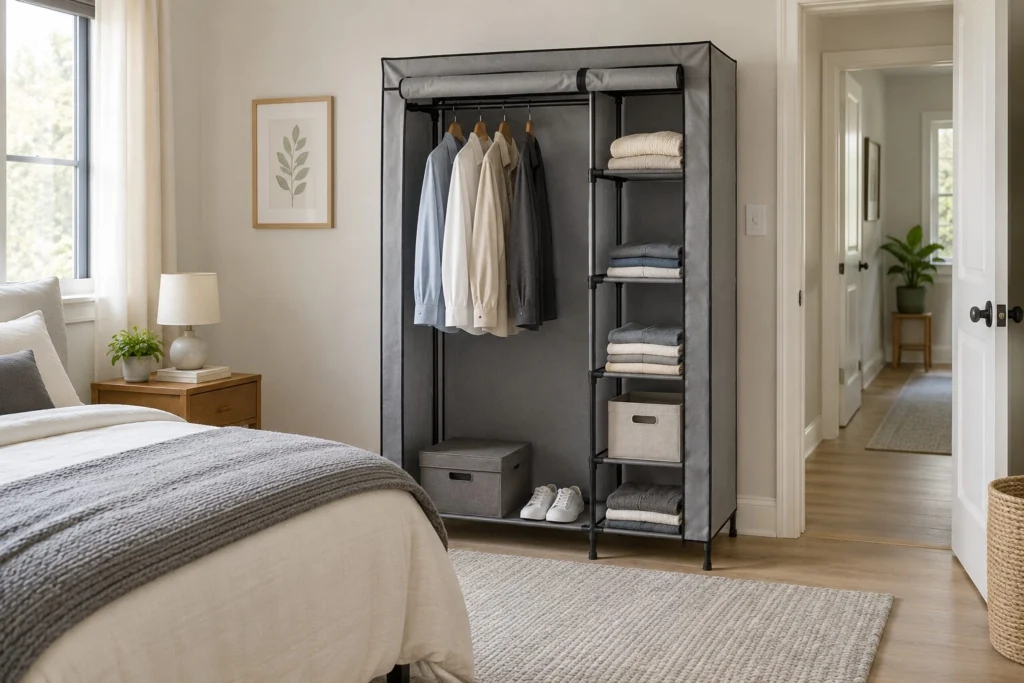
What Is a Portable Closet? Types, Uses, and Everyday Basics
A portable closet is a separate clothing-storage unit that you can set up without building a closet into a room. It usually provides a hanging rail, shelves, or both. Some designs have a fabric cover; others leave clothing visible on an open frame. Depending on the model, the unit may come apart for transport, fold for storage, or move on wheels.
Quick answer: A portable closet can add clothing storage to a bedroom, rental home, dorm room, or temporary living space. Choose a layout with enough usable space for your clothes, and check the support structure and installation instructions. Portability may mean taking the unit apart for transport; only move a filled closet if its manufacturer permits that use.
What makes a closet portable?
A portable design gives you some way to relocate or put away the storage unit. That could mean separating its frame into short sections, folding a rack, or rolling a model designed with casters. These are different forms of portability.
A lightweight fabric wardrobe may be easy to carry home in a compact box yet awkward to move after assembly. A rolling rack may be convenient within one room but too large to take through a narrow doorway without unloading it.
Think about the move you actually need to make. Bringing a flat-packed wardrobe to a new apartment is a different task from moving hanging clothes between rooms every week.
Portable, freestanding, and temporary describe different things
A freestanding closet has its own supporting structure instead of relying on an existing closet rail. Some freestanding units still require a wall restraint, so the term does not mean that all installation hardware is optional.
A freestanding wardrobe can also be a substantial cabinet with rigid doors. It may stand independently but remain difficult to dismantle or move. Freestanding is therefore a broader description than portable.
Temporary describes how you plan to use the product. A closet bought for a short rental still needs to suit the clothing and room conditions. A short period of use does not make an unsuitable structure more capable.
A portable closet is not a travel garment bag
A garment bag encloses clothing and usually needs a hanger, rail, or another support. A portable wardrobe closet includes the structure that creates a place to hang or arrange clothes.
This distinction matters when looking at photographs. A fabric cover hanging from a built-in rail might resemble a small wardrobe, but it does not create a freestanding storage space by itself.
Check what comes in the package. A replacement cover, a hanging organizer, and a complete closet can appear in similar search results even though they solve different problems.
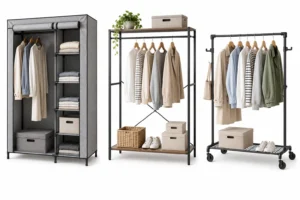
What are the main types of portable closets?
The most useful distinctions are whether the unit has a cover, how it supports clothing, and how it moves or packs away. Several features can appear together in one design.
Fabric-covered wardrobes
A fabric-covered wardrobe surrounds a frame with a textile enclosure. A zippered or overlapping front gives access to the clothes inside, and some covers can be rolled up and held open.
The cover keeps the contents out of sight and can reduce their exposure to settling dust. Its protection depends on how fully it closes and where openings remain. A fabric enclosure should not be assumed airtight, waterproof, or pest-proof.
Inside, there may be one long hanging space, separate hanging sections, shelves, or a mixture. The shape visible from outside does not tell you how the interior is divided.
This format can suit a bedroom where you want clothing stored together without a permanently open display. Consider how often you will open the cover and whether the doorway gives enough access to both ends of the rail.
Open closet racks
An open closet rack leaves the hanging rail and shelves exposed. You can see the contents immediately and reach clothing without opening a cover or door.
That makes it easy to find frequently used items, but it also makes the contents part of the room’s appearance. Empty hangers, mixed storage boxes, and long garments remain visible.
An open design does not provide an enclosure around clothes. If you want coverage for an occasional-use jacket or dress, an appropriate garment cover may be useful, provided it fits the storage arrangement.
Pay attention to the full footprint. Some racks have feet that extend beyond the hanging rail, and clothes on hangers can project beyond the frame shown in a front-view photograph.
Rolling wardrobes and garment racks
A rolling design has wheels intended to help move the unit. Whether it can move while loaded, which surfaces it can cross, and how its brakes work depend on the particular model.
Wheels are useful only when the route permits them. A carpet edge, threshold, tight turn, or narrow doorway can make a short move more complicated than the product image suggests.
A portable closet rack on casters also needs a suitable parking position. Follow the instructions for locking the wheels and securing the unit during use. A wheel brake and a wall restraint perform different functions.
If frequent movement is important, read the movement instructions before deciding on the design. Do not infer a rolling load limit from the product’s stationary capacity.
Knock-down and folding designs
A knock-down unit comes apart into components. A folding unit has an intended folding arrangement that reduces its size without necessarily separating every part.
These terms are sometimes used loosely in product descriptions. A wardrobe that can be disassembled may still take time to pack away, especially if its cover or shelves fit around several frame sections.
Look for a picture of the packed form and the relevant instructions. A small delivery carton does not prove that the assembled closet folds in one motion.
For occasional relocation, dismantling may be acceptable. For a room that must return to another use every evening, the time and space needed to put the unit away become much more important.
Modular storage with hanging sections
Some stand-alone closet systems combine connected panels or cubes with a hanging compartment. They can provide separate spaces for folded clothing, accessories, and suitable hanging garments.
The hanging compartment needs its own support arrangement. A layout made entirely of small cubes does not automatically turn into a wardrobe by removing a few panels and adding a rod.
Use only configurations the manufacturer permits. Moving a shelf or panel can change the structure as well as the appearance, particularly when that part helps keep neighboring sections aligned.
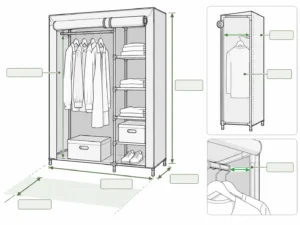
How does a portable wardrobe hold clothing?
The rail or shelf receives the clothing’s weight, while the frame and its connections carry that weight down to the floor. A cover usually provides an enclosure, although some designs also depend on fitted textile parts for their intended assembled shape.
Understanding the separate components helps explain why two similar-looking wardrobes can behave differently. A loose connector or poorly seated rail can affect the whole unit even when the visible tubes appear substantial.
The frame establishes the shape
Upright members set the height, horizontal members define the openings, and feet or a base establish contact with the floor. The exact arrangement varies between models.
Some frames use metal tubes with molded connectors. Others use different materials and joining systems. The description metal frame tells you little about the joints, bracing, or way the hanging rail is attached.
A photograph can show the layout, but the assembly instructions explain which parts must be present and how they connect. A back bar that looks unnecessary in a picture may have an important role in the completed structure.
The hanging rail supports a particular section
The rail needs to fit the hangers and provide enough usable length for the clothes. Its attachment points also need to remain correctly positioned during use.
A rail’s stated capacity applies to the conditions specified for that product. It does not describe the capacity of every shelf or mean that all the wardrobe’s weight can be concentrated in one place.
Avoid treating an unused rail or crossbar as a convenient hook unless the design allows it. An outside bag or accessory can put weight in a place that was not intended as storage.
Shelves support folded contents
Shelves may use fabric, mesh, panels, or another construction. Some rest on a surrounding frame; others connect through sleeves or supports that must be installed in a specific sequence.
Their useful capacity depends on the entire shelf assembly. A fabric shelf can look broad while having a lower stated limit than the rail above it.
Check whether the shelf has a removable insert and whether that insert belongs in a particular orientation. The completed shelf should match the manufacturer’s diagram before you add contents.
Connectors keep the components in position
Connectors may look similar while having different openings, angles, or attachment points. Substituting one for another can create an assembly that appears almost correct but does not align properly.
Keep the part list until assembly is complete. If a connector does not fit as shown, confirm the part and orientation before applying more force.
Once the wardrobe is in use, changes such as a newly loose joint or a leaning frame deserve attention. Remove the contents as needed and consult the manufacturer’s guidance instead of continuing to load a damaged or unstable unit.
Where is a portable closet useful?
A portable closet is useful when you need a defined place for clothing and have suitable floor space, but do not have enough built-in storage. It can also separate a temporary group of clothes from the main wardrobe.
A room without a built-in closet
In a bedroom with no closet, a portable wardrobe can provide hanging space that a chest of drawers cannot. A combined design may also offer shelves for items you normally fold.
Start with the clothing you use most. If much of it needs hanging, a unit divided into many small shelves may not solve the main problem, even if its total dimensions seem generous.
Leave a comfortable route beside the bed and through the doorway. Storage that fits into the room but blocks everyday movement can make a small bedroom harder to use.
A rental or short-term home
A unit that dismantles can be useful when you expect to move again. It allows you to bring the storage structure with you, subject to its disassembly instructions and condition.
Installation still matters. Check whether a wall restraint is required and whether your rental arrangement permits the necessary fixing. A no-tools frame does not establish that the complete installation needs no attachment to the wall.
Keep the instructions and label the parts when packing for a move. That small effort makes it easier to identify missing pieces before rebuilding the wardrobe in the next room.
Extra space for guests or household changes
A portable closet can give guests a place to hang clothes without clearing an entire permanent wardrobe. An open rack may be sufficient for a short stay if the room and clothing are suitable.
Think about the space when guests are actually present. An unfolded sofa bed, luggage on the floor, or a bedside chair may occupy the area that looked available beforehand.
If you plan to store the unit between visits, check its packed dimensions and the work involved in dismantling it. Those details affect whether it is practical to set up only when needed.
Seasonal clothing overflow
A covered wardrobe can keep a selected group of seasonal garments together. This can free hanging space in the main closet while keeping the stored items visible when the cover opens.
It does not solve an unsuitable storage environment. Clothing still needs appropriate preparation, care, and a suitable indoor location. A cover cannot make a damp room dry or turn a lightweight unit into outdoor furniture.
Seasonal storage also involves different clothes. Bulky coats use space and load capacity differently from light shirts, so consider the actual garments before moving a whole seasonal collection onto one rail.

How much room does a portable closet need?
It needs space for the frame, the clothes, and normal access. The stated width, depth, and height are the starting measurements, not a complete description of how it will occupy a room.
Measure the position at floor level
Measure the usable floor area, including the effect of baseboards, floor vents, radiators, and furniture legs. A wall-to-wall measurement taken above the furniture may overstate the space available to the wardrobe’s feet.
Include any projecting base or caster assembly. A rack’s feet can extend beyond the width or depth of the storage area visible higher up.
Mark the approximate footprint with removable paper or another method that will not damage the floor. Walk past it and open nearby doors to see how the room would work with the unit in place.
Leave room to reach the clothing
A covered wardrobe needs enough space to open its front and reach the back or sides. A zippered flap may roll upward, fold sideways, or hang down, depending on the design.
An open rack still needs access space. You must be able to slide a hanger, remove a garment, and place it back without constantly moving nearby furniture.
Think about the largest item you will retrieve. Pulling a winter coat out of a crowded rack takes more room than removing a light shirt from an almost empty rail.
Check usable hanging height
Measure from the rail to the first shelf, base, or other obstruction below it. The overall height of the unit includes parts that do not contribute to garment clearance.
Hang a representative long garment on the hanger you intend to use, then measure from the top of that hanger to the hem. Compare that measurement with the available internal space, allowing the garment to hang without bunching on the shelf below.
A design with two hanging levels may work for shorter clothes while leaving no uninterrupted section for a long dress. More rails do not always create more useful storage for your wardrobe.
Check depth with a real hanger
A hanger occupies space from front to back when placed on the rail, and the garment adds its own bulk. The cover should close without pressing tightly against the clothing.
Measure the hanger you actually use. Children’s hangers, broad coat hangers, and different garment shapes do not have identical space requirements.
On an open rack, clothing may extend outside the nominal frame depth. Include that projection when checking the route between the rack and another piece of furniture.
Look at the space between shelves
Shelf spacing affects how much you can stack and how easily you can remove an item. A tall compartment can hold a bulky article, while a shorter one may keep small stacks more manageable.
Look at each compartment’s opening and usable space. A low shelf partly obstructed by a crossbar may be inconvenient for a large storage box, even when the box fits within the frame’s overall dimensions.
If you already own bins, measure their external dimensions, including handles. They should fit through the opening and remain easy to pull out without pushing the surrounding frame.
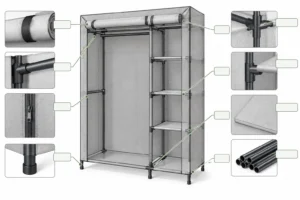
How much weight can a portable closet hold?
There is no single load limit for all portable closets. Use the limits for the exact model, including any separate figures for hanging rails, shelves, and the complete unit.
Read the capacity by component
Some manufacturers publish separate limits for different parts. For example, SONGMICS lists maximum static loads for each hanging rod and each shelf on its URYG092 product page. That shows the kind of distinction to look for; the figures for that model are not a general rule for portable wardrobes. SONGMICS product specifications
A combined capacity figure should not be interpreted as permission to place that entire load on one rail. Follow any distribution conditions and total limit given in the instructions.
If the listing provides only a large headline number, look for the detailed specification. Contact the seller when the relationship between the total and component limits is unclear.
Static capacity concerns stationary use
A static load description refers to the stated stationary conditions. It does not establish how the unit behaves while rolling, being lifted, or crossing an uneven surface.
Movement can also change the position of clothes and the forces on the structure. Read the movement instructions separately from the capacity information.
For a design that must be emptied before relocation, removing the clothes is part of using it correctly. Wheels or a light frame do not cancel that instruction.
Clothing counts are only rough illustrations
A claim that a rail holds a certain number of garments depends on their size, bulk, weight, and hangers. A row of light shirts differs from the same number of winter coats.
Even within a permitted weight limit, the clothes need enough room for normal access. A tightly packed rail can make removal difficult and press garments against a cover.
Use garment counts to visualize a layout, then check the actual space and published load limits. Stop adding contents if the unit develops a problem, even if your estimated total appears to be below a number in the listing.
What does a fabric cover protect against?
A cover provides a physical layer around clothing and can keep the storage area visually enclosed. How much protection it offers depends on the fabric, openings, seams, and the way you use it.
Everyday dust and visibility
A closed cover reduces direct exposure to settling dust, but openings around the frame or zipper may remain. Regular cleaning is still part of maintaining the storage area.
The front opening also affects how you use the product. A cover that you leave open throughout the day offers a different degree of enclosure from one kept closed between uses.
For a visible bedroom location, opacity may matter as much as dust coverage. A light or translucent fabric can show the outline of dark clothing, particularly when light comes from behind it.
Moisture and ventilation
A cover is not a drying system. Put away clothing in an appropriate clean, dry condition and use a location suited to textile storage.
Descriptions such as breathable and water-resistant refer to different properties. Neither tells you that the whole wardrobe can manage damp air, spills, or condensation in the surrounding room.
Avoid assuming that a cover makes a garage, basement, or outdoor area suitable. Consider the conditions in the actual space and the product’s stated use before moving clothing there.
Access and closure
A zipper or flap needs room to operate without catching on clothes. If you must press hard against the contents to close it, review the amount and placement of clothing.
Look at where the opening stops. A narrow opening can make the far end of a wide rail inconvenient, even when the wardrobe has plenty of internal space.
For frequent access, try to picture an ordinary morning: opening the cover, finding one shirt, removing it, and closing the front again. The product should suit that routine, as well as look neat when fully closed.
What do the material names tell you?
Material names explain parts of the construction, but they do not give a complete account of strength, care, or service life. Read the cover, frame, and connectors as separate components.
Non-woven, polyester, and Oxford fabric
Non-woven describes a textile structure made by joining fibers without conventional weaving or knitting. Polyester identifies a fiber material, while Oxford describes a type of woven construction. These labels do not all answer the same question.
A cover can therefore have both a fiber description and a construction description. A general statement such as fabric wardrobe may leave both unspecified.
For everyday understanding, focus on what the finished cover does: whether it closes comfortably, whether you can see the clothes through it, how it attaches, and how it should be cleaned. A technical-sounding fabric name does not answer those questions by itself.
Frame material and joints
A frame can combine several materials. The rails, legs, connectors, and feet do not have to share the same composition or function.
IKEA’s VUKU is one example: its product information identifies different materials for the clothes rail, legs, fabric, and connections. This illustrates why a single description such as metal wardrobe may not explain the full design. IKEA VUKU materials and care
Follow the instructions for the actual product. Do not assume that a connector can be replaced with a similar-looking part from a different wardrobe or that a missing brace is unnecessary because the unit stands without it.
Appearance and care are separate questions
A smooth cover may look easy to clean without being machine washable. A dark fabric may conceal some marks while still needing a suitable cleaning method.
Read the care label before removing the cover. Check whether the manufacturer permits removal and whether the cover can be reinstalled without dismantling other parts.
You do not need to become a textile specialist to use a portable closet. You do need care instructions that apply to the complete product you own.
How does it compare with a permanent wardrobe or dresser?
A portable closet creates accessible clothing storage with a structure that can be relocated in the way its design permits. A permanent wardrobe, dresser, and open rail provide different combinations of hanging space, enclosure, and furniture structure.
Compared with a rigid wardrobe
A rigid freestanding wardrobe often has solid panels and doors. Those features create a different appearance and enclosure from a fabric-covered frame, but the particular model still determines capacity and installation requirements.
A portable design may be easier to dismantle or transport in smaller pieces. The tradeoff can include more visible fabric, different access, or limits on how it should be loaded and moved.
Consider the room and expected use. Someone furnishing a home for a short stay may value a compact packed form. Someone planning a permanent bedroom arrangement may place more weight on the doors, finish, and available interior fittings.
Compared with a dresser
A dresser stores clothing in drawers and generally suits items that you fold. A portable wardrobe with a rail gives hanging garments a place of their own.
If most of your storage shortage involves socks, folded T-shirts, or small accessories, additional hanging length may not solve it. Shelves with suitable containers, or drawer storage, could be more useful for those contents.
The two products can also work together. Use hanging space for garments you intend to hang and a separate contained space for small items that would be awkward on an open shelf.
Compared with a simple clothes rail
A simple rail provides a place for hangers. A closet-style unit may add shelves, an enclosure, or divided storage, depending on the design.
Those additions occupy space and may add assembly or cleaning tasks. If you only need a place for a few frequently worn garments, a more elaborate wardrobe may provide features you seldom use.
An open rail can leave you looking for another place to store folded clothes. Lay out the items you need to accommodate and compare them with the proposed storage sections. A smaller unit with a suitable hanging area may be more useful than a larger one divided into short compartments.
What should you know before assembly?
Read the product’s own instructions before joining the first parts. Portable closets differ in the sequence used to fit shelves, textile sleeves, covers, and frame members.
Check the parts and the working area
Lay out the components where you can compare them with the parts list. Keep pieces with different lengths or connector shapes separate until you know where each belongs.
Allow enough room to handle the longest member and turn the partly assembled frame. The floor area needed during assembly can be larger than the wardrobe’s final footprint.
Check the destination before building in another room. A completed unit may not pass through a doorway or turn around a corner in the way you expected.
Follow the sequence for the model
Some textile components fit around frame sections during assembly. If you complete the frame first without checking the manual, you may have to take it apart to fit those pieces correctly.
Use the stated method for seating connectors or tightening fasteners. If parts will not align, recheck their labels and orientation instead of forcing the cover or frame into position.
Tool-free refers to the assembly method described for a particular product. It does not establish an exact assembly time, remove the need to read instructions, or determine whether the completed unit requires a restraint.
Inspect before filling
Confirm that the required parts are fitted and that the unit sits as intended on the floor. Operate the cover and check the rail and shelves before filling the wardrobe.
A crooked frame or a cover that will not close can indicate a misplaced part or another problem. Investigate before using stored clothes to hide or brace the issue.
Keep the manual and model information after assembly. They are useful when ordering a replacement component or setting up the wardrobe again after a move.
How do you use a portable closet safely?
Use the assembled unit within its stated limits, on a suitable surface, and with the restraints required by its instructions. Stability depends on the complete setup and how the contents are arranged.
The U.S. Consumer Product Safety Commission’s Anchor It guidance advises following the manufacturer’s instructions to secure furniture and keeping tempting objects off furniture tops where children may climb to reach them. Apply the installation guidance for your particular product and wall type. CPSC furniture tip-over guidance
Do not let children climb the rails or shelves, and do not use the unit as a step. Keep the surrounding route clear so clothing storage does not obstruct a doorway or normal movement through the room.
If an anti-tip device is required, being able to dismantle the closet does not make that device optional during use. In a rental, resolve the installation requirement before choosing the product.
Watch for changes after moving or rearranging the contents. A newly uneven stance, damaged connector, or bent part should be addressed before the wardrobe returns to normal use.
Ask the manufacturer about damaged or missing components before attempting a structural repair. A specified replacement helps preserve the intended connection between parts; a similar-looking piece may fit without performing the same function.
How should you arrange clothes inside it?
Arrange the interior around access and the product’s load instructions. Grouping clothes is useful when you can remove one item without pulling on the cover, shifting a large stack, or disturbing an overloaded section.
Give long garments a clear drop
Use the longest uninterrupted hanging section for garments that need it. Check the hem after placing boxes or shoes underneath, since those additions reduce the clear space below the rail.
If a garment bunches against a shelf, moving it to a shorter hanger may not solve the layout problem. Check the actual length of the garment and the available hanging section together.
Keep the rail accessible enough to slide hangers. A gap that allows you to select a coat is useful space, even though it does not appear as extra capacity in a tightly packed photograph.
Keep small items contained
Small accessories can disappear behind folded clothes or fall from an open shelf. A suitable lightweight box or organizer can keep them together, provided it fits and remains within the shelf’s limits.
Include the container’s own weight when considering the shelf load. Check that its handle can be reached and that you can remove it without catching on the frame.
Avoid hanging additional storage from a crossbar or the outside of the wardrobe unless the manufacturer permits that arrangement. Accessories can change both the weight and its position.
Separate daily access from occasional access
Put frequently used clothes where the opening gives comfortable access. Items used less often can occupy another suitable compartment without blocking the daily routine.
This does not require filling every available gap. A little working space can make the contents easier to see and return to their place.
After using the wardrobe for a few days, notice which actions feel awkward. If the same stack is always in the way, adjust the contents within the permitted layout before adding more organizers.
Can you clean, move, and store it between uses?
These tasks depend on the design and care instructions. A removable cover may have restricted washing options, and a closet that packs into a small box may still need careful dismantling.
Cleaning the cover and frame
Follow the care label for the cover and any separate textile shelves. IKEA’s VUKU instructions, for example, say not to wash the product while allowing its bottom to be cleaned with a damp cloth. This is a model-specific example of why cleaning guidance should not be inferred from the word fabric. IKEA VUKU care instructions
Avoid soaking a cover or putting it in a washing machine unless its instructions permit that method. Coatings, seams, closures, and fitted dimensions can affect the appropriate care.
Clean accessible floor space as part of the routine. Dust can collect beneath or behind the unit even when the cover itself appears clean.
Moving an assembled unit
Check whether the manufacturer allows movement while loaded. If the guidance is unclear, ask before trying to carry or roll a filled wardrobe.
Never use the fabric cover as a lifting handle. Follow the designated handling method and avoid dragging a non-rolling frame by its rail or pushing it across a surface to make it move.
Check the route first, including door width and changes in floor level. After relocation, inspect the assembly and restore any required restraints before loading or using the closet again.
Packing it away
Use the intended disassembly or folding sequence. Keep fasteners and connectors labeled so similar pieces do not become difficult to identify next time.
Put away clean, dry components in conditions appropriate to the materials. Fold the cover as directed and avoid trapping sharp frame ends against it during packing.
Before the next assembly, compare the contents with the parts list and inspect their condition. Store the manual with the components so you can identify the correct replacement if a piece has been lost or damaged.
How can you tell whether a design suits your room?
Start with one specific storage problem and picture the unit in normal use. This keeps the decision focused on the clothing and space you have instead of an idealized product photograph.
Example: a bedroom with little hanging space
Suppose your room has drawers for folded clothes but nowhere convenient to hang shirts and jackets. A rail-focused portable closet may address the missing function without adding many shelves.
Measure the position beside the existing furniture and check hanger depth. If a covered model closes across the same space needed to pass the bed, the location or design needs to change.
In this situation, the useful features are accessible hanging length, sufficient garment clearance, and an appropriate installation. A high shelf count does not address the main shortage.
Example: a multipurpose guest room
Suppose a room is normally a workspace but occasionally hosts visitors. You need clothing storage during visits and an unobstructed room afterward.
A suitable folding or dismantling design may help, but examine the packed form and instructions. Decide where the components will be stored between visits and whether assembly is practical in the available space.
Also check the room with the guest bed open. A closet that fits beside a folded sofa may block access when the room changes function.
These are planning examples, not performance claims for a particular model. They show how the same product category can suit different needs when the layout matches the room.
What should a product description make clear?
A useful description identifies the design, usable dimensions, component load limits, and care requirements. It should also show what arrives in the package and how the complete unit is installed.
Before deciding, look for:
- The assembled footprint, including projecting feet or wheels.
- Internal hanging height and the arrangement of shelves.
- The cover opening and whether the pictured cover is included.
- Separate limits for rails and shelves, plus any overall limit.
- Installation requirements, including restraints where specified.
- Cleaning guidance and the permitted method of relocation.
Read the dimensions beside a clear diagram. A package measurement describes the delivery box, while an assembled measurement describes the product in use. They answer different questions.
Pay attention to the exact version shown. A product family can include open racks, covered models, and several sizes with different arrangements. A photograph of one version should not be used to infer the capacity of another.
If a listing describes a closet as heavy-duty, ask what documented dimensions or limits support that description. The adjective alone does not tell you whether it suits a particular collection of clothes.
Frequently asked questions
Is a portable closet the same as a portable wardrobe?
The terms often describe the same general type of separate clothing-storage unit. Sellers use them for several designs, so check whether the product has a frame, a cover, shelves, and a hanging rail. The name alone does not identify the configuration.
Is a portable closet suitable for daily use?
It can be, when the model’s structure, capacity, access, and installation suit the routine. Check whether the opening is convenient and whether the contents fit within the stated limits. Inspect any developing looseness or damage instead of relying on the product category as a promise of durability.
Do portable closets all have wheels?
Many models stand on fixed feet and are portable because they can be dismantled or folded. Wheeled models have their own movement instructions. Confirm whether movement while loaded is permitted before using a rack that way.
Can a portable closet hold winter coats?
Some designs can accommodate suitable coats within their stated limits. Check the hanging height, usable rail length, garment bulk, and permitted load. A general photograph showing coats is less useful than the specifications for the exact model.
Can you use one without its fabric cover?
Only if the manufacturer permits that configuration. The cover or its attached components may be part of the intended assembly, and removing it can change how the product is used. An open rack designed for uncovered use is a different configuration.
Can you add shelves or move the hanging rail?
Adjust only the parts and positions described as adjustable. Some shelves or crossbars also contribute to the structure, so removing them can affect the assembled unit. Use approved accessories and configurations for that model.
Can a portable wardrobe be used outdoors?
Use it outdoors only if the specific product is designed and documented for that setting. A fabric cover or powder-coated rail does not establish outdoor suitability. Ordinary indoor storage guidance should not be extended to rain, direct sun, or other exposure without confirmation.
Is a covered portable closet moth-proof?
A normal fabric cover should not be assumed moth-proof or insect-tight. Gaps, closures, and openings vary. Follow appropriate care for the garments and avoid treating a general dust-cover claim as evidence of pest protection.
How long does a portable closet last?
There is no reliable lifespan for the whole category. Construction, loading, handling, environment, and maintenance all affect service. Follow the care instructions, address damage when it appears, and check whether replacement parts are available for the model you own.
Is it useful if I already have a built-in closet?
It can provide overflow or temporary hanging space if the room has a suitable location. First identify what the existing closet lacks. If the problem is small-item organization or inaccessible shelves, an additional freestanding unit may take up floor space without addressing the main difficulty.
Explore related clothing-storage options
A portable closet gives clothing its own storage space when a built-in closet is absent or insufficient. The most useful design is one that fits the room, accommodates the actual garments, and remains convenient during everyday use.
For ways to organize folded clothes and accessories within suitable storage spaces, explore Great Shine’s closet organizers. The range includes hanging organizers and drawer-style storage. When adding an organizer to a portable closet, account for its dimensions, attachment method, and combined weight with the contents.