OEM vs ODM Storage Boxes: Which Customization Route Fits Your Brand?
If you are searching for OEM ODM storage boxes, the key question is not only whether a supplier can make a box. It is whether your brand needs a fully custom development route, a faster modification route, or something between the two. OEM usually fits buyers who already have a product concept, dimensions, materials, construction details, or retail requirements. ODM usually fits buyers who want to start from an existing supplier concept and adjust size, fabric, color, logo, inserts, and packaging for a private label program.
For sourcing managers, the right choice affects sample cost, development time, packaging decisions, quality-control checks, and the information you should include in the RFQ. A storage box can look simple in a catalog, but small choices such as fabric weight, board thickness, lid structure, handle reinforcement, foldability, window material, stitching, odor control, and carton packing can change the finished product and the landed cost.
Great Shine Home Storage Supplier works with buyers across storage bags, boxes, bins, closet organizers, travel organizers, and private label storage products. If your team is comparing custom routes, the OEM, ODM and private label manufacturing page is a useful starting point before preparing an RFQ.
OEM vs ODM Storage Boxes: The Practical Difference
In B2B sourcing, OEM and ODM are sometimes used loosely. For storage boxes, it is better to define them by how much product development work is required.
OEM storage boxes are made according to your brand’s product specification. You may provide drawings, reference samples, target dimensions, material requirements, packaging artwork, labeling instructions, color standards, and performance expectations. The supplier then evaluates whether the construction is manufacturable, where costs may rise, and what sample steps are needed before bulk production.
ODM storage boxes start closer to the supplier’s existing product base. You select a proven style or structure and customize the commercial details. These may include logo placement, fabric color, handle type, size adjustment, lid options, insert cards, hang tags, barcodes, retail packaging, or bundle configuration.
For retail buyers and importers, ODM can reduce early development complexity. OEM can create stronger differentiation, but it also requires clearer specifications and more decision-making before sampling.
Common Buying Scenario: Retail Program or Private Label Line?
A buyer may start with a simple request: “We need foldable fabric storage boxes with our logo.” The supplier will still need to understand the sales channel, target shelf price, expected order quantity, packaging method, and end-user use case.
A mass retailer may need carton efficiency, consistent color, clear labeling, and packaging that survives distribution. A private label brand may care more about a distinctive fabric texture, reinforced handles, premium insert card, and a matching product family. An importer may need flexible product variations that can be sold to multiple customers with different packaging.
This is where the OEM vs ODM decision becomes practical. If your brand already knows the exact size, material, structure, and packaging, OEM may be suitable. If you need a workable base product that can be adapted for your channel, ODM may be the smarter first discussion. Buyers planning a retail storage program can also review our custom storage boxes and fabric bins manufacturing program for available structures, materials, branding and packaging options.
Key Product Specs Buyers Should Define Before RFQ
Before requesting a quote, prepare enough detail for the supplier to compare options accurately. Storage boxes can vary widely even when they share the same outer dimensions.
Size and Structure
Confirm whether the storage box should be foldable, stackable, rigid, semi-rigid, lidded, open-top, drawer-style, or collapsible. A custom size may require adjustments to cutting patterns, support boards, carton packing, and sample evaluation. For storage products sold online, check whether the folded size and shipping carton dimensions support your logistics model.
Materials
Common storage box materials may include non-woven fabric, polyester fabric, Oxford fabric, canvas-style fabric, clear PVC windows, mesh panels, cardboard inserts, MDF-style boards, bamboo components, zipper parts, hook-and-loop closures, or metal frames depending on the product type. Do not treat material as only a visual choice. It affects strength, hand feel, foldability, cleaning expectations, and cost.
If your market has restricted-substance or labeling requirements, ask the supplier what documentation can be provided and what testing must be arranged by the buyer or agreed before order placement. Do not assume certification coverage unless it is confirmed for the exact material, product, and destination market.
Handles, Lids, Windows, and Closures
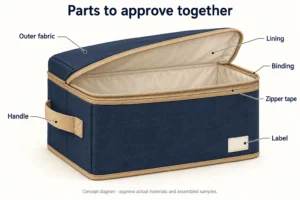
Handles are a common weak point in storage boxes. Ask whether handles are stitched, riveted, reinforced with extra fabric, or integrated into the side panel. For lids, confirm whether they are detachable, attached, zippered, magnetic, or simple fabric covers. For clear windows, ask about material type, thickness, clarity, odor, cold resistance, and packaging protection during shipment.
Logo and Branding
Private label customization may include woven labels, printed logos, embroidery, heat transfer, leather patches, hang tags, insert cards, color cards, stickers, and retail cartons. The best method depends on material, brand position, order quantity, and durability expectations. A supplier should review logo size, placement, artwork format, and color reference before sampling.
OEM vs ODM Comparison Table
| Decision Area | OEM Storage Boxes | ODM Storage Boxes | Buyer Question to Ask |
|---|---|---|---|
| Starting point | Your own design, sample, drawing, or specification | Existing supplier style adapted to your brand | Do we need a unique structure, or is a modified existing style enough? |
| Customization depth | Higher control over size, construction, materials, and packaging | Moderate customization of size, logo, color, materials, and packaging | Which features must be exclusive to our brand? |
| Sampling complexity | Usually more detailed and iterative | Usually simpler if the base product is already developed | How many sample rounds should we plan before approval? |
| Cost control | More variables to evaluate | Easier to compare against known construction | Which specs drive the biggest cost changes? |
| Risk level | Higher if the design is untested | Lower when the base design is proven | What parts of the product need extra QC attention? |
| Best fit | Differentiated retail lines, private label exclusives, special dimensions | Faster assortment building, wholesale programs, market testing | Are we building a long-term line or testing a first order? |
MOQ, Sampling, and Packaging Questions
MOQ is not a single universal number for storage boxes. It depends on material availability, color, logo method, packaging, hardware, product size, and whether the style is OEM or ODM. Instead of asking only “What is your MOQ?”, give the supplier enough context to explain what changes the minimum order requirement.
Ask these questions early:
- Is the MOQ different for existing materials versus custom-dyed materials?
- Does logo method change the MOQ?
- Can the same structure be ordered in multiple colors or sizes under one program?
- Are custom cartons, insert cards, labels, or barcode stickers included in the quote or quoted separately?
- What sample type is recommended: material swatch, pre-production sample, logo sample, or full packaging sample?
- Which details must be confirmed before bulk production starts?
For packaging, buyers should specify whether the product will be packed flat, folded, nested, polybagged, boxed, bundled as a set, or prepared for retail shelf display. Packaging affects carton size, product appearance on arrival, freight efficiency, and warehouse handling.
If the product is part of a wider private label program, consider whether storage boxes should visually match other products such as packing cubes, toiletry bags, closet organizers, or seasonal storage.
Quality-Control Points for Storage Box Orders
QC for storage boxes should focus on practical use, not only visual inspection. A buyer should align with the supplier on inspection points before production.
Key checkpoints include:
- Correct dimensions after assembly and folding
- Fabric color, texture, and consistency against approved sample
- Board thickness, rigidity, and placement
- Stitching quality at corners, seams, and handles
- Lid fit, zipper movement, hook-and-loop alignment, or closure function
- Handle reinforcement and load-related expectations to be confirmed
- Clear window cleanliness, scratches, and odor check where applicable
- Logo position, color, size, and durability expectations
- Packaging count, barcode placement, carton marks, and shipping label requirements
- Final product appearance after being folded and repacked
For any performance requirement, ask how it will be evaluated and who is responsible for testing. If your retail channel requires a specific test, provide the standard, test method, and acceptance criteria instead of expecting the supplier to infer it.
Buyer Checklist Before Requesting a Quote
Use this checklist to make your RFQ easier for a storage box manufacturer or supplier to evaluate:
- Product type: fabric box, storage bin, lidded box, drawer bin, document box, toy storage box, bedding organizer, or seasonal storage box
- Route: OEM, ODM, or private label modification
- Target market: United States, Europe, Japan, South Korea, or another destination
- Target channel: retail shelf, e-commerce, wholesale, gift program, distributor catalog, or private label line
- Size requirements: assembled size, folded size, and acceptable tolerance if known
- Material preference: fabric type, board support, clear window, mesh, zipper, handle, and trim details
- Branding: logo method, label type, artwork file, color reference, and placement
- Packaging: polybag, insert card, retail box, carton marks, barcode, set packing, or shipping carton requirements
- Quantity plan: estimated first order and future reorder expectations, without assuming the supplier’s MOQ
- Sample needs: plain sample, logo sample, packaging sample, or pre-production sample
- QC requirements: inspection checklist, performance expectations, and destination-market requirements to confirm
- Commercial notes: target price range, shipment preference, and deadline if already fixed
A complete RFQ reduces repeated clarification and helps the supplier suggest realistic options. It also makes quotes easier to compare across factories.
When OEM Is the Better Route
OEM is usually the better choice when your brand needs a storage box that competitors cannot easily match. This may include a unique size system, special internal compartments, a custom lid design, special reinforced handles, a coordinated family of sizes, or packaging designed for a specific retail planogram.
Choose OEM when product differentiation matters more than speed. Also choose it when your brand has already validated the target customer need and wants tighter control over material, structure, and visual identity.
The tradeoff is that OEM requires stronger project management. Your team should prepare drawings, samples, reference products, and clear approval points. Expect more discussion around tooling, pattern adjustment, sampling, and QC confirmation. If proof is missing for a required claim, ask for confirmation instead of placing it in the product copy.
When ODM Is the Better Route
ODM is usually better when your team wants to launch or test a storage category with lower development complexity. It can be useful for importers, wholesalers, and private label brands that need a reliable product family but do not need exclusive construction at the first order stage.
Choose ODM when speed, cost comparison, and assortment building are more important than structural uniqueness. You can still customize logo, color, packaging, size, and some materials, but the base product remains closer to a supplier-developed style.
ODM can also be a sensible first step before OEM. A buyer may start with an adapted storage box to validate demand, then develop a more distinctive OEM version after sales data and buyer feedback are clearer.
How to Work With Great Shine on a Storage Box RFQ
If your team is preparing a storage box program, send Great Shine the product type, target quantity, destination market, size, material preference, logo requirement, packaging needs, and any retail compliance questions that must be confirmed. For early-stage projects, explain whether you want an OEM development route or an ODM/private label route.
You can review the OEM/ODM private label manufacturing service to understand the cooperation model, then use the contact page to request a quote. A clear brief helps the supplier recommend whether a current product base can be adapted or whether a custom development path is more appropriate.
FAQ
What is the difference between OEM and ODM storage boxes?
OEM storage boxes are developed around the buyer’s own specification, drawing, sample, or required structure. ODM storage boxes start from an existing supplier style and are customized with changes such as logo, color, material, size, and packaging.
Are ODM storage boxes suitable for private label brands?
Yes, ODM can suit private label storage programs when the buyer does not need a fully unique structure. Confirm which customization options are available, including logo method, fabric color, packaging, labels, and carton requirements.
What should I include in an RFQ for custom storage boxes?
Include product type, size, material preference, logo details, packaging method, quantity estimate, destination market, target channel, sample requirements, and QC expectations. If compliance or testing is required, provide the exact requirement for confirmation.
Does OEM always cost more than ODM?
Not always, but OEM usually has more variables because the product may require new patterns, more sample revisions, or more detailed material sourcing. Ask the supplier which design choices affect cost before finalizing the specification.
Can one supplier make storage boxes and related organizer products?
A supplier with a broader home storage range may support related products such as storage bags, fabric bins, closet organizers, packing cubes, garment bags, and toiletry bags. Confirm the exact product scope, materials, and customization options for your program.
When should I request a quote?
Request a quote once you can describe the product type, route, size, material, logo, packaging, quantity plan, and target market. If some details are undecided, ask the supplier to recommend options and identify which points must be confirmed before sampling.